2012 VOLKSWAGEN PASSAT CTe
[x] Cancel search: CTePage 166 of 392

Tire labeling (example) Meaning
M+S or M/S Indicates Mud and Snow capability (also M/S).
RADIAL TUBELESS Tubeless radial tire.
E4 ... Labeling according to international regulations (E) including number of the approving country. The multi-digit approval number is listed next.
DOT BT RA TY5 1709 Tire identification number (TIN5 - In some cases the manufacturing date is only on one side of the tire:
DOT The tire complies with the requirements of the United States Department of Transportation, responsible for issuing safety standards.
BT Identification letter of the manufacturing site.
RA Manufacturer information regarding tire dimensions.
TY5 Tire characteristics provided by the manufacturer.
1709 Manufacturing date: 17th week in 2009.
TWI Marks the position of the treadwear indicator.
Made in Germany Country of manufacture.
MAX LOAD 615 KG (1356 LBS) United States maximum load rating per wheel.
MAX INFLATION 350 KPA (51 PSI) United States maximum permissible inflation pressure.
ROTATION Rotation direction (unidirectional tires)
SIDEWALL 1 PLY RAYON Tire ply composition and materials used: 1 layer of rayon.
TREAD 4 PLIES 1 RAYON + 2 STEEL + 1 NYLON
Tire tread composition and materials used: In this example there are 4 layers under the tread: 1 layer of rayon, 2 layers of steel belt and 1 layer of nylon.
Consumer information regarding comparison to specified base tires (standardized test
procedure) ⇒ page 332:
TREADWEAR 220 Relative service life expectancy of the tire referenced to a US-specific standard test.
TRACTION A Traction rating under wet conditions (AA, A, B or C).
TEMPERATURE A Temperature stability of the tire at increased test bench speeds (A, B or C).
Additional numbers found on the tire could either be tire manufacturer internal labels or country-specific labels (such as for Brazil and China).
Unidirectional tires
Unidirectional tires are designed to rotate only in one direction. Unidirectional tires have arrows on the sidewalls that show the direction of rotation. Make sure you mount the tire so that it rotates in the proper direction. The tire's performance with regard to hydroplaning, traction, noise, and wear is worse if it is not mounted in the proper direction of rotation.
5 TIN represents the serial number of the tire.
Page 169 of 392

WARNING
Driving faster than the maximum speed for which the winter tires on your vehicle were designed can cause sudden tire failure including a blowout and sudden deflation, loss of control, crashes and serious personal injuries.
x Winter tires have a maximum speed rating that may be lower than your vehicle's maximum speed.
x Never drive faster than the maximum speed for which the winter tires installed on your vehicle are rated because tires that are driven faster than their rated speed can fail suddenly.
x Never exceed the maximum load rating for the winter tires installed on your vehicle.
Install summer tires promptly in the spring. Summer tires offer better handling characteristics for temperatures above +45 °F (+7 °C). They are quieter, do not wear as quickly, and reduce fuel consumption.
The Tire Pressure Monitoring System must be recalibrated using the SET button whenever you remove and remount or change any wheel or tire on the vehicle, even if the reinstalled or replacement wheels and tires are identical to those that were removed and even if the tire pressure does not change, Tire Pressure Monitoring System (TPMS).
If necessary, ask your authorized Volkswagen dealer or authorized Volkswagen Service Facility about permissible winter tire dimensions.
Snow chains
Page 173 of 392

Section width
The linear distance between the exteriors of the sidewalls of an inflated tire, excluding elevations due to labeling decoration, or protective bands.
Sidewall
The portion of a tire between the bead and the tread.
Sidewall separation
The parting of the rubber compound from the cord material in the sidewall.
Speed rating (letter code)
A standardized letter code indicating the maximum speed at which a tire is designed to be driven for extended periods of time. The ratings range from 93 mph or 150 km/h (“P”) to 186 mph or (300 km/h) “Y”.
The speed rating letter code, where applicable, is molded on the tire sidewall, Tire labeling. You may not find this information on all tires because it is not required by law.
Tire Pressure Monitoring System
A system that detects when at least one of a vehicle's tires is underinflated and illuminates a low tire-pressure warning light.
Tread
The portion of a tire that normally touches the road.
Tread rib
A tread section running circumferentially around a tire.
Tread separation
Tire failure caused by the tread pulling away from the tire carcass.
Tread wear indicators (TWI)
Raised areas within the main tread grooves that show, visually, when tires are worn and near the end of their useful life, Tread depth and tread wear indicators.
Uniform Tire Quality Grading (UTQG)
A tire information system developed by the U.S. National Highway Traffic Safety Administration (NHTSA) that is designed to help buyers compare tires. UTQG is not a safety rating, nor is it a guarantee that a tire will last for a certain number of miles or perform a certain way. It gives tire buyers more information to compare with factors such as price, brand loyalty and dealer recommendations. Under UTQG, tires are graded by the tire manufacturers in 3 areas: tread wear, traction and temperature resistance. UTQG information is molded into the tire sidewalls.
U.S. DOT Tire Identification Number (TIN)
A tire's serial number. It begins with the letters “DOT” (“Department of Transportation”) and indicates that the tire meets all federal standards. The next two numbers or letters indicate the plant where the tire was manufactured. The last four numbers represent the week and year of manufacture.
For example, the numbers 1709 mean that the tire was produced in the 17th week of 2009. Any other numbers are marketing codes used by the tire manufacturer. This information is used to help identify affected consumers if a tire defect requires a recall.
Vehicle capacity weight
The total rated cargo, luggage and passenger load. Passenger load is 150 lbs (68 kilograms) times the vehicle's total seating capacity (as listed on the label inside the driver door).
Page 181 of 392
WARNING
Failure to heed warning lights and instrument cluster text messages can cause the vehicle to break down in traffic and result in a collision and serious personal injury.
x Never ignore warning lights or text WARNINGS.
x Always stop the vehicle as soon as it is safe to do so.
NOTICE
Failure to heed warning lights or text WARNINGS can result in vehicle damage.
If the ignition is switched on, an acoustic warning sounds when low tire pressure is detected. If a system malfunction is detected, no acoustic warning sounds.
Driving for a longer period of time on rough roads or with a dynamic and sporty style can make the TPMS system temporarily unavailable. The indicator light will come on, signaling a malfunction, but will go out again once the road condition or driving style changes.
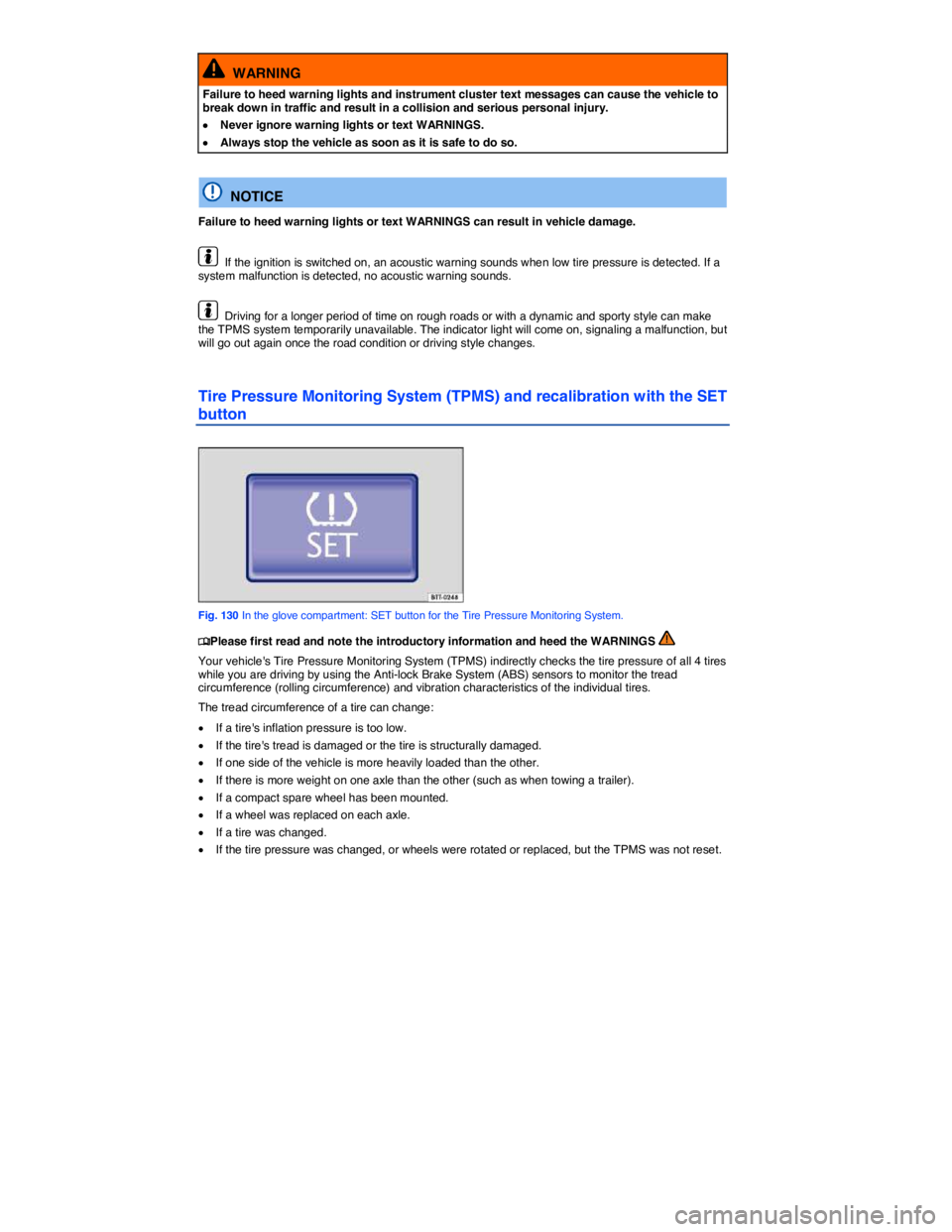
Tire Pressure Monitoring System (TPMS) and recalibration with the SET
button
Fig. 130 In the glove compartment: SET button for the Tire Pressure Monitoring System.
Page 200 of 392

x In the storage compartment in the front center console ⇒ fig. 145 (1).
x In the storage compartment in the front center armrest ⇒ fig. 146.
NOTICE
x Follow the manufacturer's instructions for connected devices!
x Never exceed the maximum power consumption, or the entire vehicle electrical system may be damaged.
x 12 Volt socket:
– Only use equipment that has been tested for electromagnetic compatibility and complies with applicable guidelines.
– Never feed current into the socket, with a solar panel, for example.
Unshielded devices may interfere with radio reception or the vehicle's electrical system.
Page 202 of 392
WARNING
To reduce the risk of serious personal injury when starting and running the vehicle's engine:
x Never start the engine or let it run in a confined or enclosed area. Engine exhaust contains carbon monoxide, a poisonous, colorless, and odorless gas. Carbon monoxide can cause unconsciousness and death.
x Never leave the vehicle unattended with the engine running. The vehicle could move suddenly or some other unexpected event could occur, resulting in property damage or personal injury.
x Never use starting assist fluids. Starting fluids can explode and can cause a “run-away” vehicle condition.
WARNING
The vehicle exhaust system and the catalytic converter or diesel particulate filter get very hot. They can cause fires and serious personal injury.
x Never park the vehicle where the hot exhaust system or catalytic converter could ignite flammable materials, such as brush, leaves, dry grass, spilled fuel, etc.
x Never apply additional undercoating or rust proofing on or near the exhaust manifold, exhaust pipes, catalytic converter, diesel particulate filter, or heat shields.
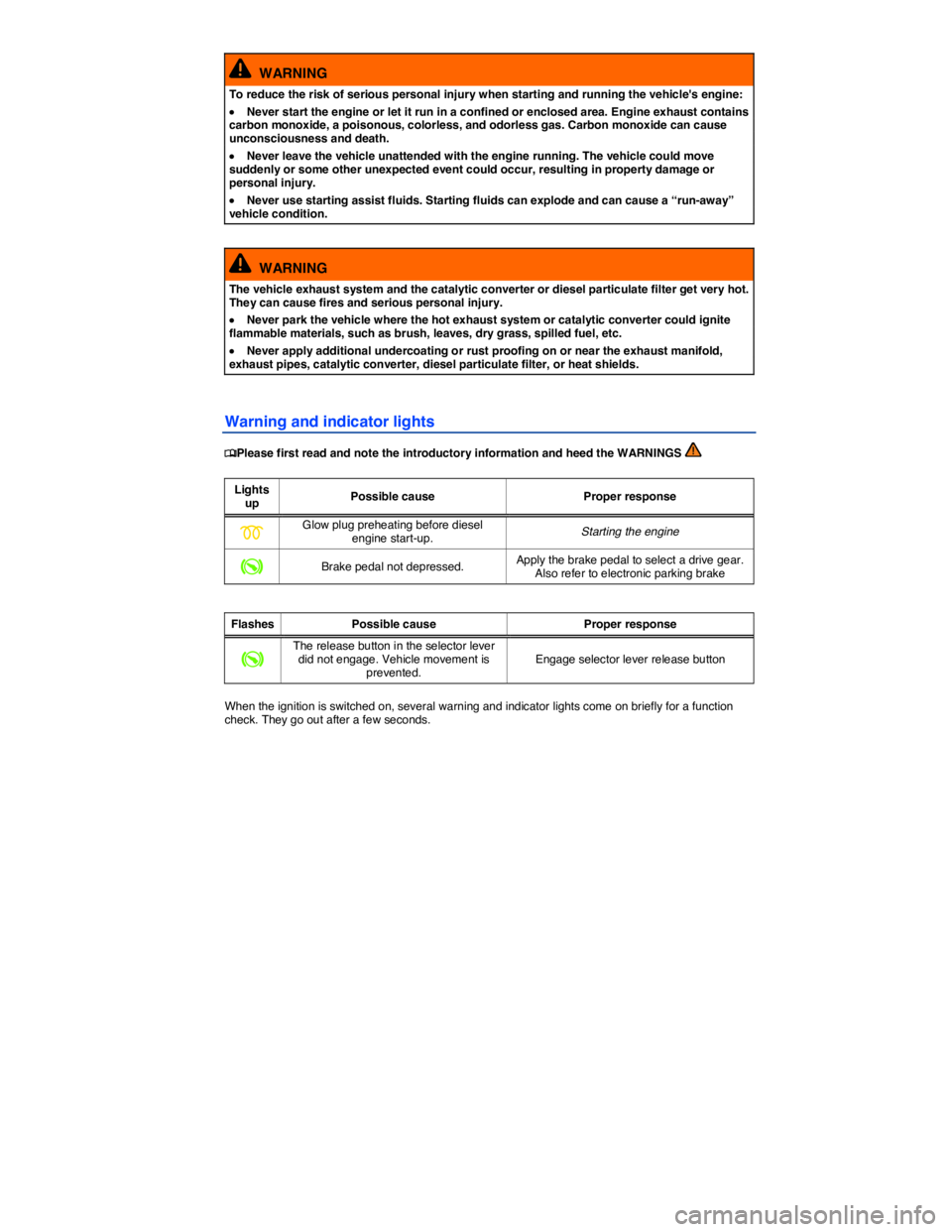
Warning and indicator lights
Page 210 of 392
WARNING
Improper use of the remote start feature can cause fire, burns and other serious injuries.
x Always park the vehicle in a place that is vented to the outdoors and has a continuous exchange of fresh, outside air.
x Only use the remote start feature when no one is around or inside the vehicle.
x Always make sure that you can see the vehicle when the engine is running.
x Never leave children, disabled persons, anyone who cannot help themselves, or pets in the vehicle. The doors are locked when the engine is running with the remote start feature. Vehicle occupants would be trapped in the vehicle in an emergency and rescue from the outside would be delayed.
x Never start the engine if children or animals are inside the vehicle. When the engine is running, electrical equipment including electrical seat adjustment controls can be operated and cause serious injuries.
x Never start the engine or let it run in a garage, in an enclosed or confined area. Engine exhaust contains carbon monoxide, a poisonous, colorless and odorless gas. Carbon monoxide can cause dizziness, nausea, unconsciousness and even death.
x Always make sure that the area where the engine runs in the remote start mode is well ventilated. Carbon monoxide in a garage or other enclosed area can cause dizziness, impair the ability to drive, and even result in unconsciousness.
x Never start the engine when the vehicle is covered with a protective cover. Hot vehicle components and exhaust could ignite the protective cover.
x Never start the engine near combustible or explosive materials. The exhaust could ignite flammable materials.
NOTICE
x Do not use the remote start feature if the engine Malfunction Indicator Light (MIL), Indicator lights, has come on, smoke or unusual smells come from the vehicle, an unusual or unexpected operating condition occurs and the condition has not been diagnosed and corrected. Please see an authorized Volkswagen dealer or authorized Volkswagen Service Facility.
x Remote start is possible when one or more windows are open. Always remember that unauthorized access to the vehicle through open windows as well as operation of HomeLink®, including access to your garage or other property, is possible when the engine is running in remote start mode. Always make sure that all of the windows are securely closed to help prevent unauthorized access to the vehicle, its features and contents.
Using the remote start feature can increase fuel consumption and drain the vehicle battery.
Use of the remote start feature may be regulated or prohibited in some areas. In some areas you may be required to be able to see the vehicle when it is running in remote start mode. Please inform yourself about state and local requirements that may apply and be sure to follow them when using the remote start feature.
Various vehicle functions, such as the low beam headlights and the windshield wipers, are disabled when the engine is running during a remote start.
Page 219 of 392
To release the ASL, depress and hold the brake pedal with the ignition switched on. Press the release button on the selector lever at the same time.
The ASL is not engaged if the selector lever is moved quickly through Neutral (N) (e.g., when shifting from Reverse (R) to Drive (D)). This makes it possible to “rock” the vehicle backwards and forwards if it is stuck in snow or mud. The ASL engages automatically if the brake pedal is not depressed and the lever is in Neutral (N) for more than about 1 second and the vehicle is traveling no faster than about 3 mph (5 km/h).
In rare cases, the ASL may not engage on vehicles with DSG® Direct Shift Gearbox. If this happens, power to the drive wheels will be interrupted to prevent the vehicle from moving unexpectedly. The green indicator light k will blink and a text message will be displayed. To engage the Automatic Shift Lock (ASL):
x Depress and then release the brake pedal. Try to engage the ASL again.
WARNING
Moving the selector lever to the wrong position can cause loss of vehicle control, a collision, and serious personal injury.
x Never accelerate when moving the selector lever.
x When the engine is running and a drive position is engaged, the vehicle will start to move as soon as the brake pedal is released.
x Never shift into Reverse or Park when the vehicle is moving.
WARNING
Unintended vehicle movement can cause serious personal injury.
x Never get out of the driver's seat while the engine is running, especially when the transmission is in a drive gear. If you must leave your vehicle while the engine is running, always set the parking brake and shift the transmission into Park (P).
x Never leave the vehicle in Neutral (N). It will roll down hills, whether the engine is running or not.
x When the engine is running and a drive gear - Drive (D), Sport Drive (S), or Reverse (R) - has been selected, press and hold the brake pedal to keep the vehicle from moving. The vehicle may “creep” and move forward or backward even if the engine is idling slowly.
x Never shift into Reverse (R) or Park (P) when the vehicle is moving.
NOTICE
Even though the transmission is in Park (P), the vehicle may move a couple of inches (a few centimeters) forwards or backwards if you take your foot off the brake pedal after stopping the vehicle without first setting the parking brake.
If the selector lever is moved into Neutral (N) by mistake when the vehicle is moving, take your foot off the accelerator pedal. Wait until the engine speed has dropped to idle speed before moving the selector lever into a drive gear.
Leaving the selector lever for a long period of time in any position other than Park (P) when the ignition is switched off can drain the vehicle battery.