2012 VOLKSWAGEN GOLF PLUS roof
[x] Cancel search: roofPage 141 of 541
Driving a
first read and note the introductory informat io n and heed the WARNINGS on page 137.
F
or good h andli ng w he n driving a loa ded ve hicl e,
please observe the following:
Secure ly stow page 138.
Dr ive especially caref ully and acce le rate gently.
Avoid sudd en braking and driv ing man eu ve rs.
Brake earlier than you wou ld if yo u were not
drivi ng a loa ded vehicle.
page 152.
If applicabl e, observe information rega rdin g driv in g w ith roof page 149.
Weights and
firs t read and no te the introductory information and heed the WARNINGS o n page 137.
The gross weight of any vehicle depends on its en gin e, basic equipment, an y factory- in stalled
optional equipment for the given model, and any retrofitted accessories. T he gross vehicle weig ht
rat ing
catio n Label loca ted on the door pillar of the dri ver
door.
The gross vehicl e we ight rating includ es the
weight of the ve hicle itself w ith of its tank of gaso line, the
Before driving
lo ads can ch ange the way your vehicle
h andles and incre ase stop ping dista nces. loads that are not properly sto wed or secured can shift suddenly, causing loss of co ntrol and serio us injury.
the load prope rly to keep it from
shifting.
A lways remember w hen tra nsp o rtin g
h eavy obje cts th at th ey vehicle's cente r of gravity and also the way it handles.
- Always dis
tribute the load as eve nly as
possible. -h eavy obj ec ts as far forward in
th e luggage compartment as poss ible. -If your ve hicle has tie-downs in the
Always tie down heavy items securely wit h
s uitable straps.
Secure ly latch th e rear backrest in the upright position .
Never excee d th e Gross Axle Weight Ratin g
o r the Gross Weight Ratin g on the safe ty compliance sti cker on the left door jamb. Exceeding permissi b le weight ca n ca use the
ve hicl e to skid and ha ndl e diff erently.
Always adapt speed and drivi ng to th e
h ea vie r load and th e we ight di stribution in the vehicle.
Always accelerate gently and avo id
s udd en braking an d drivin g maneuvers.
Always brake ea rlier than yo u wo uld if you were not drivin g a loaded ve hicle .
engine oil and coola nt, lbs/68 kg per seatin g position ) and ca rgo .
T
he gross axle weig ht ra tin gs sp ec ify th e imum allowab le load for ax le.
The cargo payload may not be increased by using
a roof rack without commen surat ely reducing th e
we ig ht from vehicle Dete rmin ing
th e gross vehicle weight page 276.
pay load cons is ts of th e co mbin ed w eight of th e following:
Passe ngers.
Tota l luggage and othe r ca rgo .
Roof load including the roof rack system.
Tong ue weig ht for trailer towing.
Page 150 of 541
Roof rack
this section you'll find informatio n on th e lowin g:
Mounting the roof rock bose carrier and roof rock
mize aerod ynamics and does not have tradit io nal
rain gutters used to attach many kinds of roof
ra cks.
the rain gutte rs are m old ed into the roof to prov ide efficient ae rody nami cs, only approved base carrie r mounts and roof racks can be u se d.
When should the roof rack be removed?
it is no lo nge r need ed.
Befo re dri vin g throug h an automatic car wash.
th e ve hicl e would otherw ise be too high to achieve minimum clearance to enter, for ample, a ga rage.
More information:
page
Tran sp o rtin g=> page 137
Sav ing f uel and h e lping the en vironment 198
Tires and page 276
Parts, a ccesso ries, repa irs and modifica tio ns
Transporting heavy or bulky loads o n the roof rack will change the way the ve hicl e handles by shifting the ve hicl e's cente r of gravity and creasing the wind drag area.
Always secu re the load properly wit h suitable and undamaged straps so that the load wiH not s hift.
Cargo that is larg e, heavy, bulky, long or flat
will have a negativ e effect on the vehicle's
dling.
Always avoid sudden maneuvers and hard braking.
Always adapt your speed and driving to the heavier load and the we ight distribution in the ve hicle. Take road, weather, and vis ibili ty
conditions into account as we ll.
Note
Always remove the roof rack before driving through an automatic car wash.
vehicle is higher when the roof rack i s stalled, especially when it is loaded. Compare the ve hicl e height with ex isting clearance heights,
s u ch as underpasses and garage doors.
Always make sure that the roof rack system and anything being carried on it docs not
Make sure that the rear h atc h does not touch items on the roof rack when open ed.
a roof rack is installe d, fue l co nsumption inc reases due to in creased air resis tance.
148 149
Page 151 of 541
Mounting the roof rack base carrier and roof rack
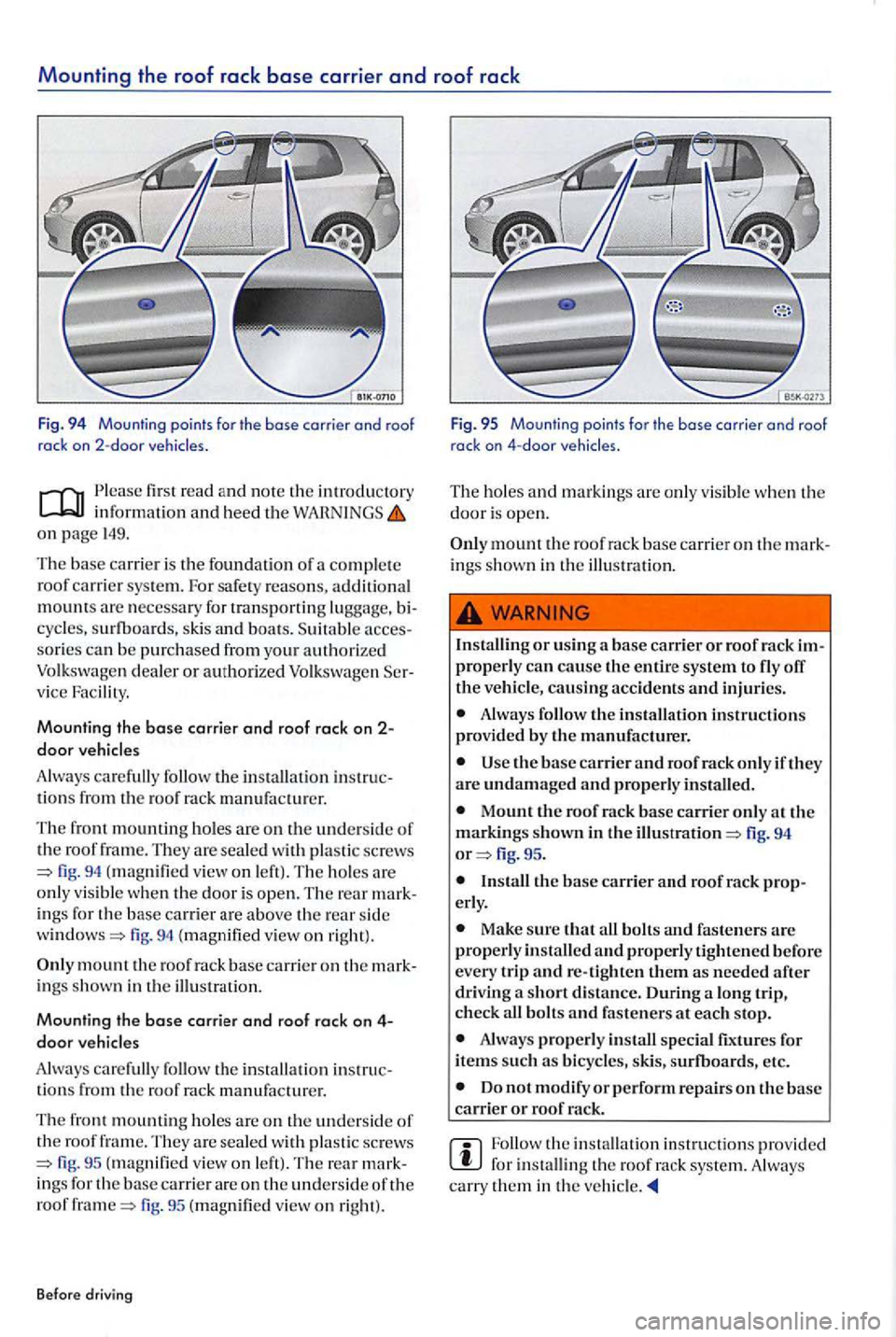
Fig. 94 Mounting points for the base carrier and roof
rack on 2-door
first read and note the in troduc tory information and heed the on page 149.
Th e base carrier is the foundat i
on of a co mpl ete roof carrier syste m . For safe ty reasons, additio n al
mo unts necessary for transporting luggage, bi
cy cles, su rfb oards, skis and boats. acces
sories be purchased from your authorized Volkswage n dealer or a uthori zed Volkswagen
th e installat io n instru c
tions from the roo f rack manufa cturer.
The fr o nt mounting ho les are on th e underside of the roof frame. They are with pla stic screws (m ag nified view on le ft). The holes o nl y vis ible whe n th e door is open. The rear mark
in gs fo r th e ba se carrier are above the rear side fig. 94 (magnified view on right).
on th e undersid e of the roof fr ame. They are sea led with plastic sc rews (mag nified view on le ft). T he rea r mark
in gs for the base carrier are on the unders ide o f the roof fig. 95 (magnifi ed view on rig ht).
Before driving
Fig. 95 Mou nting points for the bose carrier and roof
rock on 4-door
The hol es markin gs onl y vis ib le whe n th e door is open.
m ount the roof rack base carrier on the mark ings shown in the illu stra tion.
or using a base ca rrier or roof rack im
p roperly can cause the entire syste m to fly off the ve hicle, causing accide nts and injuri es.
the installation instructions provid ed by th e manufacturer.
Mount the roof rack base carrier only at the markings shown in the fig. 94 fig. 95 .
Make sure that bolt s and fasteners are properly re -tighten them as needed after dri ving a short distance. Du ring a lo ng trip,
c h ec k bolts fasteners at each stop.
Always properly s pecial fixtures fo r
items such bicy cle s, skis, su rfboard s, etc.
the in stallatio n instructi ons prov ided the roof rack system. carry them in the veh icle.
Page 152 of 541
Securing a
first r ead and note the introdu ctory information and heed the on pag e 149.
It is no t pos sibl e secure a load unless the roof rack sys te m has bee n pro perly
Maximum permissible roof load
Th e ma ximum permi ssibl e roof load is l65lb s. (75 kg). Th e roof load is the combined weight of
the roo f ra ck and the item s bein g carri ed on th e
Transporting
Checking the mountings
Afte r the base carrier and rook rack have been in
s talled, check all bolt s and faste n ers after drivin g a
s h ort time and at regular int erva ls th ereaft er.
If the maximum permissible roof load is ex
ceeded, accidents and substantial vehicle damage may occur.
Never exceed the specified roof load, the maximum gross axle weight rating, or the gross
veh icle weight rating .
Always make sure that loads are evenly dis
tributed and that heavier it ems are, as far as pos
sible, toward the front.
Loose
or improperly secured item s can fall off the roof rack and cause accid ents and injuri es.
Always use suitabl e, undamaged tie-down
ropes and ratchet straps.
the load
151
Page 228 of 541
Air conditioner operation
information and heed the WAHNINGS on page 226.
The cooling syste m for the passenger compart
ment o nl y functions when the engin e is running
and the fan is switched on.
The air conditioner is most efficient when the w indows an d the power sunroof are closed. However,
if th e vehicle is sta ti o nary and the passenger compartment becomes very hot due to sunlight, opening the w indows briefly may speed up the cooling proce ss.
Keep
the a ir intake slot in front of the windshield
free of i ce, snow and lea ves in order to maintain proper funct ioning of the heating and ventilation systems.
Settings for optimal driving safety
When yo u sw itch on the cooling system, both the temperature and humidity in the vehicle are reduced. Th is will help make passengers feel more comfo rtable and prevent windows from fogging
up.
For
Sw itch off a ir page 232.
fan to Ievell or 2.
T urn the temperature knob to t he center posi
tion.
all air vents in the in strument panel page232 .
Turn the air distribution knob to the des ired settin g.
butto n to turn on the air conditioner. The indicator light illumin ate s in the button.
For
th e button.
temperature to +72
pa ge232.
Sw itching between Fahrenheit and Celsius in Cli
matronic
The t empe ratu re disp lay is switched from to Fahrenheit and vice versa in the display of the factory- in stalled radio or naviga tion system via the in strument cluster page
control
H eating
Maximum heating output and fas t defrosting will
only be possib le a fte r the e ngin e has reached operating tempe rature.
T he e ng in e is not running.
T he fan is switc hed off.
The a ir conditi one r fuse has blown.
The ambien t a ir temperature is colder than (+3
T he air condition er compresso r has been tem
porarily switched off due to excess ive engin e coolant temperature.
The re is a nother malfunction in the ve hicle.
Ha ve the ai r conditioner checked by an authorize d
Volkswage n dealer or authorized Volkswage n Ser
v ice Facility.
Special considerations
Whe n it is very hot and humid outside, water con
d ensation can drip from the air condition er evaporator and form
The air condit ioner takes a few minutes to reach the selected temperature in the passenger compartment.
Due to residual m oisture in the air condi tione r, th e windshi eld may fog up after the
engi ne is s tarted.
23 1
Page 260 of 541
Washing the
fir st read and note th e in formatio n and heed th e on page 262.
The lo nge r insect splaue r, b ird droppings. tree sap,
road din, indu strial depo sits, road and o ther aggressive materials sta y on your ve
hicle , more damage they do sunlight ) crease the corros ive effects. The vehicle underbody sh o uld als o be was hed regularl y and thor
o ughly.
to the information by the car wash operator. Before going through a
ca r wash , b e s ure
you have installed addition al accessorie s on the vehicle, su ch as a spoiler, a roof rack, or an ant enna, alway s
a sk th e car was h opera tor if thi s po se s problem
The paint finish is
dep end s a la rge exte nt on th e rype of ca r
was h. Volk swagen recommend s using brush le ss
ca r w as h faciliti es.
' l b
rem ove wax res idu e from th e windows and
avoi d jerky wind shi eld wip er move m ent , heed the
f ollow ing page 265, outsi de
w ith
on the roof and work down. Usc sp ec ia l shampoo only on hard-to -remove or grim e.
Hinsc
different sponge or wash mill.
edges under the vehicle
Always protect your hands
Alway s dry the brakes and clean off any icc
coatings with a few caref ul appli cations oftlte brake. Make sure not to endanger other motoris ts or cyclists or disob ey lega l requirement s.
Note
The water temperature mus t not be more than
To help prevent damage to the paint, do not wash the vehicle in direct sunlight .
Do not use insect sponges, abrasive kitchen
s ponges or similar things to clean the ve hicle .
These can damage the paint finish.
Neve r clean headlight s with a dry cloth or sponge. Always use a
When washin g or rinsing the vehicle in cold
weather, do not let water get into the lock cylin ders or point the hose The water could freeze on the locks and seals and make it difficult to open the vehicle!
Note
To help prevent vehicle damage in a car wash:
the vehicle track width with the di
men sion s of the guide rail s in the car wash to help prevent damage to wheel rims tires!
off the rain sensor before driving
through a wash .
Mak e sure there is enough clearan ce for the height and width of the ve hicle.
Fold the outside mirrors toward the vehicle
body. Do not fold power mirrors manually!
262 263
Page 265 of 541
rims
Please fir st read and no te the introducto ry inform atio n and heed the WARN INGS on page 262.
Cleaning
steel wheel s
S
tubborn brake dus t can b e removed an in dustrial clean e r. s teel wheel s regularly with
a se pa rat e s po nge.
Repai r any paint damage o n steel wheels befor e rust begins to fo rm .
Cleaning alloy
wheels
Every two weeks: Wash road salt and brak e dust ofT alloy wheel s, and clean the w heels w ith an ac id-
of rubber door and window
Please information and heed the WARNINGS on p age262.
T he
rubbe r seals around the d oors and w indow s
will s ta y soft a nd flexib le, sea l bett er and la st
De-icing door
Please informatio n and heed th e WARNINGS on page 262.
Volkswage n recommends us in g only genuine Volkswagen spray with lubricating and anti -corro
s iv e pro perti es de-ice door lock cylind ers.
Undercoatin g
Ple ase read and n ot e the introductory heed th e o n page 262.
The ve hicl e underbody is co ated to help protect it
f rom corrosio n and damage. The undercoating could b e damaged durin g normal u se. We there
for e recommend that you have the protectiv e coatin gs on the underbody and su sp e nsion in spected
regularly, and repaired if necessary.
compound to the wheel s.
road and brake dust are not re m ove d regu
larly, they can corrode m etal.
the protective coating is damaged, fo r example
b y s tone impact, repai r the damaged area right
longer if the seals are treat ed regu larly with a suit
able rubbe r care product.
B efor e applyin g the treatment, usc a soft cloth to
r emove dust and dirt from the rubber
Lock de-ic ers that contain grease solvents can cause the lock cylinder to
Undercoating and rust-proofin g products can catch fire on the hot ex h au st sy stem or any othe r
h ot engine componen t.
Neve r apply additional undercoating or rust
proofi ng on or near the ex hau st manifold, the exhaust pipes, catalytic converter, the heat s hields, or any oll 1e r hot vehi cle component
Page 269 of 541
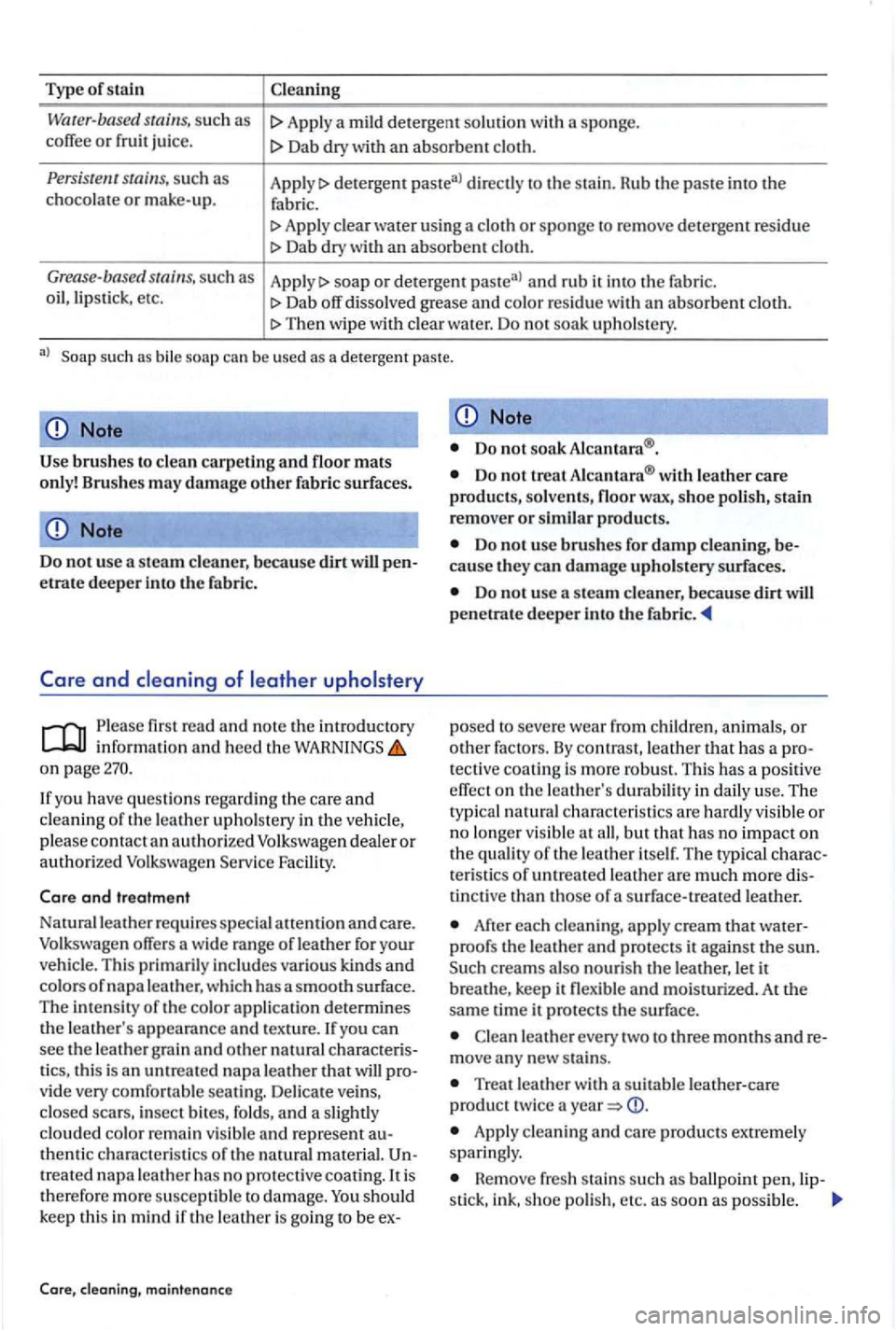
Type of stain
Water-based Apply a mild detergent solution with a sponge.
Dab dry with an absorbent cloth.
Persist directly to the s tain . Rub the paste into the
f a bric.
t> Apply clear water u sing a cloth or sponge to remove detergent residu e t> Dab dry with an absorbent cloth.
Grease-based and rub it into the fabri c. t> Dab off dissolved grease and color residue w ith an absorbent cloth. t> Then wipe with clear water. Do not soak uphols tery.
a l Soap su ch a s bile soap can be used as a detergent paste .
Note ---
fir st read and note the introductory information and heed the on page
If yo u have question s regarding the care and cleaning of th e leather uphols tery in the vehicle,
please contact an authorized Volk swagen dealer or authorized Volkswagen Service Faciliry.
tics, this is an untreated napa le ather that will vide very comfortabl e seating. Delica te veins,
closed scars , insect bites, fold s, and a slightly clouded color remain visible and represent thentic characteristics of the natural material.
should keep thi s in mind if the leath er is going to be ex -
maintenance
Note
Do not soak
Do not treat with leather care products, solvents, floor wax, shoe polish, stain remover or similar products.
Do not use brushes for damp cleaning. cause they can damage upholstery surfaces.
Do not use a steam cleaner, because will penetrate deeper into tl1e
posed to seve re wear from children, animals, or other facto rs . B y contrast, leather that has a tective coati ng is more robust. This has a positive
effec t o n the leath er's durability in daily use. The typical na tural characteristics are hardl y visib le or no lo ng er vis ib le at but that has no impact on the qualit y of the leather itself. The typical teristics of untreated leath er a re much more
Af te r each cleaning, apply cream that proofs the leather and protects it against the sun. Such creams also n o uri sh th e leather, let it breathe, keep it flexible and moisturized. At the same tim e it protects the s urfa ce.
leather every two to three months
Treat leathe r with a suitabl e leather-care product t wice a CD.
Apply cleaning and care products extremely
sparing ly.
R emove fresh stain s such as ballpoint pen, li p-
s tick, ink, shoe polis h, etc. as soon as poss ible.