2012 VOLKSWAGEN GOLF PLUS fuel
[x] Cancel search: fuelPage 32 of 541

Technical data
In thi s section yo u 'll find inf ormatio n on the fol
l owing:
.... _.. . . 31
Engi ne data and dimensions ......... _. . . . . . . . . 32
D im ensions . . . . . . . . . . . . . . . . . . . . . . . . . . . . . . . . . 33
Th e engine configu rat io n ca n be found on the ve
hi cle identification label in the Warranty an d
Maint enance bookle t or in th e officia l vehicle documents.
Specifications in ve hicl e documents al
way s take precede nce. Th e specificatio n s i n thi s
Manual r e fer to the basic m odel. The stated values m ay vary, dep ending upon diff erent equipment opti o ns o r models , a s well as with respect to special vehicles and vehicles exported to different countries.
45-7-5545
o
PRSSRT Lim. NRR
147kl.J
..
D9l 162 5RQ 5SL TQ3 352 BGV 12H
Fig. Vehicle identification Iobel: shown in the ex
ample with eng ine classi fication code BLF
read and no te th e introductory informatio n an d heed th e on page31.
V ehicl e id entification number
The ve hicl e identification number is on a plate on top of the in strument pan el o n the dri ver's s ide,
and is v isibl e from the outsid e th rough the windfig . The v iew window is on t h e side at the botto m of th e w ind shi eld. Th e vehicle identification number i s al so in the right drip
Some basic s
M ore informatio n:
page
Sav ing fuel and helping th e enviro nment
Fu el page 23 9
Engine page 247
En gin e page 252
Tires and 276
page 311
Disregarding or exceeding stated values for weights , loads, dimensions and maximum speed may result in accidents and serious per-son al
Fig. 11 Vehicle identification number
c h a
nnel. The drip ch annel is between the spring stru t towe r and the right fender.
p age 242.
Vehicle identification Iobel
T he ve hicle i
dentifi cation fig . is in th e area o f th e spare w heel well in the luggage
compartm en t a nd contains th e follo wing informa-
tion :
31
Page 153 of 541
In thi s section lowing:
Techni cal requirem ents ..... ............•. . . . 153
Hitching up and connecting a trailer . . . . . . . . . . . 154
Loading the traile r . . . . . . . . . . . . . . . . . . . . . . . . . . 155
Dri ving with a trailer . . . . . . . . . . . . . . . . . . . . . . . . 156
mo unt . . . . . . . . . . . . . . . . . . . . . . . . . . . . . . . . 157
Retrofitting a traile r hitch . . . . . . . .
country -s pecifi c requir em elll s about trailer
towin g and trai ler hit ches.
Your Volkswage n was mainl y designed f o r ca rryin g
passen gers. If yo u plan to tow a trail er, ple ase member your ve hicl e will be perfo rming job for
which it wa s no t primarily in tende d . Th e tion alload will aiTec t durabi lity, handling, fu el
economy, and p e rf ormance , and may re quir e th e
veh icle to be service d mo re ofte n.
T ra
iler towing only place s more str ess on th e
ve hicle , calls for more concentration from the
dri ver. Always follow the o p era ting and dri ving s tru ction s give n, and use common sense.
perm issible bar load
exerted on th e ball moulll should not exceed
More informati on:
ala rm pag e 38
page
Sav ing fuel and h elpin g th e en vir onment 198
S tarti ng ass istanc e page
T ires and page 276
acc essories, repairs and modifica tion s
Riding in a trailer is dangerou s and may be legal.
Before driving
Improper use o f the trailer hitch ca n cause
correct, or damaged trailer hitch ca n cause the
trailer to separate from the towing ve hicl e and cause se rious personal injuri es.
use an undamaged , properly mounted trailer hitch.
Never repair or modify the trailer hitch.
To reduce the risk of injury in rear-end sio ns and th e risk to pedestrians and cyclists when the vehicle is parked, always remove the ball mount when a trailer is not being used.
Neve r in stall a or hitch on you r ve hicle. The hicle was not design ed for these kind s of trailer
hit ch es. The hitch attachment can fail , ca using
th e trailer to tear loose from
Improper trailer towin g can cause loss of vehicle
co ntrol and serio us personal injury.
Driving with a trailer and carry ing heavy
o r large things can change th e way the vehicl e handles, increase the distance it need s to sto p
safely, and ca use accidents.
Always secure the load properl y with suitable and und amaged straps so that th e load will not
s hift .
Alw ays adapt your sp ee d and driv in g to
th e heav ier load and weight distribution in the vehicle. Take road, weather, traffic, and
Reduce your s pe ed even more th an yo u otherw is e would when going downhill and und er
unfavorabl e lo ad, weather, or wind co ndition s.
a lo w center of grav ity.
Always avo id sudd en maneu vers and hard
Be especiall y caref ul when pas sin g other ve hicl es. Reduce sp eed immediately if the traile r
shows the slightest sig n of swaying.
Page 173 of 541
In this section yo u'll fin d information on th e
ke y p ositions . . . . . . . . . . . . . . . . . . . . . . . . 17 4
Starter button . . . . . . . . . . . . . . . . . . . . . . . . . . . . . . 175
Sta rting the engine . . . . . . . . . . . . . . . . . . . . . . . . . 176
S topping th e e ngine . . . . . . . . . . . . . . . . . . . . . . . . . 177
Electro nic immobi lizer . . . . . . . . . . . . . . . . . . . . . . . . 178
Explanatory no tes in thi s chapter regard
rec t S hift Gea rbox.
Immob i
lizer display
I f a n unauthori z
ed vehicle ke y is used or the
s y s te m malf un ctions, o r Immobiliz er activ e!
m ay appear on th e in strum ent cluster. The e ng in e cannot b e s tarte d.
P ush -starting
and tow-starting
F o r t ec hni cal re as
ons, never try to pus h -s ta rt or
stead w hil e following proper a nd safe proc edures.
Mor e information:
Vehicle key pag e 34
Shifting pag e
B raking, sto pping and page
pag e
234
Fuel page 23 9
E m erge ncy clo sing and page 322
353
Towing and page 357
W hile driv ing
Switch in g off the engin e whil e th e ve hicle is
m oving can m ake the ve hicl e harder to s top and re sult in loss of ve hicl e control,lcading to sion s and seve re personal injuri es.
Brake and steerin g assis ta n ce sys tem s, the
a irbag syste m, safety belt pretensione rs, and oth er vehicle safety features onl y wor k when the
e n gi ne is runni n g.
Sw itch off theengineon lyw he n th e vehicl e is
not m ov ing.
The ris k of serious injury ca n be reduced with
the e n g in e runnin g or when startin g the en gine .
To reduce th e risk of seriou s perso nal inju ry
w hen sta rling and running the ve hicle's en gi ne,
n eve r start the e ngine or le t it run in a confined or en clo se d area. Carbon an odorl ess and colorless poisonous gas, is one co mpone nt of en gine exhaust fumes . monoxide can cause loss of conscio usn ess and d ea th.
Never leave the ve hicle unattended with the
e ngin e running. Th e ve hicl e could move denly or a n unusu al operating condition could
occ ur res ult ing in property damage or personal
i njury.
Neve r usc assi st
The ve hicle exhau st s ys tem and th e ca ta ly tic
co nve rter or diese l particula te filter ge t very ho t
and ca n cause and seriou s perso nal injury .
Never park th e veh icle where the ho t ex haust
sys te m or cataly tic co nverte r could ignit e mable materials, su ch brus h , leaves, dry grass, spilled fuel, etc.
Page 178 of 541
Never leave the vehicl e unattend ed w hil e th e e ngin e is running . The ve hicle could move sud
d enl y, es peci ally w hen th e vehicl e is in gear, re
s ultin g in accide nts and personal injury.
assis t ca n ex plode and ca n
ca use a ve hicle condition.
Neve r u se
Note
Yo u can damage the s tarter o r vehicl e is still
mo vin g, or if you try to res ta rt
Not e (c onti nued)
Avoid high en gin e sp ee ds, full throttl e and heavy en gin e lo ads wh en th e eng in e is cold.
D o n ot push-sta rt or tow-start the ve hicl e. Un
burne d fuel can ge t int o the cataly tic convert er
and damag e it.
Do not let yo ur vehicle warm up whil e sta nding; ins tead, sta rt driving right away
after makin g sure th at you have good vis ibil ity
t hrou g h all windows. This will he lp th e e ngin e
reach operating temperature fas ter an d keep down
emiss io ns.
Majo r consu mers of e lectricity are te mporarily swi tc hed off when th e e ng in e is bei ng
s tarted .
After starting cold engin e, increased operating nois es may be heard f or f ew seconds.
Thi s is no rmal and
firs t r ead an d note th e intro ductory in fo rm atio n an d heed th e page 172.
Pl
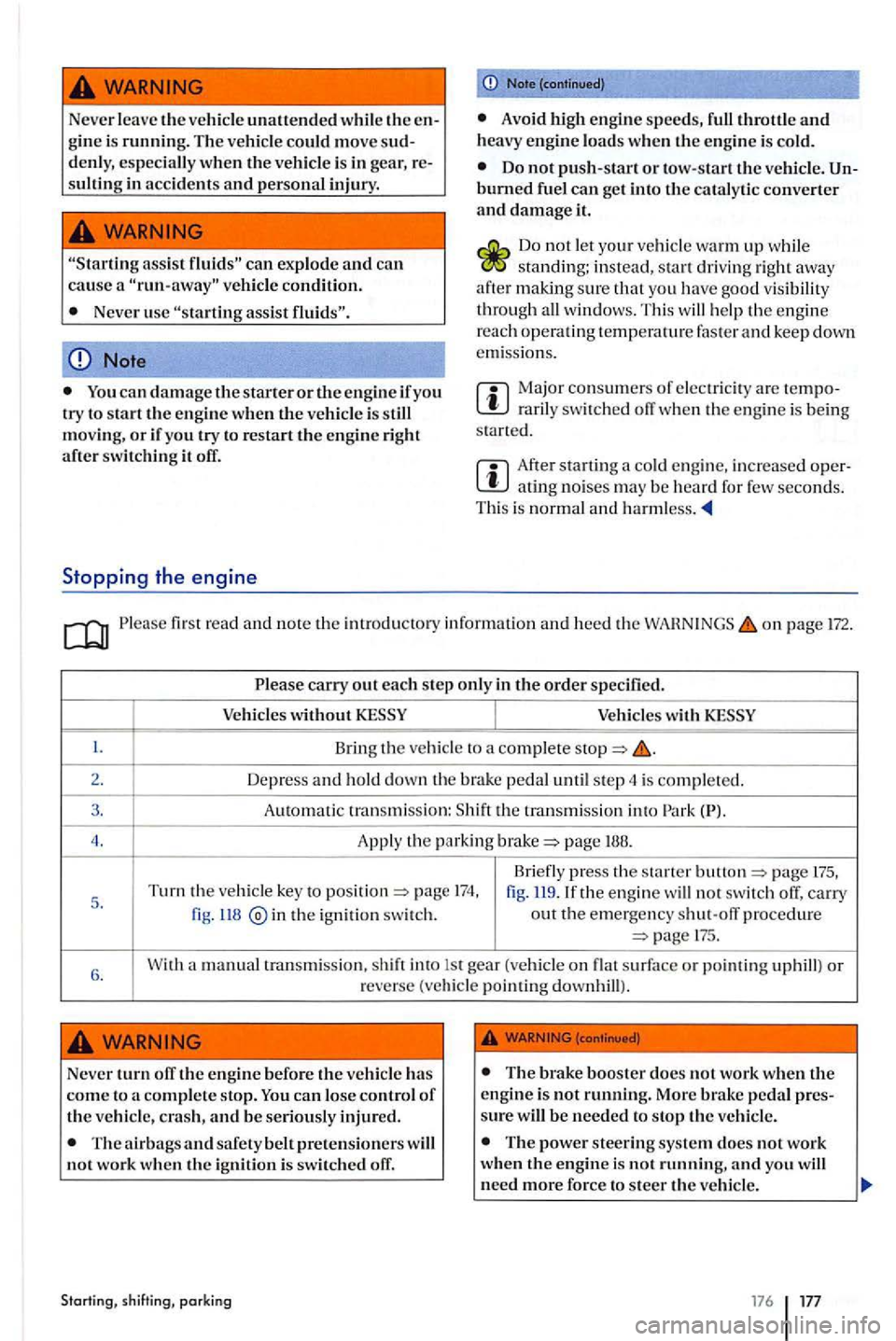
ease car ry out each ste p onl y in the order sp ecified .
Vehicl es with out
Bring th e veh icle to a co mplete
2. Depress an d hold down th e brake pedal until step 4 i s co mpleted.
3 . A uto matic tra nsm ission: Shif t the tra nsmiss io n in to Park (P).
4 .
Apply the parking page
pag e 175,
5. Turn th e vehicle key to pag e fig. 119. th e ignitio n sw itch. out the emergency sh ut -offproc edure
6. W ith a manual tra nsmiss ion, sh ift in to Ist gear (vehicle on fla t surfa ce or p ointing uphill ) or reve rse (vehicle pointing downhill ).
N ever turn off the e ngin e before th e ve hicle has come to
T he a irbags and safe ty belt prete nsio ners w ill not work when th e ig nition is swit ch ed off .
Starting, parking 176 177
Page 193 of 541
Befo re stopping th e en gine, turn the s teerin g
w heel so th at, if the ve hicl e sta rt s to its w heels w ill int o th e curb:
Fac ing turn the fro nt whee ls s o th a t
they point t oward the curb .
Fa c in g uphill , turn the front whee ls so that th ey
p o int away from the curb .
WARNING
The vehicl e exh aust system and the catalyt ic
co nverter or diesel particulate filter get very hot and can cause a and serious personal injury.
Never park where the ho t exhaust system could ignite flammable m aterial s, su ch as brush, leaves, dry grass , spilled fuel, etc.
About the brakes
read and note th e introductor y information and hee d th e on page 188.
New d o not provi de to miles to km) and m ust firs t be
hard braking and situ atio ns that
mi ght re quir e hard braking (such follow in g other vehicles too closely)-during the break-in period .
pad wear depe nd s m ostly o n operatin g the vehicle is d riven.lfyou do a l ot o f ci ty and shor t-dis ta nce driv ing and/or have
a sp o rt y driv in g s ty le, yo u sh ould have th e brake
p ad s checke d by a n authorized Vol ksw age n d eal er or a u thori ze d Volkswagen Service Fa cilit y m ore
o fte n than the regula r servi ce interva ls.
Wet
r e la tive ly hi gh speed.
Mak e sure nobo dy is be hind you and that yo u do
not endanger yo urself or
Not e
Alwa ys be careful when you park in areas with parking barriers or high curbs . T hese vary in heig ht and could damage your bumper lated parts if the front of your ve hicl e hits a barrier or curb that is too high while you are getting into or out of parking spot. To help prevent dam age,
s top b efore the tires of your ve hicle touch a parking barrier or c urb.
Alwa ys be c areful when you enter a or down steep ramps or over curbs or other obstacl es. o f th e v ehicl e close to the ground be damaged (such as btm1per covers,
s p oi lers, and parts of the en gine, suspension, and exhaust sys tems).
coa ted with road sa lt also react slowe r and need lo nge r stopping dis ta n ces. there is salt o n
t h e ro ads and you are no t b raki ng reg ularly , b ra ke carefully and ge ntl y from tim e to tim e to rem ove
a n y salt coa ting from the bra ke discs an d pad s
Brake d isc corro sion (rust) and dirt buil d-up on
th e br
ake pads are m ore like ly to o ccur if th e hide is no t dri ven muc h or i s drive n only fo r sh o rt dista nces w ith littl e brakin g. th e brake s have not
been use d and th ere is so me ru st o n t he di scs, clean th e brak e discs and p ad s o nce in a whi le by carefully braking co upl e of times whi le dri v in g at
r e lati vely hi gh sp ee d to help clean the bra ke di scs
and pad s. Mak e sure n o bod y is behind you and that you do no t enda nger yo urself or
B rake system malfunction
you brake and
th e ve hicl e to the n earest authorize d Volkswage n dea ler or
p in g d is ta nce, and be ready to pus h lo nger and harder on th e brak e pedal to slow th e ve hicl e
d own.
Page 199 of 541
In thi s section yo u'll fin d information on th e lowing:
Effi cient driving style
Fuel-effici ent
driving
199
200
Fue l consumption, environmen ta l impa ct. a nd
wear and tear on engi ne, brak es and tires depend mainly on the following three factor s:
Your personal dri ving style.
Exte rnal condition s (weather, road tio n s).
While driving
Tec hnica l requir ements.
You can reduce fuel consumption by up to 25% by
u sing a few s impl e techniqu es and adjusting you r
driv ing sry le.
Always adjust your speed and the distance you
keep betwee n you and the vehi cles ahead of you to the road,
Page 200 of 541
Efficient driving
Please information and heed the on page 198.
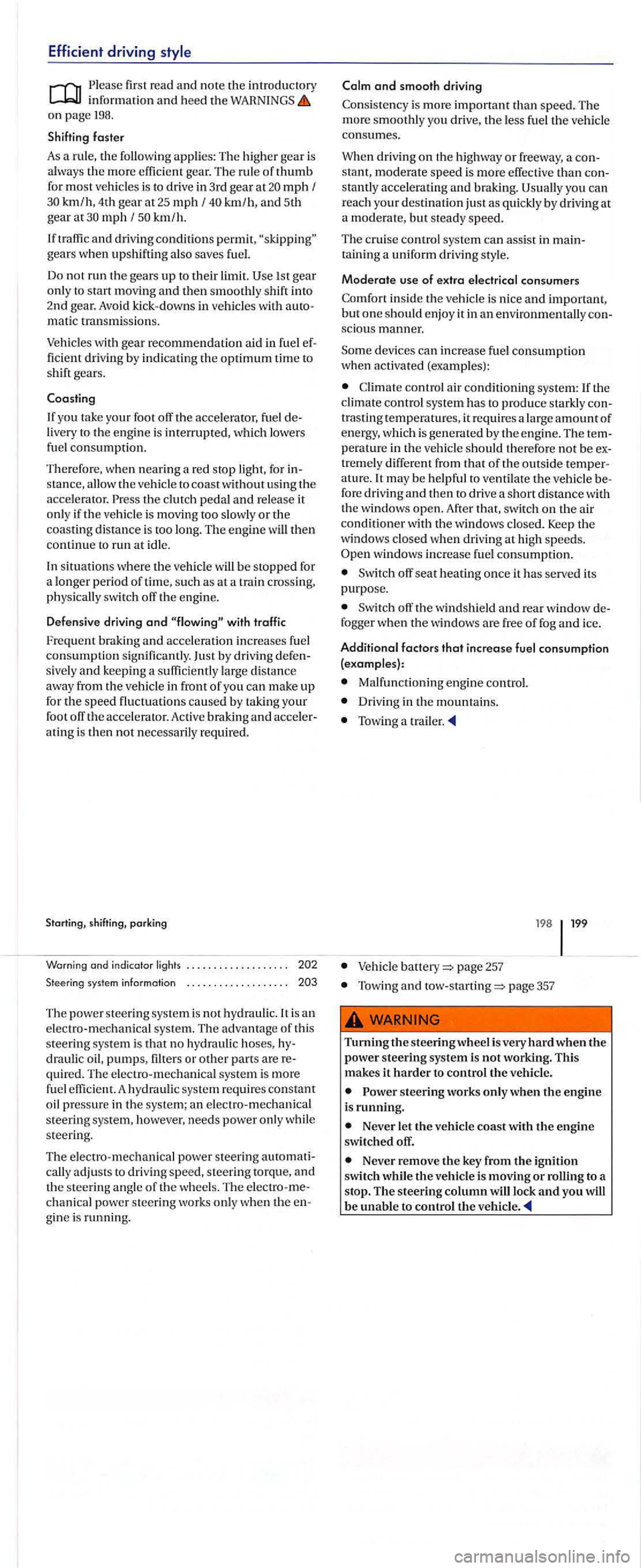
Shifting faster
As a rule, the following applies: The higher gear is
a lways the more efficient gear. The rule of thumb for most vehicles is to drive in 3rd gear at mph f km/h, 4th gear at 25 mph f km/h, and 5th gear at mph f km /h.
If
and driving conditions permit, gears when upshifting also saves fuel.
Do
not run the gears up to their limit.
mati c transmissions .
Vehicles with gear recommendation aid in fuel fic ient dri ving by indicating the optimum time to shift gears.
livery to the engine is interrupted, which lowers
fuel consumption.
T herefore, when nearing a red stop light , for s tanc e, allow the vehicle to coast without using the accelera tor. Press the clutch pedal and release it only if the v ehicle is moving too slowly or the coasting distance is too long. The engine will then continue to run at idl e.
In situati ons
where the vehicle will be stopped for
a longer period of time, such as at a train cros sing,
physically switch off the engin e.
D efens ive driving
and with traffic
Fre
quent braking and accel eration increases fuel consumption sign ific antly. Just by driving sivel y and keeping a su fficiently large distance away fro m the vehicle in front of you can make up for the speed fluctuation s caused by taking your foot off the accelerator. Active braking and ating is then not necessarily required.
system information
The power stee ring syste m i s not hydrauli c.lt is an electro-mechanical syste m. The advantage of this
s te ering system is tha t no hydra uli c hoses, draulic oil, pumps, filters or other parts are quired . Th e e lectro-m echanica l system is more fue l effi cient. A hydraulic system requires constant oil pressure in the syste m; an electro -mechanical
s teerin g sys tem, however, needs power only whil e
s teering.
Th e el
ectro-mechanical power steering
chanical power steering works only when the gin e is running.
and smooth driving
Consistency is more important than speed. The more smoothly yo u drive, the less fuel the vehicle consumes.
When driving on the highwa y or freeway, a
stantly accelerating and braking. you can r each your destinatio n just as quickly by driving at a moderate, but steady speed.
The c rui se control syste m can a ssis t in
sciou s manner.
Some dev ices can increase fuel consumption when activated (examples):
C limate control air conditioning system:
trasting temperatures, it requires a large amount of energy, which is generated by the e ngin e. T he
tr emely different from that of the outside
windows increase fuel consumption.
Switch off seat heating once it has served its
purpose.
Sw itch off the windshield and rear window
Malfunctioning engine control.
Driving in the mountains.
Towing a trailer .
page 257
Towing and page 357
Turning the steering wheel is very hard when the power steering system is not working. This makes it harder to control the vehicle.
steering works only when the engine is running.
Never let the vehicle coast with the engine switched off.
Never remove the key from the ignition
switch while the vehicle is moving or rolling to a
stop. The steering column will lock and you will be unable to control the vehicle.
Page 201 of 541
Fuel-efficient driving
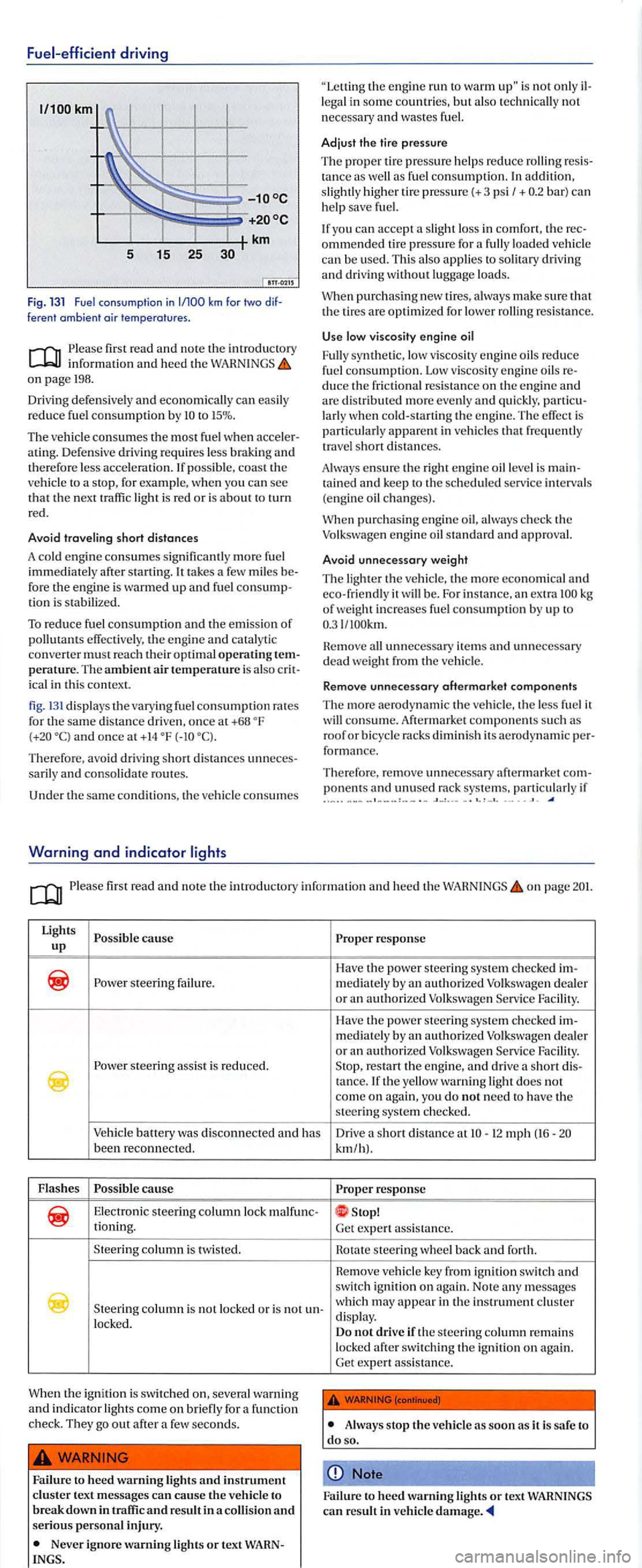
Fig. 131 Fuel consumption in ferent ambient air temperatures .
info rmation and heed the on page 198.
Dri vin g defensive ly and economically can easily
r educe fuel con sumption by to 15 % .
The ve hicle consu mes the most fu el w he n atin g. D efe nsive dri vin g require s less brakin g and therefore less accelerat ion. If possib le, coast the ve hicle to a sto p, for exa mple, when yo u ca n see th a t th e next traffic ligh t is red or is about to turn
red.
Avoid traveling short distanc
es
A cold engine consumes sig nificantl y more fuel
imm ediately after sta rtin g. It take s a few miles fore the engi ne is warm ed up and fuel tion i s stabili zed.
To reduce fuel consumptio n and the emission of pollutants effect ive ly, the e ng in e and ca talytic
conve rter must reach th eir optimal operating
ica l in thi s context.
fig. 13 1 displays the v a ry ing fuel consumption rates
for the same d istance dri ven, once at +68 and once at + 14
th e e ngin e run to warm is not o nl y lega l in some co untries, but also technicall y not
n ecessary and wastes fu el.
Adjust the tire pres sure
T he prop er tir e
pressure help s reduce rollin g tance as well as fue l co nsumption. In additi on ,
slig htl y higher tire pressure(+ 3 psi I+ bar) ca n
h e lp save fuel.
If you ca n a ccept a slight los s in comfort, the ommend ed tir e pressure for a fully loade d ve hicl e
ca n be used. This als o applies to so litary dri vin g and driv ing withou t lu ggage loa ds.
When purchasing new t ires, alway s ma ke sure th at
th e tires are optimi zed for lower rollin g resis tance.
Us e low viscosity engine oil
F ull y sy nth e
tic, low viscosity e ngine oils reduce
fuel consumption. Low viscosity e ngin e oils duce the fric tional res istance on th e engine and are dis tributed m ore evenly and qui ckly, larly w hen co ld -s tarting the engine. The effect is parti c ularl y apparent in vehicles th at frequentl y
tra vel s hort dis tan ces.
A lways ens
ure th e righ t e n g in e oil leve l is ta in ed and keep to the sc h edul ed serv ice interva ls
(e ng ine oil ch an ges).
W
hen purch asing e ngine oil, always ch eck th e Volksw agen en gine oil standard and approval.
Avoid unnecessary weight
The lighter th e ve hicl e, th e more economica l and ceo-friend ly it w ill be. For in stance, an extra
H e m ove
consum e. Aftermark et co mponents s uch as
ro of or b icycle racks dimin is h its aerod yn a m ic fonnan ce.
Th erefo re, re
mov e un necessary aftermark e t ponents and unused rac k systems, parti cul arly if ....... -
fir st read and note th e introductory informa tion and h ee d th e WAHNINGS page
response
Ha ve the power stee rin g sys te m ch ec ked ste eri ng failure. mediatel y by an authori zed Volk swag en deale r
o r a n authorized Volk swagen
Fac ility. steeri ng ass is t i s reduced. re start the e n gine, and dri ve a sh ort tan ce. If th e yello w warning light does not
c o m e on again, you do not need to have th e
s te ering syste m ch ec ke d .
Vehicle battery was di sconnected and has Drive a short distan ce at 12 mph been reconnec te d . km/h).
F lashes re sponse
Elec troni c steering column lo ck malfunc -
which m ay appea r in the in strument clu ste r
di sp lay. loc ke d.
W
hen the i g nit ion is switc h ed on, seve ra l wa rnin g and indicator lights come on bri efly for a f un ction ch e ck . T hey go out after a few seconds.
Failure to
heed warning light s and in strument cluster text m essages can cause th e vehicl e to break down in t raffic and result in a collisio n and seriou s personal injury.
Neve r igno re warning lights or tex t
Do not dri ve if th e s teerin g co lumn remains
l ocke d switch in g th e ig niti on on aga in.
Ge t expert assis ta nce.
Alwa ys sto p the vehicl e as soon as it is safe to do so .
Note
Failur e to heed warning lights or tex t WARNINGS can res ult in vehicl e damage