Page 111 of 400

When driving2
111
2-1. Driving proceduresDriving the vehicle............ 112
Engine (ignition) switch .... 124
Automatic transmission .... 127
Manual transmission ........ 129
Turn signal lever .............. 130
Parking brake ................... 131
Horn ................................. 132
2-2. Instrument cluster Gauges and meters ......... 133
Indicators and warning lights .............................. 136
Multi-information display............................ 140
2-3. Operating the lights and wipers
Headlight switch ............... 145
Fog light switch ................ 148
Windshield wiper and washer ........................... 150
Rear window wiper and washer ........................... 153
2-4. Using other driving systems Cruise control ................... 158
Driving assist systems ..... 162 2-5. Driving information
Cargo and luggage .......... 167
Vehicle load limits ............ 171
Winter driving tips ............ 172
Trailer towing (except 3-door models
for Canada) .................... 176
Trailer towing (3-door models
for Canada) .................... 177
Dinghy towing (vehicles with an automatic
transmission) ................. 187
Dinghy towing (vehicles with a manual
transmission) ................. 188
Page 135 of 400
135
2-2. Instrument cluster
2
When driving
Instrument panel light control
The brightness of the instrument pa nel lights can be adjusted by turn-
ing the dial.
Brighter
Darker
■The meters and display operate when
The engine switch is in the “ON” position.
NOTICE
■To prevent damage to the engine and its components
●On vehicles with a tachometer, do not let the indicator needle of the
tachometer enter the red zone, which indicates the maximum engine
speed.
● The engine may be overheating if the high engine coolant temperature
warning light flashes or comes on. In this case, immediately stop the vehi-
cle in a safe place, and check the engine after it has cooled completely.
(
P. 334)
Page 136 of 400
136
2-2. Instrument cluster
Indicators and warning lights
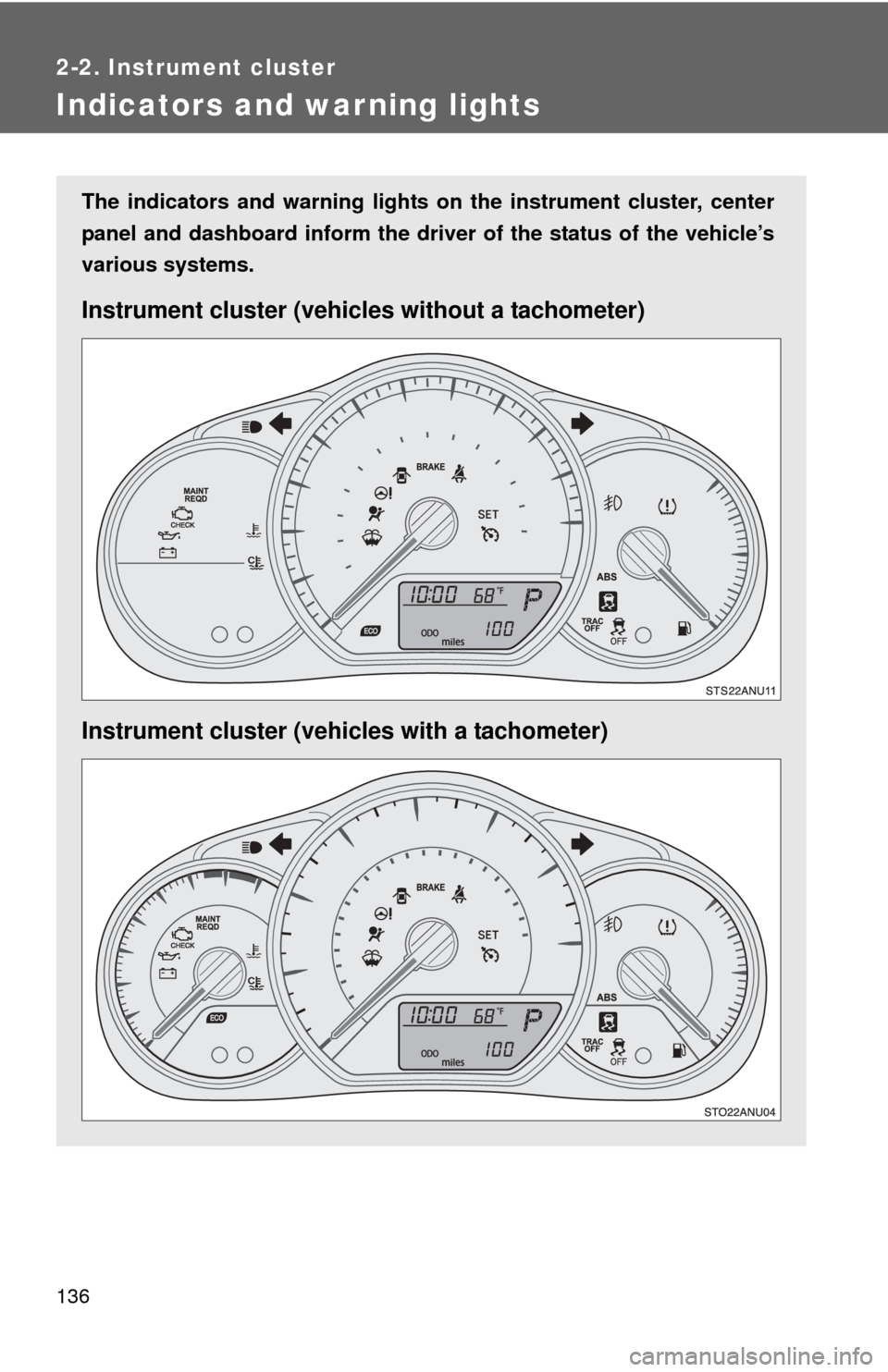
The indicators and warning lights on the instrument cluster, center
panel and dashboard inform the driver of the status of the vehicle’s
various systems.
Instrument cluster (vehic les without a tachometer)
Instrument cluster (vehicles with a tachometer)
Page 139 of 400
139
2-2. Instrument cluster
2
When driving
CAUTION
■
If a safety system warning light does not come on
Should a safety system light such as the ABS and SRS warning light not
come on when you start the engine, this could mean that these systems are
not available to help protect you in an accident, which could result in death
or serious injury. Have the vehicle inspected by your Toyota dealer immedi-
ately if this occurs.
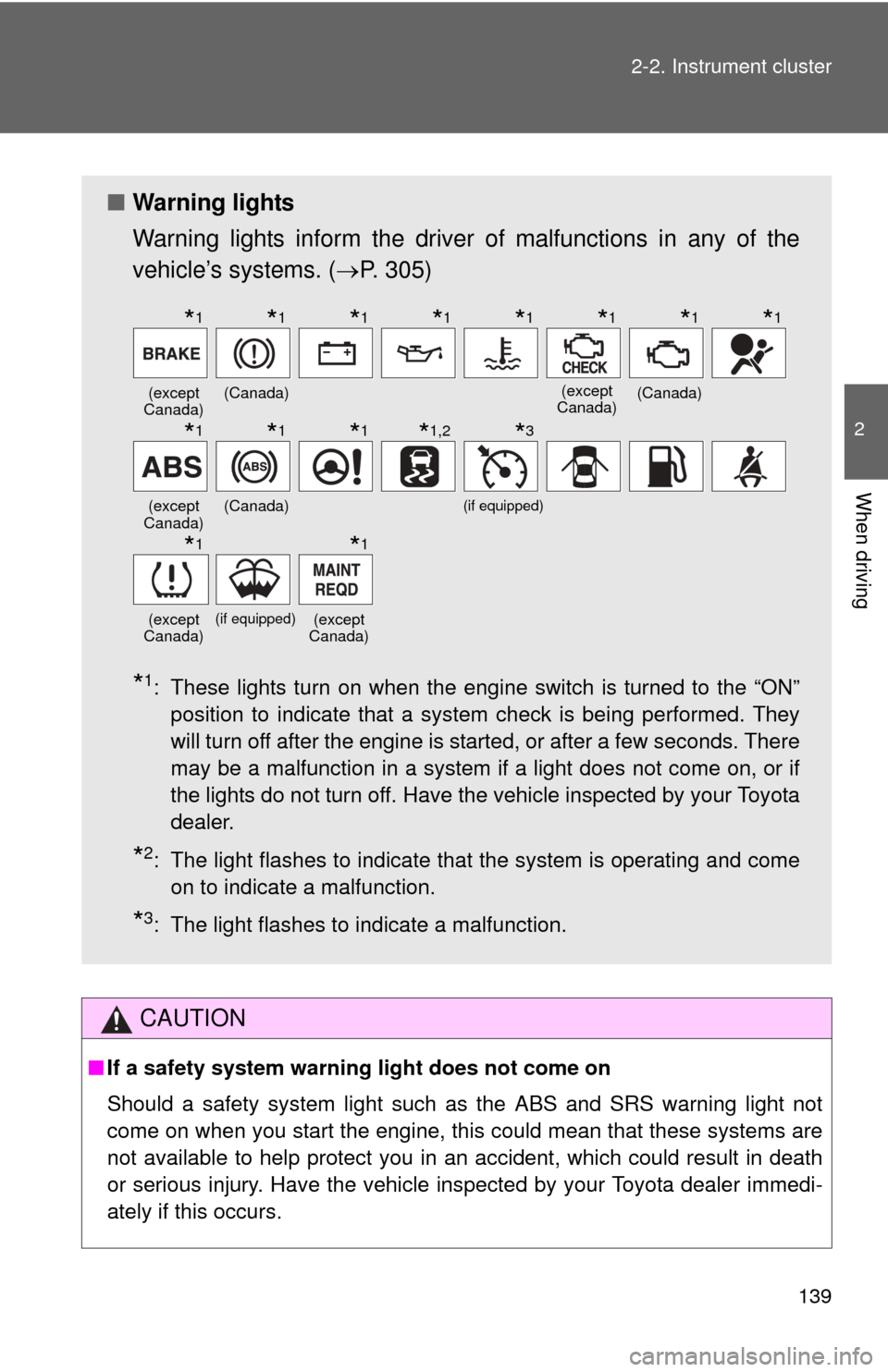
■ Warning lights
Warning lights inform the driver of malfunctions in any of the
vehicle’s systems. ( P. 305)
*1: These lights turn on when the engine switch is turned to the “ON”
position to indicate that a system check is being performed. They
will turn off after the engine is started, or after a few seconds. There
may be a malfunction in a system if a light does not come on, or if
the lights do not turn off. Have the vehicle inspected by your Toyota
dealer.
*2: The light flashes to indicate that the system is operating and comeon to indicate a malfunction.
*3: The light flashes to indicate a malfunction.
(except
Canada)(Canada)(except
Canada)(Canada)
(except
Canada)(Canada)(if equipped)
(except
Canada)
(if equipped)(except
Canada)
*1*1*1*1*1*1*1*1
*1*1*1*1,2*3
*1*1
Page 181 of 400

181
2-5. Driving information
2
When driving
●
Crosswinds and rough roads will adversely affect handling of your
vehicle and trailer, causing sway . Periodically check the rear to
prepare for being passed by large trucks or buses, which may
cause your vehicle and trailer to sway. If swaying occurs, firmly grip
the steering wheel, reduce speed immediately but gradually, and
steer straight ahead. Never increase speed. If you make no
extreme correction with the stee ring or brakes, your vehicle and
trailer will stabilize.
● Take care when passing other vehicles. Passing requires consider-
able distance. After passing a vehicle, do not forget the length of
your trailer, and be sure you hav e plenty of room before changing
lanes.
● To maintain engine braking efficiency and charging system perfor-
mance when using engine braking, do not use the transmission in
D (vehicles with an automatic transmission) or 5 (vehicles with a
manual transmission).
● Due to the added load of the trailer, your vehicle’s engine may
overheat on hot days (at temperatures over 85°F [30°C]) when
driving up a long or steep grade. If the high engine coolant temper-
ature warning light flashes or co mes on overheating, immediately
turn off the air conditioning (if in use), pull your vehicle off the road
and stop in a safe place. ( P. 334)
Page 252 of 400
252 4-3. Do-it-yourself maintenance
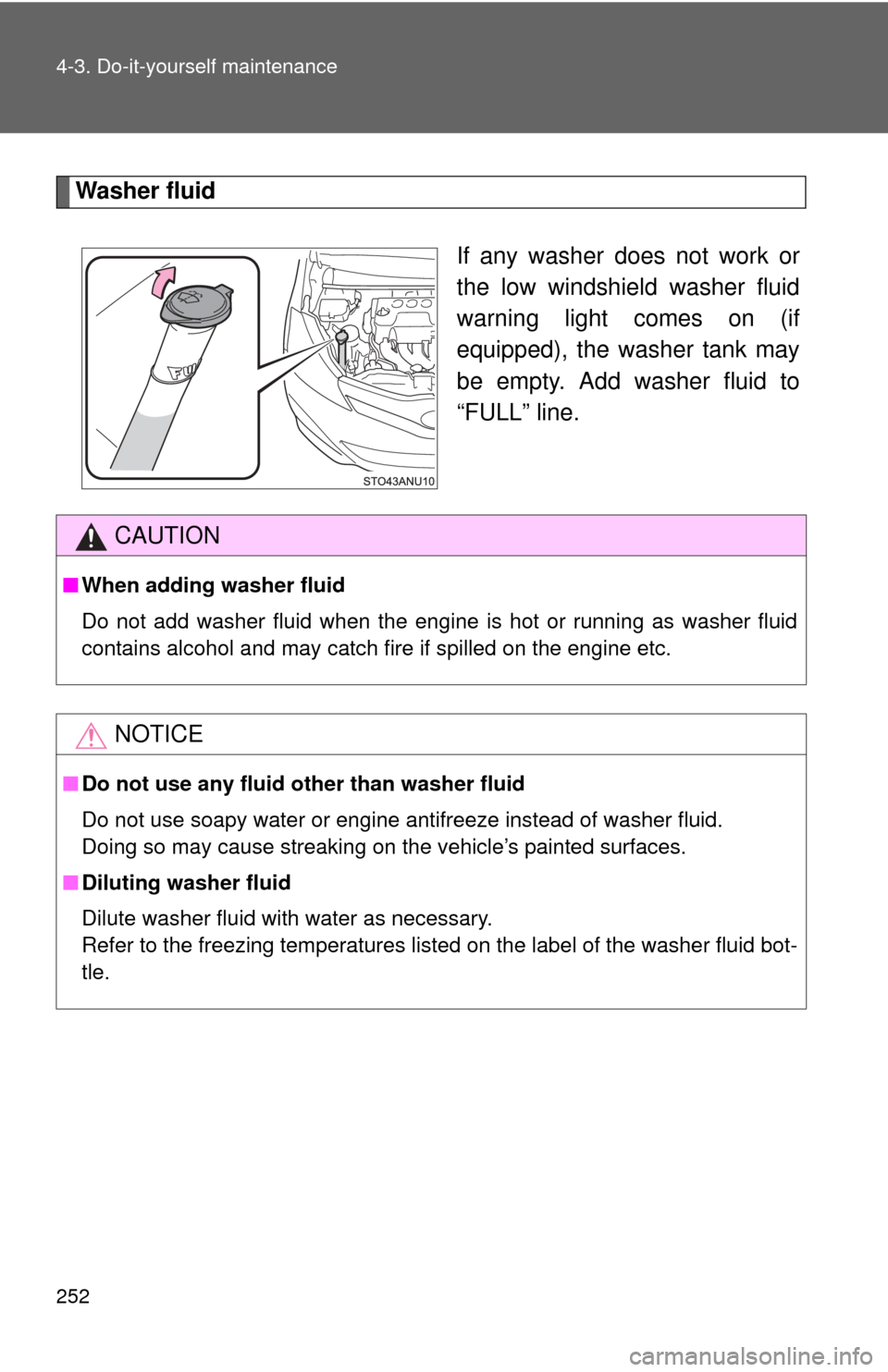
Washer fluidIf any washer does not work or
the low windshield washer fluid
warning light comes on (if
equipped), the washer tank may
be empty. Add washer fluid to
“FULL” line.
CAUTION
■When adding washer fluid
Do not add washer fluid when the engine is hot or running as washer fluid
contains alcohol and may catch fire if spilled on the engine etc.
NOTICE
■Do not use any fluid other than washer fluid
Do not use soapy water or engine antifreeze instead of washer fluid.
Doing so may cause streaking on the vehicle’s painted surfaces.
■ Diluting washer fluid
Dilute washer fluid with water as necessary.
Refer to the freezing temperatures listed on the label of the washer fluid bot-
tle.
Page 255 of 400
255
4-3. Do-it-yourself maintenance
4
Maintenance and care
Adjust the tire pressure to the specified cold tire inflation pres-
sure level. (
P. 351)
Make sure to adjust the tire pressure to the specified cold tire
inflation pressure level. The ti re pressure warning system will
operate based on this pressure level.
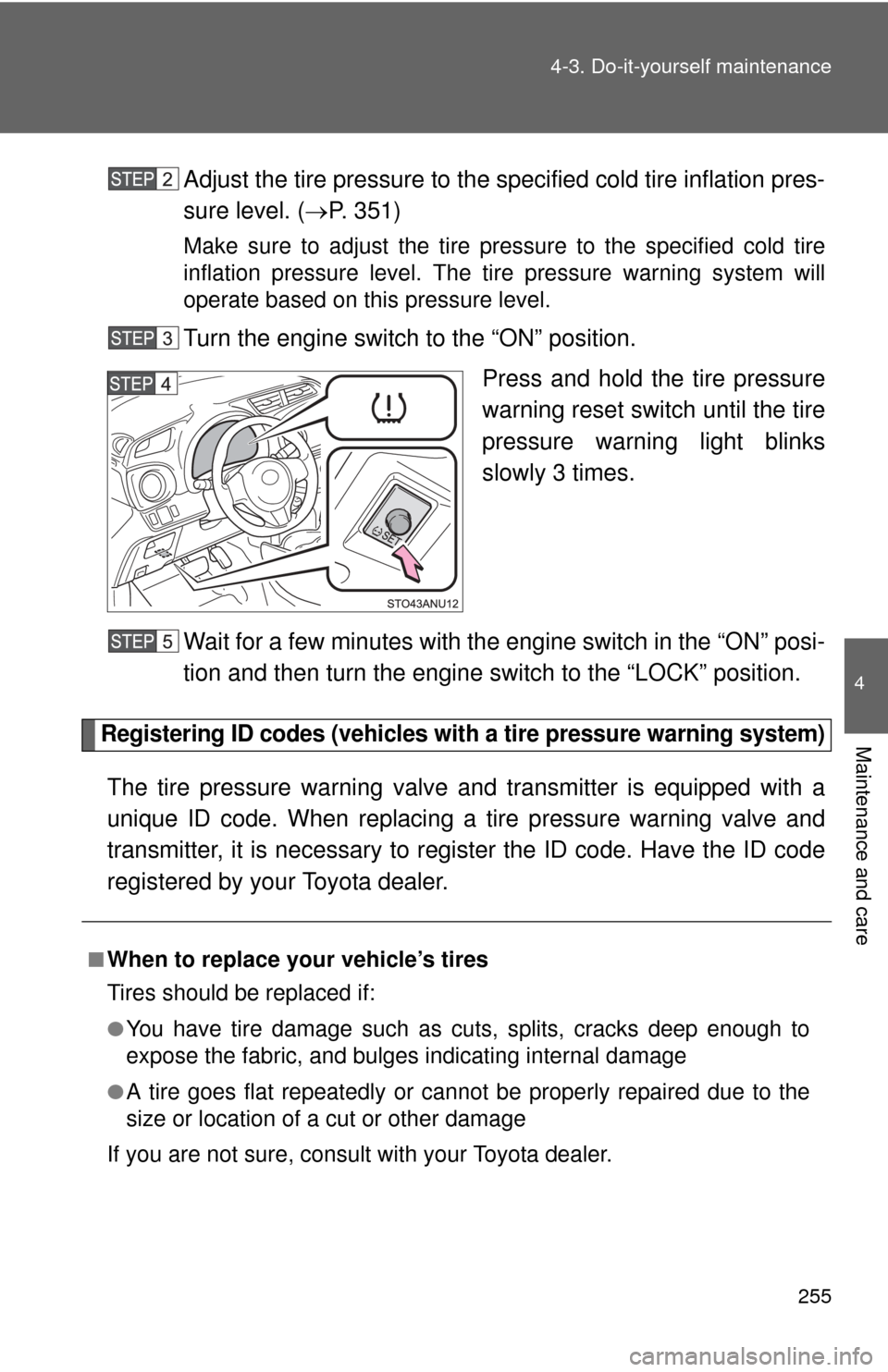
Turn the engine switch to the “ON” position.
Press and hold the tire pressure
warning reset switch until the tire
pressure warning light blinks
slowly 3 times.
Wait for a few minutes with the engine switch in the “ON” posi-
tion and then turn the engine switch to the “LOCK” position.
Registering ID codes (vehicles with a tire pressure warning system)
The tire pressure warning valve and transmitter is equipped with a
unique ID code. When replacing a tire pressure warning valve and
transmitter, it is necessary to regi ster the ID code. Have the ID code
registered by your Toyota dealer.
■When to replace your vehicle’s tires
Tires should be replaced if:
●You have tire damage such as cuts, splits, cracks deep enough to
expose the fabric, and bulges indicating internal damage
●A tire goes flat repeatedly or c annot be properly repaired due to the
size or location of a cut or other damage
If you are not sure, consult with your Toyota dealer.
Page 256 of 400

256 4-3. Do-it-yourself maintenance
■Replacing tires and wheels (vehicles with a tire pressure warning
system)
If the ID code of the tire pressure warning valve and transmitter is not
registered, the tire pressure warning system will not work properly. After
driving for about 20 minutes, the tire pressure warning light blinks for 1
minute and stays on to indicate a system malfunction.
■Tire life
Any tire over 6 years old must be checked by a qualified technician even
if it has seldom or never been used or damage is not obvious.
■Routine tire inflation pressure checks (vehicles with a tire pressure
warning system)
The tire pressure warning system doe s not replace routine tire inflation
pressure checks. Make sure to check tire inflation pressure as part of
your routine of daily vehicle checks.
■Low profile tires (vehicle s with P195/50R16 tires)
Generally, low profile tire s will wear more rapidly and tire grip perfor-
mance will be reduced on snowy and/or icy roads when compared to
standard tires. Be sure to use snow tires or tire chains on snowy and/or
icy roads and drive carefully at a speed appropriate for road and weather
conditions.
■Maximum load of tire
Check that the maximum load of the replacement tire is greater than 1/2
of the Gross Axle Weight Ratings (GAW R) of either the front axle or the
rear axle, whichever is greater.
For the GAWR, see the Certification
Label. For the maximum load of the
tire, see the load limit at maximum cold
tire inflation pressure mentioned on the
sidewall of the tire. ( P. 356)