2012 TOYOTA YARIS HYBRID recharging 12 v battery
[x] Cancel search: recharging 12 v batteryPage 49 of 704
49 1-1. Hybrid system (hybrid vehicle)
1
Before driving
YARIS_F (including HV)_WE_52C79E
Regenerative braking
In the following situations, kinetic energy is converted to electric energy and
deceleration force can be obtained in conjunction with the recharging of the
hybrid battery (traction battery).
The accelerator pedal is released.
The brake pedal is depressed with the shift lever in D or B.
When stopped/during start off
The gasoline engine stops
* when the vehicle is stopped. During
start off, the electric motor (traction motor) drives the vehicle. At
slow speeds or when traveling down a gentle slope, the engine
is stopped
* and the motor is used.
*: However, when the hybrid battery (traction battery) needs to be
charged or while the engine is being warmed up, the gasoline engine
may not stop automatically. (P. 50)
During normal driving
The gasoline engine is predominantly used. The electric motor
(traction motor) charges the hybrid battery (traction battery) as
necessary.
When accelerating sharply
The power of the hybrid battery (traction battery) is added to that
of the gasoline engine via the electric motor (traction motor).
When braking (regenerative braking)
The electric motor (traction motor) charges the hybrid battery
(traction battery).
Page 81 of 704
81 1-3. Opening, closing and locking the doors
1
Before driving
YARIS_F (including HV)_WE_52C79E
Security feature
If a door is not opened within approximately 30 seconds after the vehicle is
unlocked, the security feature automatically locks the vehicle again.
To operate the system properly
Make sure to carry the electronic key when operating the system. Do not get
the electronic key too close to the vehicle when operating the system from
the outside of the vehicle.
Depending on the position and holding condition of the electronic key, the
key may not be detected correctly and the system may not operate properly.
(The alarm may go off accidentally, or the door lock prevention function may
not operate.)
If the smart entry & start system does not operate properly
Locking and unlocking the doors: Use the mechanical key. (P. 619)
Starting the engine (except hybrid vehicle) or the hybrid system (hybrid
vehicle): P. 619
Electronic key battery depletion
The standard battery life is 1 to 2 years.
If the battery becomes low, an alarm will sound in the cabin when the
engine (except hybrid vehicle) or the hybrid system (hybrid vehicle)
stops. (P. 575)
As the electronic key always receives radio waves, the battery will
become depleted even if the electronic key is not used. The following
symptoms indicate that the electronic key battery may be depleted.
Replace the battery when necessary. (P. 505)
• The smart entry & start system or the wireless remote control does not
operate.
• The detection area becomes smaller.
• The LED indicator on the key surface does not turn on.
To avoid serious deterioration, do not leave the electronic key within 1 m
(3 ft.) of the following electrical appliances that produce a magnetic field:
•TVs
• Personal computers
• Cellular phones, cordless phones and battery chargers
• Recharging cellular phones or cordless phones
• Glass top ranges
• Table lamps
Page 483 of 704

483 4-3. Do-it-yourself maintenance
4
Maintenance and care
YARIS_F (including HV)_WE_52C79E
Before recharging
When recharging, the battery produces hydrogen gas which is flammable
and explosive. Therefore, observe the following before recharging:
If recharging with the battery installed on the vehicle, be sure to discon-
nect the ground cable.
Make sure the power switch on the charger is off when connecting and
disconnecting the charger cables to the battery.
After recharging/reconnecting the battery (vehicles with a smart entry
& start system)
Unlocking the doors using the smart entry & start system may not be
possible immediately after reconnecting the battery. If this happens, use
the wireless remote control or the mechanical key to lock/unlock the
doors.
Start the engine with the “ENGINE START STOP” switch in ACCES-
SORY mode. The engine may not start with the “ENGINE START STOP”
switch turned off. However, the engine will operate normally from the sec-
ond attempt.
The “ENGINE START STOP” switch mode is recorded by the vehicle. If
the battery is reconnected, the vehicle will return the “ENGINE START
STOP” switch mode to the status it was in before the battery was discon-
nected. Make sure to turn off the engine before disconnect the battery.
Take extra care when connecting the battery if the “ENGINE START
STOP” switch mode prior to discharge is unknown.
If the engine will not start even after multiple attempts, contact any autho-
rized Toyota dealer or repairer, or another duly qualified and equipped pro-
fessional.
Page 485 of 704

485 4-3. Do-it-yourself maintenance
4
Maintenance and care
YARIS_F (including HV)_WE_52C79E
Washer fluid
If the washer fluid level is less
than “FULL” line, add washer
fluid to “FULL” line.
NOTICE
When recharging the battery
Never recharge the battery while the engine is running. Also, be sure all
accessories are turned off.
CAUTION
When adding washer fluid
Do not add washer fluid when the engine is hot or running (except hybrid
vehicle) or the hybrid system is hot or operating (hybrid vehicle) as washer
fluid contains alcohol and may catch fire if spilled on the engine etc.
NOTICE
Do not use any fluid other than washer fluid
Do not use soapy water or engine antifreeze instead of washer fluid.
Doing so may cause streaking on the vehicle’s painted surfaces.
Diluting washer fluid
Dilute washer fluid with water as necessary.
Refer to the freezing temperatures listed on the label of the washer fluid bot-
tle.
Page 491 of 704
491 4-3. Do-it-yourself maintenance
4
Maintenance and care
YARIS_F (including HV)_WE_52C79E
Before recharging
When recharging, the 12-volt battery produces hydrogen gas which is flam-
mable and explosive. Therefore, observe the following precautions before
recharging:
If recharging with the 12-volt battery installed on the vehicle, be sure to
disconnect the ground cable.
Make sure the power switch on the charger is off when connecting and
disconnecting the charger cables to the 12-volt battery.
When disconnecting the 12-volt battery terminals
Always disconnect the negative (-) terminal first.
After recharging/reconnecting the 12-volt battery
Unlocking the doors using the smart entry & start system may not be
possible immediately after reconnecting the 12-volt battery. If this hap-
pens, use the wireless remote control or the mechanical key to lock/
unlock the doors.
Vehicles with an electronic key: Start the hybrid system with the
“POWER” switch in ACCESSORY mode. The hybrid system may not
start with the “POWER” switch turned off. However, the hybrid system will
operate normally from the second attempt.
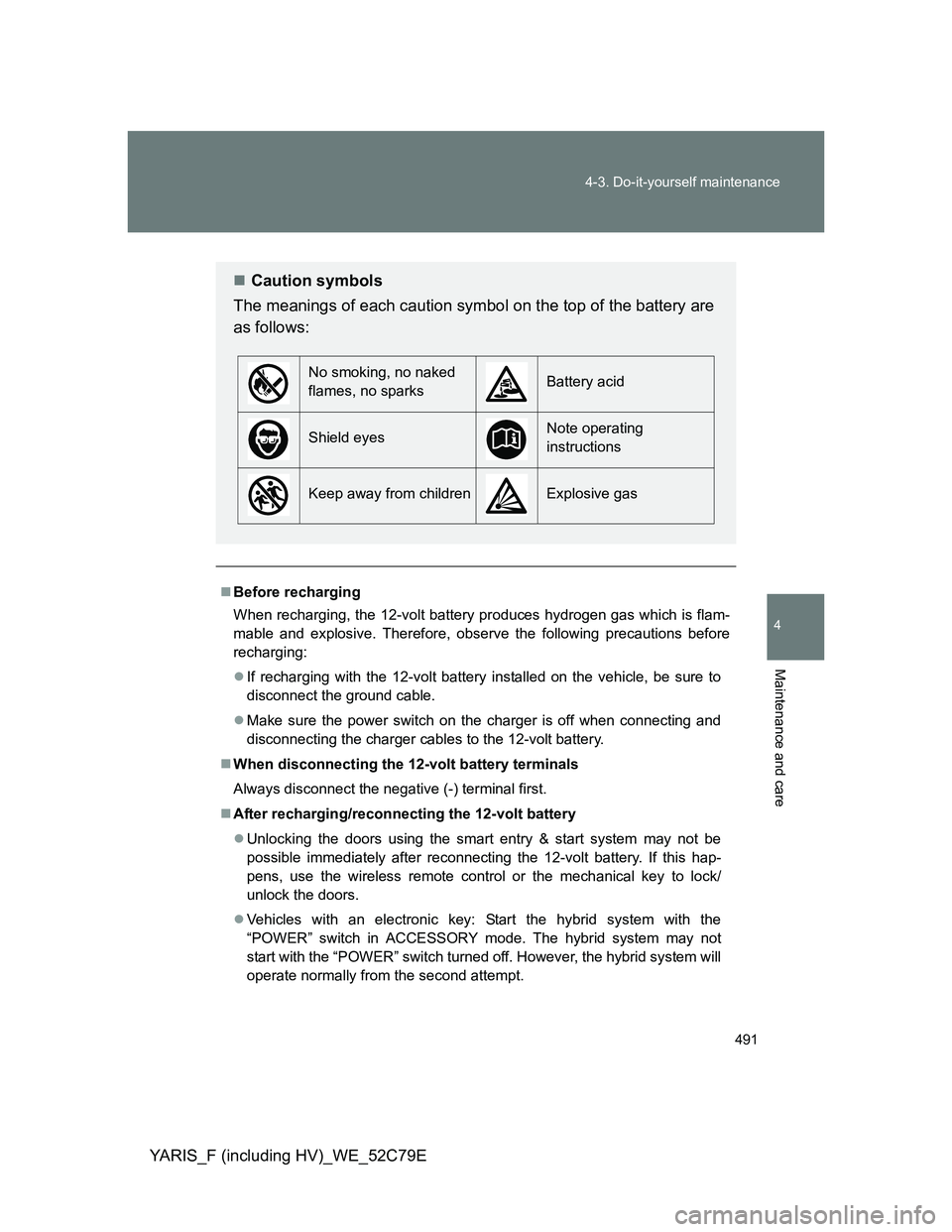
Caution symbols
The meanings of each caution symbol on the top of the battery are
as follows:
No smoking, no naked
flames, no sparksBattery acid
Shield eyesNote operating
instructions
Keep away from childrenExplosive gas
Page 493 of 704
493 4-3. Do-it-yourself maintenance
4
Maintenance and care
YARIS_F (including HV)_WE_52C79E
CAUTION
Emergency measures regarding electrolyte
If electrolyte gets in your eyes
Flush your eyes with clean water for at least 15 minutes and get immedi-
ate medical attention. If possible, continue to apply water with a sponge or
cloth while traveling to the nearest medical facility.
If electrolyte gets on your skin
Wash the affected area thoroughly. If you feel pain or burning, get medical
attention immediately.
If electrolyte gets on your clothes
It can soak through clothing on to your skin. Immediately take off the cloth-
ing and follow the procedure above if necessary.
If you accidentally swallow electrolyte
Drink a large quantity of water or milk. Get emergency medical attention
immediately.
When replacing the 12-volt battery
Use a 12-volt battery designed for this vehicle. Failure to do so may cause
gas (hydrogen) to enter the passenger compartment, causing a fire or explo-
sion.
For replacement of the 12-volt battery, contact any authorized Toyota dealer
or repairer, or another duly qualified and equipped professional.
NOTICE
When recharging the 12-volt battery
Never recharge the 12-volt battery while the hybrid system is operating.
Also, be sure all accessories are turned off.
Page 634 of 704
634 5-2. Steps to take in an emergency
YARIS_F (including HV)_WE_52C79E
CAUTION
After recharging the 12-volt battery
Have the 12-volt battery inspected at any authorized Toyota dealer or
repairer, or another duly qualified and equipped professional as soon as
possible.
If the 12-volt battery is deteriorating, continued use may cause the 12-volt
battery to emit a malodorous gas, which may be detrimental to the health of
passengers.
When replacing the 12-volt battery
P. 493
12-volt battery precautions
The 12-volt battery contains poisonous and corrosive acidic electrolyte,
while related parts contain lead and lead compounds. Observe the following
precautions when handling the 12-volt battery:
When working with the 12-volt battery, always wear safety glasses and
take care not to allow any battery fluids (acid) to come into contact with
skin, clothing or the vehicle body.
Do not lean over the 12-volt battery.
In the event that battery fluid comes into contact with the skin or eyes,
immediately wash the affected area with water and seek medical attention.
Place a wet sponge or cloth over the affected area until medical attention
can be received.
Always wash your hands after handling the battery support, terminals, and
other battery-related parts.
Do not allow children near the 12-volt battery.