Page 261 of 365
282 4-3. Do-it-yourself maintenance
Engine compartment (type C fuse box)
FuseAmpereCircuit
1 ALT 120 A ID/UP, EPS, ABS NO.2, DEF, PTC,
HTR, H-LP CLN, RDI FAN, ABS
NO.1, TAIL NO.2, PANEL, DOOR
R/R, DOOR P, ECU-IG NO.1,
ECU-IG NO.2, A/C, GAUGE,
WASHER, WIPER, WIPER RR,
P/W, DOOR R/L, DOOR, CIG,
ACC, D/L, OBD, STOP, AM1, FOG
FR
2 MAIN 80 A BBC, ST, AMP, D/L NO.2, D.C.C,
STR LOCK, MIR-HTR, ETCS,
HAZ, AM2, ALT-S, R/I, EU-DRL,
S-HORN, H-LP MAIN, H-LP RH HI,
H-LP LH HI, H-LP RH LO, H-LP LH
LO
Page 262 of 365
283
4-3. Do-it-yourself maintenance
4
Maintenance and care
Under the driver’s side instrument panel
FuseAmpereCircuit
1 TAIL NO.2 10 A Parking lights, tail lights, license
plate lights, side marker lights
2 PANEL 5 A Gauges and meters, instrument
panel lights, switch illumination
3 DOOR R/R 20 A Power windows
4 DOOR P 20 A Power windows
5 ECU-IG NO.1 5 A Electric cooling fan, rear window
defogger, vehicle stability control
system, electric power steering
system, main body ECU, wireless
remote control system, tire pres-
sure warning system
6 ECU-IG NO.2 5 A Vehicle stability control system
7 A/C 7.5 A Air conditioning system, rear win-
dow defogger, outside rear view
mirror defoggers
8 GAUGE 10 A Back-up lights, shift lock control
system, audio system, charging
system, multiport fuel injection sys-
tem/sequential multiport fuel injec-
tion system
9 WASHER 15 A Windshield washer
10 WIPER 20 A Windshield wiper
11 WIPER RR 15 A Rear window wiper
Page 263 of 365

284 4-3. Do-it-yourself maintenance
12 P/W30 A Power windows
13 DOOR R/L 20 A Power windows
14 DOOR 20 A Power windows
15 CIG 15 A Power outlets
16 ACC 5 AMain body ECU, outside rear view
mirrors, audio system, shift lock
control system
17 D/L 25 APower door lock system, main
body ECU
18 OBD 7.5 A On-board diagnosis system
19 STOP 7.5 AMultiport fuel injection system/
sequential multiport fuel injection
system, vehicle stability control
system, stop lights, high mounted
stoplight
20 AM1 7.5 A Starting system, engine switch
21 FOG FR 15 A Front fog lights
■ After a fuse is replaced
●If the lights do not turn on even after the fuse has been replaced, a bulb
may need replacement. ( →P. 286)
● If the replaced fuse blows again, have the vehicle inspected by your
Toyota dealer.
■ If there is an overload in a circuit
The fuses are designed to blow, protecting the wiring harness from damage.
■ When replacing light bulbs
Toyota recommends that you use genuine Toyota products designed for this
vehicle.
Because certain bulbs are connected to circuits designed to prevent over-
load, non-genuine parts or parts non designed for this vehicle may be unus-
able.
FuseAmpereCircuit
Page 272 of 365
293
4-3. Do-it-yourself maintenance
4
Maintenance and care
CAUTION
■
Replacing light bulbs
●Turn off the lights. Do not attempt to replace the bulb immediately after
turning off the lights.
The bulbs become very hot and may cause burns.
● Do not touch the glass portion of the light bulb with bare hands. Hold the
bulb by the plastic or metal portion.
If the bulb is scratched or dropped, it may blow out or crack.
● Fully install light bulbs and any parts used to secure them. Failure to do so
may result in head damage, fire, or water entering the headlight unit. This
may damage the headlights or cause condensation to build up on the lens.
■ To prevent damage or fire
Make sure bulbs are fully seated and locked.
Page 275 of 365
5
When trouble arises
297
5-1. Essential information
If your vehicle needs to be towed
Before towingThe following may indicate a problem with your transmission. Contact
your Toyota dealer before towing.
● The engine is running but the vehicle will not move.
● The vehicle makes an abnormal sound.
Emergency towing
If a tow truck is not available in
an emergency, your vehicle may
be temporarily towed using a
cable or chain secured to the
emergency towing eyelet. This
should only be attempted on
hard surfaced roads for short
distances at low speeds.
A driver must be in the vehicle to
steer and operate the brakes.
The vehicle’s wheels, drive train,
axles, steering and brakes must
be in good condition.
If towing is necessary, we recommend having your vehicle towed by
your Toyota dealer or a commerci al towing service, using a lift-type
truck or flatbed truck.
Use a safety chain system for all to wing, and abide by all state/pro-
vincial and local laws.
Page 277 of 365
5
When trouble arises
299
5-1. Essential information
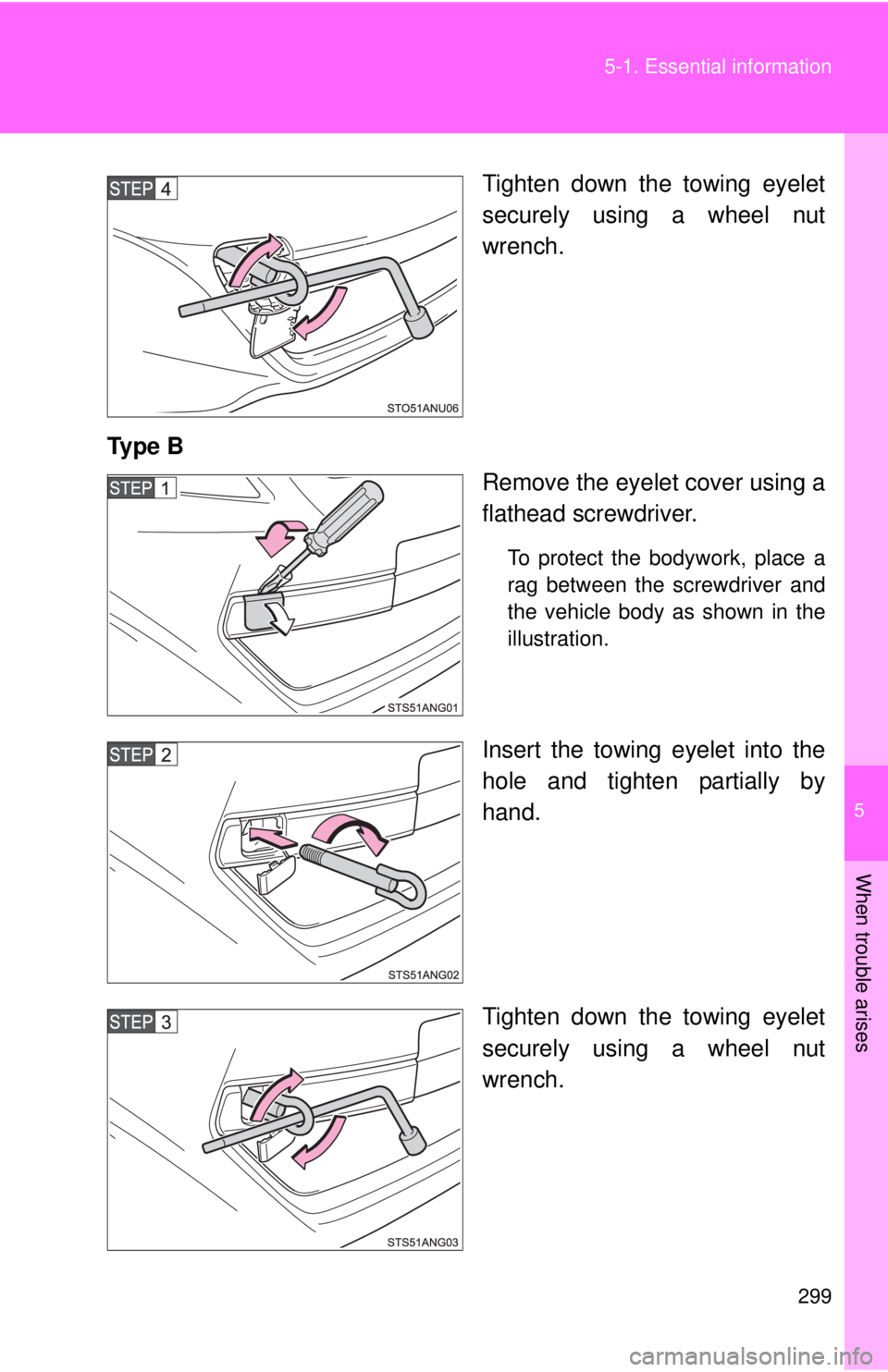
Tighten down the towing eyelet
securely using a wheel nut
wrench.
Ty p e B Remove the eyelet cover using a
flathead screwdriver.
To protect the bodywork, place a
rag between the screwdriver and
the vehicle body as shown in the
illustration.
Insert the towing eyelet into the
hole and tighten partially by
hand.
Tighten down the towing eyelet
securely using a wheel nut
wrench.
Page 280 of 365

302 5-1. Essential information
CAUTION
■Caution while towing
●Use extreme caution when towing the vehicle.
Avoid sudden starts or erratic driving maneuvers which place excessive
stress on the emergency towing eyelet and the cables or chains. Always
be cautious of the surroundings and other vehicles while towing.
● If the engine is not running, the power assist for the brakes and steering
will not function, making steering and braking more difficult.
■ Installing towing eyelet to the vehicle
Make sure that towing eyelet is installed securely.
If not securely installed, towing eyelet may come loose during towing. This
may lead to accidents that cause serious injury or even death.
NOTICE
■To prevent causing serious damage to the transmission when towing
using a wheel-lift type truck (vehic les with an automatic transmission)
Never tow this vehicle from the rear with the front wheels on the ground.
■ To prevent damage to the vehicle when towing using a wheel-lift type
truck (vehicles with an automatic transmission)
When raising the vehicle, ensure adequate ground clearance for towing at
the opposite end of the raised vehicle. Without adequate clearance, the
vehicle could be damaged while being towed.
■ To prevent damage to the vehicle when towing using a wheel-lift type
truck (vehicles with a manual transmission)
●Do not tow the vehicle from the rear when the engine switch is in the
“LOCK” position or the key is removed.
The steering lock mechanism is not strong enough to hold the front wheel
straight.
● When raising the vehicle, ensure adequate ground clearance for towing at
the opposite end of the raised vehicle. Without adequate clearance, the
vehicle could be damaged while being towed.
■ To prevent body damage when to wing with a sliding-type truck
Do not tow with a sling-type truck, either from the front or rear.
Page 288 of 365

310 5-2. Steps to take in an emergency
■SRS warning light
This warning light system monitors the airbag sensor assembly, front impact
sensors, side impact sensors, driver’s seat belt buckle switch, front passen-
ger occupant classification system (ECU and sensors), “AIR BAG ON” indi-
cator light, “AIR BAG OFF” indicator light, front passenger’s seat belt buckle
switch, seat belt pretensioner assemblies, airbags, interconnecting wiring
and power sources. ( →P. 80)
■ Front passenger detection sensor, passenger seat belt reminder and
warning buzzer
●If luggage is placed on the front passenger seat, the front passenger
detection sensor may cause the warning light to flash and the warning
buzzer to sound even if a passenger is not sitting in the seat.
● If a cushion is placed on the seat, the sensor may not detect a passen-
ger, and the warning light may not operate properly.
■ Electric power steering system warning light (warning buzzer)
The electric power steering system warning light may come on and the
warning buzzer may sound when the voltage is low or the voltage drops.
■ If the malfunction indicator lamp comes on while driving
First check the following:
● Is the fuel tank empty?
If it is, fill the fuel tank immediately.
● Is the fuel tank cap loose?
If it is, tighten it securely.
The malfunction indicator lamp will go off after several driving trips.
If the malfunction indicator lamp does not go off even after several trips, con-
tact your Toyota dealer as soon as possible.
■
When the tire pressure warning li ght comes on (vehicles with a tire
pressure warning system)
Check the tire inflation pressure and adjust to the appropriate level.
Pushing the tire pressure warning reset switch will not turn off the tire
pressure warning light.