Page 629 of 708
5
When trouble arises
629
5-2. Steps to take in an emergency
NOTICE
■Do not drive the vehicle with a flat tire.
Do not continue driving with a flat tire.
Driving even a short distance with a flat tire can damage the tire and the
wheel beyond repair.
■When replacing the tires
●When removing or fitting the wheels, tires or the tire pressure warning
valve and transmitter, contact your Toyota dealer as the tire pressure
warning valve and transmitter may be damaged if not handled cor-
rectly.
●Replace the grommets for the tire pressure warning valves and trans-
mitters as well.
■To avoid damage to the tire pressure warning valves and transmit-
ters
When a tire is repaired with liquid
sealants, the tire pressure warning
valve and transmitter may not operate properly. If a liquid sealant is
used, contact your Toyota dealer or other qualified service shop as soon
as possible. Make sure to replace the tire pressure warning valve and
transmitter when replacing the tire. ( P. 550)
Page 640 of 708

640
5-2. Steps to take in an emergency
If the vehicle becomes stuck
CAUTION
■When attempting to free a stuck vehicle
If you choose to rock the vehicle back and forth to free it, make sure the sur-
rounding area is clear, to avoid striking other vehicles, objects or persons.
The vehicle may also lunge forward or lunge back suddenly as it becomes
free. Use extreme caution.
■ When shifting the shift lever
Be careful not to shift the shift lever with the accelerator pedal depressed.
This may lead to unexpected rapid acceleration of the vehicle that may
cause an accident and result in death or serious injury.
NOTICE
■To avoid damaging the transmission and other components
●Avoid spinning the wheels and do not rev the engine.
● If the vehicle remains stuck after trying these procedures, the vehicle may
require towing to be freed.
Carry out the following procedures if the tires spin or the vehicle
becomes stuck in mud, dirt, or snow.
Stop the engine. Set the parking brake and put the shift
lever in P.
Remove the mud, snow, or sand from around the stuck tire.
Place wood, stones or some other material to help provide
traction under the tires.
Restart the engine.
Turn off the VSC. ( P. 255, 257)
Shift the shift lever to D or R and carefully apply the accel-
erator to free the vehicle.
Page 654 of 708
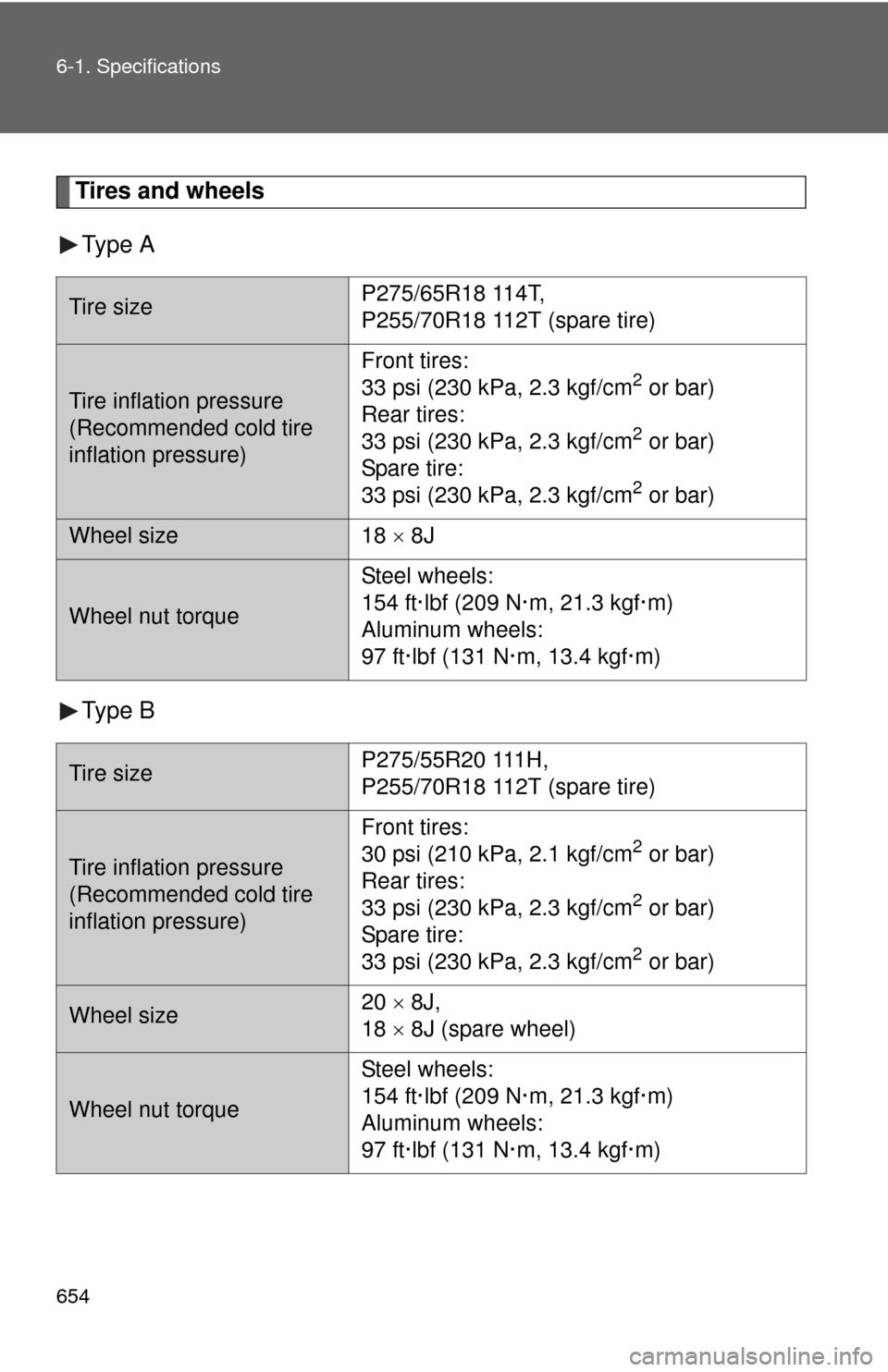
654 6-1. Specifications
Tires and wheelsType A
Type B
Tire size P275/65R18 114T,
P255/70R18 112T (spare tire)
Tire inflation pressure
(Recommended cold tire
inflation pressure)Front tires:
33 psi (230 kPa, 2.3 kgf/cm
2 or bar)
Rear tires:
33 psi (230 kPa, 2.3 kgf/cm
2 or bar)
Spare tire:
33 psi (230 kPa, 2.3 kgf/cm
2 or bar)
Wheel size 18 8J
Wheel nut torque Steel wheels:
154 ft·lbf (209 N·m, 21.3 kgf·m)
Aluminum wheels:
97 ft·lbf (131 N·m, 13.4 kgf·m)
Tire size
P275/55R20 111H,
P255/70R18 112T (spare tire)
Tire inflation pressure
(Recommended cold tire
inflation pressure)Front tires:
30 psi (210 kPa, 2.1 kgf/cm
2 or bar)
Rear tires:
33 psi (230 kPa, 2.3 kgf/cm
2 or bar)
Spare tire:
33 psi (230 kPa, 2.3 kgf/cm
2 or bar)
Wheel size 20
8J,
18 8J (spare wheel)
Wheel nut torque Steel wheels:
154 ft·lbf (209 N·m, 21.3 kgf·m)
Aluminum wheels:
97 ft·lbf (131 N·m, 13.4 kgf·m)
Page 662 of 708
662 6-1. Specifications
Typical DOT and tire identification number (TIN)DOT symbol
*
Tire Identification Number
(TIN)
Tire manufacturer’s identifica-
tion mark
Tire size code
Manufacturer’s optional tire
type code (3 or 4 letters)
Manufacturing week
Manufacturing year
*:The DOT symbol certifies thatthe tire conforms to applicable
Federal Motor Vehicle Safety
Standards.
Radial tires or bias-ply tires
A radial tire has RADIAL on the sidewall. A tire not marked RADIAL
is a bias-ply tire.
Summer tire or all season tire ( P. 552)
An all season tire has M+S on the sidewall. A tire not marked M+S
is a summer tire.
Page 664 of 708
664 6-1. Specifications
Tire section namesBead
Sidewall
Shoulder
Tread
Belt
Inner liner
Reinforcing rubber
Carcass
Rim lines
Bead wires
Chafer
Uniform Tire Quality GradingThis information has been prepared in accordance with regulations
issued by the National Highway Tr affic Safety Administration of the
U.S.A. Department of Transportation.
It provides the purchasers and/or prospective purchasers of Toyota
vehicles with information on uniform tire quality grading.
Your Toyota dealer will help answ er any questions you may have as
you read this information.
■ DOT quality grades
All passenger vehicle tires mu st conform to Federal Safety
Requirements in addition to these grades. Quality grades can be
found where applicable on the tire sidewall between tread shoulder
and maximum section width.
For example: Treadwear 200 Traction AA Temperature A
Page 665 of 708

665
6-1. Specifications
6
Vehicle specifications
■
Treadwear
The treadwear grade is a comparative rating based on the wear
rate of the tire when tested under controlled conditions on a speci-
fied government test course.
For example, a tire graded 150 would wear one and a half (1 - 1/2)
times as well on the government course as a tire graded 100.
The relative performance of tires depends upon the actual conditions
of their use, however, and may depart significantly from the norm due
to variations in driving habits, service practices and differences in
road characteristics and climate.
■ Traction AA, A, B, C
The traction grades, from highest to lowest, are AA, A, B and C,
and they represent the tire’s ab ility to stop on wet pavement as
measured under controlled cond itions on specified government
test surfaces of asphalt and concrete.
A tire marked C may have poor traction performance.
Warning: The traction grade assigned to this tire is based on braking
(straight ahead) traction tests and does not include cornering (turn-
ing) traction.
■ Temperature A, B, C
The temperature grades are A (the highest), B, and C, represent-
ing the tire’s resistance to the generation of heat and its ability to
dissipate heat when tested under controlled conditions on a speci-
fied indoor laboratory test wheel.
Sustained high temperature can cause the material of the tire to
degenerate and reduce tire life, and excessive temperature can lead
to sudden tire failure.
The grade C corresponds to a level of performance which all passen-
ger car tires must meet under the Federal Motor Vehicle Safety Stan-
dard No. 109.
Grades B and A represent higher levels of performance on the labo-
ratory test wheel than the minimum required by law.
Page 676 of 708
676
6-2. Customization
Items to initialize
ItemWhen to initializeReference
Power back door
• After reconnecting or changing the battery.
• After changing a fuse.
P. 4 2
Maintenance dataAfter the maintenance is per-
formedP. 524
Tire pressure warning sys-
tem
• When rotating the tires on vehi- cles differing with front and rear
tire inflation pressures.
• When changing the tire inflation pressure by changing traveling
speed or load weight, etc.
• When changing the tire size.
P. 550
The following items must be initia lized for normal system operation
in cases such as after the battery is reconnected, or maintenance is
performed on the vehicle.
Page 701 of 708

701
Alphabetical index
Outside temperature
display ................................... 478
Overhead console ................... 466
Overheating, Engine ............... 637
Parking assist .......................... 220
Parking brake .......................... 167
Parking lights Replacing light bulbs ............ 580
Switch ................................... 188
Wattage ................................ 655
Pen holder................................ 461
Personal lights Switch ................................... 451
Wattage ................................ 655
Power back door ....................... 43
Power back window .................. 96
Power outlet............................. 483
Power windows ......................... 93
Radiator.................................... 541
Radio ........................................ 321
Rear air conditioning system ................................... 308
Rear console box .................... 463
Rear seat Adjustment ............................. 54
Folding down second
seatback............................... 58
Folding down third
seatback............................... 60
Rear seat entertainment system ................................... 384
Rear seat entertainment system controller battery ..... 389
Rear side sunshade ................ 495
Rear turn signal lights
Replacing light bulbs ............ 580
Wattage ................................ 655 Rear view mirror
Anti-glare ...........................84, 89
Compass ...............................511
Indicator ................................236
Rear view monitor system ......227
Rear window defogger ............312
Rear window wiper ..................200
Replacing
Fuses ....................................568
Key battery ............................566
Light bulbs .............................580
Tires ......................................619
Reporting safety defects for U.S.A. owners ........................678
Roll sensing of curtain shield airbags off switch.......126
Roof luggage carrier ..................91
Seatback table ....................52, 497
Seat belts
Adjusting the seat belt .............72
ALR .........................................77
Automatic Locking Retractor ...............................77
Child restraint system
installation ...........................136
Cleaning and maintaining the seat belts ......................521
Comfort guide..........................75
ELR .........................................77
Emergency Locking Retractor ...............................77
How to wear your seat belt......72
How your child should wear the seat belt ..........................78
Pregnant women, proper seat belt use .................................77
Reminder light .......................605
Seat belt extenders .................78
Seat belt pretensioners ...........76
P
R
S