Page 161 of 544
161
2-2. Instrument cluster
2
When driving
Indicators and war ning lights
The indicator and warning lights on the instrument cluster and cen-
ter panel inform the driver of the status of the vehicle’s various sys-
tems.
■ Instrument cluster
■ Center panel
Page 167 of 544
167
2
When driving
2-3. Operating the lights and wipers
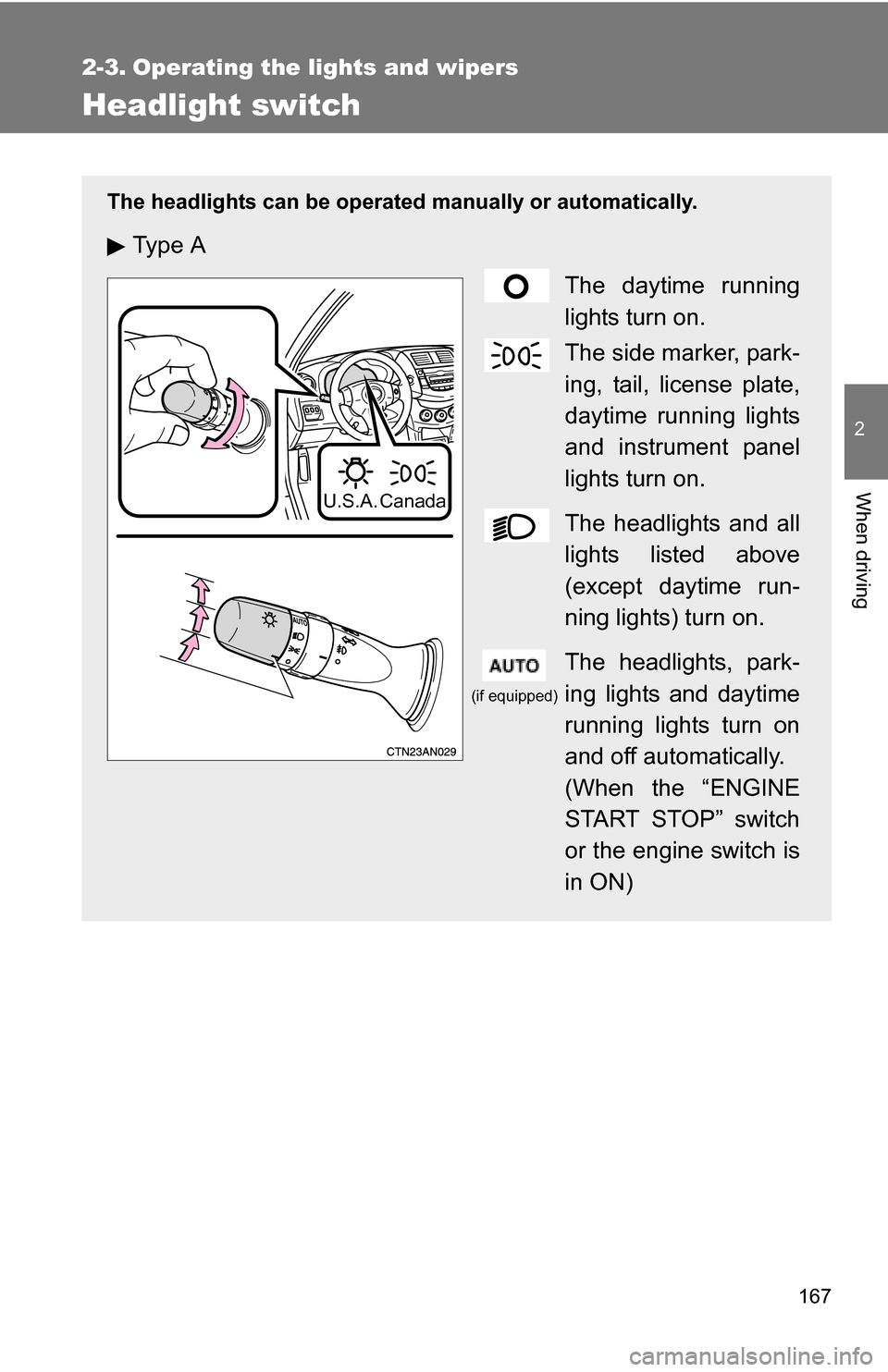
Headlight switch
The headlights can be operated manually or automatically.
Ty p e AThe daytime running
lights turn on.
The side marker, park-
ing, tail, license plate,
daytime running lights
and instrument panel
lights turn on.
The headlights and all
lights listed above
(except daytime run-
ning lights) turn on.
The headlights, park-
ing lights and daytime
running lights turn on
and off automatically.
(When the “ENGINE
START STOP” switch
or the engine switch is
in ON)
U.S.A. Canada
(if equipped)
Page 168 of 544
168 2-3. Operating the lights and wipers
Ty p e BThe daytime running
lights turn on.
The side marker, park-
ing, tail, license plate,
daytime running lights
and instrument panel
lights turn on.
The headlights and all
lights listed above
(except daytime run-
ning lights) turn on.
The headlights, park-
ing lights and daytime
running lights turn on
and off automatically.
(When the “ENGINE
START STOP” switch
or the engine switch is
in ON)
(if equipped)
Page 212 of 544

212 2-5. Driving information
As shown in the above example, if the number of occupants
increases, the cargo and luggage load will be reduced by an amount
that equals the increased weight du e to the additional occupants. In
other words, if an increase in the number of occupants causes an
excess of the total load capacity (combined weight of occupants plus
cargo and luggage load), you must reduce the cargo and luggage on
your vehicle.
CAUTION
■Things that must not be carried in the luggage compartment
The following things may cause a fire if loaded in the luggage compart-
ment.
●Receptacles containing gasoline
●Aerosol cans
■Storage precautions
Observe the following precautions.
Failing to do so may result in death or serious injury.
●Do not place cargo or luggage in or on the following locations as the
item may get under the brake or accelerator pedal and prevent the
pedals from being depressed properly , block the driver’s vision, or hit
the driver or passengers, causing an accident.
• Driver’s feet
• Front passenger or rear seats (when stacking items)
• Luggage cover
• Instrument panel
• Dashboard
• Auxiliary box or tray that has no lid
●Secure all items in the occupant compartment, as they may shift and
injure someone during sudden braking, sudden swerving or an acci-
dent.
●Never allow anyone to ride in the luggage compartment. It is not
designed for passengers. They should ride in their seats with their seat
belts properly fastened. Otherwise, th ey are much more likely to suffer
serious bodily injury, in the event of sudden braking, sudden swerving
or an accident.
Page 350 of 544

350 4-1. Maintenance and care
■Caring for leather areas
Toyota recommends cleaning the interior of the vehicle at least twice a year
to maintain the quality of the vehicle's interior.
■ Shampooing the carpets
There are several commercial foaming-type cleaners available. Use a
sponge or brush to apply the foam. Rub in overlapping circles. Do not apply
water. Excellent results are obtained by keeping the carpet as dry as possi-
ble.
■ Seat belts
Clean with mild soap and lukewarm water using a cloth or sponge. Also
check the belts periodically for excessive wear, fraying or cuts.
CAUTION
■Water in the vehicle
●Do not splash or spill liquid in the vehicle. Doing so may cause electrical
components etc. to malfunction or catch fire.
● Do not get any of the SRS components or wiring in the vehicle interior wet.
( P. 101)
Electrical malfunction may cause the airbags to deploy or not function
properly, resulting in death or severe injury.
■ Cleaning the interior (esp ecially instrument panel)
Do not use polish wax or polish cleaner. The instrument panel may reflect off
the windshield, obstructing the driver 's view and leading to an accident,
resulting in death or serious injury.
Page 351 of 544

351
4-1. Maintenance and care
4
Maintenance and care
NOTICE
■
Cleaning detergents
●Do not use organic substances such as benzene or gasoline, acidic or
alkaline solutions, dye, bleach or other detergent. Doing so may discolor
the vehicle interior or cause streaks or damage to painted surfaces.
● Do not use polish wax or polish cleaner. The instrument panel's or other
interior part’s painted surface may be damaged.
■ Preventing damage to leather surfaces
Observe the following precautions to avoid damage to and deterioration o\
f
leather surfaces.
●Remove any dust or dirt on leather surfaces immediately.
● Do not expose the vehicle to direct sunlight for extended periods of time.
Park the vehicle in the shade, especially during summer.
● Do not place items made of vinyl, plastic, or that contain wax on the uphol-
stery, as they may stick to the leather surface if the vehicle interior heats
up significantly.
■ Water on the floor
Do not wash the vehicle floor with water.
Vehicle systems such as the audio system may be damaged if water comes
into contact with electrical components under the floor of the vehicle, and
may also cause the body to rust.
■ Cleaning the inside of the rear window
●Do not use glass cleaner to clean the rear window, as this may cause
damage to the rear window defogger heater wires. Use a cloth dampened
with lukewarm water to gently wipe the windows clean. Wipe the windows
in strokes running parallel to the heater wires.
● Be careful not to scratch or damage the heater wires.
Page 402 of 544
402 4-3. Do-it-yourself maintenance
Under the instrument panelRemove the lid.
After a system failure, see “Fuse layout and amperage rat-
ings” ( P. 405) for details about which fuse to check.
Remove the fuse with the pull-
out tool.
Check if the fuse has blown.
STEP 4
STEP 5
STEP 6
Page 409 of 544
409
4-3. Do-it-yourself maintenance
4
Maintenance and care
*1: Vehicles without towing package
*
2: Vehicles with towing package
*
3: Vehicles with 2.5 L 4-cylinder (2AR-FE) engine
*
4: Vehicles with 3.5 L V6 (2GR-FE) engine
■ Under the instrument panel
20 A/F 20 A A/F sensor, fuel pump*3
FuseAmpereCircuit
1 TAIL 10 A Parking lights, tail lights, license
plate light, front fog lights, rear side
marker lights
2 PANEL 7.5 A Clock, instrument panel lights,
audio system
3 GAUGE 1 10 A Back-up lights, charging system
4 D FR DOOR 20 A Power windows (front doors)
5 RL DOOR 20 A Power windows
6 RR DOOR 20 A Power windows
7 S/ROOF 25 A Electric moon roof
8 CIG 15 A Power outlet
FuseAmpereCircuit