Page 593 of 684
5
When trouble arises
593
5-2. Steps to take in an emergency
PRIUS PHV_OM_OM47818U_(U)
■
Stopping the hybrid system
Set the parking brake, shift the shift position to P and press the “POWER”
switch as you normally do when stopping the hybrid system.
■ Replacing the key battery
As the above procedure is a temporary measure, it is recommended that the
electronic key battery be replaced immediately when the battery is depleted.
(P. 493)
■ Changing “POWER” switch modes
Within 10 seconds of the buzzer sounding, release the brake pedal and
press the “POWER” switch.
The hybrid system does not start and modes will be changed each time the
switch is pressed. ( P. 240)
Page 597 of 684
5
When trouble arises
597
5-2. Steps to take in an emergency
PRIUS PHV_OM_OM47818U_(U)
■
Starting the hybrid system when the 12-volt battery is discharged
The hybrid system cannot be started by push-starting.
■ To prevent 12-volt battery discharge
● Turn off the headlights and the audio system while the hybrid system is
off.
● Turn off any unnecessary electrical components when the vehicle is run-
ning at a low speed for an extended period, such as in heavy traffic.
■ When the 12-volt battery is removed or discharged
● The hybrid system may not start. ( P. 473)
● If the 12-volt battery is depleted with the shift position in P, it will not be
possible to shift the shift position other than P. In this case, the vehicle
cannot be towed without lifting both front wheels because the front
wheels are locked by the parking lock. ( P. 525)
● When the 12-volt battery is reconnected, start the hybrid system, depress
the brake pedal, and confirm that it is possible to shift into each shift posi-
tion.
■ Charging the 12-volt battery
The electricity stored in the 12-volt battery will discharge gradually even
when the vehicle is not in use, due to natural discharge and the draining
effects of certain electrical appliances. If the vehicle is left for a long time, the
12-volt battery may discharge, and the hybrid system may be unable to start.
(The 12-volt battery charges automatically while the hybrid system is operat-
ing.)
Page 605 of 684
5
When trouble arises
605
5-2. Steps to take in an emergency
PRIUS PHV_OM_OM47818U_(U)
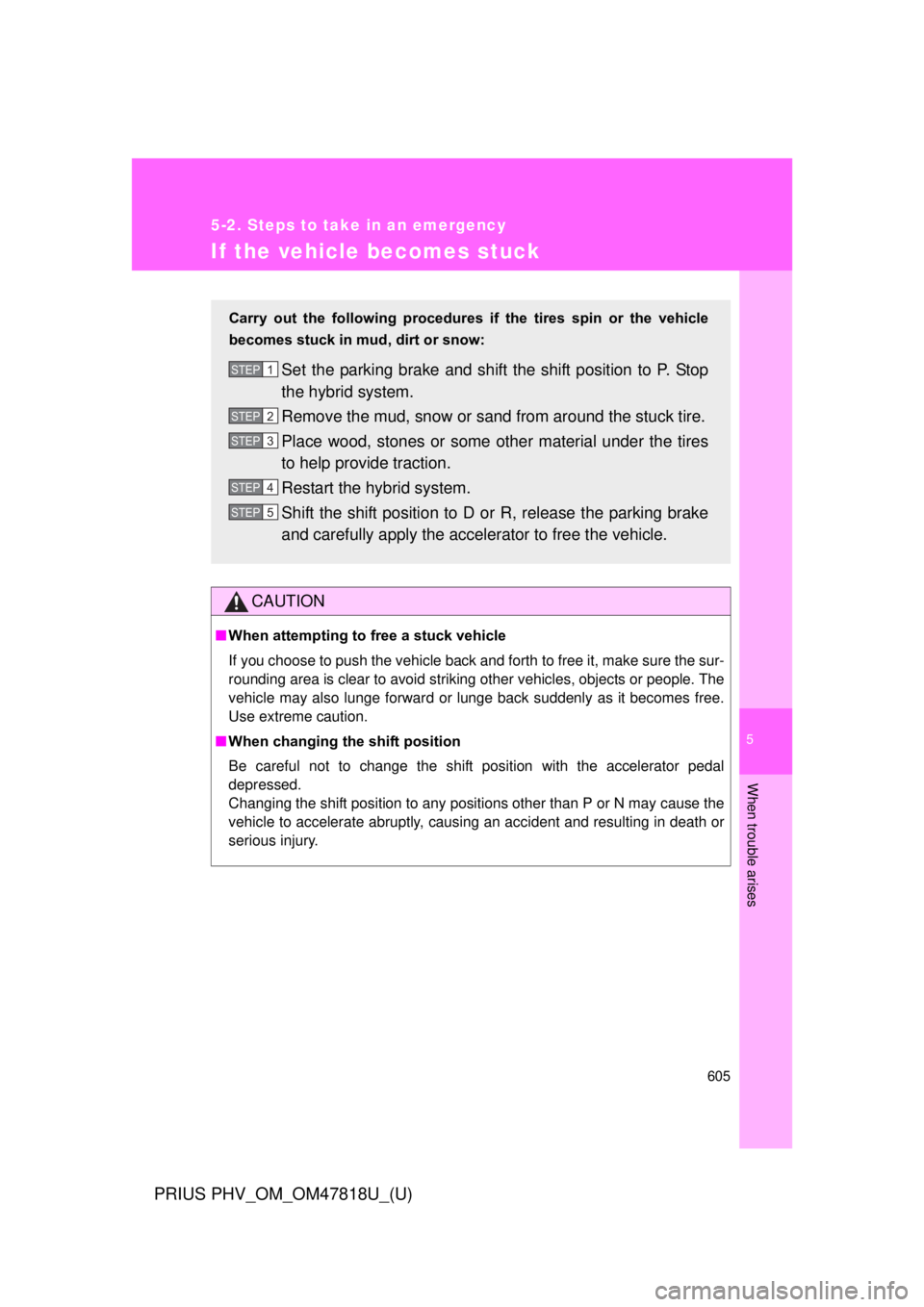
If the vehicle becomes stuck
CAUTION
■When attempting to free a stuck vehicle
If you choose to push the vehicle back and forth to free it, make sure the sur-
rounding area is clear to avoid striki ng other vehicles, objects or people. The
vehicle may also lunge forward or lu nge back suddenly as it becomes free.
Use extreme caution.
■ When changing the shift position
Be careful not to change the shift position with the accelerator pedal
depressed.
Changing the shift position to any positions other than P or N may cause the
vehicle to accelerate abruptly, causing an accident and resulting in death or
serious injury.
Carry out the following procedures if the tires spin or the vehicle
becomes stuck in mud, dirt or snow:
Set the parking brake and shift the shift position to P. Stop
the hybrid system.
Remove the mud, snow or sand from around the stuck tire.
Place wood, stones or some other material under the tires
to help provide traction.
Restart the hybrid system.
Shift the shift position to D or R, release the parking brake
and carefully apply the accelerator to free the vehicle.STEP 1
STEP 2
STEP 3
STEP 4
STEP 5
Page 607 of 684
5
When trouble arises
607
5-2. Steps to take in an emergency
PRIUS PHV_OM_OM47818U_(U)
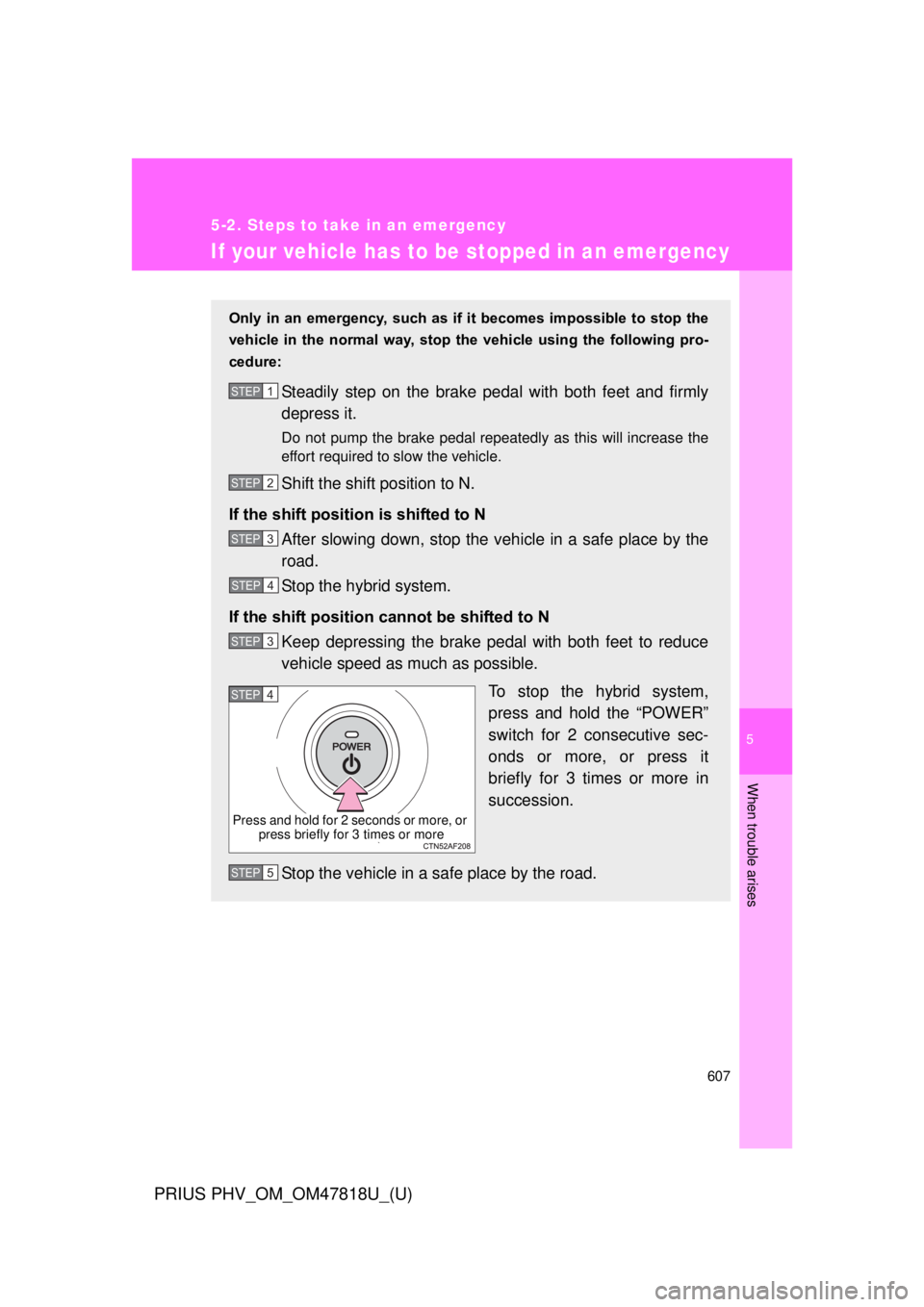
If your vehicle has to be stopped in an emergency
Only in an emergency, such as if it becomes impossible to stop the
vehicle in the normal way, stop the vehicle using the following pro-
cedure:
Steadily step on the brake pedal with both feet and firmly
depress it.
Do not pump the brake pedal repeatedly as this will increase the
effort required to slow the vehicle.
Shift the shift position to N.
If the shift position is shifted to N After slowing down, stop the vehi cle in a safe place by the
road.
Stop the hybrid system.
If the shift position cannot be shifted to N Keep depressing the brake pedal with both feet to reduce
vehicle speed as much as possible.
To stop the hybrid system,
press and hold the “POWER”
switch for 2 consecutive sec-
onds or more, or press it
briefly for 3 times or more in
succession.
Stop the vehicle in a safe place by the road.
STEP 1
STEP 2
STEP 3
STEP 4
STEP 3
STEP 4
Press and hold for 2 seconds or more, or press briefly for 3 times or more
STEP 5
Page 608 of 684
608 5-2. Steps to take in an emergency
PRIUS PHV_OM_OM47818U_(U)
CAUTION
■If the hybrid system has to be turned off while driving
Power assist for the brakes and steering wheel will be lost, making the brake
pedal harder to depress and the steering wheel heavier to turn. Decelerate
as much as possible before turning off the hybrid system.
Page 619 of 684
619
6-1. Specifications
6
Vehicle specifications
PRIUS PHV_OM_OM47818U_(U)
Brakes
*1: Minimum pedal clearance when depressed with a force of 44.1 lbf (196 N,
20.0 kgf) while the hybrid system is operating.
*2: Parking brake pedal travel when depressed with a force of 67.5 lbf (300 N,30.6 kgf).
Steering
Tires and wheels
Pedal clearance*13.03 in. (77 mm) Min.
Pedal free play 0.04 0.24 in. (1.0 6.0 mm)
Brake pad wear limit 0.04 in. (1.0 mm)
Parking brake lining wear limit 0.04 in. (1.0 mm)
Parking brake pedal travel*28 11 clicks
Fluid type SAE J1703 or FMVSS No. 116 DOT 3
Free playLess than 1.2 in. (30 mm)
Tire sizeP195/65R15 89S
Tire inflation pressure
(Recommended cold tire
inflation pressure)Front tire
35 psi (240 kPa, 2.4 kgf/cm2 or bar)
Rear tire 33 psi (230 kPa, 2.3 kgf/cm
2 or bar)
Wheel size 15 6J
Wheel nut torque 76 ft•lbf (103 N•m, 10.5 kgf•m)
Page 631 of 684
631
6-1. Specifications
6
Vehicle specifications
PRIUS PHV_OM_OM47818U_(U)
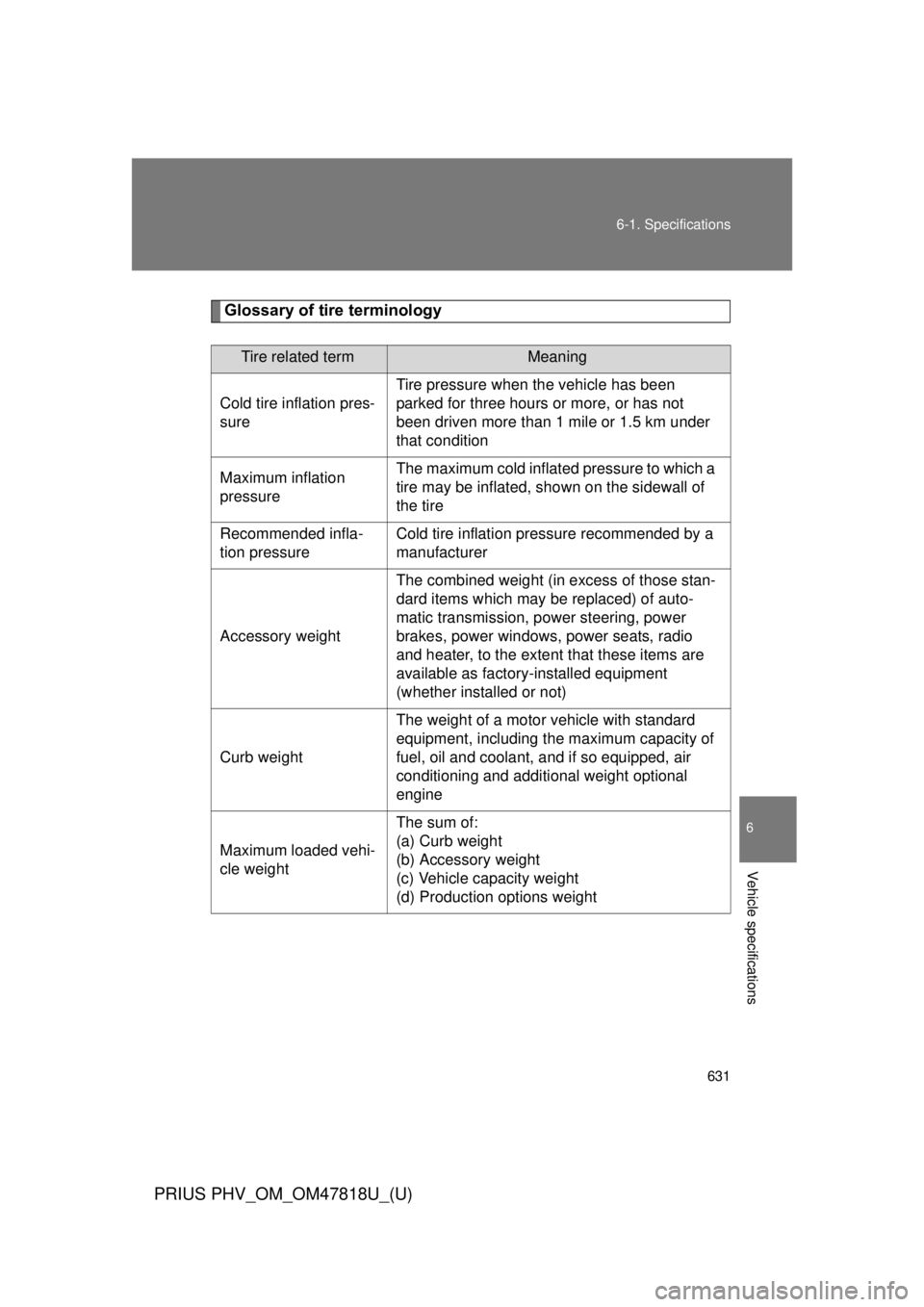
Glossary of tire terminology
Tire related termMeaning
Cold tire inflation pres-
sure Tire pressure when the vehicle has been
parked for three hours or more, or has not
been driven more than 1 mile or 1.5 km under
that condition
Maximum inflation
pressure The maximum cold inflated
pressure to which a
tire may be inflated, s hown on the sidewall of
the tire
Recommended infla-
tion pressure Cold tire inflation pressure recommended by a
manufacturer
Accessory weight The combined weight (in excess of those stan-
dard items which may be replaced) of auto-
matic transmission, power steering, power
brakes, power windows, power seats, radio
and heater, to the extent that these items are
available as factory-installed equipment
(whether installed or not)
Curb weight The weight of a motor vehicle with standard
equipment, including the maximum capacity of
fuel, oil and coolant, and if so equipped, air
conditioning and additional weight optional
engine
Maximum loaded vehi-
cle weight The sum of:
(a) Curb weight
(b) Accessory weight
(c) Vehicle capacity weight
(d) Production options weight
Page 632 of 684
632 6-1. Specifications
PRIUS PHV_OM_OM47818U_(U)
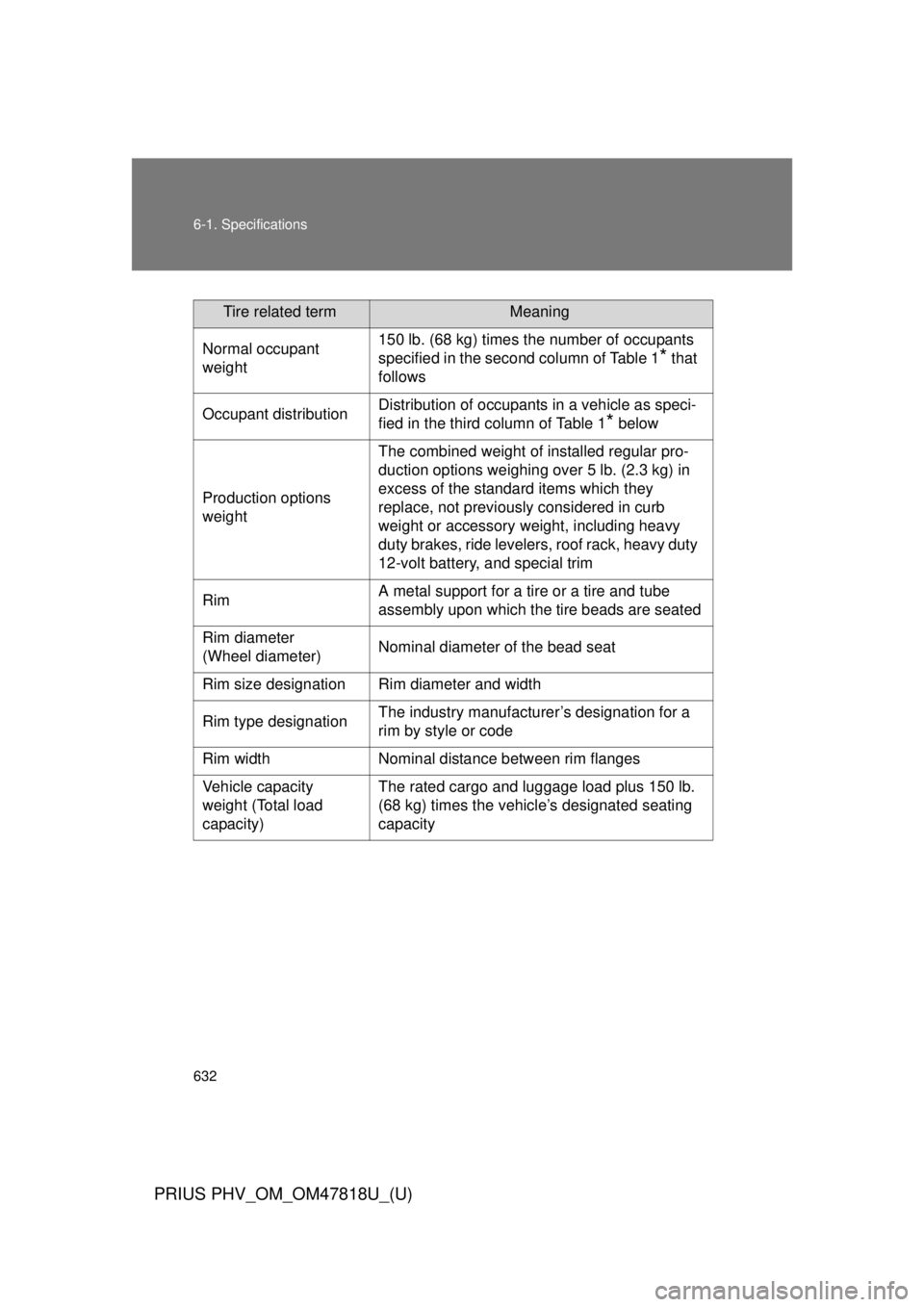
Tire related termMeaning
Normal occupant
weight 150 lb. (68 kg) times the number of occupants
specified in the second column of Table 1
* that
follows
Occupant distribution Distribution of occupants in a vehicle as speci-
fied in the third column of Table 1
* below
Production options
weight The combined weight of installed regular pro-
duction options weighing over 5 lb. (2.3 kg) in
excess of the standard items which they
replace, not previously considered in curb
weight or accessory weight, including heavy
duty brakes, ride levelers, roof rack, heavy duty
12-volt battery, and special trim
Rim A metal support for a tire or a tire and tube
assembly upon which the tire beads are seated
Rim diameter
(Wheel diameter) Nominal diameter of the bead seat
Rim size designation Rim diameter and width
Rim type designation The industry manufacturer’s designation for a
rim by style or code
Rim width Nominal distance between rim flanges
Vehicle capacity
weight (Total load
capacity) The rated cargo and luggage load plus 150 lb.
(68 kg) times the vehicle’s designated seating
capacity