Page 404 of 636
404 4-2. Maintenance
CAUTION
■If your vehicle is not properly maintained
Improper maintenance could result in serious damage to the vehicle and
possible serious injury or death.
■ Handling of the 12-volt battery
●Engine exhaust, some of its constituents, and a wide variety of automobile
components contain or emit chemicals known to the State of California to
cause cancer and birth defects and other reproductive harm. Work in a
well ventilated area.
● Oils, fuels and fluids contained in vehicles as well as waste produced by
component wear contain or emit chemicals known to the State of Califor-
nia to cause cancer and birth defects or other reproductive harm. Avoid
exposure and wash any affected area immediately.
● 12-volt battery posts, terminals and related accessories contain lead and
lead compounds which are known to cause brain damage. Wash your
hands after handling. ( P. 431)
Page 410 of 636
410
4-3. Do-it-yourself maintenance
Do-it-yourself ser vice precautions
If you perform maintenance by yourself, be sure to follow the correct
procedure as given in these sections.
ItemsParts and tools
12-volt battery condition (P. 431)• Grease
• Conventional wrench
(for terminal clamp bolts)
Brake fluid level ( P. 427)
• FMVSS No.116 DOT 3 or SAE
J1703 brake fluid
• Rag or paper towel
• Funnel (used only for adding brake fluid)
Engine/power control unit coolant
level ( P. 424)
• “Toyota Super Long Life Coolant”
or a similar high quality ethylene
glycol-based non-silicate, non-
amine, non-nitrite and non-borate
coolant with long-life hybrid
organic acid technology
For the U.S.A.:
“Toyota Super Long Life Cool-
ant” is pre-mixed with 50% cool-
ant and 50% deionized water.
For Canada:
“Toyota Super Long Life Cool-
ant” is pre-mixed with 55% cool-
ant and 45% deionized water.
• Funnel (used only for adding cool- ant)
Page 432 of 636
432 4-3. Do-it-yourself maintenance
■Before recharging
When recharging, the 12-volt battery produces hydrogen gas which is flam-
mable and explosive. Therefore, observe the following precautions before
recharging:
●If recharging with the 12-volt battery installed on the vehicle, be sure to
disconnect the ground cable.
● Make sure the power switch on the charger is off when connecting and
disconnecting the charger cables to the 12-volt battery.
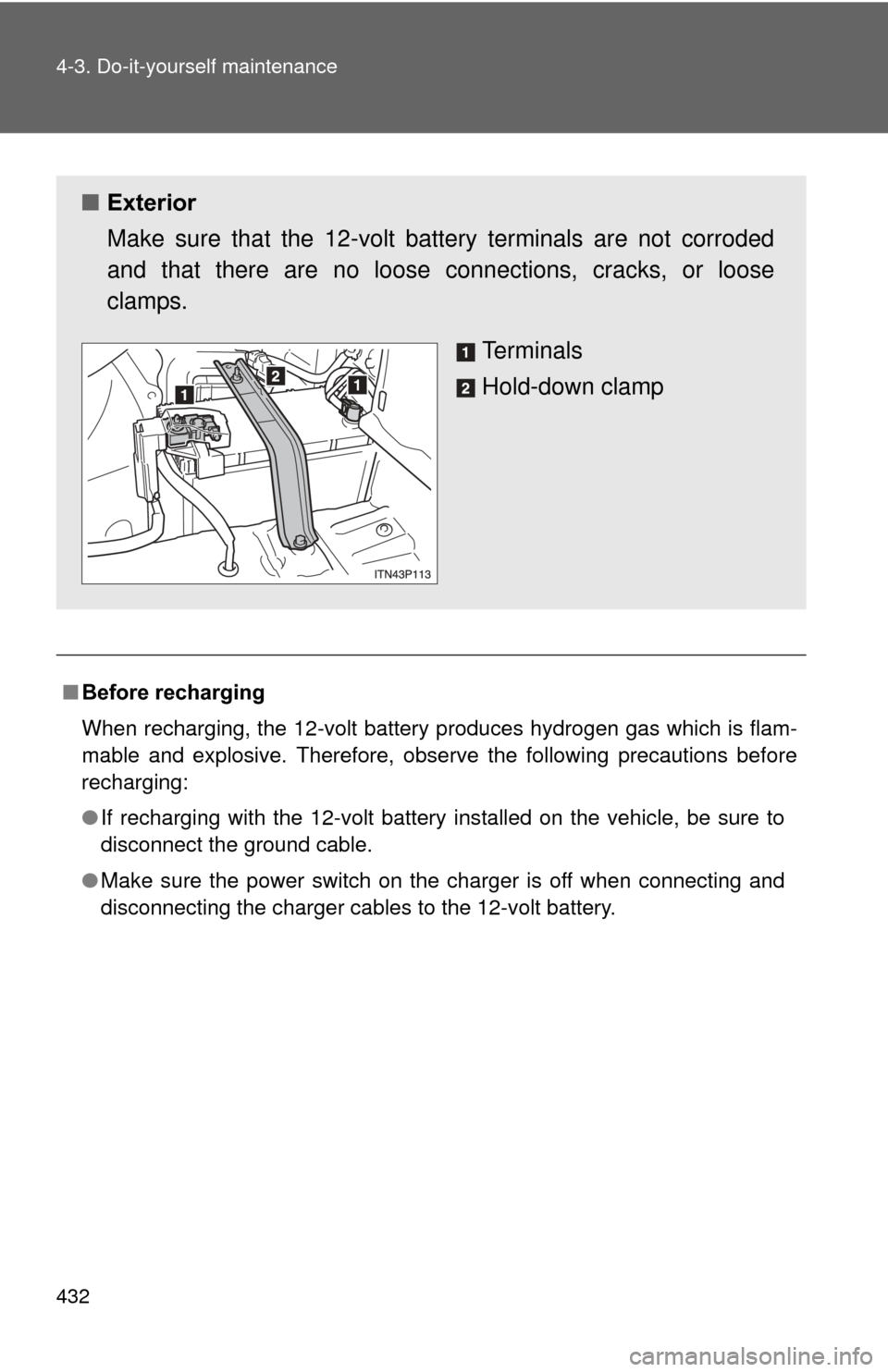
■ Exterior
Make sure that the 12-volt battery terminals are not corroded
and that there are no loose c onnections, cracks, or loose
clamps.
Terminals
Hold-down clamp
Page 434 of 636
434 4-3. Do-it-yourself maintenance
CAUTION
■Chemicals in the 12-volt battery
The 12-volt battery contains poisonous and corrosive sulfuric acid and may
produce hydrogen gas which is flammable and explosive. To reduce the risk
of death or serious injury, take the following precautions while working on or
near the 12-volt battery:
●Do not cause sparks by touching the 12-volt battery terminals with tools.
● Do not smoke or light a match near the 12-volt battery.
● Avoid contact with eyes, skin and clothes.
● Never inhale or swallow electrolyte.
● Wear protective safety glasses when working near the 12-volt battery.
● Keep children away from the 12-volt battery.
■ Where to safely charge the 12-volt battery
Always charge the 12-volt battery in an open area. Do not charge the 12-volt
battery in a garage or closed room where there is insufficient ventilation.
■ How to recharge the 12-volt battery
Only perform a slow charge (5 A or less). The 12-volt battery may explode if
charged at a quicker rate.
Page 436 of 636
436 4-3. Do-it-yourself maintenance
CAUTION
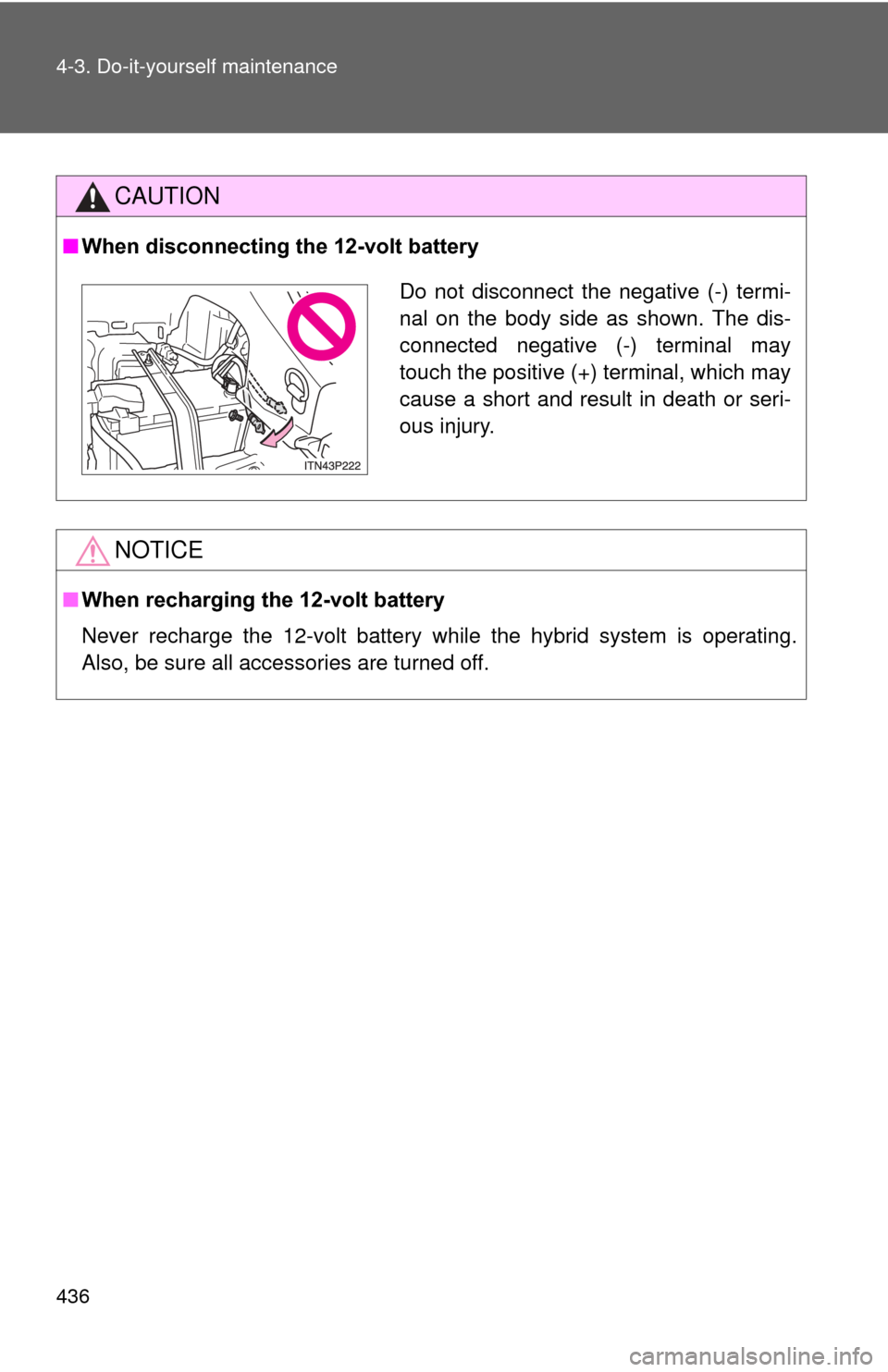
■When disconnecting the 12-volt battery
NOTICE
■When recharging the 12-volt battery
Never recharge the 12-volt battery while the hybrid system is operating.
Also, be sure all accessories are turned off.
Do not disconnect the negative (-) termi-
nal on the body side as shown. The dis-
connected negative (-) terminal may
touch the positive (+) terminal, which may
cause a short and result in death or seri-
ous injury.
Page 454 of 636
454
4-3. Do-it-yourself maintenance
Electronic key batter y
Replace the battery with a new one if it is depleted.
■You will need the following items:
●Flathead screwdriver
● Lithium battery CR1632
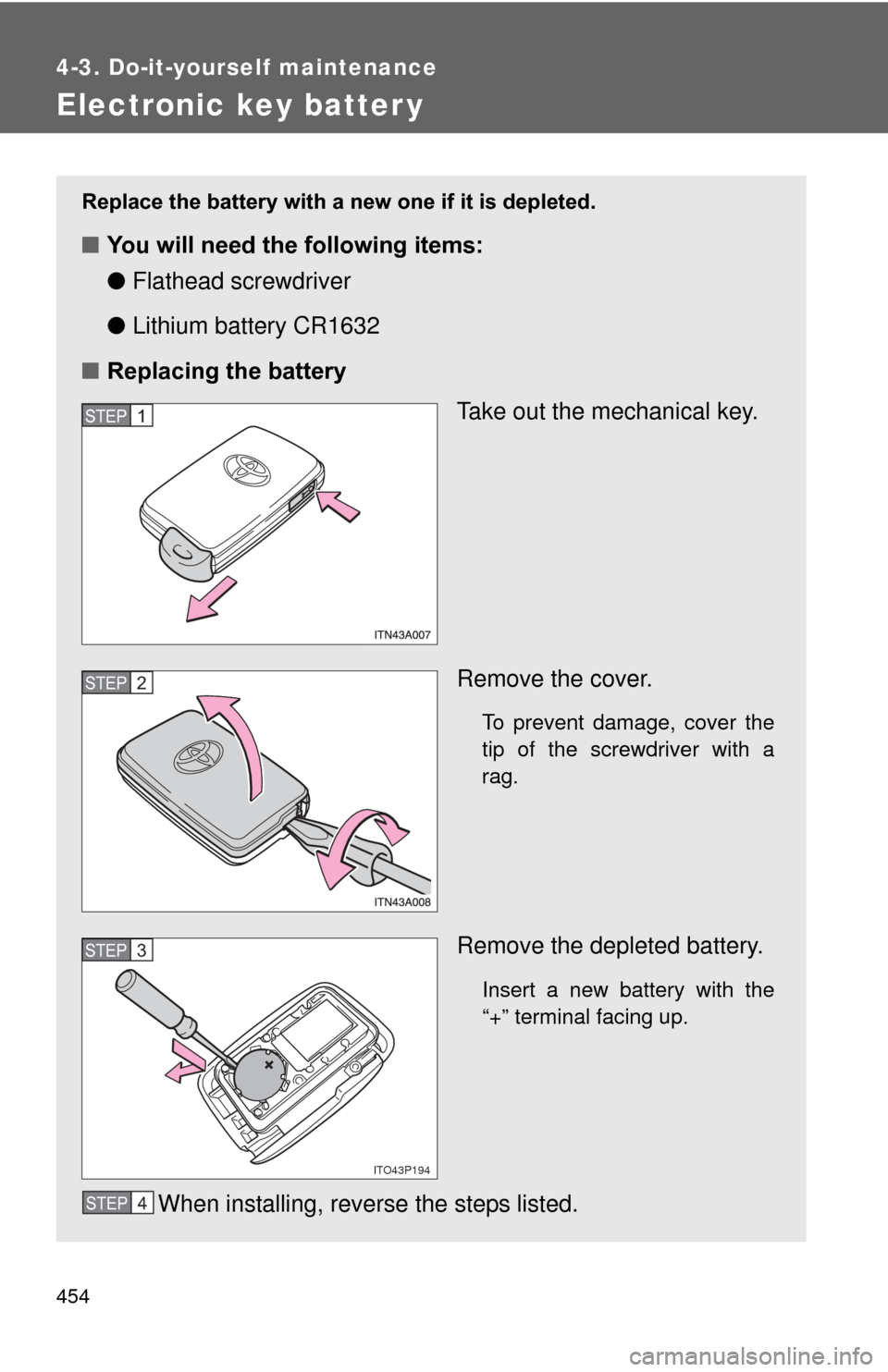
■ Replacing the battery
Take out the mechanical key.
Remove the cover.
To prevent damage, cover the
tip of the screwdriver with a
rag.
Remove the depleted battery.
Insert a new battery with the
“+” terminal facing up.
When installing, reverse the steps listed.
STEP 1
STEP 2
ITO43P194
STEP 3
STEP 4
Page 455 of 636
455
4-3. Do-it-yourself maintenance
4
Maintenance and care
■
Use a CR1632 lithium battery
●Batteries can be purchased at your Toyota dealer, local electrical appli-
ance shops or camera stores.
● Replace only with the same or equivalent type recommended by the
manufacturer.
● Dispose of used batteries according to local laws.
■ If the electronic key battery is depleted
The following symptoms may occur:
●The smart key system and wireless remote control will not function prop-
erly.
● The operational range will be reduced.
CAUTION
■Removed battery and other parts
Keep away from children. These parts are small and if swallowed by a child,
they can cause choking. Failure to do so could result in death or serious
injury.
NOTICE
■For normal operation after replacing the battery
Observe the following precautions to prevent accidents:
●Always work with dry hands.
Moisture may cause the battery to rust.
● Do not touch or move any other component inside the remote control.
● Do not bend either of the battery terminals.
Page 538 of 636
538
5-2. Steps to take in an emergency
If the hybrid system will not start
Reasons for the hybrid system not starting vary depending on the
situation. Check the following a nd perform the appropriate proce-
dure:
■ The hybrid system will not start even though the correct
starting procedure is being followed ( P. 192)
One of the following may be the cause of the problem:
● The electronic key may not be functioning properly.
*
( P. 541)
● There may not be sufficient fuel in the vehicle’s tank.
Refuel the vehicle.
● There may be a malfunction in the immobilizer system.
*
( P. 135)
● There may be a malfunction in the P position control system.
*
( P. 197, 509)
*: It may not be possible to shift the shift position from P to another
position.
■ The interior lights and headlights are dim, or the horn does
not sound or sounds at a low volume
One of the following may be the cause of the problem:
●The 12-volt battery may be discharged. ( P. 543)
● The 12-volt battery terminal c onnections may be loose or cor-
roded.