Page 180 of 516

180 2-5. Driving information
CAUTION
■Hitch
Trailer hitch assemblies have different weight capacities established by the
hitch manufacturer. Even though the vehicle may be physically capable of
towing a higher weight, the operator must determine the maximum weight
rating of the particular hitch assembly and never exceed the maximum
weight rating specified for the trailer-hitch. Exceeding the maximum weight
rating set by the trailer-hitch manufacturer can cause an accident resulting in
death or serious personal injuries.
■ When towing a trailer
Toyota recommends trailers with brakes that conform to any applicable fed-
eral and state/provincial regulations.
●If the gross trailer weight exceeds unbraked TWR, trailer brakes are
required. Toyota recommends trailers with brakes that conform to all appli-
cable federal and state/provincial regulations.
● Never tap into your vehicle’s hydraulic system, as this will lower the vehi-
cle’s braking effectiveness.
● Never tow a trailer without using a safety chain securely attached to both
the trailer and the vehicle. If damage occurs to the coupling unit or hitch
ball, there is danger of the trailer wandering into another lane.
NOTICE
■When installing a trailer hitch
Use only the position recommended by your Toyota dealer. Do not install the
trailer hitch on the bumper; this may cause body damage.
■ Do not directly splice trailer lights
Do not directly splice trailer lights. Directly splicing trailer lights may damage
your vehicle’s electrical system and cause a malfunction.
Page 181 of 516
181
2-5. Driving information
2
When driving
Dinghy towing (automatic transmission)
NOTICE
■To avoid serious damage to your vehicle
■ To prevent causing serious damage to the transmission and Active
Torque Control 4WD system (AWD models)
Your vehicle is not designed to be dinghy towed (with 4 wheels on
the ground) behind a motor home.
Do not tow your vehicle with 4 wheels on
the ground.
2WD models: Never tow this vehicle from
the rear with the front wheels on the
ground. This may cause serious damage
to the transmission.
AWD models: Never tow this vehicle with
any of the wheels on the ground. This
may cause serious damage to the trans-
mission and Active Torque Control 4WD
system.
Page 182 of 516
182
2-5. Driving information
Dinghy towing (manual transmission)
Towing your vehicle with 4 wheels on the groundTo prevent damage to your vehicle, perform the following procedures
before towing. Shift the shift lever to N.
Switch to the “ACC” position. ( P. 118)
Ensure that the audio system and other powered devices have been
turned off.
Release the parking brake.
After towing, leave the engine in idle for at least 3 minutes before
driving the vehicle.
■Necessary equipment and accessories
Specialized equipment and accessories are required for dinghy towing. Con-
tact the service branch of the motor home manufacturer regarding recom-
mended equipment.
Your vehicle can be dinghy towed in a forward direction (with 4
wheels on the ground) behind a motor home.
STEP1
STEP2
STEP3
Page 183 of 516
183
2-5. Driving information
2
When driving
NOTICE
■
Dinghy towing direction
■ To prevent the steering from locking
Ensure the engine switch is in the “ACC” position.
Do not tow the vehicle backwards.
Doing so may cause serious damage.
Page 405 of 516
5
When trouble arises
405
5-1. Essential information
If your vehicle needs to be towed
Before towingThe following may indicate a problem with your transmission. Contact
your Toyota dealer before towing.
● The engine is running, but the vehicle will not move.
● The vehicle makes an abnormal sound.
If towing is necessary, we recommend having your vehicle towed by
your Toyota dealer or a commerci al towing service, using a lift-type
truck or a flat bed truck.
Use a safety chain system for all to wing, and abide by all state/pro-
vincial and local laws.
2WD models: If towing your vehicle with a wheel-lift type truck from
the front, the vehicle's rear wheels and axles must be in good condi-
tions. ( P. 407, 410)
If they are damaged, use a towing dolly or flat bed truck.
AWD models: If towing your vehicle with a wheel-lift type truck, use a
towing dolly. ( P. 407, 410)
Page 406 of 516
406 5-1. Essential information
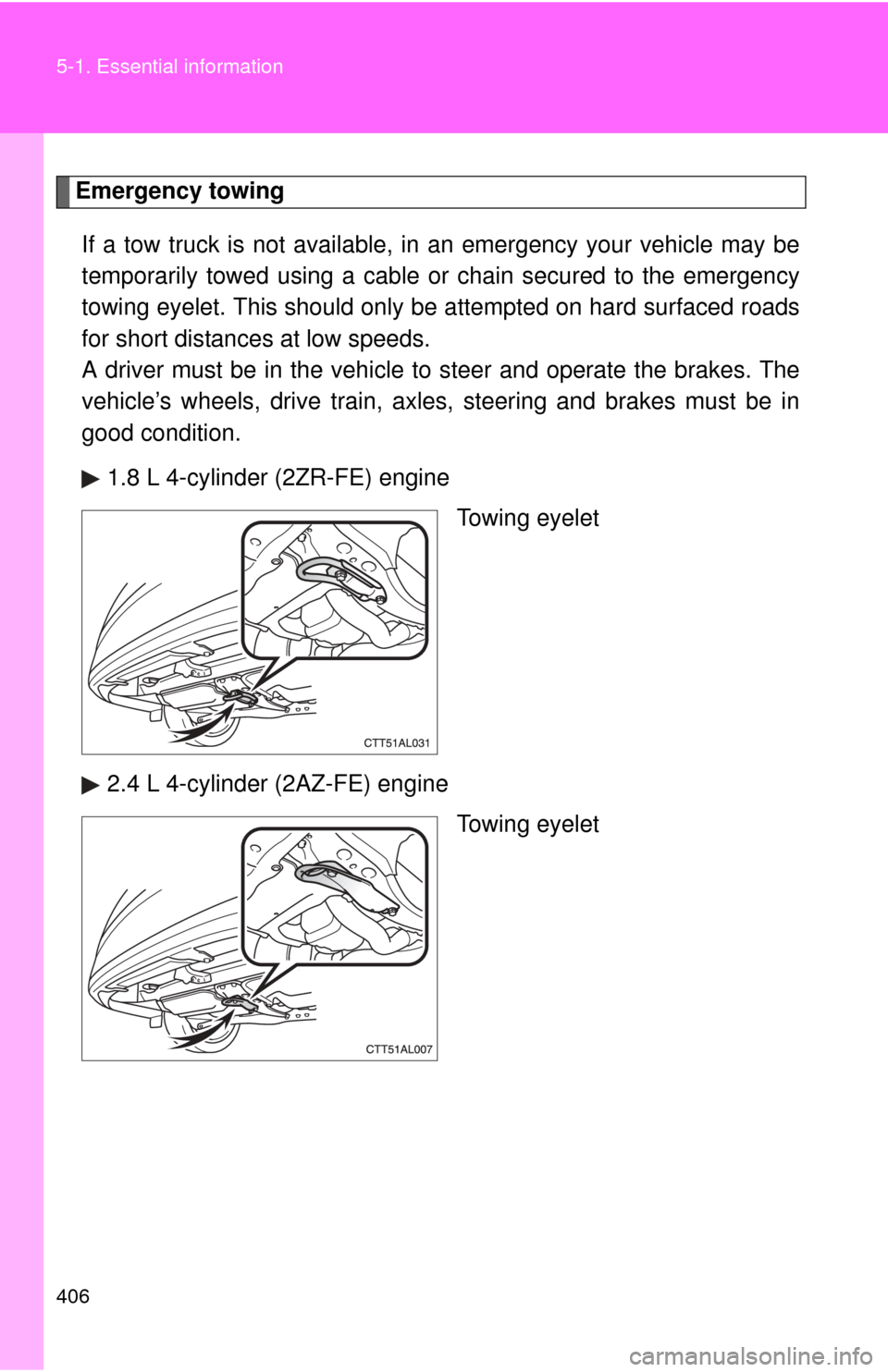
Emergency towingIf a tow truck is not available, in an emergency your vehicle may be
temporarily towed using a cable or chain secured to the emergency
towing eyelet. This should only be attempted on hard surfaced roads
for short distances at low speeds.
A driver must be in the vehicle to steer and operate the brakes. The
vehicle’s wheels, drive train, axles, steering and brakes must be in
good condition.
1.8 L 4-cylinder (2ZR-FE) engine Towing eyelet
2.4 L 4-cylinder (2AZ-FE) engine Towing eyelet
Page 407 of 516
5
When trouble arises
407
5-1. Essential information
Towing with a sling-type truck
Do not tow with a sling-type truck
to prevent body damage.
Towing with a wheel-lift type truckFrom the front (2WD models) Release the parking brake.
From the front (AWD models) Use a towing dolly under the rear
wheels.
Page 408 of 516
408 5-1. Essential information
From the rearAutomatic transmission: Use a
towing dolly under the front
wheels.
Manual transmission: We recom-
mend to use a towing dolly under
the front wheels.
When not using a towing dolly,
turn the engine switch to the
“ACC” position and shift the shift
lever to N.
Using a flat bed truck
If you use chains or cables to tie
down your vehicle, the angles
shaded in black must be 45.
Do not overly tighten the tie
downs or the vehicle may be
damaged.
■ Emergency towin g procedure
Release the parking brake.
Shift the shift lever to N.
Turn the engine switch to the “ACC” (engine off) or “ON” (engine
running) position.
STEP1
STEP2
STEP3