Page 130 of 692
130 1-6. Theft deterrent system
L/C200_EE (OM60G38E)
Items to check before locking the vehicle
To prevent unexpected triggering of the alarm and vehicle theft, make sure
of the following.
Nobody is in the vehicle.
The windows and moon roof are closed before the alarm is set.
No valuables or other personal items are left in the vehicle.
Triggering of the alarm
The alarm may be triggered in the following situations:
(Stopping the alarm deactivates the alarm system.)
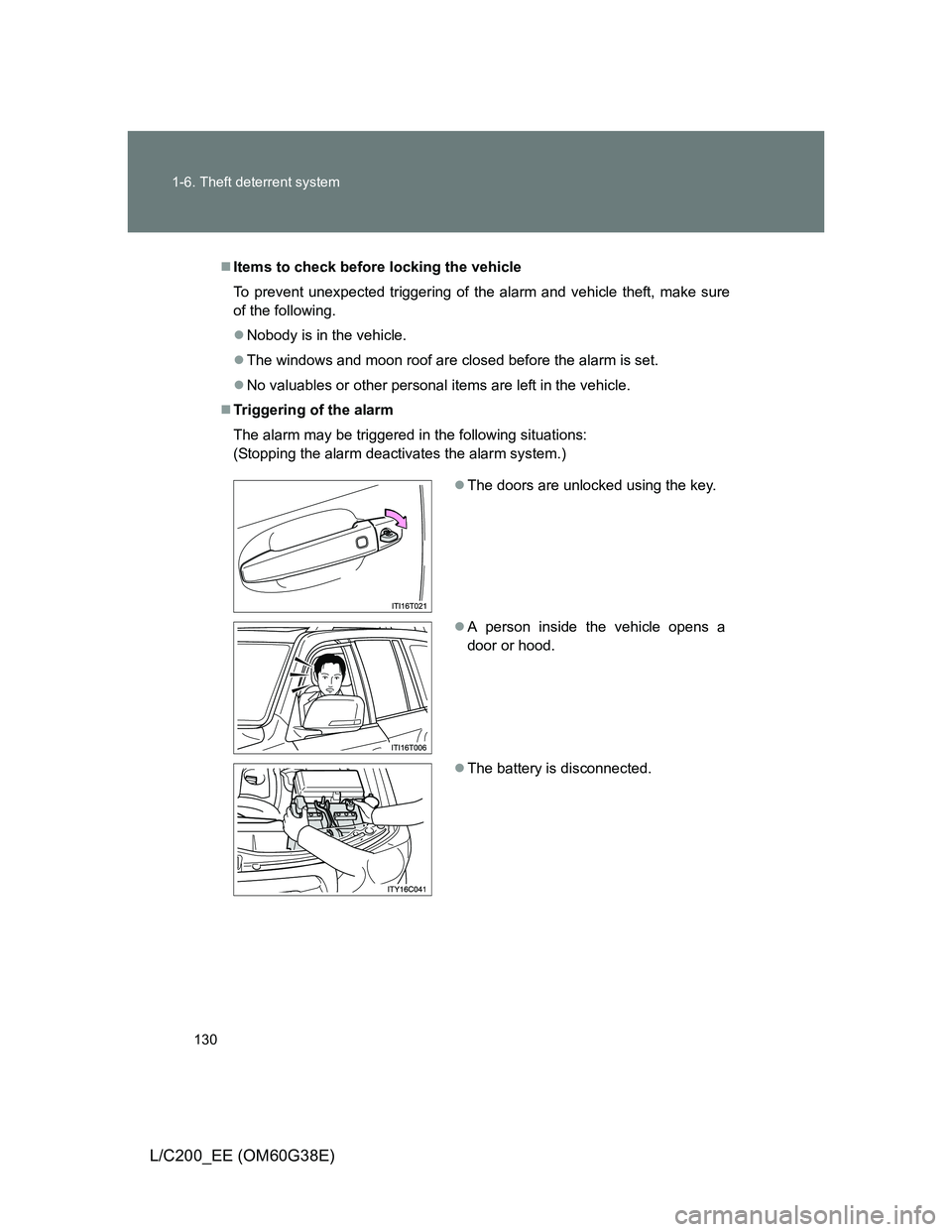
The doors are unlocked using the key.
A person inside the vehicle opens a
door or hood.
The battery is disconnected.
Page 131 of 692
131 1-6. Theft deterrent system
1
Before driving
L/C200_EE (OM60G38E)
Alarm-operated door lock
When the alarm is operating, the doors are locked automatically to pre-
vent intruders.
Do not leave the key inside the vehicle when the alarm is operating, and
make sure the key is not inside the vehicle when recharging or replacing
the battery.
Canceling and automatic re-enabling of the intrusion sensor and tilt
sensor
The alarm will still be set even when the intrusion sensor and tilt sensor
are canceled.
After the intrusion sensor and tilt sensor are canceled, pressing the
“ENGINE START STOP” switch or unlocking the doors using the entry
function or wireless remote control will re-enable the intrusion sensor and
tilt sensor.
When the alarm system is set again, the intrusion sensor and tilt sensor
will be set.
Page 154 of 692
154 1-7. Safety information
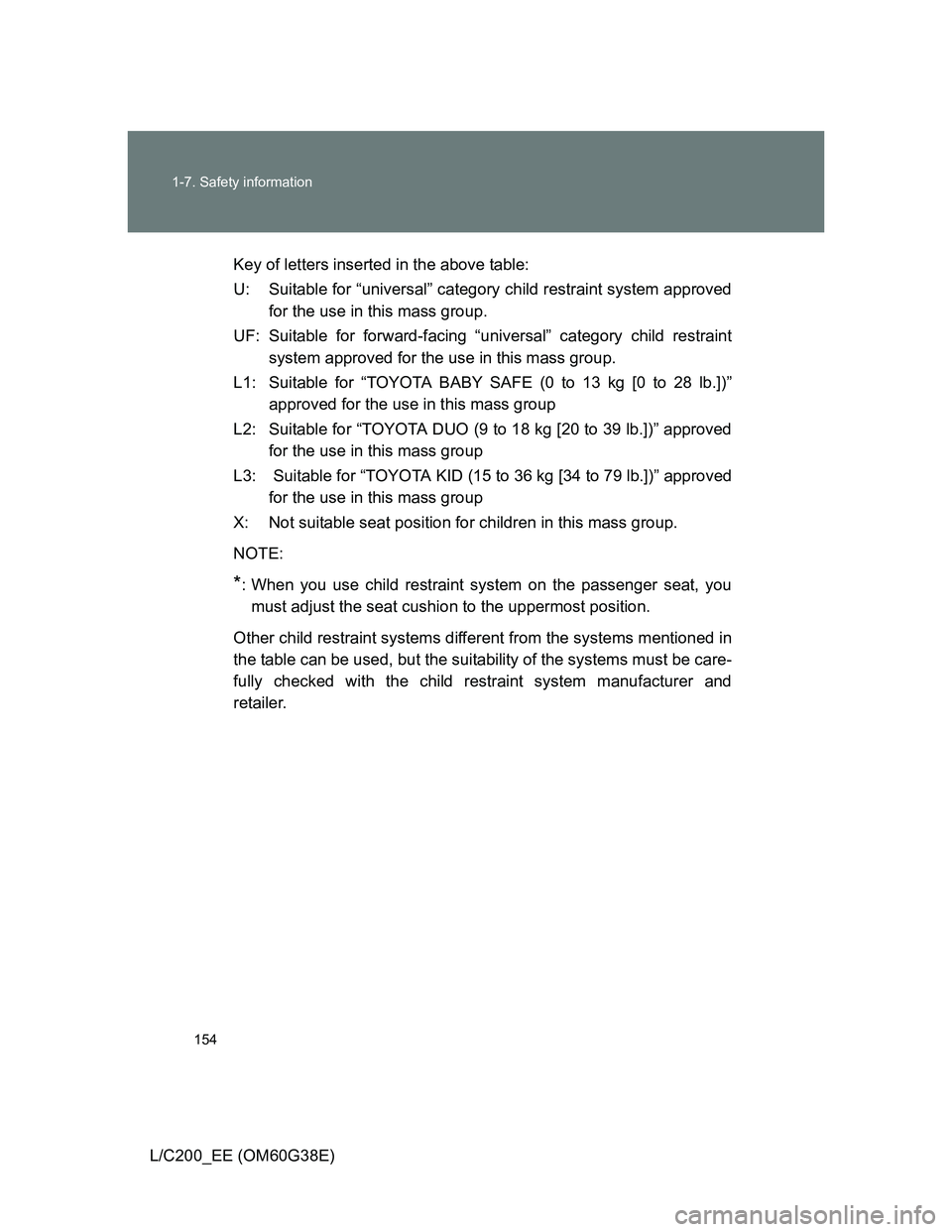
L/C200_EE (OM60G38E)Key of letters inserted in the above table:
U: Suitable for “universal” category child restraint system approved
for the use in this mass group.
UF: Suitable for forward-facing “universal” category child restraint
system approved for the use in this mass group.
L1: Suitable for “TOYOTA BABY SAFE (0 to 13 kg [0 to 28 lb.])”
approved for the use in this mass group
L2: Suitable for “TOYOTA DUO (9 to 18 kg [20 to 39 lb.])” approved
for the use in this mass group
L3: Suitable for “TOYOTA KID (15 to 36 kg [34 to 79 lb.])” approved
for the use in this mass group
X: Not suitable seat position for children in this mass group.
NOTE:
*: When you use child restraint system on the passenger seat, you
must adjust the seat cushion to the uppermost position.
Other child restraint systems different from the systems mentioned in
the table can be used, but the suitability of the systems must be care-
fully checked with the child restraint system manufacturer and
retailer.
Page 156 of 692
156 1-7. Safety information
L/C200_EE (OM60G38E)(1) For the child restraint system which do not carry the ISO/XX size
class identification (A to G), for the applicable mass group, the
car manufacturer shall indicate the vehicle specific ISOFIX child
restraint system(s) recommended for each position
Key of letters inserted in the above table:
IUF: Suitable for ISOFIX forward-facing child restraint systems of uni-
versal category approved for use in this mass group
X: ISOFIX position not suitable for ISOFIX child restraint systems in
this mass group and/or this size class.
Other child restraint systems different from the systems mentioned in
the table can be used, but the suitability of the systems must be care-
fully checked with the child restraint system manufacturer and
retailer.
Page 174 of 692
174
1-7. Safety information
L/C200_EE (OM60G38E)
Airbag manual on-off system
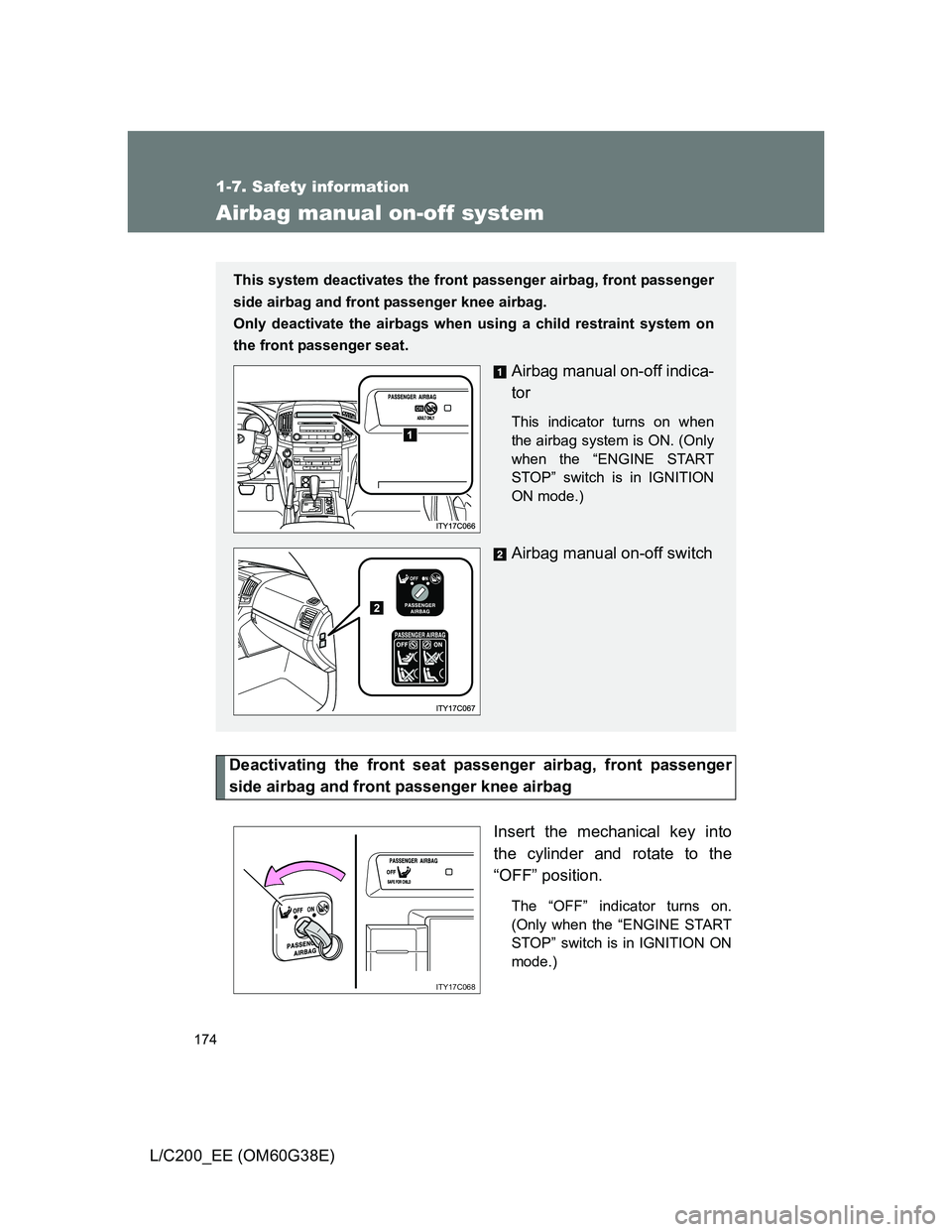
Deactivating the front seat passenger airbag, front passenger
side airbag and front passenger knee airbag
Insert the mechanical key into
the cylinder and rotate to the
“OFF” position.
The “OFF” indicator turns on.
(Only when the “ENGINE START
STOP” switch is in IGNITION ON
mode.)
This system deactivates the front passenger airbag, front passenger
side airbag and front passenger knee airbag.
Only deactivate the airbags when using a child restraint system on
the front passenger seat.
Airbag manual on-off indica-
tor
This indicator turns on when
the airbag system is ON. (Only
when the “ENGINE START
STOP” switch is in IGNITION
ON mode.)
Airbag manual on-off switch
ITY17C068
Page 178 of 692
178
L/C200_EE (OM60G38E)
2-1. Driving procedures
Driving the vehicle
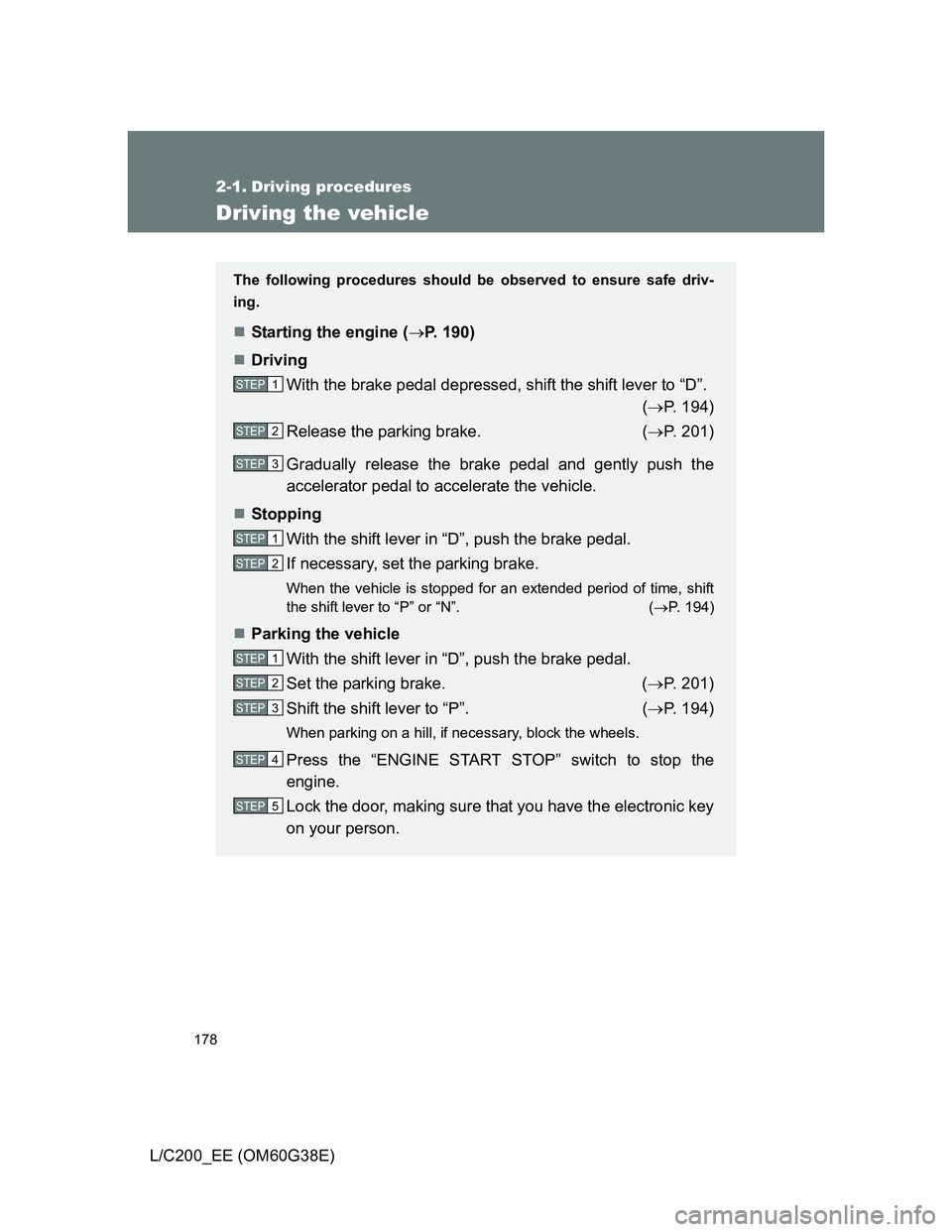
The following procedures should be observed to ensure safe driv-
ing.
Starting the engine (P. 190)
Driving
With the brake pedal depressed, shift the shift lever to “D”.
(P. 194)
Release the parking brake. (P. 201)
Gradually release the brake pedal and gently push the
accelerator pedal to accelerate the vehicle.
Stopping
With the shift lever in “D”, push the brake pedal.
If necessary, set the parking brake.
When the vehicle is stopped for an extended period of time, shift
the shift lever to “P” or “N”. (P. 194)
Parking the vehicle
With the shift lever in “D”, push the brake pedal.
Set the parking brake. (P. 201)
Shift the shift lever to “P”. (P. 194)
When parking on a hill, if necessary, block the wheels.
Press the “ENGINE START STOP” switch to stop the
engine.
Lock the door, making sure that you have the electronic key
on your person.
STEP1
STEP2
STEP3
STEP1
STEP2
STEP1
STEP2
STEP3
STEP4
STEP5
Page 190 of 692
190
2-1. Driving procedures
L/C200_EE (OM60G38E)
Engine (ignition) switch
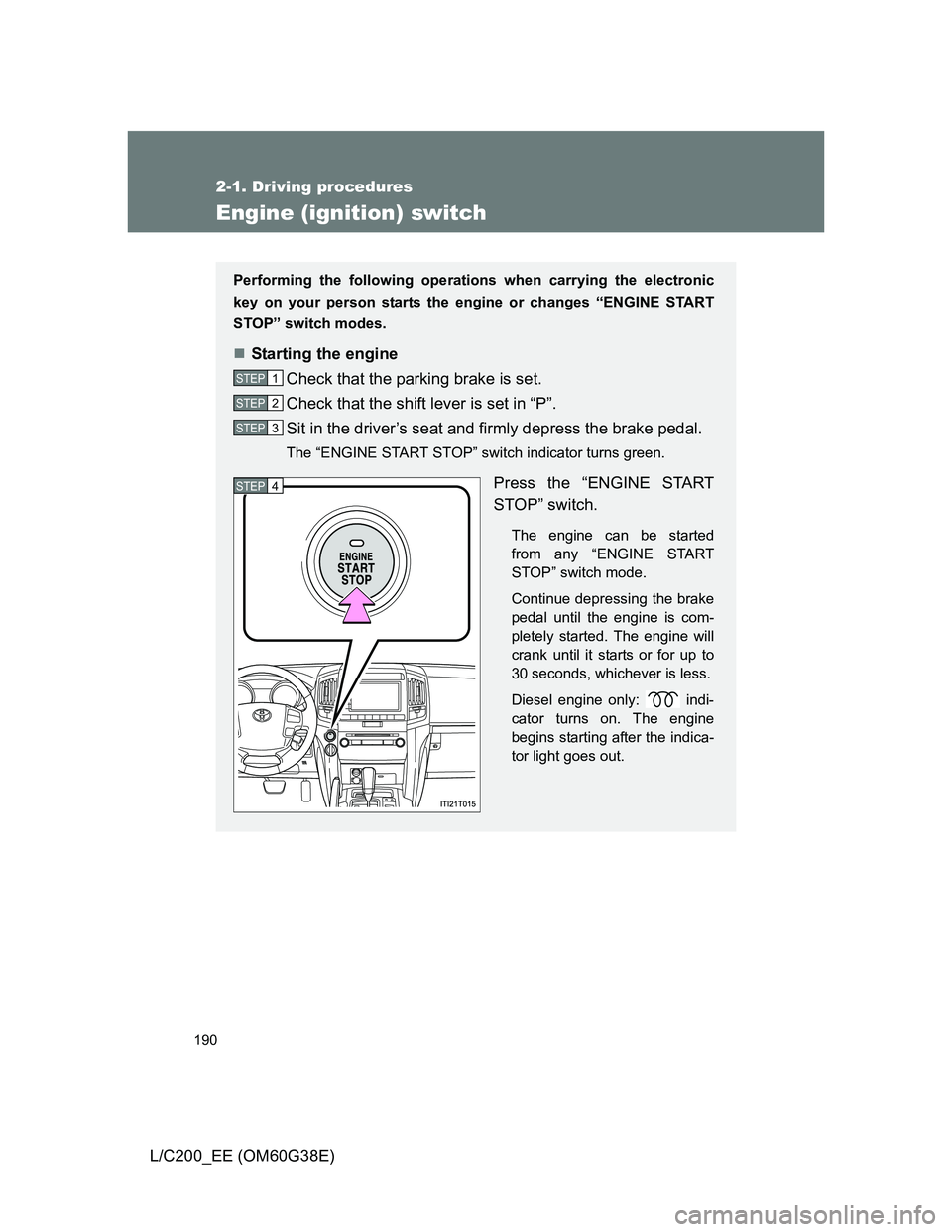
Performing the following operations when carrying the electronic
key on your person starts the engine or changes “ENGINE START
STOP” switch modes.
Starting the engine
Check that the parking brake is set.
Check that the shift lever is set in “P”.
Sit in the driver’s seat and firmly depress the brake pedal.
The “ENGINE START STOP” switch indicator turns green.
Press the “ENGINE START
STOP” switch.
The engine can be started
from any “ENGINE START
STOP” switch mode.
Continue depressing the brake
pedal until the engine is com-
pletely started. The engine will
crank until it starts or for up to
30 seconds, whichever is less.
Diesel engine only: indi-
cator turns on. The engine
begins starting after the indica-
tor light goes out.
STEP1
STEP2
STEP3
STEP4
Page 192 of 692
192 2-1. Driving procedures
L/C200_EE (OM60G38E)
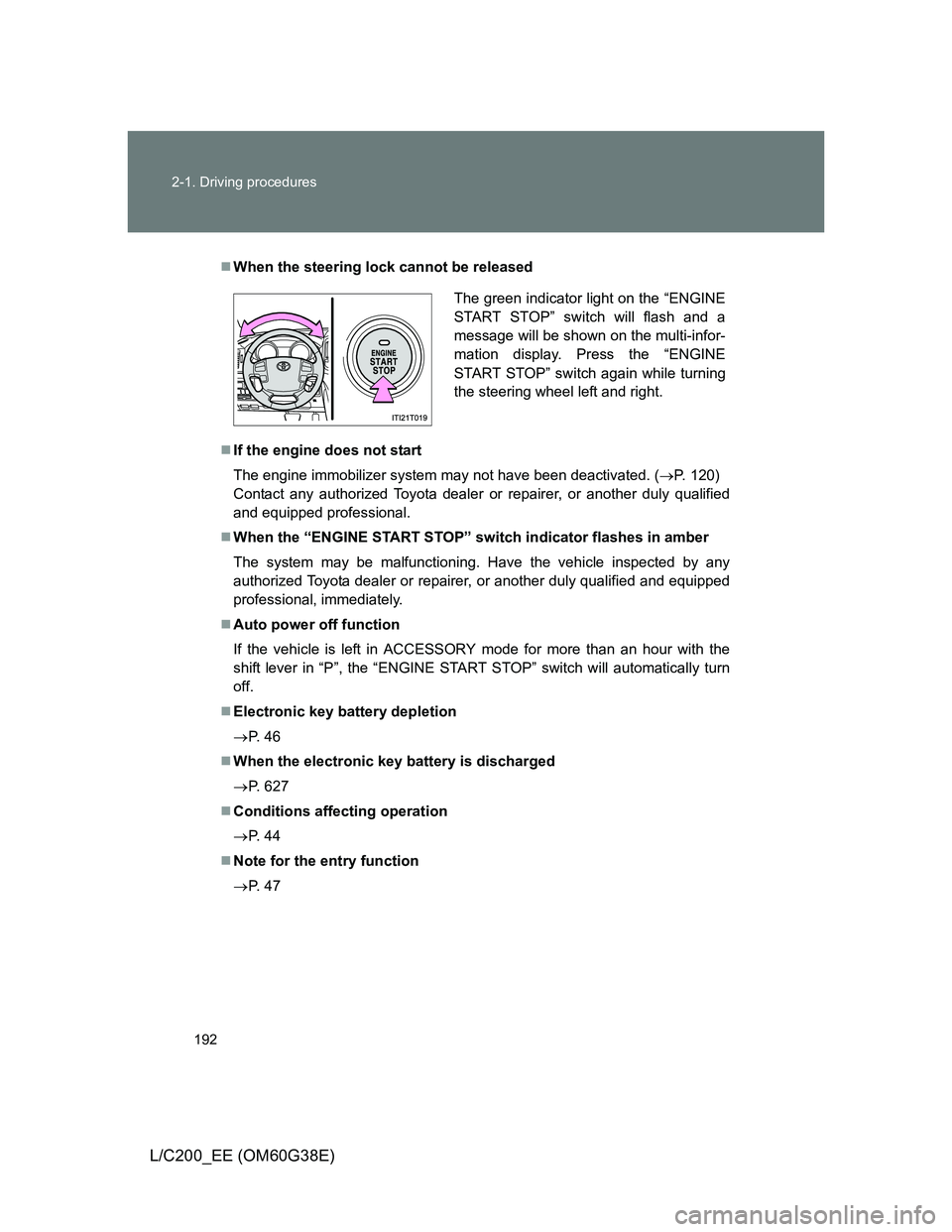
When the steering lock cannot be released
If the engine does not start
The engine immobilizer system may not have been deactivated. (P. 120)
Contact any authorized Toyota dealer or repairer, or another duly qualified
and equipped professional.
When the “ENGINE START STOP” switch indicator flashes in amber
The system may be malfunctioning. Have the vehicle inspected by any
authorized Toyota dealer or repairer, or another duly qualified and equipped
professional, immediately.
Auto power off function
If the vehicle is left in ACCESSORY mode for more than an hour with the
shift lever in “P”, the “ENGINE START STOP” switch will automatically turn
off.
Electronic key battery depletion
P. 4 6
When the electronic key battery is discharged
P. 627
Conditions affecting operation
P. 4 4
Note for the entry function
P. 4 7
The green indicator light on the “ENGINE
START STOP” switch will flash and a
message will be shown on the multi-infor-
mation display. Press the “ENGINE
START STOP” switch again while turning
the steering wheel left and right.