Page 243 of 692
243 2-4. Using other driving systems
2
When driving
L/C200_EE (OM60G38E)
Setting up Toyota parking assist-sensor (vehicles with naviga-
tion system)
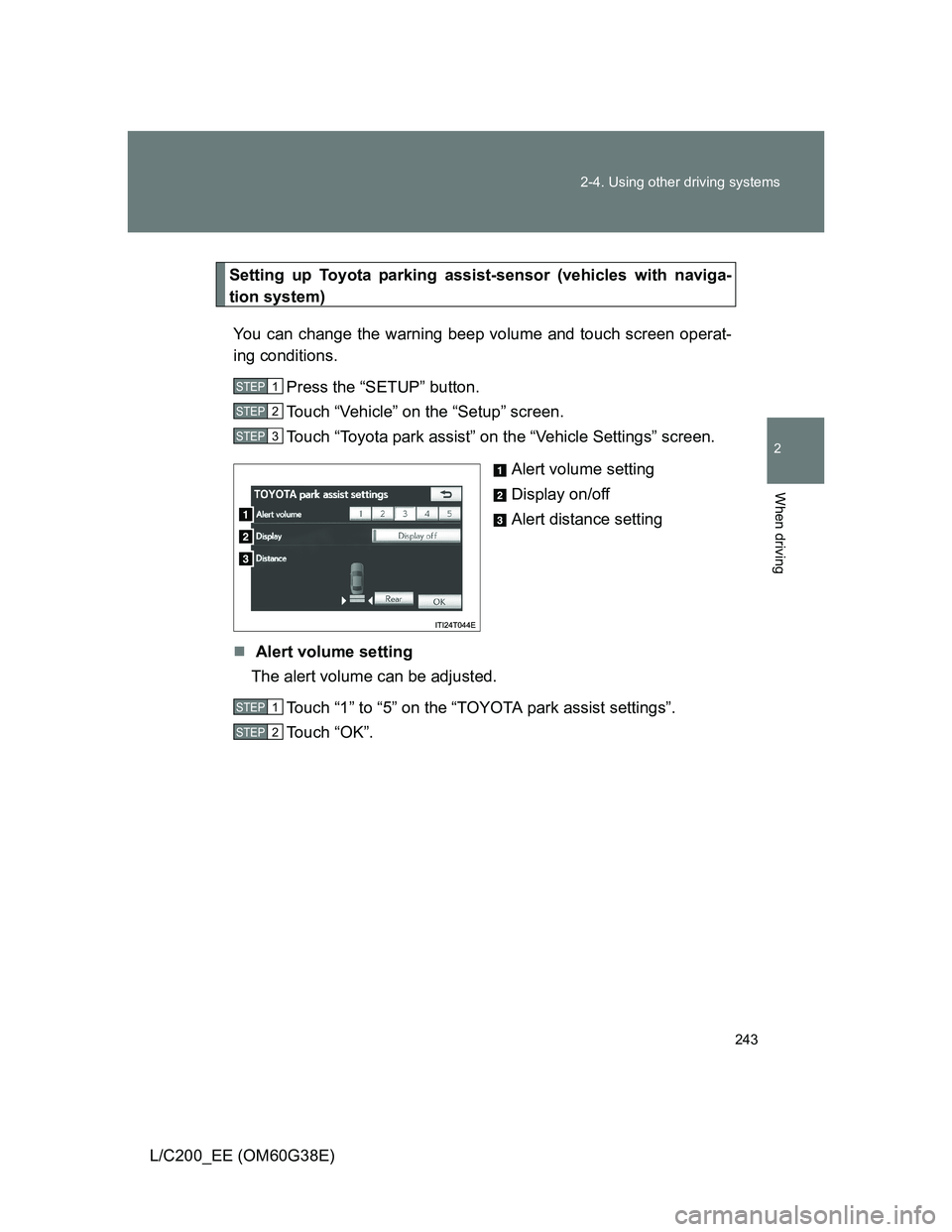
You can change the warning beep volume and touch screen operat-
ing conditions.
Press the “SETUP” button.
Touch “Vehicle” on the “Setup” screen.
Touch “Toyota park assist” on the “Vehicle Settings” screen.
Alert volume setting
Display on/off
Alert distance setting
Alert volume setting
The alert volume can be adjusted.
Touch “1” to “5” on the “TOYOTA park assist settings”.
Touch “OK”.
STEP1
STEP2
STEP3
STEP1
STEP2
Page 244 of 692
244 2-4. Using other driving systems
L/C200_EE (OM60G38E)Display on/off setting
On or off can be selected for Toyota parking assist-sensor display.
Touch “Display Off”.
When the “Display Off” indicator is turned on, the display of Toyota
parking assist-sensor will be off. Touch “Display Off” again to turn the
display of Toyota parking assist-sensor on.
Touch “OK”.
Alert distance setting
Front or rear center sensors display and tone indication can be set.
Touch “Rear”.
Long distance or short distance can be selected.
Touch “OK”.
The Toyota parking assist-sensor can be operated when
Front corner sensors:
• The “ENGINE START STOP” switch is in IGNITION ON mode.
• The shift lever is in a position other than “P”.
• The vehicle speed is less than approximately 10 km/h (6 mph).
Rear corner and rear center sensors:
• The “ENGINE START STOP” switch is in IGNITION ON mode.
• The shift lever is in “R”.
Toyota parking assist-sensor display
When an obstacle is detected while the Toyota parking assist monitor or
Multi-terrain monitor is in use, the warning indicator will appear in the top
right of the screen even if the display setting has been set to off.
STEP1
STEP2
STEP1
STEP2
Page 246 of 692
246 2-4. Using other driving systems
L/C200_EE (OM60G38E)
The shape of the obstacle may prevent the sensor from detecting it. Pay
particular attention to the following obstacles:
• Wires, fences, ropes, etc.
• Cotton, snow and other materials that absorb sound waves
• Sharply-angled objects
• Low obstacles
• Tall obstacles with upper sections projecting outwards in the direction
of your vehicle
The following situations may occur during use.
• Depending on the shape of the obstacle and other factors, the detec-
tion distance may shorten, or detection may be impossible.
• Obstacles may not be detected if they are too close to the sensor
• There will be a short delay between obstacle detection and display.
Even at slow speeds, there is a possibility that the obstacle will come
within the sensor’s detection areas before the display is shown and the
warning beep sounds.
• Thin posts or objects lower than the sensor may not be detected for
collision when approached, even if they have been detected once.
• It might be difficult to hear beeps due to the volume of audio system or
air flow noise of air conditioning system.
If a message is displayed on the multi-information display
P. 579
Page 255 of 692
255 2-4. Using other driving systems
2
When driving
L/C200_EE (OM60G38E)
Propeller shaft noise
If the vehicle height is adjusted on a slope, or with the shift lever in a position
other than “P” or “N” while the vehicle is stopped, you may hear a sound
caused by the expansion and contraction of the propeller shaft. This does
not indicate a malfunction.
4-Wheel AHC failure warning
If a malfunction occurs in the 4-Wheel AHC, normal mode is automatically
selected. However, the system may not switch to normal mode depending
on the location of the malfunction.
The warning message is displayed on the multi-information display, and the
4-Wheel AHC cannot be activated until the malfunction is corrected.
Stop the engine and start it again. If the warning message turns off, the sys-
tem is operating correctly. If the warning message continues to be displayed,
have the vehicle checked at any authorized Toyota dealer or repairer, or
another duly qualified and equipped professional as soon as possible.
Page 269 of 692
269 2-4. Using other driving systems
2
When driving
L/C200_EE (OM60G38E)
Sounds and vibrations caused by the Crawl Control system
A sound may be heard from the engine compartment when the engine is
started or just after the vehicle begins to move. This sound does not indi-
cate that a malfunction has occurred in Crawl Control system.
Either of the following conditions may occur when the Crawl Control sys-
tem is operating. None of these are indicators that a malfunction has
occurred.
• Vibrations may be felt through the vehicle body and steering.
• A motor sound may be heard after the vehicle comes to a stop.
When there is a malfunction in the system
Warning lights and/or warning messages will turn on. (P. 573, 579)
CAUTION
When using Crawl Control and Turn Assist function
Do not rely solely on the Crawl Control and Turn Assist function. This func-
tion does not extend the vehicle’s performance limitations. Always thor-
oughly check the road conditions, and drive safely.
These conditions may cause the system not to operate properly
When driving on the following surfaces, the system may not be able to main-
tain a fixed low speed, which may result in an accident:
Extremely steep inclines.
Extremely uneven surfaces.
Snow-covered roads, or other slippery surfaces.
NOTICE
When using Turn Assist function
The Turn Assist function is a function to assist turning performance when
driving off road. The function may be less effective on paved road surfaces.
Page 307 of 692
307
2-4. Using other driving systems
2
When driving
L/C200_EE (OM60G38E)
PCS (Pre-Crash Safety)
: If equipped
The pre-crash safety is operational when
Vehicle speed exceeds 30 km/h (19 mph).
The system detects sudden braking or skidding.
The front occupants are wearing a seat belt.
When there is a malfunction in the system
Warning message will be displayed on the multi-information display.
(P. 579)
CAUTION
Limitations of the pre-crash safety
Do not rely on the pre-crash safety system. Always drive safely, taking care
to observe your surroundings and checking for any obstacles or other road
hazards.
The system detects emergency braking from the speed and force
with which the driver presses the brake pedal, and quickly tightens
the seat belt to assist the effectiveness of the seat belt pretension-
ers (P. 96). This system also operates in the same manner when
the driver loses control of the vehicle.
Page 309 of 692
309 2-4. Using other driving systems
2
When driving
L/C200_EE (OM60G38E)
DPF system failure warning
If the DPF system warning message “DPF FULL ENGINE SER-
VICE REQUIRED” appears on the display, have the vehicle
inspected by any authorized Toyota dealer or repairer, or another
duly qualified and equipped professional, immediately. (P. 579)
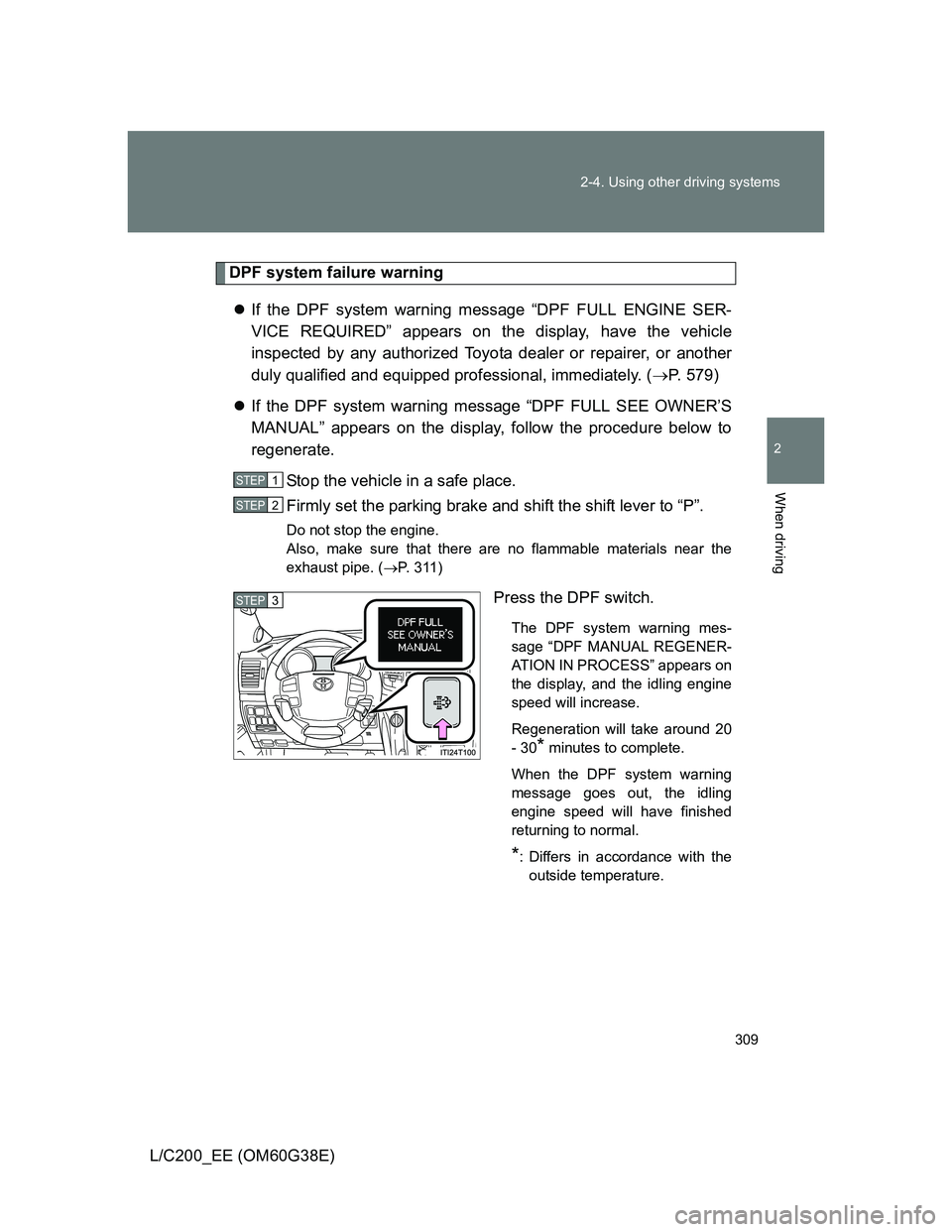
If the DPF system warning message “DPF FULL SEE OWNER’S
MANUAL” appears on the display, follow the procedure below to
regenerate.
Stop the vehicle in a safe place.
Firmly set the parking brake and shift the shift lever to “P”.
Do not stop the engine.
Also, make sure that there are no flammable materials near the
exhaust pipe. (P. 311)
Press the DPF switch.
The DPF system warning mes-
sage “DPF MANUAL REGENER-
ATION IN PROCESS” appears on
the display, and the idling engine
speed will increase.
Regeneration will take around 20
- 30
* minutes to complete.
When the DPF system warning
message goes out, the idling
engine speed will have finished
returning to normal.
*: Differs in accordance with the
outside temperature.
STEP1
STEP2
STEP3
Page 310 of 692
310 2-4. Using other driving systems
L/C200_EE (OM60G38E)
Regeneration with the DPF switch
After pressing the DPF switch, do not depress the accelerator pedal.
Depressing the pedal will stop regeneration. If regeneration has been
stopped, restart regeneration as soon as possible.
If regeneration is carried out while the exhaust pipe is hot (for example
directly after driving), it will take less time than when the engine is cold.
Replacing the engine oil
Make sure to use an oil of the recommended grade or of matching quality.
(P. 652)
DPF system warning
Under the following driving conditions, the DPF system warning message
may come on earlier than normal.
*
When only driving at low speeds (for example 20 km/h [12 mph] or
below).
If the engine is turned on and off frequently (if the engine is not left run-
ning for more than 10 minutes at a time).
*: Differs in accordance with weather, driving conditions, etc.