Page 340 of 476
340 4-3. Do-it-yourself maintenance
iQ_WE_74014E
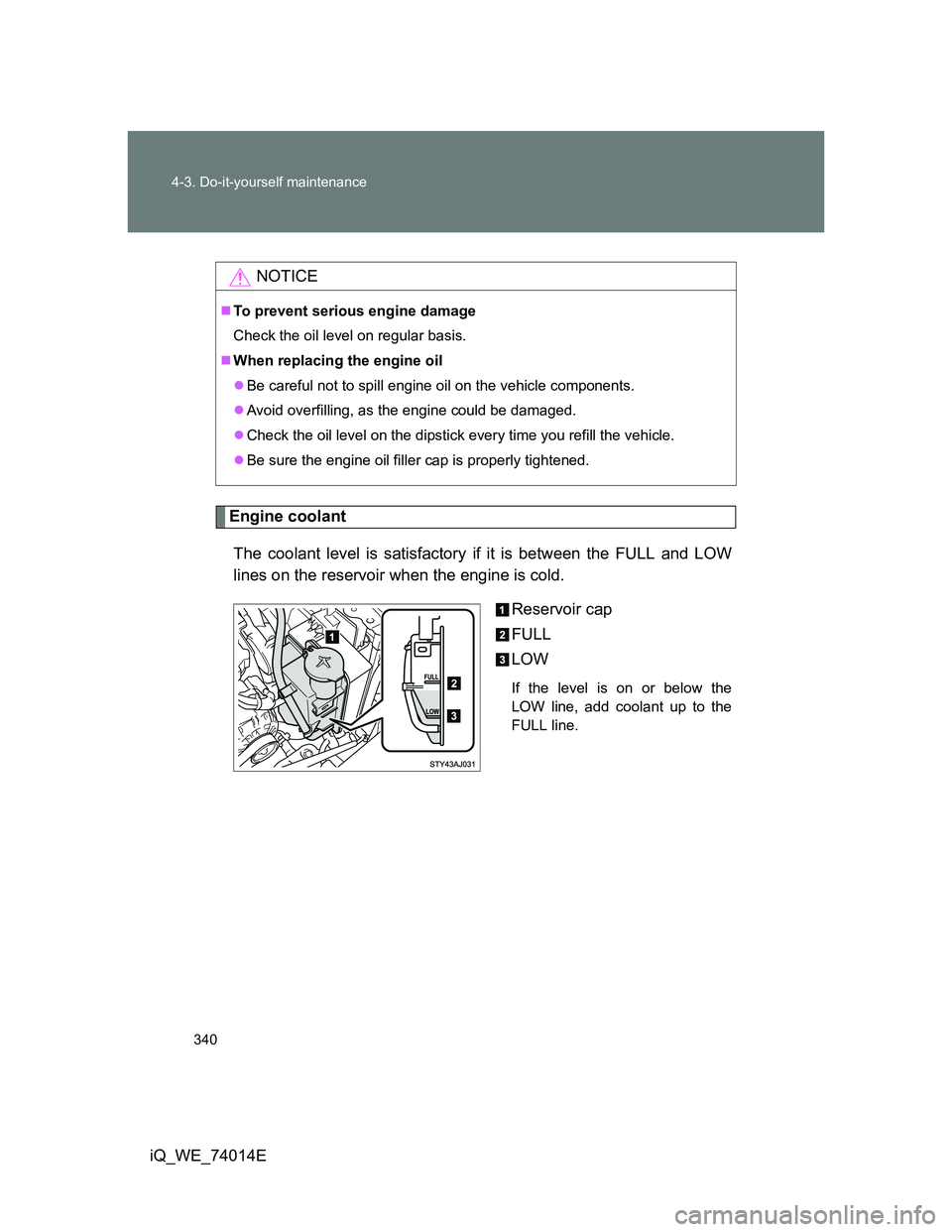
Engine coolant
The coolant level is satisfactory if it is between the FULL and LOW
lines on the reservoir when the engine is cold.
Reservoir cap
FULL
LOW
If the level is on or below the
LOW line, add coolant up to the
FULL line.
NOTICE
To prevent serious engine damage
Check the oil level on regular basis.
When replacing the engine oil
Be careful not to spill engine oil on the vehicle components.
Avoid overfilling, as the engine could be damaged.
Check the oil level on the dipstick every time you refill the vehicle.
Be sure the engine oil filler cap is properly tightened.
Page 341 of 476

341 4-3. Do-it-yourself maintenance
4
Maintenance and care
iQ_WE_74014E
If the coolant level drops within a short time after replenishing
Visually check the radiator, hoses, reservoir cap, radiator cap, drain cock
and water pump.
If you cannot find a leak, have any authorized Toyota dealer or repairer, or
another duly qualified and equipped professional, test the cap and check for
leaks in the cooling system.
Coolant selection
Only use “Toyota Super Long Life Coolant” or similar high quality ethylene
glycol based non-silicate, non-amine, non-nitrite, and non-borate coolant
with long-life hybrid organic acid technology.
“Toyota Super Long Life Coolant” is a mixture of 50% coolant and 50%
deionized water. (Enabled: -35C [-31F])
For more details about engine coolant, contact any authorized Toyota dealer
or repairer, or another duly qualified and equipped professional.
CAUTION
When the engine is hot
Do not remove the coolant reservoir cap.
The cooling system may be under pressure and may spray hot coolant if the
cap is removed, causing serious injuries, such as burns.
NOTICE
When adding engine coolant
Coolant is neither plain water nor straight antifreeze. The correct mixture of
water and antifreeze must be used to provide proper lubrication, corrosion
protection and cooling. Be sure to read the antifreeze or coolant label.
If you spill coolant
Be sure to wash it off with water to prevent damage to parts or paint.
Page 395 of 476

5
395
5-1. Essential information
When trouble arises
iQ_WE_74014E
If you think something is wrong
If you notice any of the following symptoms, your vehicle probably
needs adjustment or repair. Contact any authorized Toyota dealer or
repairer, or another duly qualified and equipped professional, as
soon as possible.
Visible symptoms
Fluid leaks under the vehicle
(Water dripping from the air conditioning system after use is
normal.)
Flat-looking tires or uneven tire wear
High engine coolant temperature warning light flashes or
comes on
Low engine coolant temperature indicator comes on or does
not come on continuously
Audible symptoms
Changes in exhaust sound
Excessive tire squeal when cornering
Strange noises related to the suspension system
Pinging or other noises related to the engine
Operational symptoms
Engine missing, stumbling or running rough
Appreciable loss of power
Vehicle pulls heavily to one side when braking
Vehicle pulls heavily to one side when driving on a level road
Loss of brake effectiveness, spongy feeling, pedal almost
touches the floor
Page 398 of 476
398 5-2. Steps to take in an emergency
iQ_WE_74014E
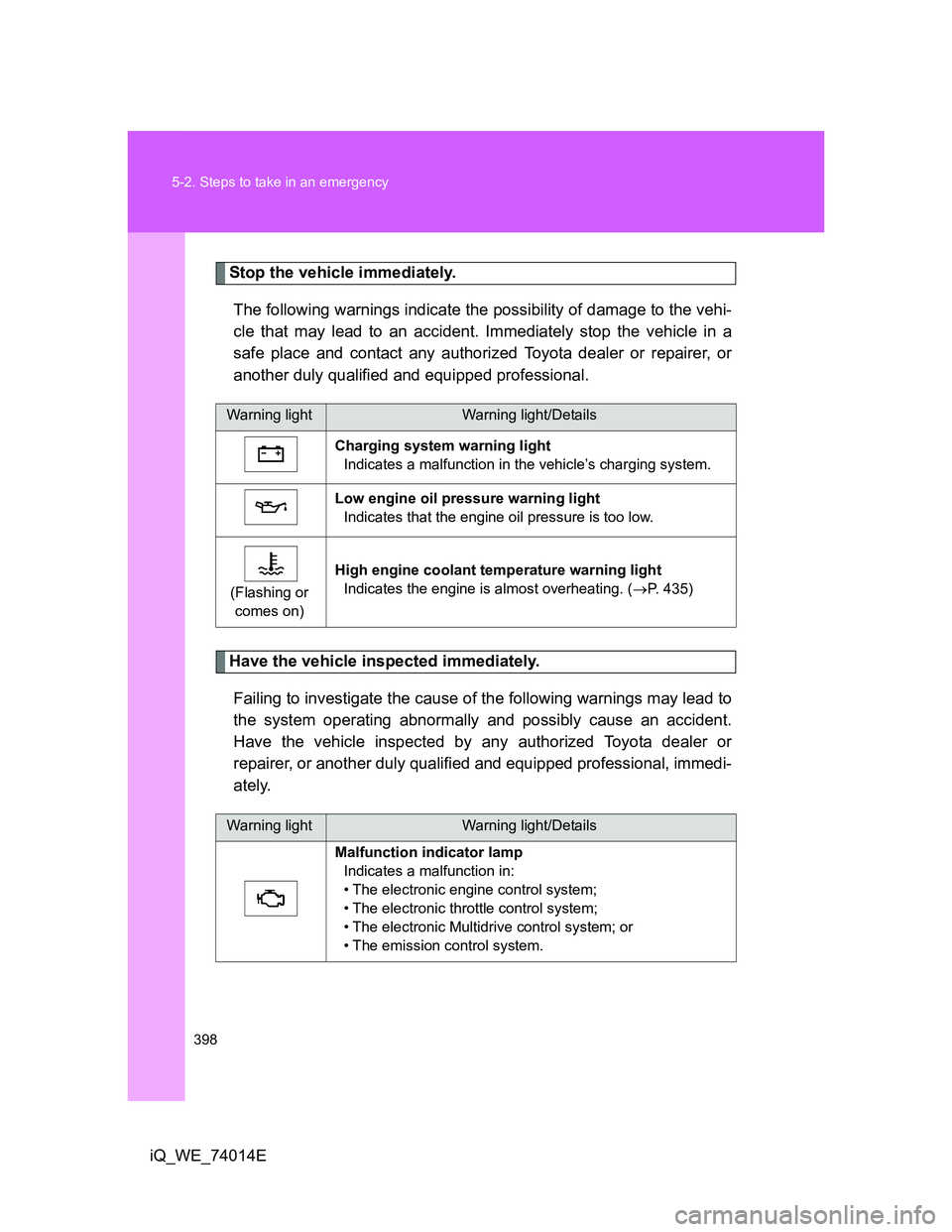
Stop the vehicle immediately.
The following warnings indicate the possibility of damage to the vehi-
cle that may lead to an accident. Immediately stop the vehicle in a
safe place and contact any authorized Toyota dealer or repairer, or
another duly qualified and equipped professional.
Have the vehicle inspected immediately.
Failing to investigate the cause of the following warnings may lead to
the system operating abnormally and possibly cause an accident.
Have the vehicle inspected by any authorized Toyota dealer or
repairer, or another duly qualified and equipped professional, immedi-
ately.
Warning lightWarning light/Details
Charging system warning light
Indicates a malfunction in the vehicle’s charging system.
Low engine oil pressure warning light
Indicates that the engine oil pressure is too low.
(Flashing or
comes on)High engine coolant temperature warning light
Indicates the engine is almost overheating. (P. 435)
Warning lightWarning light/Details
Malfunction indicator lamp
Indicates a malfunction in:
• The electronic engine control system;
• The electronic throttle control system;
• The electronic Multidrive control system; or
• The emission control system.
Page 435 of 476
5
435
5-2. Steps to take in an emergency
When trouble arises
iQ_WE_74014E
If your vehicle overheats
Correction procedures
Stop the vehicle in a safe place and turn off the air condition-
ing system, and then stop the engine.
If you see steam:
Carefully lift the hood after the steam subsides.
If you do not see steam:
Carefully lift the hood.
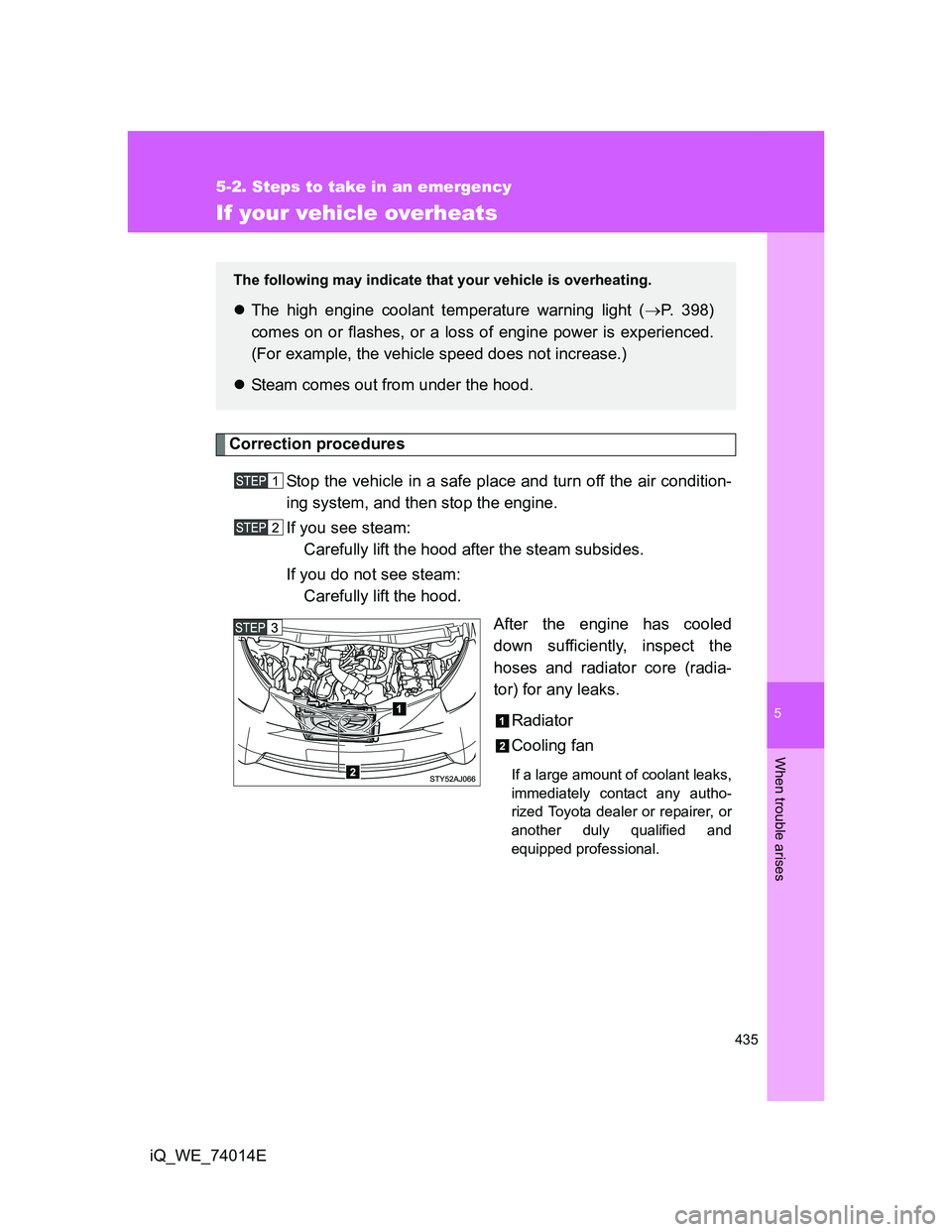
After the engine has cooled
down sufficiently, inspect the
hoses and radiator core (radia-
tor) for any leaks.
Radiator
Cooling fan
If a large amount of coolant leaks,
immediately contact any autho-
rized Toyota dealer or repairer, or
another duly qualified and
equipped professional.
The following may indicate that your vehicle is overheating.
The high engine coolant temperature warning light (P. 398)
comes on or flashes, or a loss of engine power is experienced.
(For example, the vehicle speed does not increase.)
Steam comes out from under the hood.
Page 436 of 476

436 5-2. Steps to take in an emergency
iQ_WE_74014EThe coolant level is satisfactory if
it is between the FULL and LOW
lines on the reservoir.
Reservoir
FULL
LOW
Radiator cap
Add coolant if necessary.
Water can be used in an emer-
gency if coolant is unavailable.
Start the engine and turn the air conditioning system on to
check that the radiator cooling fan operates and to check for
coolant leaks from the radiator or hoses.
The fan operates when the air conditioning system is turned on
immediately after a cold start. Confirm that the fan is operating by
checking the fan sound and air flow. If it is difficult to check these,
turn the air conditioning system on and off repeatedly.
(The fan may not operate in freezing temperatures.)
If the fan is not operating:
Stop the engine immediately and contact any authorized
Toyota dealer or repairer, or another duly qualified and
equipped professional.
If the fan is operating:
Have the vehicle inspected at the nearest authorized Toy-
ota dealer or repairer, or another duly qualified and
equipped professional.
Page 437 of 476

5
437 5-2. Steps to take in an emergency
When trouble arises
iQ_WE_74014E
CAUTION
To prevent an accident or injury when inspecting under the hood of
your vehicle
If steam is seen coming from under the hood, do not open the hood until
the steam has subsided. The engine compartment may be very hot, caus-
ing serious injuries such as burns.
Keep hands and clothing (especially a tie, a scarf or a muffler) away from
the fan and belts. Failure to do so may cause the hands or clothing to be
caught, resulting in serious injury.
Do not loosen the radiator cap and the coolant reservoir cap while the
engine and radiator are hot.
Serious injury, such as burns, may result from hot coolant and steam
released under pressure.
NOTICE
When adding engine coolant
Wait until the engine has cooled down before adding engine coolant.
When adding coolant, do so slowly. Adding cool coolant to a hot engine too
quickly can cause damage to the engine.
To prevent damage to the cooling system
Observe the following precautions:
Avoid contaminating the coolant with foreign matter (such as sand or dust
etc.).
Do not use commercially available coolant additives.
Page 452 of 476
452 6-1. Specifications
iQ_WE_74014E
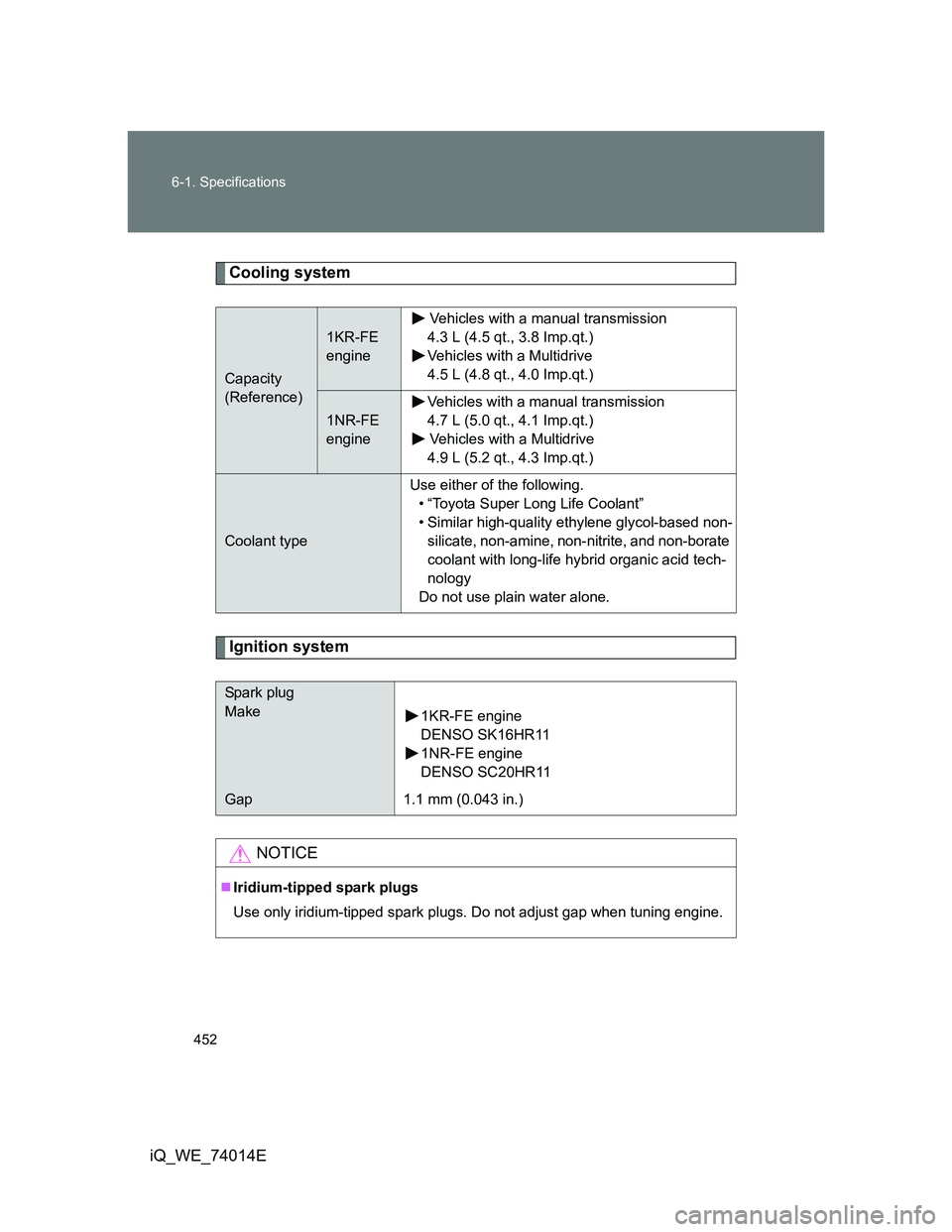
Cooling system
Ignition system
Capacity
(Reference)
1KR-FE
engineVehicles with a manual transmission
4.3 L (4.5 qt., 3.8 Imp.qt.)
Vehicles with a Multidrive
4.5 L (4.8 qt., 4.0 Imp.qt.)
1NR-FE
engineVehicles with a manual transmission
4.7 L (5.0 qt., 4.1 Imp.qt.)
Vehicles with a Multidrive
4.9 L (5.2 qt., 4.3 Imp.qt.)
Coolant typeUse either of the following.
• “Toyota Super Long Life Coolant”
• Similar high-quality ethylene glycol-based non-
silicate, non-amine, non-nitrite, and non-borate
coolant with long-life hybrid organic acid tech-
nology
Do not use plain water alone.
Spark plug
Make
1KR-FE engine
DENSO SK16HR11
1NR-FE engine
DENSO SC20HR11
Gap 1.1 mm (0.043 in.)
NOTICE
Iridium-tipped spark plugs
Use only iridium-tipped spark plugs. Do not adjust gap when tuning engine.