Page 83 of 636
83
1-3. Adjustable components (s
eats, mirrors, steering wheel)
1
Before driving
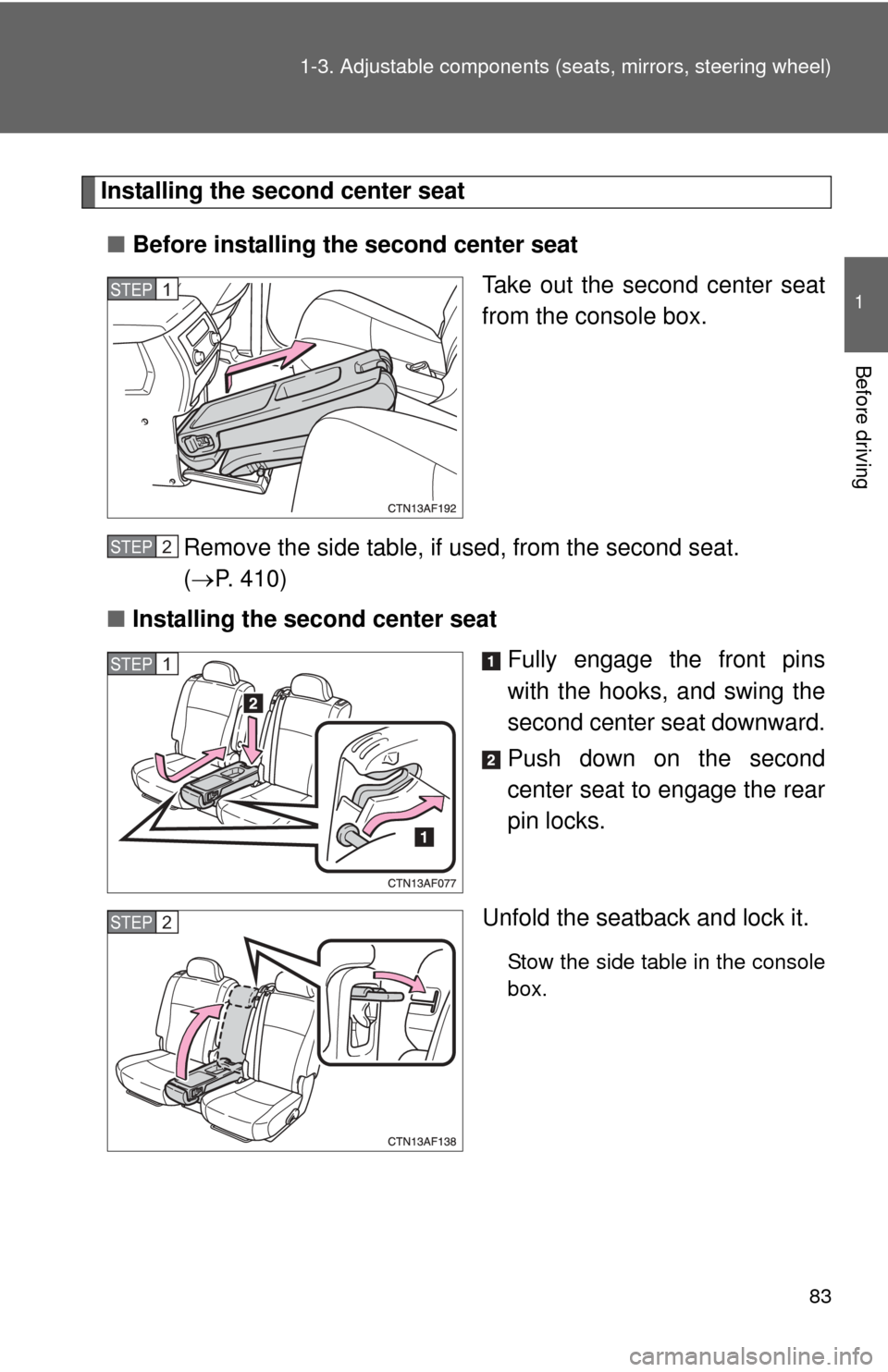
Installing the second center seat
■ Before installing the second center seat
Take out the second center seat
from the console box.
Remove the side table, if used, from the second seat.
( P. 410)
■ Installing the second center seat
Fully engage the front pins
with the hooks, and swing the
second center seat downward.
Push down on the second
center seat to engage the rear
pin locks.
Unfold the seatback and lock it.
Stow the side table in the console
box.
STEP1
STEP2
STEP1
STEP2
Page 85 of 636
85
1
1-3. Adjustable components (seats, mirrors, steering wheel)
Before driving
Head restraints
Head restraints are provided for all seats.
Front seatsVertical adjustment
Up
Pull the head restraints up.
Down
Push the head restraint down
while pushing the lock release
button.
Angle adjustment (if equipped)
Second seats Up
Pull the head restraints up.
Down
Push the head restraint down
while pushing the lock release
button.
When using the center seat,
raise the head restraint from
the stowed position.
Lock release button
Lock release buttons
Page 86 of 636
86 1-3. Adjustable components (seats, mirrors, steering wheel)
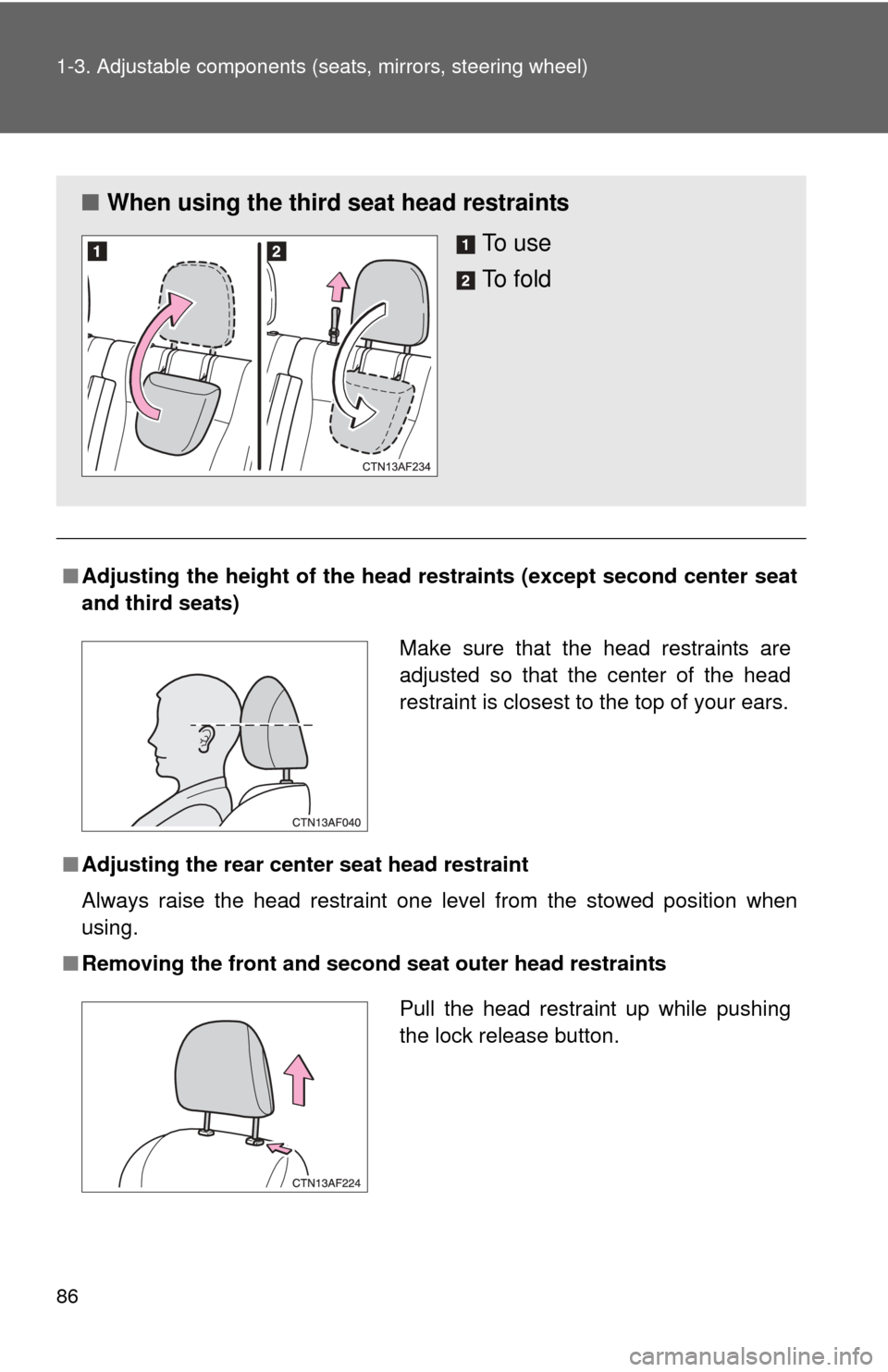
■Adjusting the height of the head restraints (except second center seat
and third seats)
■ Adjusting the rear cent er seat head restraint
Always raise the head restraint one level from the stowed position when
using.
■ Removing the front and second seat outer head restraints
■ When using the third seat head restraints
To u s e
To f o l d
Make sure that the head restraints are
adjusted so that the center of the head
restraint is closest to the top of your ears.
Pull the head restraint up while pushing
the lock release button.
Page 130 of 636

130 1-7. Safety information
CAUTION
■SRS airbag precautions
Observe the following precautions regarding the airbags.
Failure to do so may cause death or serious injury.
●The driver and all passengers in the vehicle must wear their seat belts
properly.
The SRS airbags are supplemental devices to be used with the seat belts.
● The SRS driver airbag deploys with considerable force, and can cause
death or serious injury especially if the driver is very close to the airbag.
The National Highway Traffic Safety Administration (“NHTSA”) advises:
Since the risk zone for the driver’s airbag is the first 2 - 3 in. (50 - 75 mm) of
inflation, placing yourself 10 in. (250 mm) from your driver airbag provides
you with a clear margin of safety. This distance is measured from the center
of the steering wheel to your breastbone. If you sit less than 10 in. (250 mm)
away now, you can change your driving position in several ways:
• Move your seat to the rear as far as you can while still reaching thepedals comfortably.
• Slightly recline the back of the seat. Although vehicle designs vary, many drivers can achieve the 10 in.
(250 mm) distance, even with the driver seat all the way forward, sim-
ply by reclining the back of the seat somewhat. If reclining the back of
your seat makes it hard to see the road, raise yourself by using a firm,
non-slippery cushion, or raise the seat if your vehicle has that feature\
.
• If your steering wheel is adjustable, tilt it downward. This points the air- bag toward your chest instead of your head and neck.
The seat should be adjusted as recommended by NHTSA above, while still
maintaining control of the foot pedals, steering wheel, and your view of the
instrument panel controls.
Page 132 of 636
132 1-7. Safety information
CAUTION
■SRS airbag precautions
●Do not sit on the edge of the seat or
lean against the dashboard.
● Do not allow a child to stand in front of
the SRS front passenger airbag unit or
sit on the knees of a front passenger.
● Do not drive the vehicle while the driver
or passenger has items resting on their
knees.
● Do not lean against the door, the roof
side rail or the front, side and rear pil-
lars.
● Do not allow anyone to kneel on the
passenger seat toward the door or put
their head or hands outside the vehicle.
Page 159 of 636

When driving2
159
2-1. Driving proceduresDriving the vehicle............ 160
Engine (ignition) switch (vehicles with smart
key system).................... 170
Engine (ignition) switch (vehicles without smart
key system).................... 174
Automatic transmission...... 177
Turn signal lever .............. 182
Parking brake ................... 183
Horn ................................. 184
2-2. Instrument cluster Gauges and meters ......... 185
Indicators and warning lights .............................. 187
Multi-information display............................ 191 2-3.
Operating the lights and
wipers
Headlight sw itch ............... 200
Fog light switch ................ 206
Windshield wipers and washer ........................... 208
Rear window wiper and washer ........................... 212
2-4. Using other drivin g
s ystems
Cruise control ................... 215
Rear view monitor system ........................... 219
Driving assist systems ..... 223
Hill-start assist control ...... 228
Downhill assist control system (4WD models) ... 230
2-5. Driving information Off-road precautions ........ 233
Cargo and luggage .......... 238
Vehicle load limits ............ 242
Winter driving tips ............ 243
Trailer towing ................... 247
Dinghy towing .................. 265
Page 161 of 636

161
2-1. Driving procedures
2
When driving
Starting on a steep uphill
Firmly set the parking brake and shift the shift lever to D.
Gently depress the accelerator pedal.
Release the parking brake.
■Driving in the rain
●Drive carefully when it is raining, because visibility will be reduced, the
windows may become fogged-up, and the road will be slippery.
● Drive carefully when it starts to rain, because the road surface will be
especially slippery.
● Refrain from high speeds when driving on an expressway in the rain,
because there may be a layer of water between the tires and the road
surface, preventing the steering and brakes from operating properly.
■ Breaking in your new Toyota
To extend the life of the vehicle, observing the following precautions is rec-
ommended:
●For the first 186 miles (300 km):
Avoid sudden stops.
● For the first 500 miles (800 km):
Do not tow a trailer.
● For the first 621 miles (1000 km):
• Do not drive at extremely high speeds.
• Avoid sudden acceleration.
• Do not drive continuously in the low gears.
• Do not drive at a constant speed for extended periods.
■ Drum-in-disc type parking brake system
Your vehicle has a drum-in-disc type parking brake system.
This type of brake system needs bedding-down of the brake shoes periodi-
cally or whenever the parking brake shoes and/or drums are replaced.
Have your Toyota dealer perform the bedding-down.
STEP1
STEP2
STEP3
Page 181 of 636

181
2-1. Driving procedures
2
When driving
■
If the shift lever cannot be shifted from P
P. 556
■ If the S indicator does not come on even after shifting the shift lever to
S
This may indicate a malfunction in the automatic transmission system. Have
the vehicle inspected by your Toyota dealer immediately.
(In this situation, the vehicle will operate as if the shift lever is in D.)
■ Downshift restriction warning buzzer (S mode)
To help ensure safety and driving performance, downshifting operation may
sometimes be restricted. In some circumstances, downshifting may not be
possible even when the shift lever is operated. (A buzzer will sound twice.)
■ S mode
●2.7L 4-cylinder (1AR-FE) engine: when the shift range is “5” or lower,
holding the shift lever toward “+” sets the shift range to “6”.
● 3.5L V6 (2GR-FE) engine: when the shift range is “4” or lower, holding
the shift lever toward “+” sets the shift range to “5”.
● To prevent excessive engine speed, a function was adopted that auto-
matically selects a higher shift range before engine speed becomes too
high.
● To protect the automatic transmission, a function is adopted that auto-
matically selects a higher shift range when the fluid temperature is high.
■ AI-SHIFT
AI-SHIFT automatically selects the suitable gear according to driver perfor-
mance and driving conditions.
AI-SHIFT automatically operates when the shift lever is in the D position.
(Shifting the shift lever to the S mode driving position cancels the function.)
The engine speed may remain high after releasing the accelerator pedal.
This does not indicate a malfunction.