Page 222 of 448

222
2-4. Using other driving systems
FT86_EE
Driving assist systems
When the TRC/VSC systems are operating
The slip indicator light will flash
while the TRC/VSC systems are
operating.
To help enhance driving safety and performance, the following sys-
tems operate automatically in response to various driving situations.
Be aware, however, that these systems are supplementary and
should not be relied upon too heavily when operating the vehicle.
ABS (Anti-lock Brake System)
Helps to prevent wheel lock when the brakes are applied suddenly, or if
the brakes are applied while driving on a slippery road surface
Brake assist
Generates an increased level of braking force after the brake pedal is
depressed when the system detects a panic stop situation
VSC (Vehicle Stability Control)
Helps the driver to control skidding when swerving suddenly or turning
on slippery road surfaces
TRC (Traction Control)
Helps to maintain drive power and prevent the drive wheels from spin-
ning when starting the vehicle or accelerating on slippery roads
EPS (Electric Power Steering)
Employs an electric motor to reduce the amount of effort needed to turn
the steering wheel
Page 224 of 448

224 2-4. Using other driving systems
FT86_EE
Turning off both TRC and VSC systems
To turn the TRC and VSC systems off, press and hold for more than 3
seconds while the vehicle is stopped.
The “TRC OFF” indicator light and the VSC off indicator light will come on.
Press the button again to turn the systems back on.
Sounds and vibrations caused by the ABS, brake assist, TRC and VSC
systems
A sound may be heard from the engine compartment when the brake
pedal is depressed repeatedly, when the engine is started or just after the
vehicle begins to move. This sound does not indicate that a malfunction
has occurred in any of these systems.
Any of the following conditions may occur when the above systems are
operating. None of these indicates that a malfunction has occurred.
• Vibrations may be felt through the vehicle body and steering.
• A motor sound may be heard after the vehicle comes to a stop.
• The brake pedal may pulsate slightly after the ABS is activated.
• The brake pedal may move down slightly after the ABS is activated.
EPS operation sound
When the steering wheel is operated, a motor sound (whirring sound) may
be heard. This does not indicate a malfunction.
Automatic reactivation of TRC and VSC systems
After turning the TRC and VSC systems off, the systems will be automati-
cally reactivated in the following situations:
Vehicles without a smart entry & start system: When the engine switch is
turned to “LOCK” position
Vehicles with a smart entry & start system: When the “ENGINE START
STOP” switch is turned off
If only the TRC system is turned off, the TRC will turn on when vehicle
speed is more than approximately 50 km/h (31 mph).
If both the TRC and VSC systems are turned off, automatic reactivation
will not occur when vehicle speed increases.
Page 225 of 448

225 2-4. Using other driving systems
2
When driving
FT86_EE
Reduced effectiveness of the EPS system
The effectiveness of the EPS system is reduced to prevent the system from
overheating when there is frequent steering input over an extended period of
time. The steering wheel may feel heavy as a result. Should this occur,
refrain from excessive steering input or stop the vehicle and turn the engine
off. The EPS system should return to normal after a little while.
Automatic deactivation of “VSC SPORT” mode
Vehicles without a smart entry & start system
When the engine switch is turned to “LOCK” position after driving in “VSC
SPORT” mode, the mode is automatically deactivated.
Vehicles with a smart entry & start system
When the “ENGINE START STOP” switch is turned off after driving in “VSC
SPORT” mode, the mode is automatically deactivated.
CAUTION
The ABS does not operate effectively when
Tires with inadequate gripping ability are used (such as excessively worn
tires on a snow covered road).
The vehicle hydroplanes while driving at high speed on wet or slick roads.
Stopping distance when the ABS is operating may exceed that of nor-
mal conditions
The ABS is not designed to shorten the vehicle’s stopping distance. Always
maintain a safe distance from the vehicle in front of you in the following situ-
ations:
When driving on dirt, gravel or snow-covered roads
When driving with tire chains
When driving over bumps in the road
When driving over roads with potholes or uneven surfaces
TRC may not operate effectively when
Directional control and power may not be achievable while driving on slip-
pery road surfaces, even if the TRC system is operating.
Do not drive the vehicle in conditions where stability and power may be lost.
Page 228 of 448

228 2-5. Driving information
FT86_EE
CAUTION
Storage precautions
Observe the following precautions.
Failure to do so may result in death or serious injury.
Stow cargo and luggage in the trunk whenever possible.
To prevent cargo and luggage from sliding forward during braking, do
not stack anything in the enlarged trunk. Keep cargo and luggage low,
as close to the floor as possible.
When you fold down the rear seats, long items should not be placed
directly behind the front seats.
Never allow anyone to ride in the enlarged trunk. It is not designed for
passengers. They should ride in their seats with their seat belts prop-
erly fastened. Otherwise, they are much more likely to suffer death or
serious bodily injury, in the event of sudden braking, sudden swerving
or an accident.
Do not place cargo or luggage in or on the following locations as the
item may get under the clutch, brake or accelerator pedal and prevent
the pedals from being depressed properly, block the driver’s vision, or
hit the driver or passengers, causing an accident:
• At the feet of the driver
• On the front passenger or rear seats (when stacking items)
• On the package tray
• On the instrument panel
• On the dashboard
Secure all items in the occupant compartment, as they may shift and
injure someone during sudden braking, sudden swerving or an acci-
dent.
Load and distribution
Do not overload your vehicle.
Do not apply loads unevenly.
Improper loading may cause deterioration of steering or braking control
which may cause death or serious injury.
Page 230 of 448

230 2-5. Driving information
FT86_EE
If a door is opened and closed when its side window is frozen,
the window safety device will operate and the side window
open/close function linked to door operation may not operate
correctly. If this occurs, perform the following after the ice has
melted.
Open the side window until it is approximately halfway
open.
Fully close the window by pulling the switch up to the one-
touch closing position and continue holding the switch for 1
second or more after the window fully closes.
The window position is reset and the safety device operations will
be released.
When driving the vehicle
Accelerate the vehicle slowly, keep a safe distance between you
and the vehicle ahead, and drive at a reduced speed suitable to
road conditions.
When parking the vehicle (in the winter time or in the cold
latitudes)
Park the vehicle and move the shift lever to P (automatic trans-
mission) or 1 or R (manual transmission) without setting the
parking brake. The parking brake may freeze up, preventing it
from being released. If necessary, block the wheels to prevent
inadvertent sliding or creeping.
STEP 1
STEP 2
Page 235 of 448
3Interior features
235
FT86_EE
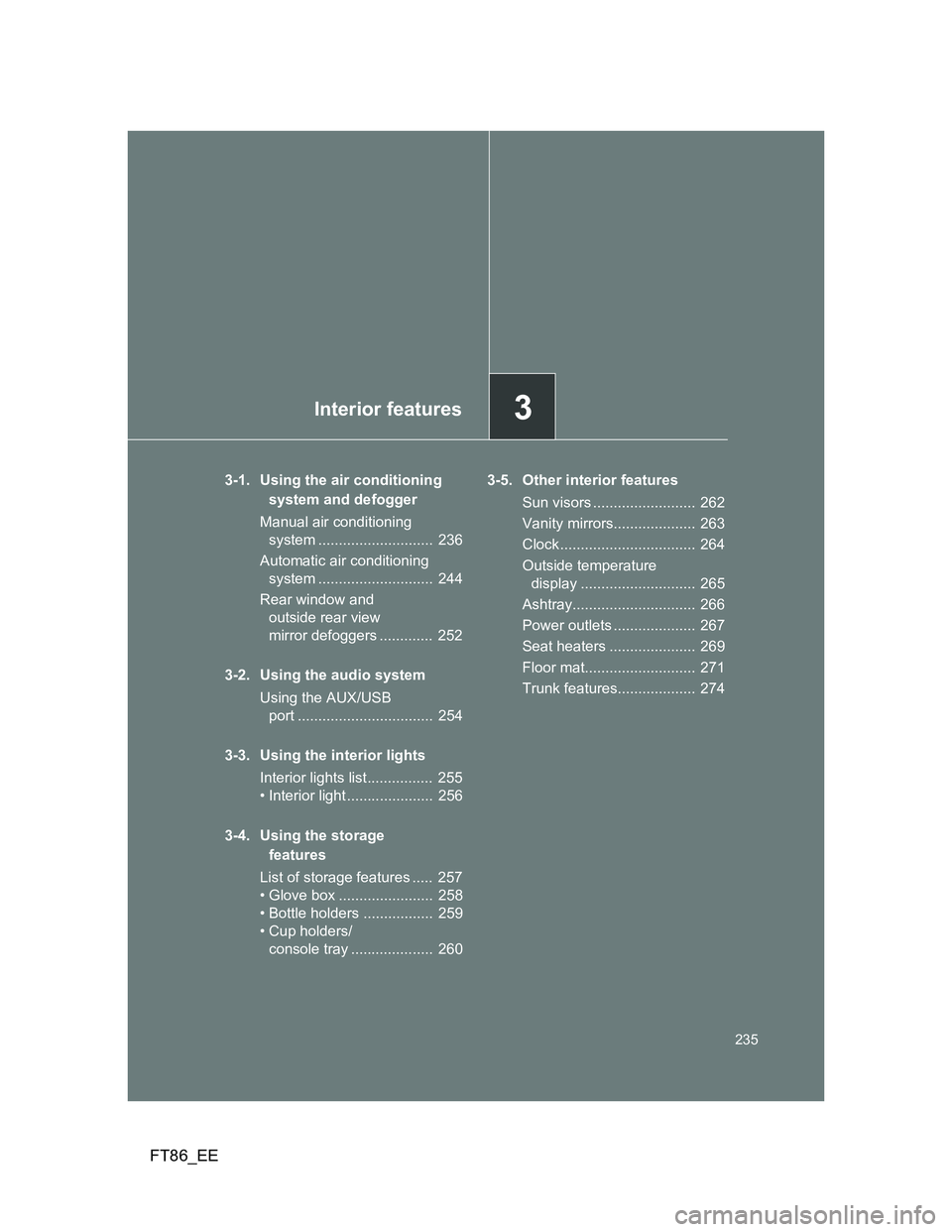
3-1. Using the air conditioning
system and defogger
Manual air conditioning
system ............................ 236
Automatic air conditioning
system ............................ 244
Rear window and
outside rear view
mirror defoggers ............. 252
3-2. Using the audio system
Using the AUX/USB
port ................................. 254
3-3. Using the interior lights
Interior lights list................ 255
• Interior light ..................... 256
3-4. Using the storage
features
List of storage features ..... 257
• Glove box ....................... 258
• Bottle holders ................. 259
• Cup holders/
console tray .................... 2603-5. Other interior features
Sun visors ......................... 262
Vanity mirrors.................... 263
Clock ................................. 264
Outside temperature
display ............................ 265
Ashtray.............................. 266
Power outlets .................... 267
Seat heaters ..................... 269
Floor mat........................... 271
Trunk features................... 274
Page 236 of 448
236
FT86_EE
3-1. Using the air conditioning system and defogger
Manual air conditioning system
Adjusting the settings
To adjust the fan speed, turn the fan speed control dial clock-
wise (increase) or counterclockwise (decrease).
Turning the dial to “0” turns off the fan.
Vehicles without the button: Turn the temperature con-
trol dial clockwise to increase the temperature.
: If equipped
Fan speed control dial Air outlet selection dial
Air conditioning on/off button
(if equipped)Temperature control dial
Outside air or recirculated air mode
STEP 1
STEP 2
Page 237 of 448
237 3-1. Using the air conditioning system and defogger
3
Interior features
FT86_EEVehicles with the button: To adjust the temperature
setting, turn the temperature control dial clockwise (warm) or
counterclockwise (cool).
is not pressed, the system will blow ambient temperature air
or heated air.
To select the air outlets, set the air outlet selection dial to the
desired position.
The positions between the air outlet selections shown below can
also be selected for more delicate adjustment.
STEP 2
STEP 3

