Page 374 of 529
374 4-3. Do-it-yourself maintenance
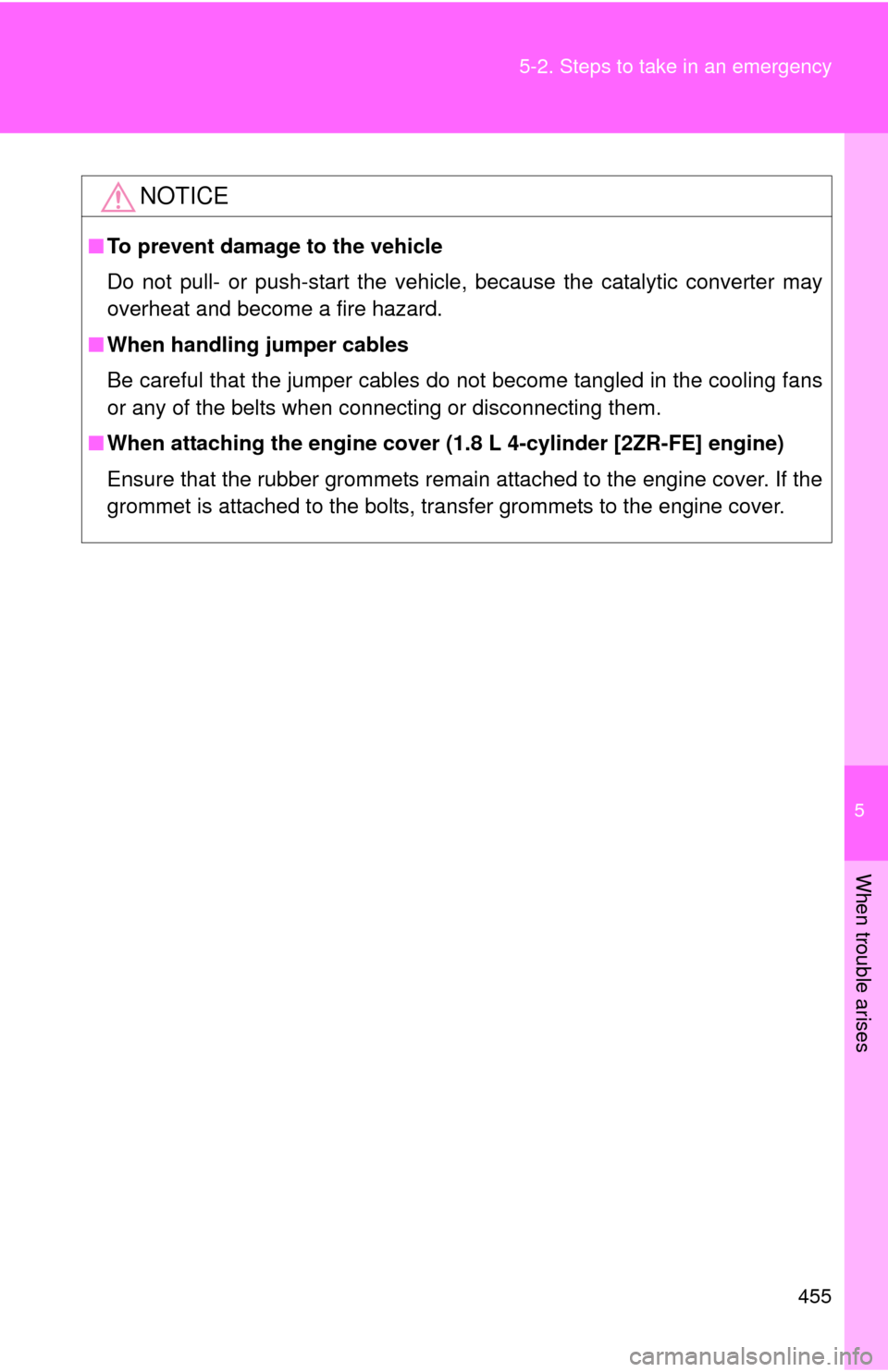
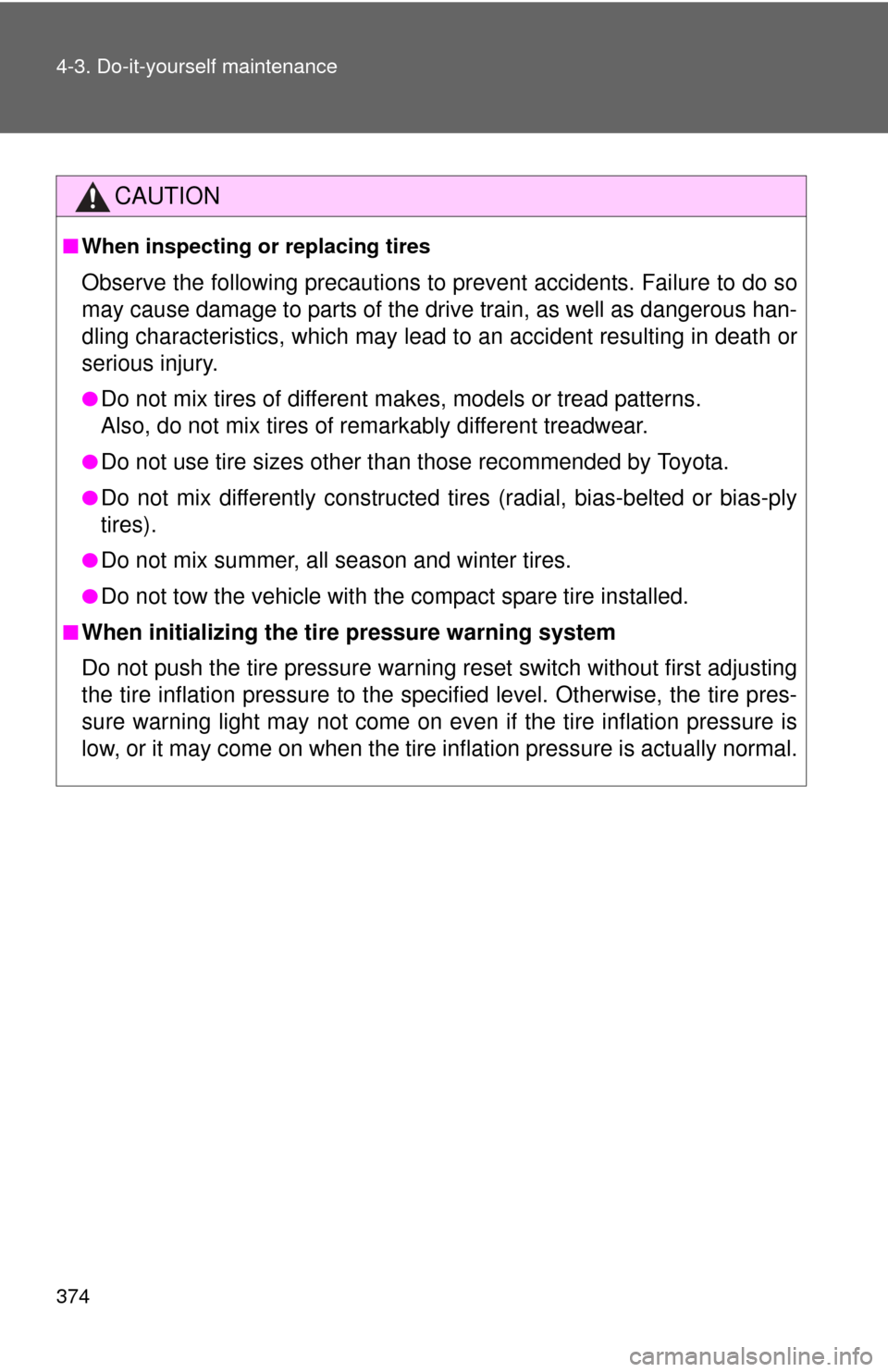
CAUTION
■When inspecting or replacing tires
Observe the following precautions to prevent accidents. Failure to do so
may cause damage to parts of the drive train, as well as dangerous han-
dling characteristics, which may lead to an accident resulting in death or
serious injury.
●Do not mix tires of different makes, models or tread patterns.
Also, do not mix tires of remarkably different treadwear.
●Do not use tire sizes other than those recommended by Toyota.
●Do not mix differently constructed ti res (radial, bias-belted or bias-ply
tires).
●Do not mix summer, all season and winter tires.
●Do not tow the vehicle with the compact spare tire installed.
■When initializing the tire pressure warning system
Do not push the tire pressure warnin g reset switch without first adjusting
the tire inflation pressure to the spec ified level. Otherwise, the tire pres-
sure warning light may not come on ev en if the tire inflation pressure is
low, or it may come on when the tire inflation pressure is actually normal.
Page 421 of 529
5
When trouble arises
421
5-2. Steps to take in an emergency
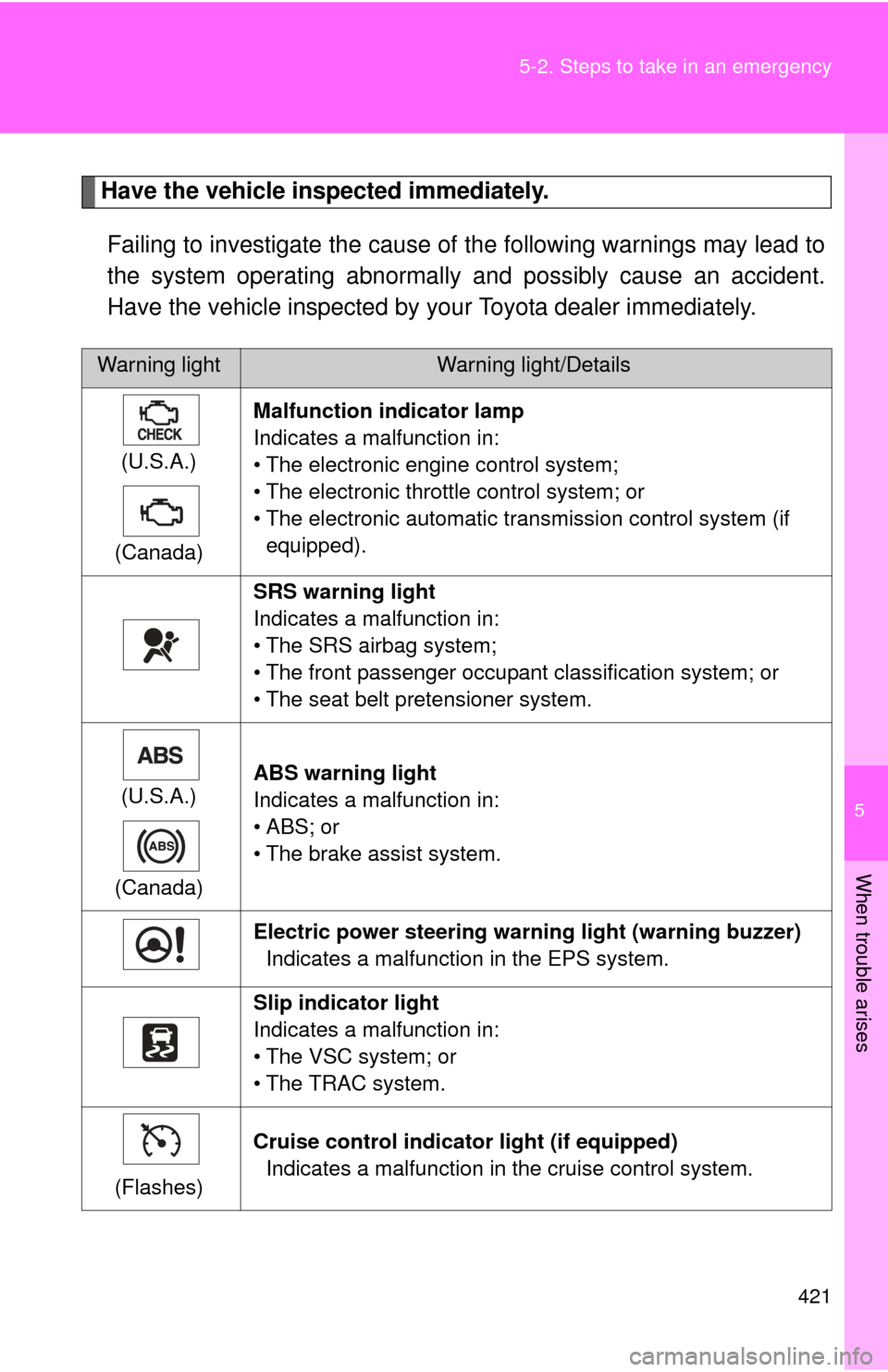
Have the vehicle inspected immediately.
Failing to investigate the cause of the following warnings may lead to
the system operating abnormally and possibly cause an accident.
Have the vehicle inspected by your Toyota dealer immediately.
Warning lightWarning light/Details
(U.S.A.)
(Canada) Malfunction indicator lamp
Indicates a malfunction in:
• The electronic engine control system;
• The electronic throttle control system; or
• The electronic automatic transmission control system (if
equipped).
SRS warning light
Indicates a malfunction in:
• The SRS airbag system;
• The front passenger occupant classification system; or
• The seat belt pretensioner system.
(U.S.A.)
(Canada) ABS warning light
Indicates a malfunction in:
•ABS; or
• The brake assist system.
Electric power steering warning light (warning buzzer)
Indicates a malfunction in the EPS system.
Slip indicator light
Indicates a malfunction in:
• The VSC system; or
• The TRAC system.
(Flashes) Cruise control indicator light (if equipped)
Indicates a malfunction in the cruise control system.
Page 423 of 529
5
When trouble arises
423
5-2. Steps to take in an emergency
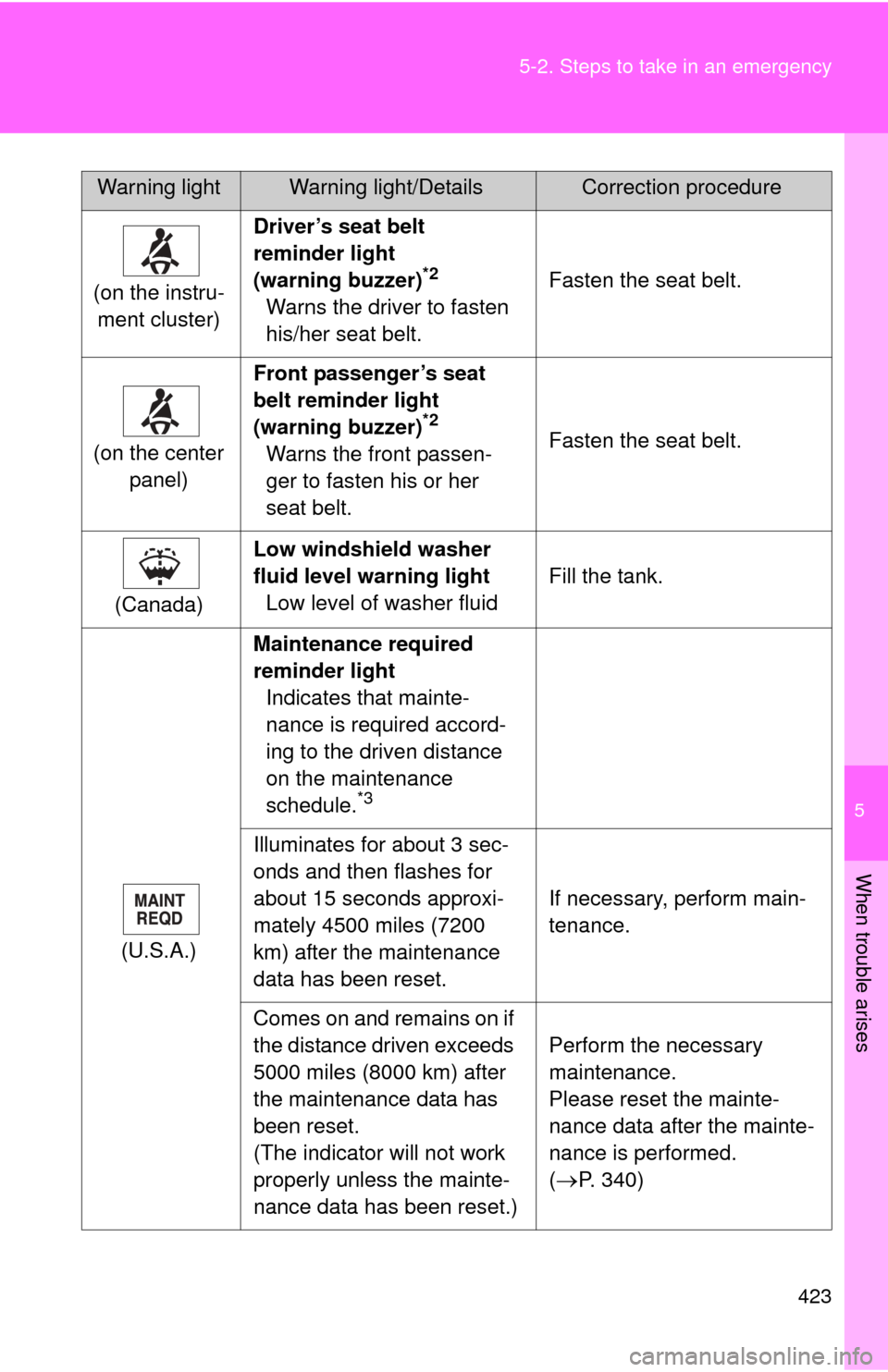
(on the instru-
ment cluster) Driver’s seat belt
reminder light
(warning buzzer)*2
Warns the driver to fasten
his/her seat belt.
Fasten the seat belt.
(on the center panel) Front passenger’s seat
belt reminder light
(warning buzzer)
*2
Warns the front passen-
ger to fasten his or her
seat belt.
Fasten the seat belt.
(Canada) Low windshield washer
fluid level warning light
Low level of washer fluid Fill the tank.
(U.S.A.) Maintenance required
reminder light
Indicates that mainte-
nance is required accord-
ing to the driven distance
on the maintenance
schedule.
*3
Illuminates for about 3 sec-
onds and then flashes for
about 15 seconds approxi-
mately 4500 miles (7200
km) after the maintenance
data has been reset. If necessary, perform main-
tenance.
Comes on and remains on if
the distance driven exceeds
5000 miles (8000 km) after
the maintenance data has
been reset.
(The indicator will not work
properly unless the mainte-
nance data has been reset.) Perform the necessary
maintenance.
Please reset the mainte-
nance data after the mainte-
nance is performed.
(
P. 340)
Warning lightWarning light/DetailsCorrection procedure
Page 424 of 529
424 5-2. Steps to take in an emergency
*1: Open door warning buzzer:The open door warning buzzer sounds to alert the driver that one or more of
the doors or trunk is not fully closed (with the vehicle having reached a speed
of 3 mph [5 km/h]).
*2: Driver's and front passenger’s seat belt warning buzzers:The driver’s and front passenger’s seat belts warning buzzers sound to alert
the driver and front passenger that his or her seat belt is not fastened. The
buzzer sounds intermittently for 10 seconds after the vehicle has reached a
speed of 12 mph (20 km/h). Then, if the seat belt is still unfastened, the
buzzer will sound at a different tone for 20 more seconds.
*3: Refer to the separate “Scheduled Maintenance Guide” or “Owner’s ManualSupplement” for the maintenance interval applicable to your vehicle. (U.S.A.)
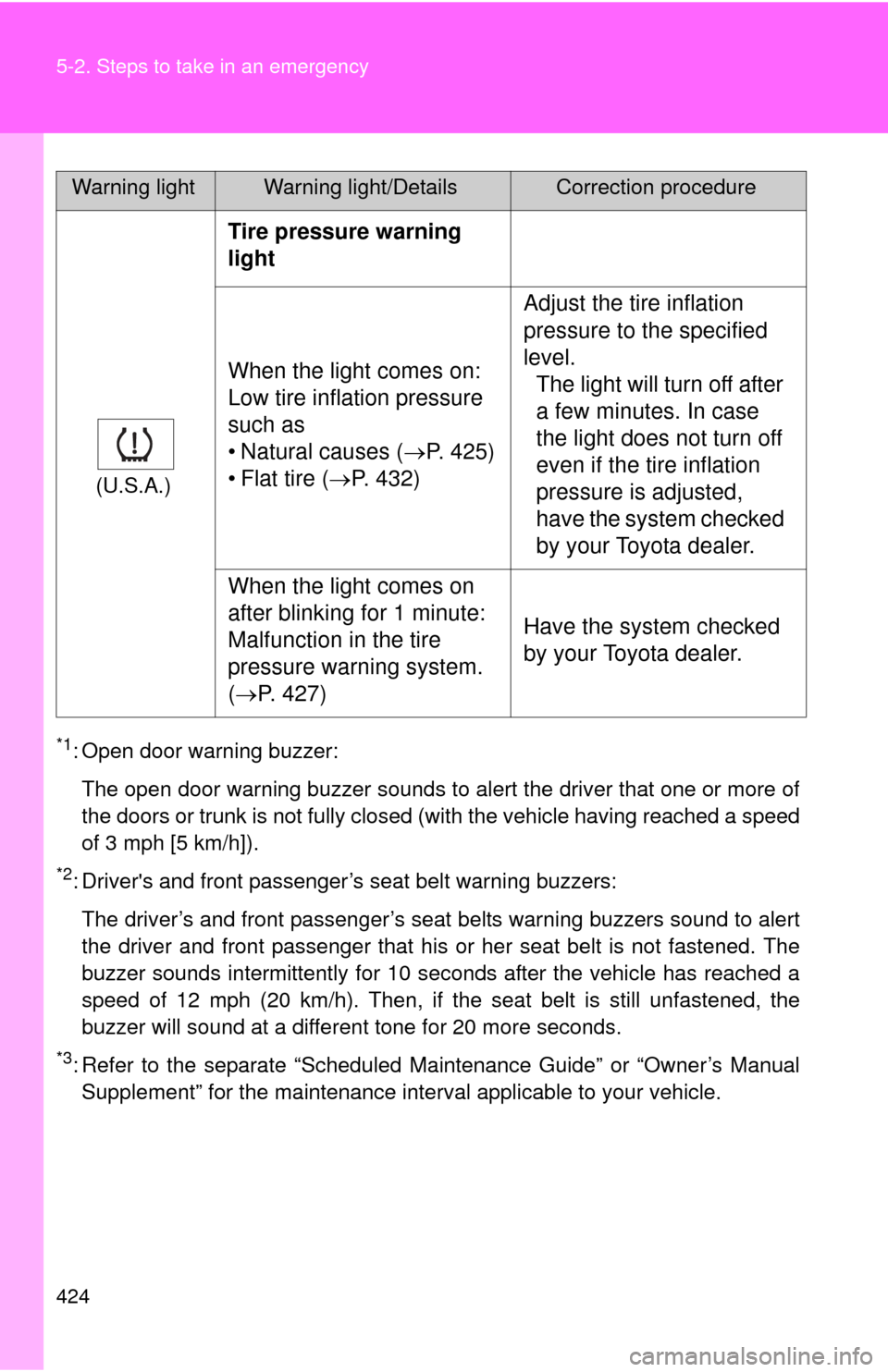
Tire pressure warning
light
When the light comes on:
Low tire inflation pressure
such as
• Natural causes (
P. 425)
• Flat tire ( P. 432) Adjust the tire inflation
pressure to the specified
level.
The light will turn off after
a few minutes. In case
the light does not turn off
even if the tire inflation
pressure is adjusted,
have the system checked
by your Toyota dealer.
When the light comes on
after blinking for 1 minute:
Malfunction in the tire
pressure warning system.
( P. 427) Have the system checked
by your Toyota dealer.
Warning lightWarning light/DetailsCorrection procedure
Page 425 of 529

5
When trouble arises
425
5-2. Steps to take in an emergency
■
SRS warning light
This warning light system monitors the airbag sensor assembly, front airbag
sensors, side and curtain shield airbag sensors, curtain shield airbag sen-
sors, driver's seat position sensor, driver's seat belt buckle switch, front pas-
senger occupant classification sy stem, “PASSENGER AIR BAG ON”
indicator light, “PASSENGER AIR BAG OFF” indicator light, front passen-
ger's seat belt buckle switch, seat belt pretensioner assemblies, inflators,
interconnecting wiring and power sources. ( P. 86)
■ Front passenger detection sensor and passenger seat belt reminder
● If luggage is placed on the front passenger seat, the front passenger
detection sensor may cause the warning light to flash, even if a passen-
ger is not sitting in the seat.
● If a cushion is placed on the seat, the sensor may not detect a passen-
ger, and the warning light may not operate properly.
■
When the tire pressure warning light comes on
Check the tire inflation pressure and adjust to the appropriate level.
Pushing the tire pressure warning reset switch does not turn off the tire
pressure warning light.
■The tire pressure warning light may turn on due to natural causes
The tire pressure warning light may turn on due to natural causes such
as natural air leaks or tire inflation pressure changes caused by temper-
ature. In this case, adjusting the ti re inflation pressure will turn off the
warning light (after a few minutes).
Page 427 of 529

5
When trouble arises
427
5-2. Steps to take in an emergency
■If the tire pressure warning light frequently comes on after blinking
for 1 minute
If the tire pressure warning light frequently comes on after blinking for 1
minute when the “ENGINE START STOP” switch or engine switch is
turned ON, have it checked by your Toyota dealer.
■
Customization that can be co nfigured at Toyota dealer
The vehicle speed linked seat belt reminder buzzer can be disabled.
(Customizable features P. 491) However, Toyota recommends that the
seat belt reminder buzzer be operational to alert the driver and front passen-
ger that the seat belts are not fastened.
CAUTION
■If the tire pressure warning light comes on
Be sure to observe the following precautions. Failure to do so could
cause loss of vehicle control and result in death or serious injury.
●Stop your vehicle in a safe place as soon as possible. Adjust the tire
inflation pressure immediately.
●If the tire pressure warning light comes on even after tire inflation pres-
sure adjustment, it is pr obable that you have a flat tire. Check the tires.
If the tire is flat, change to the spare tire and have the flat tire repaired
by the nearest Toyota dealer.
●Avoid abrupt maneuvering and braking. If the vehicle tires deteriorate,
you could lose control of the steering wheel or the brakes.
■If a blowout or sudden air leakage should occur
The tire pressure warning syste m may not activate immediately.
Page 455 of 529
5
When trouble arises
455
5-2. Steps to take in an emergency
NOTICE
■
To prevent damage to the vehicle
Do not pull- or push-start the vehicle, because the catalytic converter may
overheat and become a fire hazard.
■ When handling jumper cables
Be careful that the jumper cables do not become tangled in the cooling fans
or any of the belts when connecting or disconnecting them.
■ When attaching the engine cover (1 .8 L 4-cylinder [2ZR-FE] engine)
Ensure that the rubber grommets remain attached to the engine cover. If the
grommet is attached to the bolts, transfer grommets to the engine cover.
Page 457 of 529
5
When trouble arises
457
5-2. Steps to take in an emergency
■
Overheating
If you observe the following, your vehicle may be overheating.
●The engine coolant temperature gauge enters the red zone or a loss of
power is experienced.
● Steam is coming from under the hood.
CAUTION
■To prevent an accident or injury when inspecting under the hood of
your vehicle
●If steam is seen coming from under the hood, do not open the hood until
the steam has subsided. The engine compartment may be very hot, caus-
ing serious injury such as burns.
● Keep hands and clothing away from the fan and other belts while the
engine is running.
● Do not loosen the coolant reservoir cap while the engine and radiator are
hot.
Serious injury, such as burns, may result from hot coolant and steam
released under pressure.
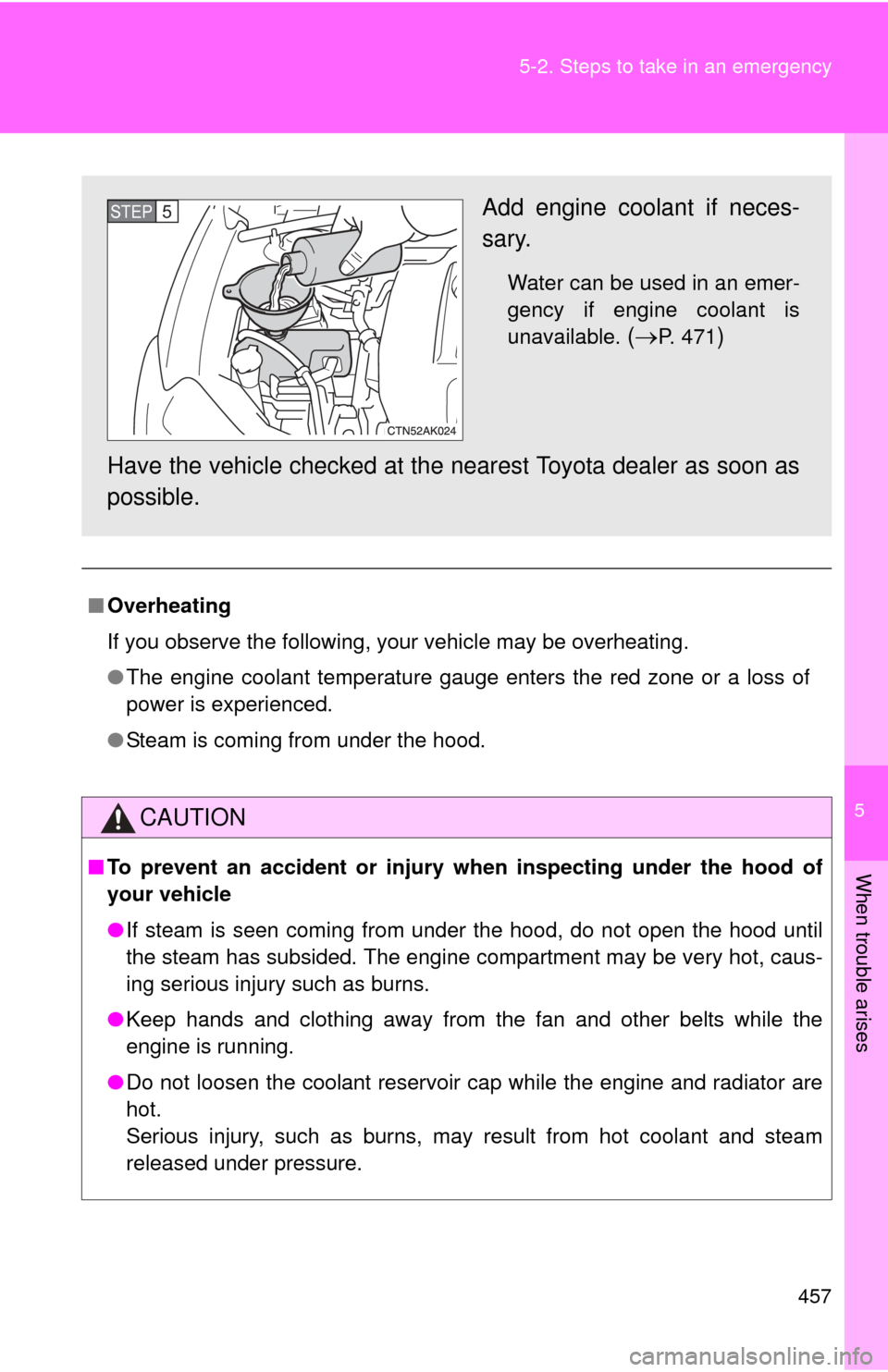
Add engine coolant if neces-
sary.
Water can be used in an emer-
gency if engine coolant is
unavailable.
(P. 471)
Have the vehicle chec ked at the nearest Toyota dealer as soon as
possible.
STEP 5