Page 74 of 529

74 1-4. Opening and closing the windows
■The moon roof can be operated when
Vehicles with smart key system
The “ENGINE START STOP” switch is in IGNITION ON mode.
Vehicles without smart key system
The engine switch is in the “ON” position.
■ Operating the moon roof af ter turning the engine OFF
Vehicles with smart key system
The moon roof can be operated for approximately 45 seconds after the
“ENGINE START STOP” switch is turned to ACCESSORY mode or turned
OFF. They cannot, however, be operated once either front door is opened.
Vehicles without smart key system
The moon roof can be operated for approximately 45 seconds after the
engine switch is turned to the “ACC” or “LOCK” position. It cannot, however,
be operated once either front door is opened.
■ Jam protection function
If an object is detected between the moon roof and the frame while closing
or tilting down, travel is stopped and the moon roof opens slightly.
■ To reduce moon roof wind noise
When the moon roof is opened automatically, it will stop slightly before the
fully open position. Driving with the moon roof in this position can help
reduce wind noise.
■ Sunshade
The sunshade can be opened and closed manually. However, the sunshade
will open automatically when the moon roof is opened.
Page 85 of 529

85
1-7. Safety information
1
Before driving
CAUTION
■
While driving
●Do not adjust the position of the driver's seat while driving.
Doing so could cause the driver to lose control of the vehicle.
● Do not place a cushion between the driver or passenger and the seatback.
A cushion may prevent correct posture from being achieved, and reduce
the effectiveness of the seat belt and head restraint, increasing the risk of
death or serious injury to the driver or passenger.
● Do not place anything under the front seats.
Objects placed under the front seats may become jammed in the seat
tracks and stop the seat from locking in place. This may lead to an acci-
dent. The adjustment mechanism may also be damaged.
■ Adjusting the seat position
●Take care when adjusting the seat position to ensure that other passen-
gers are not injured by the moving seat.
● Do not put your hands under the seat or near the moving parts to avoid
injury.
Fingers or hands may become jammed in the seat mechanism.
Page 86 of 529
86
1-7. Safety information
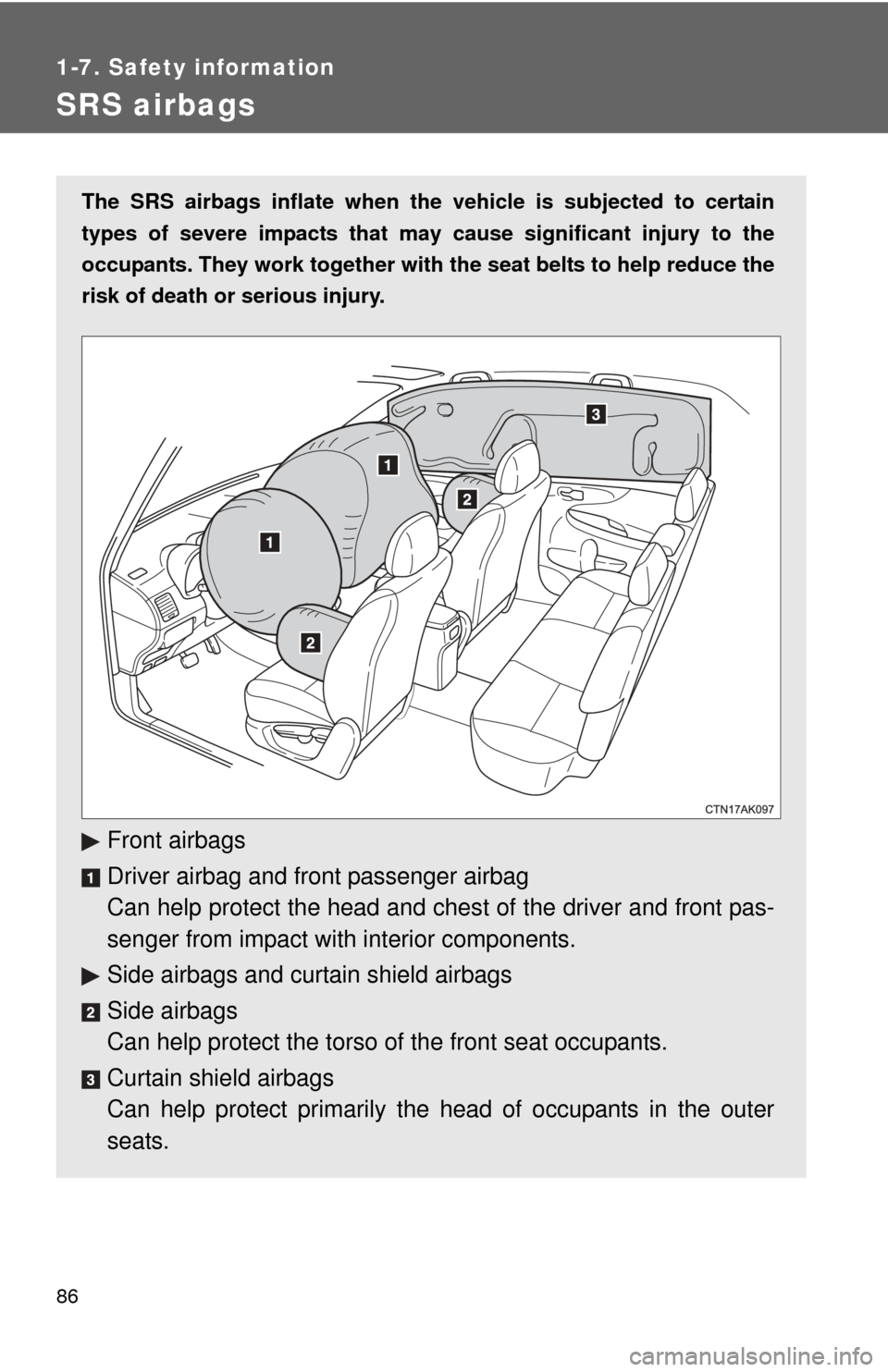
SRS airbags
The SRS airbags inflate when the vehicle is subjected to certain
types of severe impacts that may cause significant injury to the
occupants. They work together with the seat belts to help reduce the
risk of death or serious injury.
Front airbags
Driver airbag and front passenger airbag
Can help protect the head and ches t of the driver and front pas-
senger from impact with interior components.
Side airbags and curtain shield airbags
Side airbags
Can help protect the torso of the front seat occupants.
Curtain shield airbags
Can help protect primarily the head of occupants in the outer
seats.
Page 87 of 529
87
1-7. Safety information
1
Before driving
Airbag system components
Your vehicle is equipped with ADVANCED AIRBAGS designed based
on US motor vehicle safety standards (FMVSS208). The airbag sys-
tem controls airbag deployment po wer for the driver and front pas-
senger. The driver airbag system cons ists of the driver seat's position
sensor etc. The front passenger's ai rbag system consists of the front
passenger occupant classification sensor etc. Front airbag sensors
Front passenger occupant
classification system (ECU
and sensors)
Side and curtain shield air-
bag sensors
Front passenger airbag
Side airbags
Curtain shield airbags
“PASSENGER AIR BAG
ON” and “PASSENGER
AIR BAG OFF” indicator
lights
SRS warning light
Front passenger’s seat belt
buckle switch
Airbag sensor assembly
Curtain shield airbag sen-
sors
Driver airbag
Driver’s seat belt buckle
switch
Driver’s seat position sen-
sor
Page 88 of 529
88 1-7. Safety information
The main SRS airbag system components are shown above. The
SRS airbag system is controlled by the airbag sensor assembly. The
airbag sensor assembly consists of a safing sensor and an airbag
sensor.
In certain types of severe frontal or side impacts, the SRS airbag sys-
tem triggers the airbag inflators. A chemical reaction in the inflators
quickly fills the airbags with non-toxic gas to help restrain the motion
of the occupants.
Page 89 of 529

89
1-7. Safety information
1
Before driving
■
If the SRS airbags deploy (inflate)
●Bruising and slight abrasions may result from contact with a deploying
(inflating) SRS airbag.
● A loud noise and white powder will be emitted.
● Parts of the airbag module (steering wheel hub, airbag cover and inflator)
as well as the front seats, and parts of the front and rear pillars and roof
side rail, may be hot for several minutes. The airbag itself may also be
hot.
● The windshield may crack.
■ SRS airbag deployment co nditions (front airbags)
● The SRS front airbags will deploy in the event of an impact that exceeds
the set threshold level (the level of force corresponding to an approxi-
mately 12 - 18 mph [20 - 30 km/h] frontal collision with a fixed wall that
does not move or deform).
However, this threshold velocity will be considerably higher if the vehicle
strikes an object, such as a parked vehicle or sign pole, which can move or
deform on impact, or if the vehicle is involved in an underride collision (e.g.
a collision in which the front of the vehicle “underrides”, or goes under, the
bed of a truck, etc.).
● It is possible that in some collisions where the forward deceleration of the
vehicle is very close to the designed threshold level, the SRS front air-
bags and the seat belt pretensioners may not activate together.
● The SRS front passenger airbag will not activate if there is no passenger
sitting in the front passenger seat. However, the front passenger airbag
may deploy if luggage is put in the seat, or the seat belt is fastened, even
if the seat is unoccupied. ( P. 9 8 )
Page 90 of 529
90 1-7. Safety information
■SRS airbag deployment conditions (s ide airbags and curtain shield air-
bags)
The SRS side airbags and SRS curtain shield airbags will deploy in the
event of an impact that exceeds the set threshold level (the level of force
corresponding to the impact force produced by an approximately 3300 lb.
[1500 kg] vehicle colliding with the vehicle cabin from a direction perpendicu-
lar to the vehicle orientation at an approximate speed of 12 - 18 mph [20 - 30
km/h]). Depending on the conditions and type of accident, there are times
when the curtain shield airbags may deploy (inflate) in a front impact.
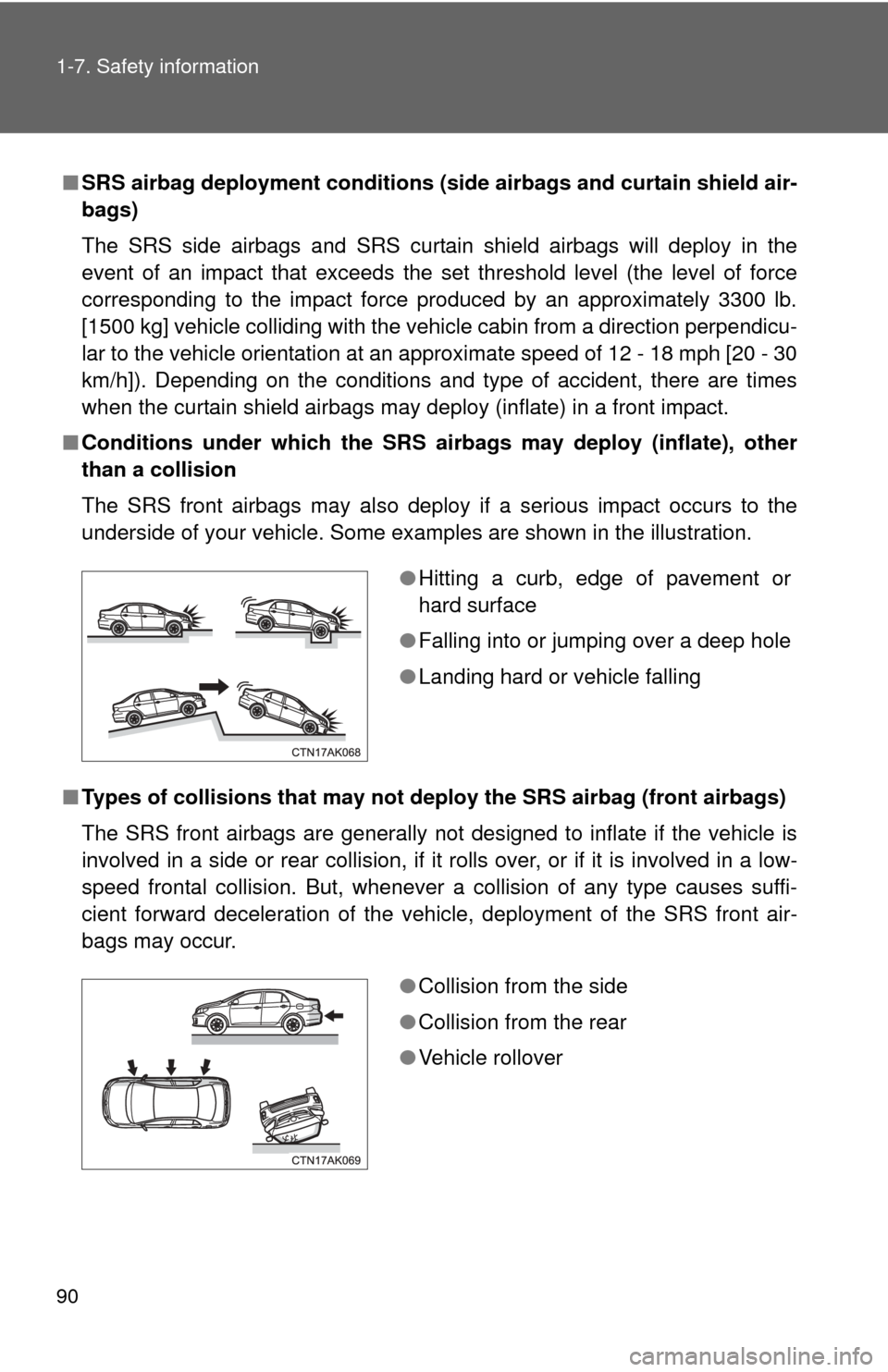
■ Conditions under which the SRS airbags may deploy (inflate), other
than a collision
The SRS front airbags may also deploy if a serious impact occurs to the
underside of your vehicle. Some examples are shown in the illustration.
■ Types of collisions that may not depl oy the SRS airbag (front airbags)
The SRS front airbags are generally not designed to inflate if the vehicle is
involved in a side or rear collision, if it rolls over, or if it is involved in a low-
speed frontal collision. But, whenever a collision of any type causes suffi-
cient forward deceleration of the vehicle, deployment of the SRS front air-
bags may occur.
● Hitting a curb, edge of pavement or
hard surface
● Falling into or jumping over a deep hole
● Landing hard or vehicle falling
●Collision from the side
● Collision from the rear
● Vehicle rollover
Page 91 of 529
91
1-7. Safety information
1
Before driving
■
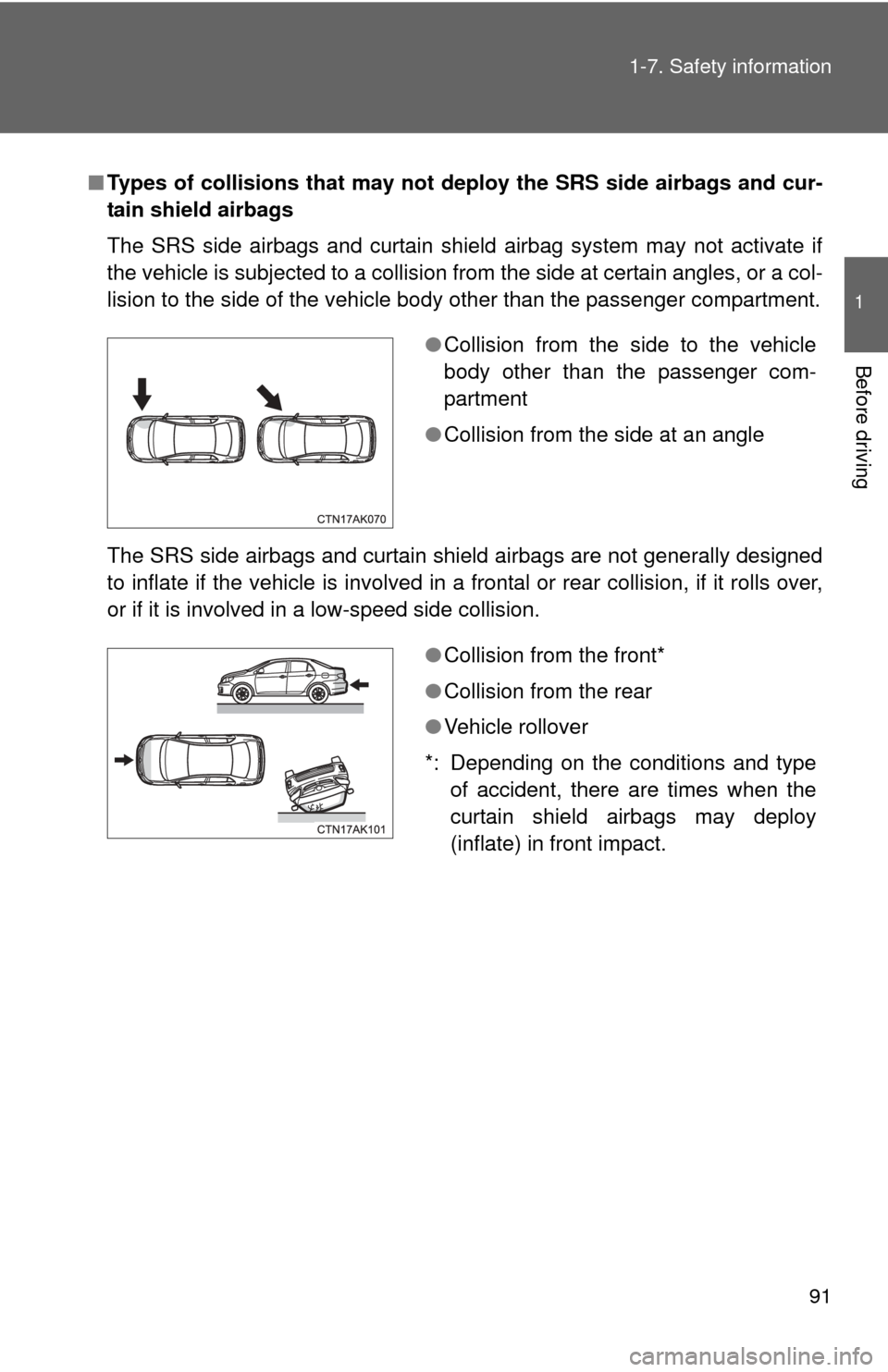
Types of collisions that may not deploy the SRS side airbags and cur-
tain shield airbags
The SRS side airbags and curtain shield airbag system may not activate if
the vehicle is subjected to a collision from the side at certain angles, or a col-
lision to the side of the vehicle body other than the passenger compartment.
The SRS side airbags and curtain shield airbags are not generally designed
to inflate if the vehicle is involved in a frontal or rear collision, if it rolls over,
or if it is involved in a low-speed side collision.
●Collision from the side to the vehicle
body other than the passenger com-
partment
● Collision from the side at an angle
●Collision from the front*
● Collision from the rear
● Vehicle rollover
*: Depending on the conditions and type of accident, there are times when the
curtain shield airbags may deploy
(inflate) in front impact.