Page 451 of 529
5
When trouble arises
451
5-2. Steps to take in an emergency
Connecting the jumper cables
Positive (+) battery terminal on your vehicle
Positive (+) battery terminal on the second vehicle
Negative (-) battery terminal on the second vehicle
Connect the jumper cable to ground on your vehicle as shown in
the illustration. Start the engine of the second vehicle. Increase the engine
speed slightly and maintain at that level for approximately 5
minutes to recharge the battery of your vehicle.
Vehicles with smart key system: Open and close any of the
doors with the “ENGINE START STOP” switch OFF.
Maintain the engine speed of the second vehicle, and turn
the “ENGINE START STOP” switch to IGNITION ON mode
(vehicles with smart key system) or turn the engine switch
to the “ON” position (vehicles without smart key system),
then start the vehicle's engine.
STEP 2
STEP 3
STEP 4
STEP 5
Page 452 of 529
452 5-2. Steps to take in an emergency
Once the vehicle’s engine has started, remove the jumper
cables in the exact reverse order in which they were con-
nected.
Once the engine starts, have the vehicle checked at your Toyota
dealer as soon as possible.
2.4 L 4-cylinder (2AZ-FE) engine
Connecting the jumper cables Positive (+) battery terminal on your vehicle
Positive (+) battery terminal on the second vehicle
Negative (-) battery terminal on the second vehicle
Connect the jumper cable to ground on your vehicle as shown in
the illustration. Start the engine of the second vehicle. Increase the engine
speed slightly and maintain at that level for approximately 5
minutes to recharge the battery of your vehicle.STEP 6
STEP 1
STEP 2
Page 453 of 529

5
When trouble arises
453
5-2. Steps to take in an emergency
■
Avoiding a discharged battery
●Turn off the headlights and the audio system while the engine is turned
off.
● Turn off any unnecessary electrical components when the vehicle is run-
ning at a low speed for an extended period, such as in heavy traffic, etc.
■ Charging the battery
The electricity stored in the battery will discharge gradually even when the
vehicle is not in use, due to natural discharge and the draining effects of cer-
tain electrical appliances. If the vehicle is left for a long time, the battery may
discharge, and the engine may be unable to start. (The battery recharges
automatically during driving.)
Maintain the engine speed of the second vehicle, and turn
the engine switch to the “ON” position, then start the vehi-
cle's engine.
Once the vehicle’s engine has started, remove the jumper
cables in the exact reverse order in which they were con-
nected.
Once the engine starts, have the vehicle checked at your Toyota
dealer as soon as possible.STEP 3
STEP 4
Page 455 of 529
5
When trouble arises
455
5-2. Steps to take in an emergency
NOTICE
■
To prevent damage to the vehicle
Do not pull- or push-start the vehicle, because the catalytic converter may
overheat and become a fire hazard.
■ When handling jumper cables
Be careful that the jumper cables do not become tangled in the cooling fans
or any of the belts when connecting or disconnecting them.
■ When attaching the engine cover (1 .8 L 4-cylinder [2ZR-FE] engine)
Ensure that the rubber grommets remain attached to the engine cover. If the
grommet is attached to the bolts, transfer grommets to the engine cover.
Page 456 of 529
456
5-2. Steps to take in an emergency
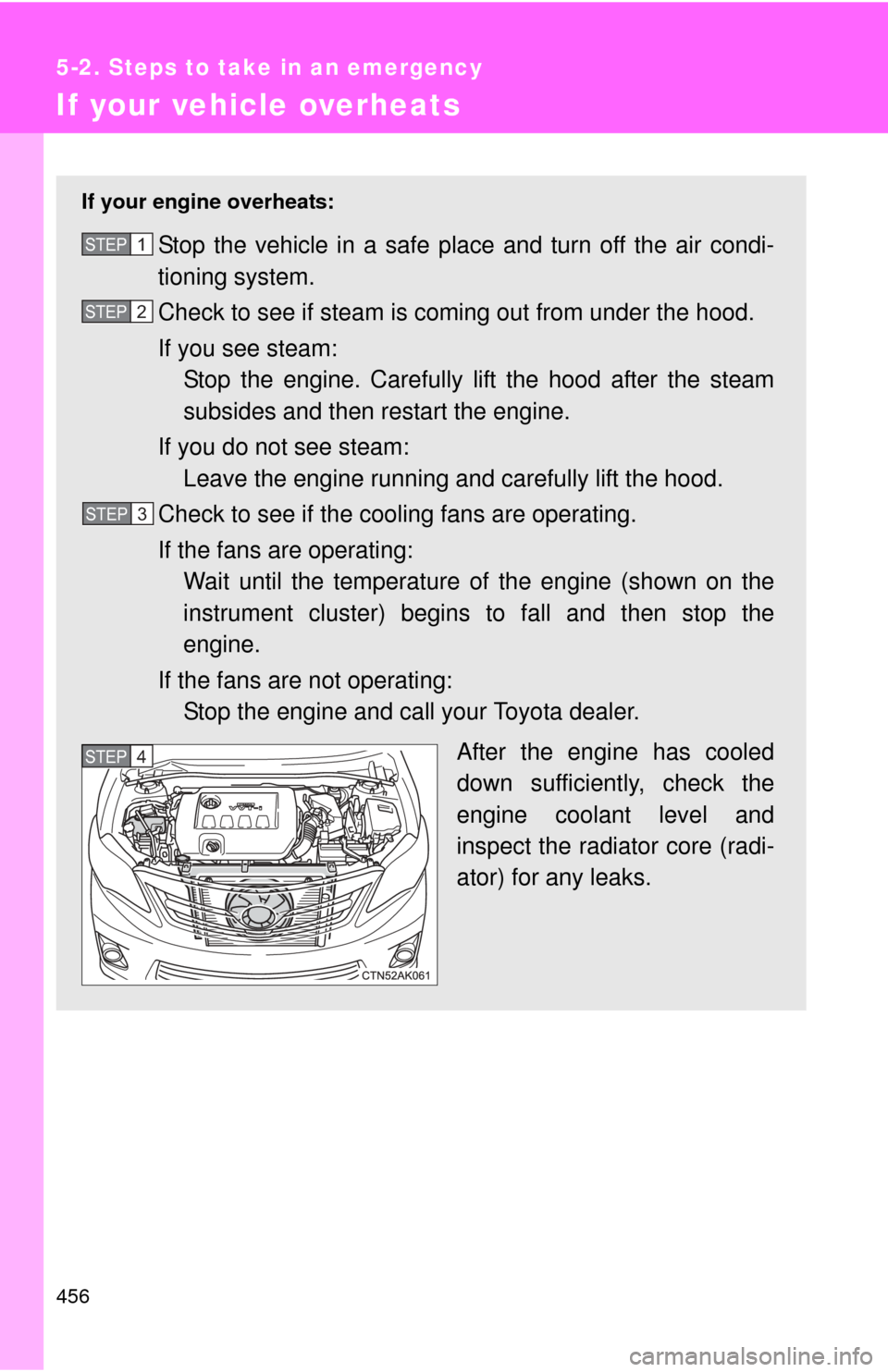
If your vehicle overheats
If your engine overheats:
Stop the vehicle in a safe place and turn off the air condi-
tioning system.
Check to see if steam is coming out from under the hood.
If you see steam: Stop the engine. Carefully lift the hood after the steam
subsides and then restart the engine.
If you do not see steam: Leave the engine running and carefully lift the hood.
Check to see if the cooling fans are operating.
If the fans are operating: Wait until the temperature of the engine (shown on the
instrument cluster) begins to fall and then stop the
engine.
If the fans are not operating: Stop the engine and call your Toyota dealer.
After the engine has cooled
down sufficiently, check the
engine coolant level and
inspect the radiator core (radi-
ator) for any leaks.STEP 1
STEP 2
STEP 3
STEP 5 STEP 4
Page 459 of 529
5
When trouble arises
459
5-2. Steps to take in an emergency
If the vehicle becomes stuck
CAUTION
■When attempting to free a stuck vehicle
If you choose to rock the vehicle back and forth to free it, make sure the sur-
rounding area is clear, to avoid striking other vehicles, objects or persons.
The vehicle may also lunge forward or lunge back suddenly as it becomes
free. Use extreme caution.
■ When shifting the shift lever
For vehicles with an automatic transmission, be careful not to shift the shift
lever with the accelerator pedal depressed.
This may lead to unexpected rapid acceleration of the vehicle that may
cause an accident and result in death or serious injury.
Carry out the following procedures if the tires spin or the vehicle
becomes stuck in mud, dirt, or snow.
Stop the engine. Set the parking brake and put the shift
lever in P (automatic transmission) or N (manual transmis-
sion).
Remove the mud, snow, or sand from around the stuck tire.
Place wood, stones or some other material to help provide
traction under the tires.
Restart the engine.
Shift the shift lever to the D or R position (automatic trans-
mission) or 1 or R position (manual transmission), release
the parking brake and carefully apply the accelerator to free
the vehicle.STEP 1
STEP 2
STEP 3
STEP 4
STEP 5
Page 462 of 529
462 5-2. Steps to take in an emergency
CAUTION
■If the engine has to be turned off while driving
●Power assist for the brakes and steering wheel will be lost, making the
brake pedal harder to depress and the steering wheel heavier to turn.
Decelerate as much as possible before turning off the engine.
● Vehicles without a smart key system: Never attempt to remove the key, as
doing so will lock the steering wheel.
Vehicles with a smart key sys-
tem: Stop the engine by press-
ing and holding the “ENGINE
START STOP” switch for 3
consecutive seconds or more.
Stop the vehicle in a safe place by the road.
Press and hold for 3 seconds or more
STEP 4
STEP 5
Page 469 of 529

469
6-1. Specifications
6
Vehicle specifications
■
Engine oil selection
“Toyota Genuine Motor Oil” is used in your Toyota vehicle. Use
Toyota approved “Toyota Genuine Motor Oil” or equivalent to satisfy
the following grade and viscosity.
Oil grade: ILSAC multigrade engine oil
Recommended viscosity:
1.8 L 4-cylinder (2ZR-FE) engine
SAE 0W-20
SAE 0W-20 is the best choice for
good fuel economy and good
starting in cold weather.
If SAE 0W-20 is not available,
SAE 5W-20 oil may be used.
However, it must be replaced
with SAE 0W-20 at the next oil
change.
Oil viscosity (0W-20 is explained here as an example):
• The 0W in 0W-20 indicates the characteristic of the oil which allowscold startability. Oils with a lower value before the W allow for easier
starting of the engine in cold weather.
• The 20 in 0W-20 indicates the viscosity characteristic of the oil when the oil is at high temperature. An oil with a higher viscosity (one with a
higher value) may be better suited if the vehicle is operated at high
speeds, or under extreme load conditions.
Outside temperature