Page 416 of 580
416 4-3. Do-it-yourself maintenance
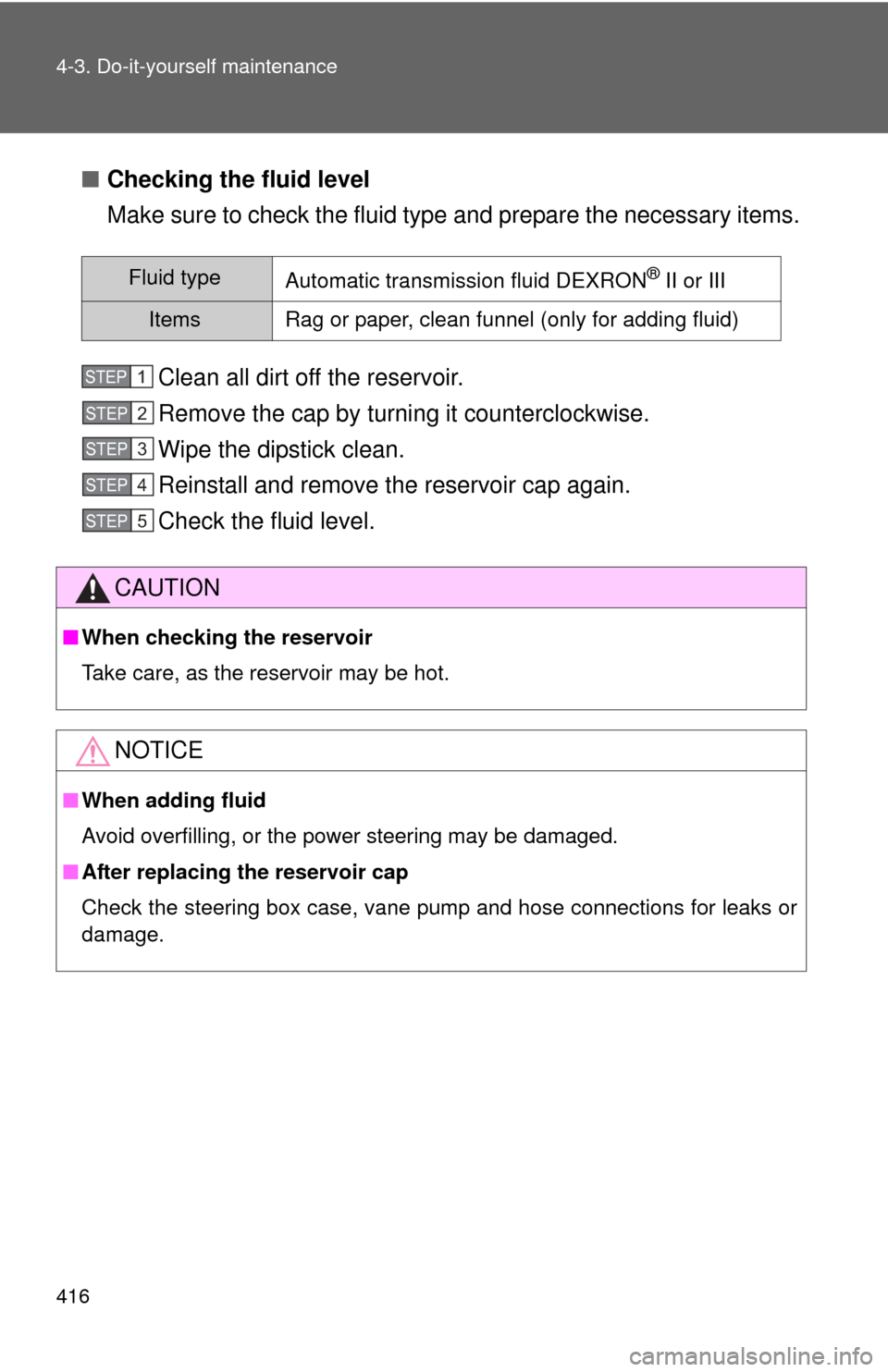
■Checking the fluid level
Make sure to check the fluid type and prepare the necessary items.
Clean all dirt off the reservoir.
Remove the cap by turning it counterclockwise.
Wipe the dipstick clean.
Reinstall and remove the reservoir cap again.
Check the fluid level.
Fluid typeAutomatic transmission fluid DEXRON® II or III
ItemsRag or paper, clean funnel (only for adding fluid)
CAUTION
■ When checking the reservoir
Take care, as the reservoir may be hot.
NOTICE
■When adding fluid
Avoid overfilling, or the power steering may be damaged.
■ After replacing the reservoir cap
Check the steering box case, vane pump and hose connections for leaks or
damage.
STEP1
STEP2
STEP3
STEP4
STEP5
Page 447 of 580
4
Maintenance and care
447
4-3. Do-it-yourself maintenance
FuseAmpereCircuit
9 STOP No.3 7.5 A Electronic controlled transmission
system, multiport fuel injection
system/sequential multiport fuel
injection system
10 INJ 15 A Multiport fuel injection system/
sequential multiport fuel injection
system
11 AM2 7.5 A Starter system
12 DOOR No.1 25 A Multiplex communication system
13 ALT-S 7.5 A Charging system
14 ETCS 10 A Multiport fuel injection system/
sequential multiport fuel injection
system
15 IG2 25 A Multiport fuel injection system/
sequential multiport fuel injection
system, electronic controlled
transmission system
16 TURN/HAZ 15 A Turn signal lights
17 AMP 30 A Audio system
18 EFI No.3 7.5 A Smart key system, electronic con-
trolled transmission system
19 STR LOCK 15 A Steering lock system
20 STOP No.1 15 A Multiplex communication system
Page 450 of 580
450 4-3. Do-it-yourself maintenance
FuseAmpereCircuit
14TA I L10 A
Parking lights, license plate lights,
tail lights, front and rear side
marker lights
15PA N E L7.5 A
Seat heaters, navigation system,
emergency flashers,
electronically controlled
automatic transmission system,
glove box light, instrument panel
lights, power outlets
16ECU IG No.110 A
Center display, shift lock control
system, moon roof, multiplex
communication system, tire pres-
sure monitoring (warning) system
17ECU IG No.210 A
Anti-lock brake system, automatic
headlight leveling system, vehicle
stability control system, multiplex
communication system
18HTR7.5 A
Air conditioning system,
instrument panel lights, electric
cooling fan
19A/C COMP7.5 AAir conditioning system
20GAUGE No.110 ABack-up lights, navigation
system, emergency flashers
21WIP30 AWindshield wipers
22RR S/SHADE10 ARear sunshade
Page 451 of 580
4
Maintenance and care
451
4-3. Do-it-yourself maintenance
FuseAmpereCircuit
23IGN10 A
Multiport fuel injection system/
sequential multiport fuel injection
system, SRS airbag system, front
passenger occupant
classification system, smart key
system, starting system, electronic
controlled transmission system
24GAUGE No.27.5 AGauges and meters, center
display
25ECU-ACC7.5 A
Power rear view mirrors, center
display, shift lock system,
multiplex communication system
26CIG15 A
27PWR OUTLET15 APower outlets
28RADIO No.27.5 AAudio system, navigation system
29MIR HTR10 AOutside rear view mirror
defoggers
Page 473 of 580
5
When trouble arises
473
5-1. Essential information
If your vehicle needs to be towed
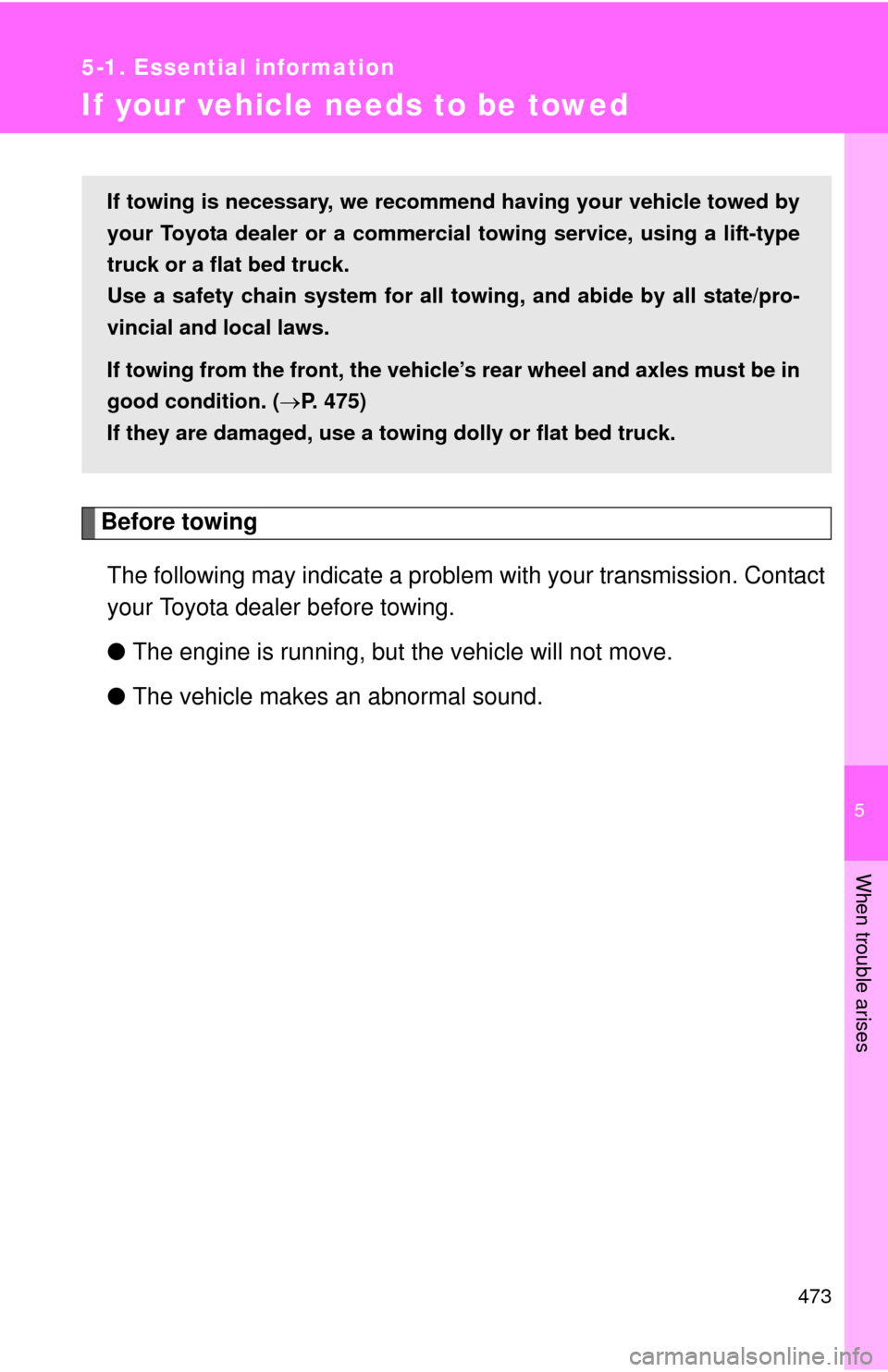
Before towingThe following may indicate a problem with your transmission. Contact
your Toyota dealer before towing.
● The engine is running, but the vehicle will not move.
● The vehicle makes an abnormal sound.
If towing is necessary, we recommend having your vehicle towed by
your Toyota dealer or a commerci al towing service, using a lift-type
truck or a flat bed truck.
Use a safety chain system for all to wing, and abide by all state/pro-
vincial and local laws.
If towing from the front, the vehicle ’s rear wheel and axles must be in
good condition. ( P. 475)
If they are damaged, use a towing dolly or flat bed truck.
Page 475 of 580
5
When trouble arises
475
5-1. Essential information
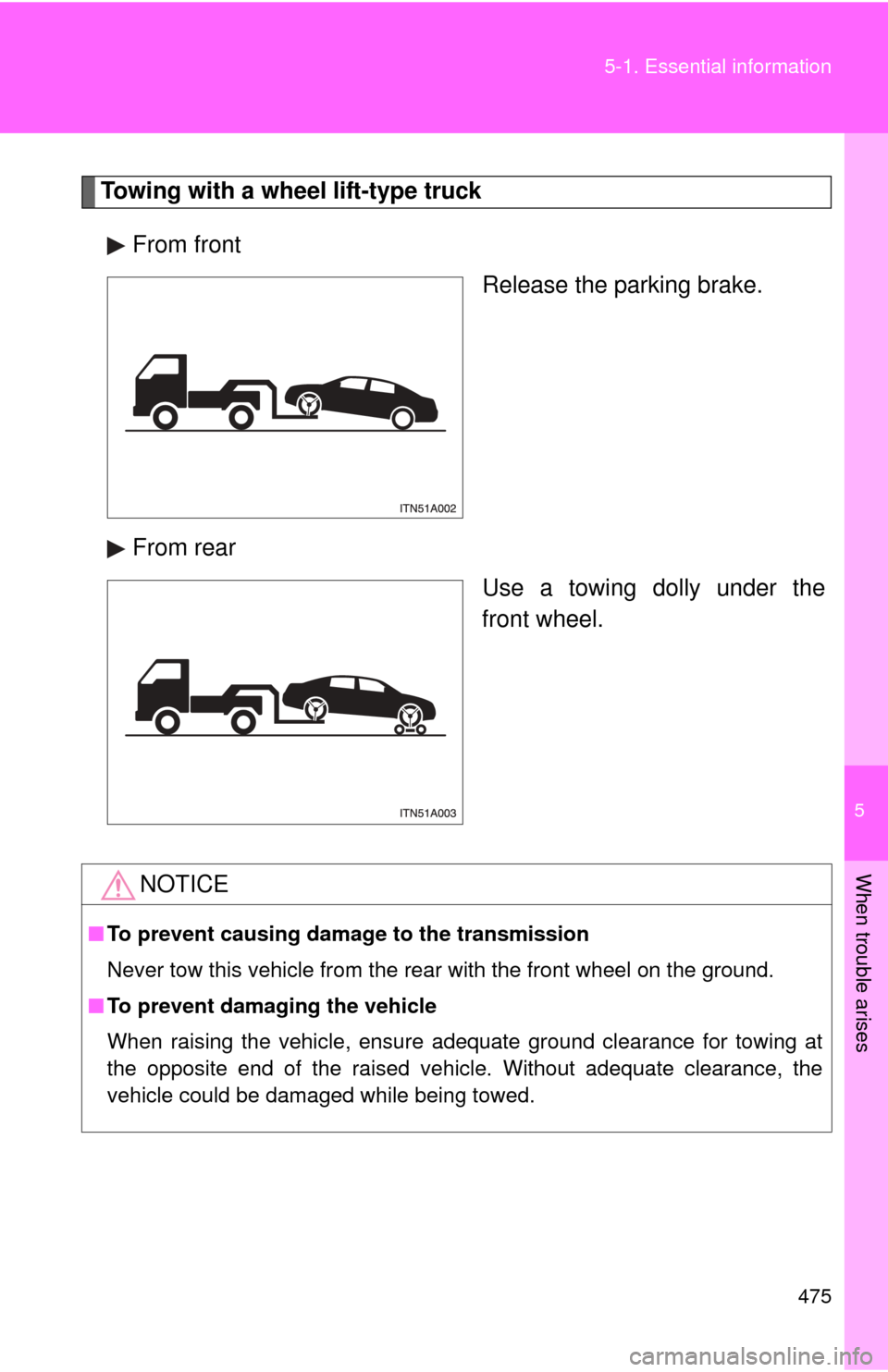
Towing with a wheel lift-type truck
From front Release the parking brake.
From rear Use a towing dolly under the
front wheel.
NOTICE
■To prevent causing damage to the transmission
Never tow this vehicle from the rear with the front wheel on the ground.
■ To prevent damaging the vehicle
When raising the vehicle, ensure adequate ground clearance for towing at
the opposite end of the raised vehicle. Without adequate clearance, the
vehicle could be damaged while being towed.
Page 480 of 580

480 5-2. Steps to take in an emergency
Stop the vehicle immediately.The following warning indicates the possibility of damage to the vehi-
cle that may lead to an accident. Immediately stop the vehicle in a
safe place and contact your Toyota dealer.
Have the vehicle inspected immediately.Failing to investigate the cause of the following warnings may lead to
the system operating abnormally and possibly cause an accident.
Have the vehicle inspected by your Toyota dealer immediately.
Warning lightWarning light/Details
Charging system warning light Malfunction in the vehicle’s charging system.
Low engine oil pressure warning light Abnormal level of engine oil pressure.
This warning light may turn on if the level of engine oil
declines. The light should turn off after checking the oil
and adding oil if necessary.
Warning lightWarning light/Details
(U.S.A.)
(Canada)
Malfunction indicator lampMalfunction in:
• The electronic engine control system;
• The electronic throttle control system; or
• The transmission control system.
Page 515 of 580

5
When trouble arises
515
5-2. Steps to take in an emergency
If the vehicle becomes stuck
CAUTION
■When attempting to free a stuck vehicle
If you choose to rock the vehicle back and forth to free it, make sure the sur-
rounding area is clear, to avoid striking other vehicles, objects or persons.
The vehicle may also lunge forward or lunge back suddenly as it becomes
free. Use extreme caution.
■ When shifting the shift lever
Be careful not to shift the shift lever with the accelerator pedal depressed.
This may lead to unexpected rapid acceleration of the vehicle that may
cause an accident and result in death or serious injury.
NOTICE
■To avoid damaging the transmission and other components
●Avoid spinning the wheels and do not rev the engine.
● If the vehicle remains stuck after trying these procedures, the vehicle may
require towing to be freed.
Carry out the following procedures if the tires spin or the vehicle
becomes stuck in mud, dirt, or snow.
Stop the engine. Set the parki ng brake and shift the shift
lever in “P”.
Remove the mud, snow, or sand from around the stuck tire.
Place wood, stones or some other material to help provide
traction under the tires.
Restart the engine.
Shift the shift lever to the “D ” or “R” position and carefully
apply the accelerator to free the vehicle.STEP1
STEP2
STEP3
STEP4
STEP5