Page 157 of 580

157
2-1. Driving procedures
2
When driving
CAUTION
■
When starting the engine
Always start the engine while sitting in the driver’s seat. Do not press the
accelerator pedal while starting the engine under any circumstances.
Doing so may cause an accident resulting in death or serious injury.
■ Stopping the engine in an emergency
If you want to stop the engine in an emergency while driving the vehicle,
press and hold the “ENGINE START STOP” switch for more than 3 seconds,
or press it briefly 3 times or more in succession.
However, do not touch the “ENGINE START STOP” switch while driving
except in an emergency. Turning the engine off while driving will not cause
loss of steering or braking control, but the power assist to these systems will
be lost. This will make it more difficult to steer and brake, so you should pull
over and stop the vehicle as soon as it is safe to do so.
NOTICE
■To prevent battery discharge
Do not leave the “ENGINE START STOP” switch in ACCESSORY or IGNI-
TION ON mode for long periods if the engine is not running.
■ When starting the engine
●Do not race the engine.
● If the engine becomes difficult to start or stalls frequently, have the engine
checked immediately.
Page 286 of 580
286
3-2. Using the audio system
Using the steering switches
Some audio features can be controlled using the switches on the
steering wheel.
Increases/decreases vol-
ume
Radio mode: Selects radio stations
CD mode: Selects tracks files
(MP3 and WMA) and
discs
iPod mode: Selects a song
USB memory mode: Selects a file and folder
Bluetooth
® audio mode:
Selects a track and
album
Turns the power on, selects
an audio source
Page 395 of 580
395
4-2. Maintenance
4
Maintenance and care
General maintenance
Engine compartment
ItemsCheck points
Battery • Maintenance-free ( P. 417)
Brake fluid • At the correct level? ( P. 414)
Engine coolant • At the correct level? ( P. 412)
Engine oil • At the correct level? ( P. 408)
Exhaust system • No fumes or strange sounds?
Power steering fluid • At the correct level? ( P. 415)
Radiator/condenser/hoses • Not blocked with foreign matter?
(P. 413)
Washer fluid • At the correct level? ( P. 420)
Listed below are the general maintenance items that should be per-
formed at the intervals specified in the “Scheduled Maintenance
Guide” or “Owner’s Manual Supp lement”. It is recommended that
any problem you notice should be brought to the attention of your
Toyota dealer or qualified service shop for advice.
Page 400 of 580
400 4-3. Do-it-yourself maintenance
ItemsParts and tools
Engine oil level (P. 408)
• “Toyota Genuine Motor Oil” or
equivalent
• Rag or paper towel, funnel (used only for adding engine oil)
Fuses (P. 444)• Fuse with same amperage rating
as original
Headlight aim ( P. 453)• Phillips-head screwdriver
Power steering fluid level
(P. 415)
• Automatic transmission fluid
DEXRON® II or III
• Rag or paper towel
• Clean funnel
Radiator and condenser (P. 413)
Tire inflation pressure ( P. 430)• Tire pressure gauge
• Compressed air source
Washer fluid (P. 420)
• Water washer fluid containing anti-
freeze (for winter use)
• Funnel
Page 406 of 580
406
4-3. Do-it-yourself maintenance
Engine compar tment
Engine coolant reservoir( P. 412)
Power steering fluid
reservoir ( P. 415)
Engine oil filler cap ( P. 409)
Engine oil level dipstick ( P. 408)Brake fluid reservoir
( P. 414)
Fuse box ( P. 444)
Battery ( P. 417)
Radiator ( P. 413)
Electric cooling fans
Condenser ( P. 413)
Washer fluid tank ( P. 420)
Page 415 of 580
4
Maintenance and care
415
4-3. Do-it-yourself maintenance
Power steering fluid
■ Fluid level
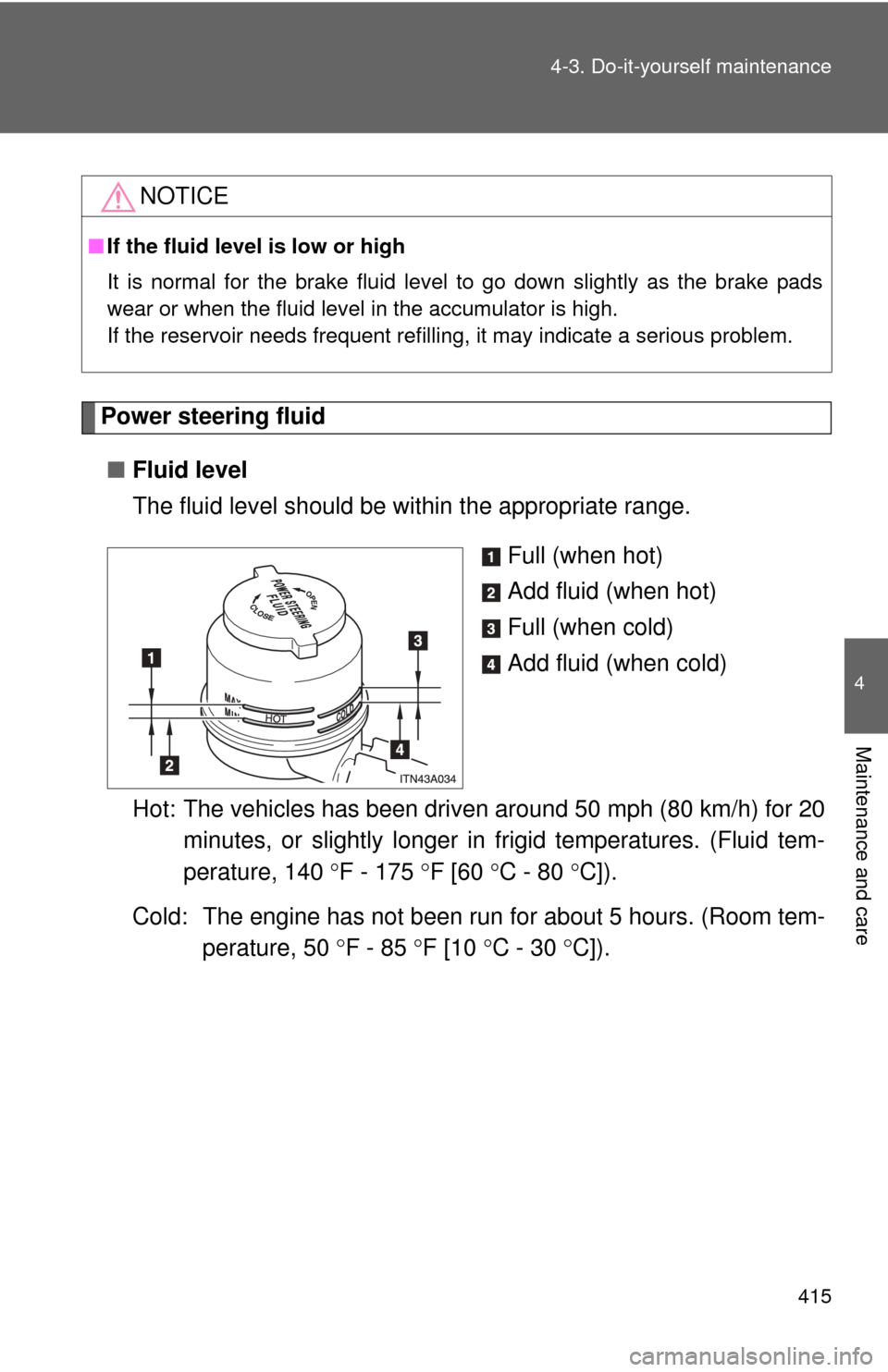
The fluid level should be within the appropriate range.
Full (when hot)
Add fluid (when hot)
Full (when cold)
Add fluid (when cold)
Hot: The vehicles has been driven around 50 mph (80 km/h) for 20 minutes, or slightly longer in frigid temperatures. (Fluid tem-
perature, 140 F - 175 F [60 C - 80 C]).
Cold: The engine has not been run for about 5 hours. (Room tem- perature, 50 F - 85 F [10 C - 30 C]).
NOTICE
■If the fluid level is low or high
It is normal for the brake fluid level to go down slightly as the brake pads
wear or when the fluid level in the accumulator is high.
If the reservoir needs frequent refilling, it may indicate a serious pro\
blem.
Page 416 of 580
416 4-3. Do-it-yourself maintenance
■Checking the fluid level
Make sure to check the fluid type and prepare the necessary items.
Clean all dirt off the reservoir.
Remove the cap by turning it counterclockwise.
Wipe the dipstick clean.
Reinstall and remove the reservoir cap again.
Check the fluid level.
Fluid typeAutomatic transmission fluid DEXRON® II or III
ItemsRag or paper, clean funnel (only for adding fluid)
CAUTION
■ When checking the reservoir
Take care, as the reservoir may be hot.
NOTICE
■When adding fluid
Avoid overfilling, or the power steering may be damaged.
■ After replacing the reservoir cap
Check the steering box case, vane pump and hose connections for leaks or
damage.
STEP1
STEP2
STEP3
STEP4
STEP5
Page 517 of 580
5
When trouble arises
517
5-2. Steps to take in an emergency
CAUTION
■
If the engine has to be turned off while driving
●Power assist for the brakes and steering wheel will be lost, making the
brake pedal harder to depress and the steering wheel heavier to turn.
Decelerate as much as possible before turning off the engine.
● Vehicles without a smart key system: Never attempt to remove the key, as
doing so will lock the steering wheel.
Vehicles with a smart key sys-
tem: To stop the engine, press
and hold the “ENGINE START
STOP” switch for 3 consecu-
tive seconds or more, or press
it briefly 3 times or more in
succession.
Stop the vehicle in a safe place by the road.
Press and hold for 3 seconds or more, or press briefly 3 times or more
STEP4
STEP5