Page 123 of 700

123
1-7. Safety information
1
Before driving
4RUNNER_U
Your vehicle is equipped with
ADVANCED AIRBAGS designed based
on the US motor vehicle safety standards (FMVSS208). The airbag
system controls airbag deployment power for the driver and front pas-
senger. The driver airbag system co nsists of the driver’s seat belt
buckle switch etc. The front pass enger’s airbag system consists of
the front passenger occupant classification sensor etc.
The main SRS airbag system components are shown above. The
SRS airbag system is controlled by the airbag sensor assembly. The
airbag sensor assembly consists of a safing sensor and an airbag
sensor.
In certain types of severe frontal or side impacts, the SRS airbag sys-
tem triggers the airbag inflators. A chemical reaction in the inflators
quickly fills the airbags with non-toxic gas to help rest rain the motion
of the occupants.
■ If the SRS airbags deploy (inflate)
● Bruising and slight abrasions may result from contact with a deploying
(inflating) SRS airbag.
● A loud noise and white powder will be emitted.
● Parts of the airbag module (steering wheel hub, airbag cover and inflator)
as well as the front seats, parts of the front and rear pillars, and roof side
rails, may be hot for several minutes. The airbag itself may also be hot.
● The windshield may crack.
● For Safety Connect subscribers, if the SRS airbags deploy or in the event
of a severe rear-end collision, the system is designed to send an emer-
gency call to the response center, notifying them of the vehicle’s location
(without needing to push the “SOS” button) and an agent will attempt to
speak with the occupants to ascertain the level of emergency and assis-
tance required. If the occupants are unable to communicate, the agent
automatically treats the call as an emergency and helps to dispatch the
necessary emergency services. ( P. 493)
Page 127 of 700
127
1-7. Safety information
1
Before driving
4RUNNER_U
■
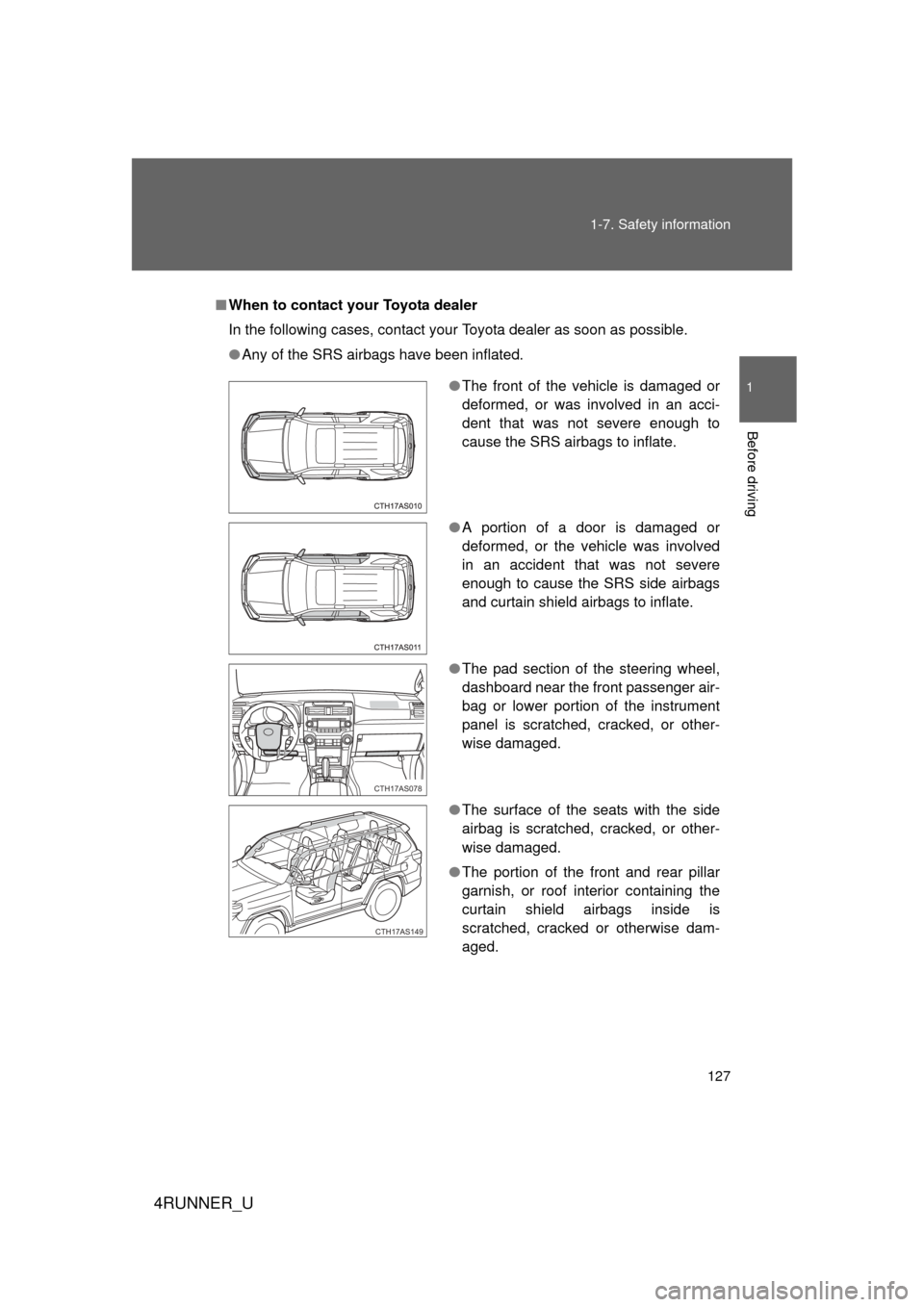
When to contact your Toyota dealer
In the following cases, contact your Toyota dealer as soon as possible.
● Any of the SRS airbags have been inflated.
●The front of the vehicle is damaged or
deformed, or was involved in an acci-
dent that was not severe enough to
cause the SRS airbags to inflate.
● A portion of a door is damaged or
deformed, or the vehicle was involved
in an accident that was not severe
enough to cause the SRS side airbags
and curtain shield airbags to inflate.
● The pad section of the steering wheel,
dashboard near the front passenger air-
bag or lower portion of the instrument
panel is scratched, cracked, or other-
wise damaged.
● The surface of the seats with the side
airbag is scratched, cracked, or other-
wise damaged.
● The portion of the front and rear pillar
garnish, or roof interior containing the
curtain shield airbags inside is
scratched, cracked or otherwise dam-
aged.
CTH17AS078
CTH17AS149
Page 129 of 700
129
1-7. Safety information
1
Before driving
4RUNNER_U
CAUTION
■
SRS airbag precautions
● The SRS front passenger airbag also deploys with considerable force, and
can cause death or serious injury especially if the front passenger is very
close to the airbag. The front passenger seat should be as far from the air-
bag as possible with the seatback adjusted, so the front passenger sits
upright.
● Improperly seated and/or restrained infants and children can be killed or
seriously injured by a deploying airbag. An infant or child who is too small
to use a seat belt should be properly secured using a child restraint sys-
tem. Toyota strongly recommends that all infants and children be placed in
the rear seats of the vehicle and properly restrained. The rear seats are
safer for infants and children than the front passenger seat. ( P. 142)
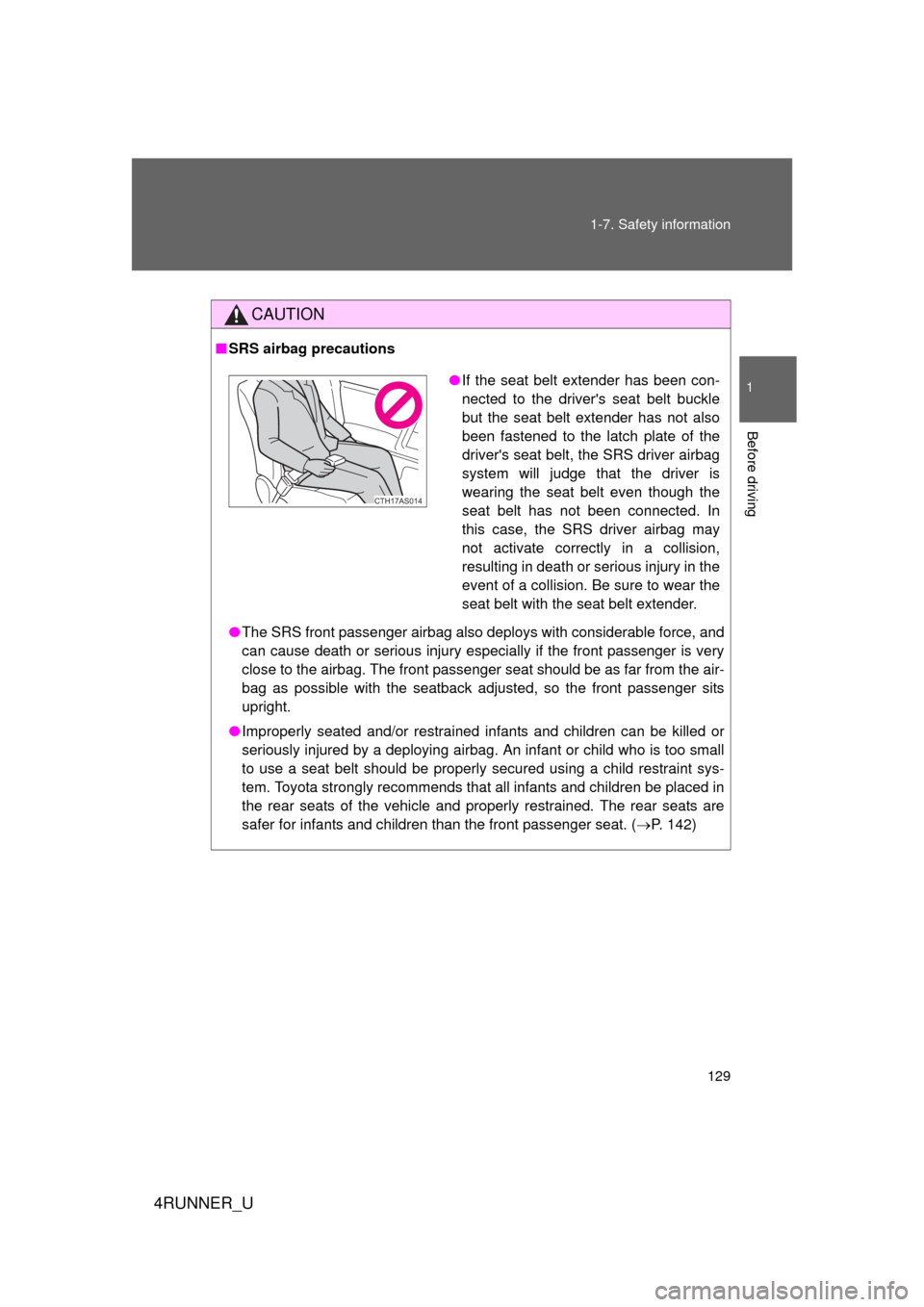
●If the seat belt extender has been con-
nected to the driver's seat belt buckle
but the seat belt extender has not also
been fastened to the latch plate of the
driver's seat belt, the SRS driver airbag
system will judge that the driver is
wearing the seat belt even though the
seat belt has not been connected. In
this case, the SRS driver airbag may
not activate correctly in a collision,
resulting in death or serious injury in the
event of a collision. Be sure to wear the
seat belt with the seat belt extender.
CTH17AS014
Page 133 of 700
133
1-7. Safety information
1
Before driving
4RUNNER_U
CAUTION
■
Modification and disposal of SRS airbag system components
Do not dispose of your vehicle or per form any of the following modifications
without consulting your Toyota dealer. The SRS airbags may malfunction or
deploy (inflate) accidentally, causing death or serious injury.
● Installation, removal, disassembly and repair of the SRS airbags
● Repairs, modifications, removal or replacement of the steering wheel,
instrument panel, dashboard, seats or seat upholstery, front and rear pil-
lars, roof side rails or roof head lining
● Repairs or modifications of the front fender, front bumper, or side of the
occupant compartment
● Installation of snow plows, winches, etc. to the front grille (bull bars, or
kangaroo bar etc.)
● Modifications to the vehicle’s suspension system
● Installation of electronic devices such as mobile two-way radios and CD
players
● Modifications to your vehicle for a person with a physical disability
Page 141 of 700
141
1-7. Safety information
1
Before driving
4RUNNER_U
CAUTION
■
Front passenger occupant cl assification system precautions
● If an adult sits in the front passenger seat, the “AIR BAG ON” indicator
light is illuminated. If the “AIR BAG OFF” indicator is illuminated, ask the
passenger to sit up straight, well back in the seat, feet on the floor, and
with the seat belt worn correctly. If the “AIR BAG OFF” indicator still
remains illuminated, either ask the passenger to move to the rear seat, or
if that is not possible, move the front passenger seat fully rearward.
● When it is unavoidable to install a forward-facing child restraint system on
the front passenger seat, install the child restraint system on the front pas-
senger seat in the proper order. ( P. 146)
● Do not modify or remove the front seats.
● Do not kick the front passenger seat or subject it to severe impact. Other-
wise, the SRS warning light may come on to indicate a malfunction of the
detection system. In this case, contact your Toyota dealer immediately.
● Child restraint systems installed on the second seat should not contact the
front seatbacks.
● Do not use a seat accessory, such as a cushion and seat cover, that cov-
ers the seat cushion surface.
● Do not modify or replace the upholstery of the front seat.
Page 146 of 700
146
1-7. Safety information
4RUNNER_U
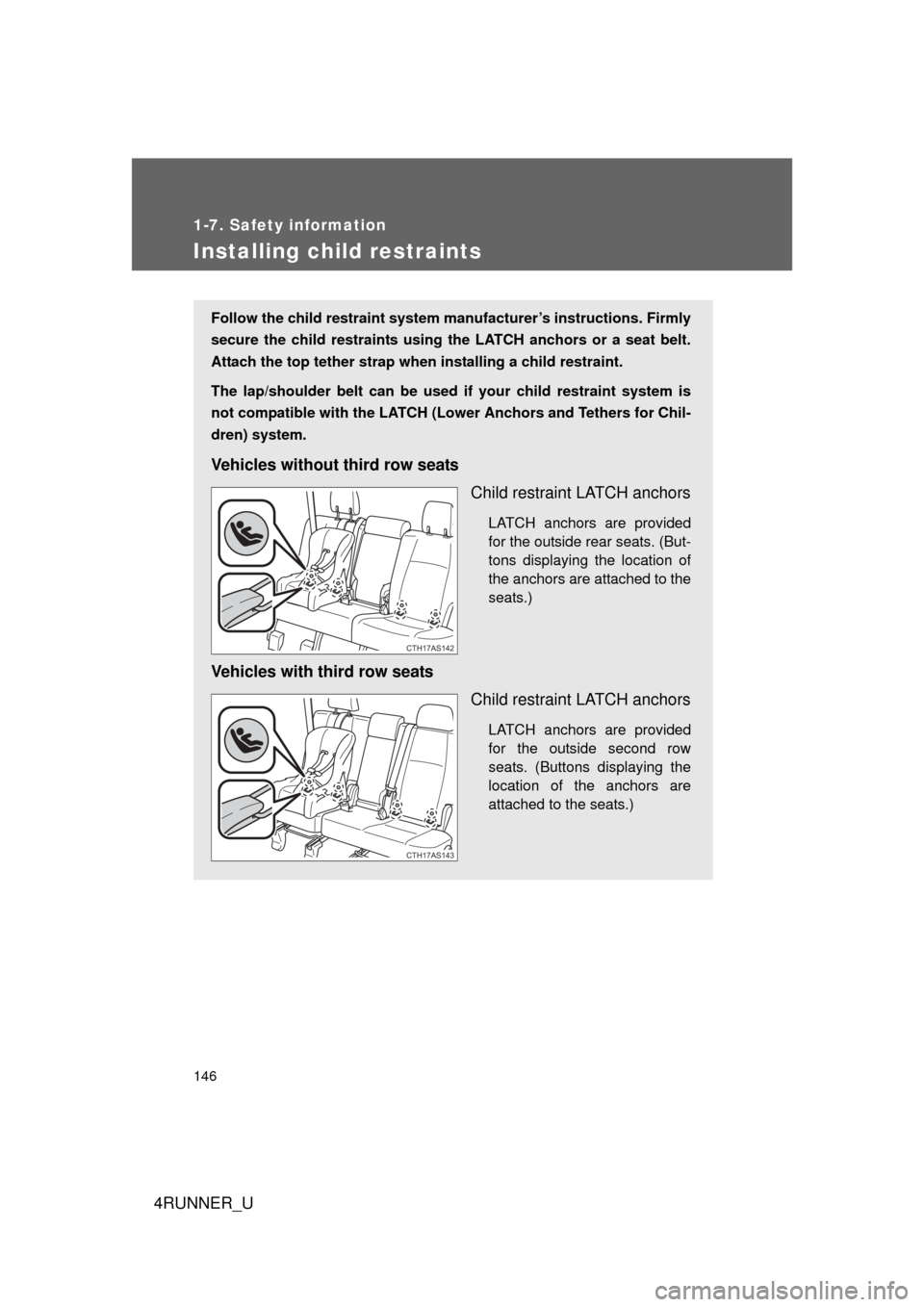
Installing child restraints
Follow the child restraint system manufacturer’s instructions. Firmly
secure the child restraints using the LATCH anchors or a seat belt.
Attach the top tether strap when installing a child restraint.
The lap/shoulder belt can be used if your child restraint system is
not compatible with the LATCH (Low er Anchors and Tethers for Chil-
dren) system.
Vehicles without third row seats
Child restraint LATCH anchors
LATCH anchors are provided
for the outside rear seats. (But-
tons displaying the location of
the anchors are attached to the
seats.)
Vehicles with third row seatsChild restraint LATCH anchors
LATCH anchors are provided
for the outside second row
seats. (Buttons displaying the
location of the anchors are
attached to the seats.)
CTH17AS142
CTH17AS143
Page 147 of 700
147
1-7. Safety information
1
Before driving
4RUNNER_U
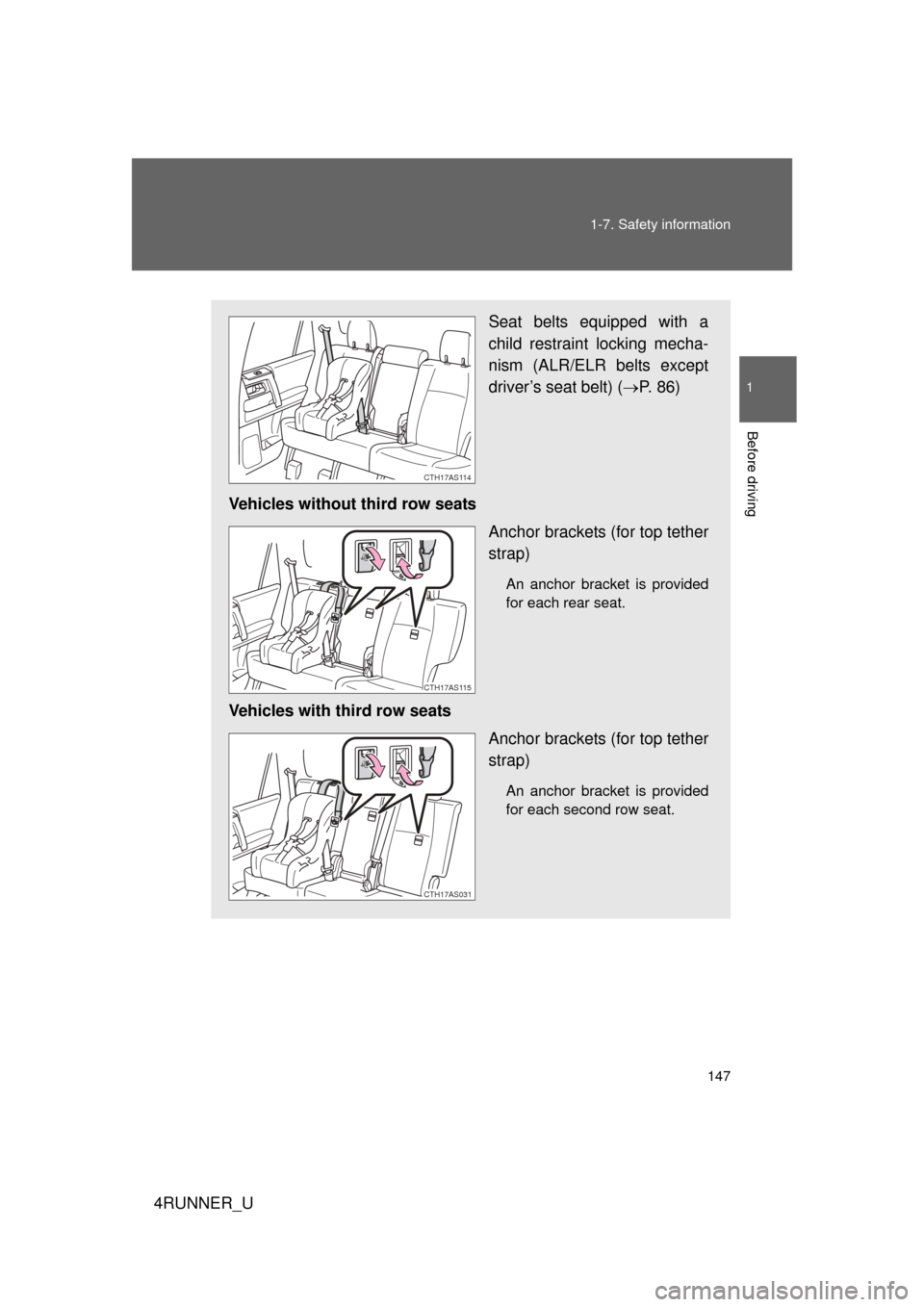
Seat belts equipped with a
child restraint locking mecha-
nism (ALR/ELR belts except
driver’s seat belt) (
P. 86)
Vehicles without third row seats Anchor brackets (for top tether
strap)
An anchor bracket is provided
for each rear seat.
Vehicles with third row seatsAnchor brackets (for top tether
strap)
An anchor bracket is provided
for each second row seat.
CTH17AS114
CTH17AS115
CTH17AS031
Page 148 of 700
148 1-7. Safety information
4RUNNER_U
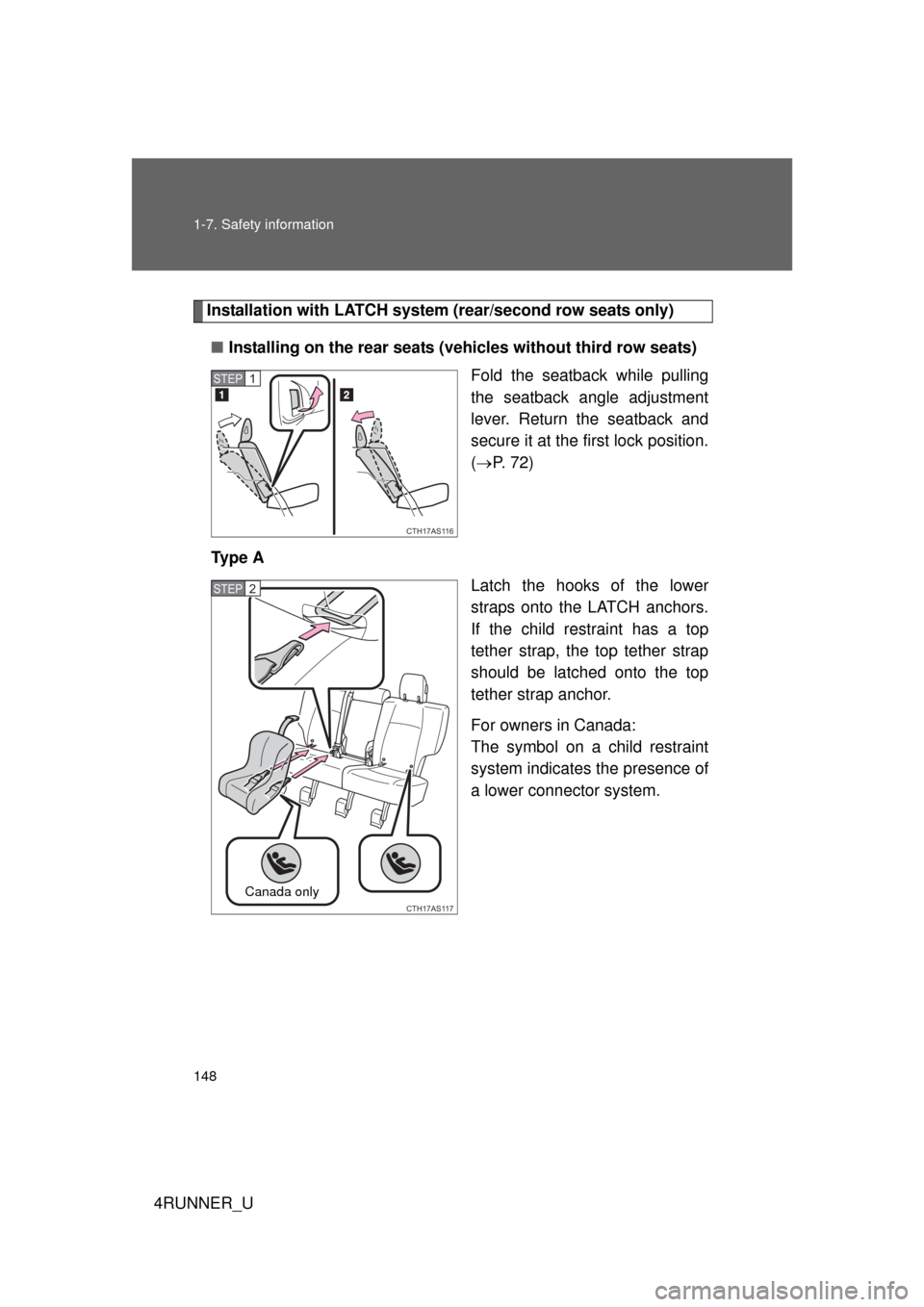
Installation with LATCH system (rear/second row seats only)
■ Installing on the rear seats (veh icles without third row seats)
Fold the seatback while pulling
the seatback angle adjustment
lever. Return the seatback and
secure it at the first lock position.
( P. 72)
Ty p e A Latch the hooks of the lower
straps onto the LATCH anchors.
If the child restraint has a top
tether strap, the top tether strap
should be latched onto the top
tether strap anchor.
For owners in Canada:
The symbol on a child restraint
system indicates the presence of
a lower connector system.
CTH17AS116
STEP 1
CTH17AS117
STEP 2
Canada only