Page 408 of 474
.Use only radial tires. Do not use
radial tires together with belted
bias tires and/or bias-ply tires.
Doing so can dangerously re-
duce controllability, resulting in
an accident.
& Wheel replacement
When replacing wheels due, for example,
to damage, make sure the replacement
wheels match the specifications of the
wheels that are fitted as standard equip-
ment. Replacement wheels are available
from SUBARU dealers.
WARNING
Use only those wheels that are
specified for your vehicle. Wheels
not meeting specifications could
interfere with brake caliper opera-
tion and may cause the tires to rub
against the wheel well housing dur-
ing turns. The resulting loss of
vehicle control could lead to anaccident. Aluminum wheels
Aluminum wheels can be scratched and
damaged easily. Handle them carefully to
maintain their appearance, performance,
and safety. .
When any of the wheels is removed
and replaced for tire rotation or to change
a flat, always check the tightness of the
wheel nuts after driving approximately 600
miles (1,000 km). If any nut is loose,
tighten it to the specified torque. . Never apply oil to the threaded parts,
wheel nuts, or tapered surface of the wheel. . Never let the wheel rub against sharp
protrusions or curbs.. When wheel nuts, balance weights, or
the center cap is replaced, be sure to
replace them with genuine SUBARU parts
designed for aluminum wheels. Windshield washer fluid
CAUTION
Never use engine coolant as washer
fluid because it could cause paintdamage.
If you spray washer fluid on the windshield
but the windshield washer fluid warning
light illuminates or the supply of washer
fluid runs out, add washer fluid in the tank. Maintenance and service
11-37
– CONTINUED –
Page 409 of 474
11-38Maintenance and service
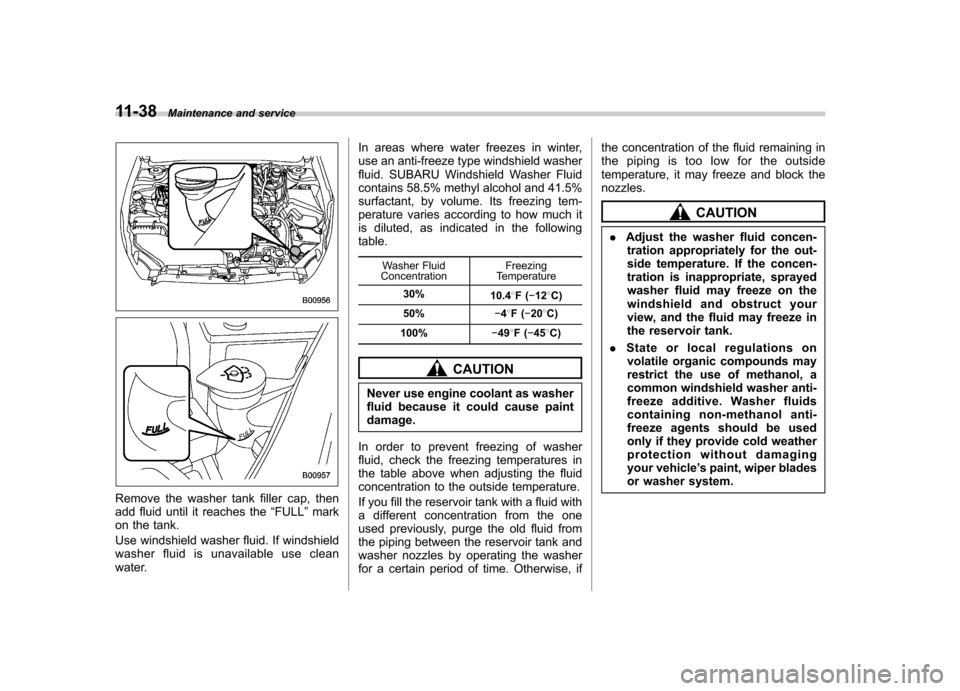
Remove the washer tank filler cap, then
add fluid until it reaches the “FULL ”mark
on the tank.
Use windshield washer fluid. If windshield
washer fluid is unavailable use clean
water. In areas where water freezes in winter,
use an anti-freeze type windshield washer
fluid. SUBARU Windshield Washer Fluid
contains 58.5% methyl alcohol and 41.5%
surfactant, by volume. Its freezing tem-
perature varies according to how much it
is diluted, as indicated in the followingtable.
Washer Fluid
Concentration Freezing
Temperature
30% 10.48F( 12 8C)
50% 48F( 20 8C)
100% 49 8F( 45 8C)
CAUTION
Never use engine coolant as washer
fluid because it could cause paintdamage.
In order to prevent freezing of washer
fluid, check the freezing temperatures in
the table above when adjusting the fluid
concentration to the outside temperature.
If you fill the reservoir tank with a fluid with
a different concentration from the one
used previously, purge the old fluid from
the piping between the reservoir tank and
washer nozzles by operating the washer
for a certain period of time. Otherwise, if the concentration of the fluid remaining in
the piping is too low for the outside
temperature, it may freeze and block thenozzles.
CAUTION
. Adjust the washer fluid concen-
tration appropriately for the out-
side temperature. If the concen-
tration is inappropriate, sprayed
washer fluid may freeze on the
windshield and obstruct your
view, and the fluid may freeze in
the reservoir tank.
. State or local regulations on
volatile organic compounds may
restrict the use of methanol, a
common windshield washer anti-
freeze additive. Washer fluids
containing non-methanol anti-
freeze agents should be used
only if they provide cold weather
protection without damaging
your vehicle ’s paint, wiper blades
or washer system.
Page 415 of 474
11-44Maintenance and service
Fuses
CAUTION
Never replace a fuse with one hav-
ing a higher rating or with material
other than a fuse because serious
damage or a fire could result.
The fuses are designed to melt during an
overload to prevent damage to the wiring
harness and electrical equipment. The
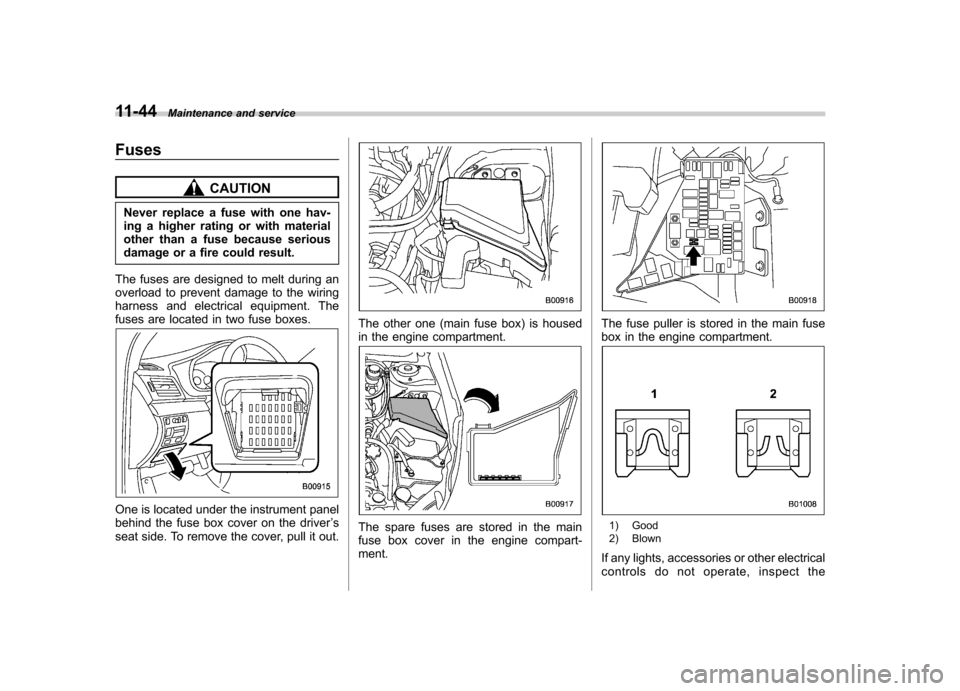
fuses are located in two fuse boxes.
One is located under the instrument panel
behind the fuse box cover on the driver ’s
seat side. To remove the cover, pull it out.
The other one (main fuse box) is housed
in the engine compartment.
The spare fuses are stored in the main
fuse box cover in the engine compart-ment.
The fuse puller is stored in the main fuse
box in the engine compartment.
1) Good
2) Blown
If any lights, accessories or other electrical
controls do not operate, inspect the
Page 419 of 474
11-48Maintenance and service
& Front turn signal light
NOTE
It may be difficult to replace the bulbs.
We recommend that you have the bulbs
replaced by your SUBARU dealer if
necessary.
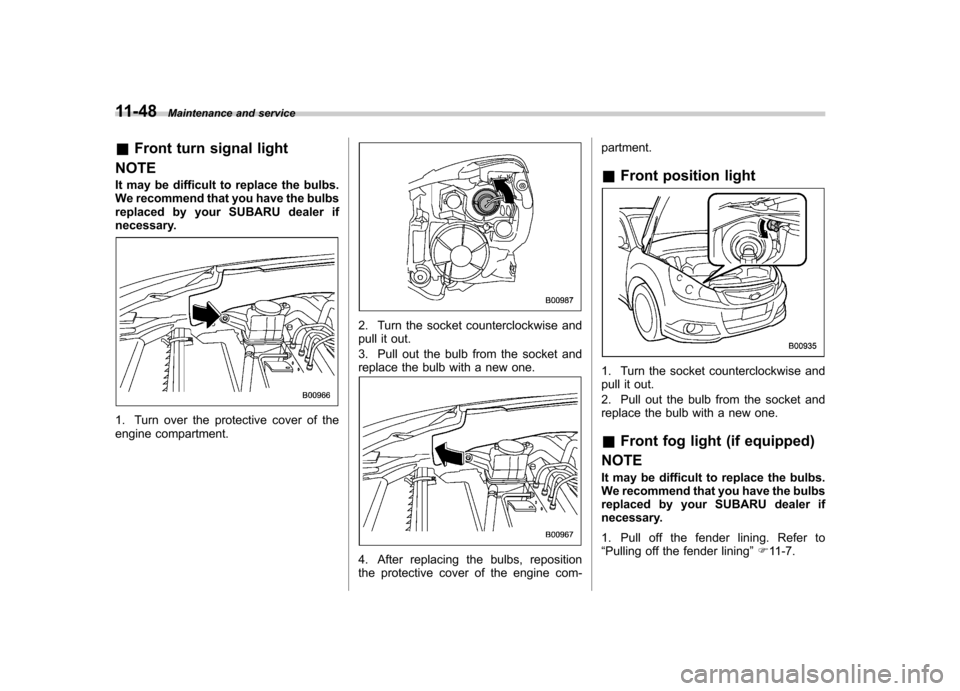
1. Turn over the protective cover of the
engine compartment.
2. Turn the socket counterclockwise and
pull it out.
3. Pull out the bulb from the socket and
replace the bulb with a new one.
4. After replacing the bulbs, reposition
the protective cover of the engine com- partment. &
Front position light
1. Turn the socket counterclockwise and
pull it out.
2. Pull out the bulb from the socket and
replace the bulb with a new one. &Front fog light (if equipped)
NOTE
It may be difficult to replace the bulbs.
We recommend that you have the bulbs
replaced by your SUBARU dealer if
necessary.
1. Pull off the fender lining. Refer to “ Pulling off the fender lining ”F 11-7.
Page 428 of 474

Specifications..................................................... 12-2
Dimensions ........................................................ 12-2
Engine ............................................................... 12-3
Fuel ................................................................... 12-3
Engine oil .......................................................... 12-4
Manual transmission, front differential and rear differential gear oil ........................................... 12-7
Fluids ................................................................ 12-8
Engine coolant ................................................... 12-8 Electrical system
............................................... 12-9
Tires .................................................................. 12-9
Fuses and circuits ........................................... 12-10
Fuse panel located in the passenger compartment ................................................. 12-10
Fuse panel located in the engine compartment ................................................. 12-12
Bulb chart ......................................................... 12-14
Vehicle identification ....................................... 12-17Specifications
12
Page 430 of 474
&Engine
Engine model EJ253
(2.5 L, SOHC, non-turbo) EJ255
(2.5 L, DOHC, turbo) EZ36D
(3.6 L, DOHC, non-turbo)
Engine type Horizontally opposed, liquid cooled 4 cylinder,
4 stroke gasoline engine Horizontally opposed, liquid cooled 6 cylinder,
4 stroke gasoline engine
Displacement cu-in (cc) 149.9 (2,457) 221.5 (3,630)
Bore 6Stroke in (mm) 3.92 63.11 (99.5 679.0) 3.62 63.58 (92.0 691.0)
Compression ratio 10.0 : 1 8.4 : 1 10.5 : 1
Firing order 1– 3–2 – 4 1
–6– 3–2– 5–4
& Fuel
Vehicle model Fuel requirementFuel tank capacity
Non-turbo models Unleaded gasoline with 87 AKI (90 RON) or higher
18.5 US gal (70 liters, 15.4 Imp gal)
Turbo models Premium unleaded gasoline with 93 AKI (98 RON) or higher*
1
*1: If 93 AKI (98 RON) fuel is not available, refer to “Fuel requirements ”F 7-2. Specifications
12-3
– CONTINUED –
Page 431 of 474

12-4Specifications
& Engine oil
For the checking, adding and replacing procedure or other details, refer to “Engine oil ”F 11-12.
NOTE
The procedure for changing the engine oil and oil filter should be performed by a properly-trained expert. It is recommended
that you have this service performed by your SUBARU dealer. ! Approved engine oil
Always use the SUBARU approved engine oil. For further details, please contact your SUBARU dealer.
If the approved engine oil is unavailable, use the alternative engine oil described on the next page. ! Alternative engine oil
If the SUBARU approved oil is unavailable, the following alternative oil can be used. NOTE . Each quantity indicated is only a guideline. The necessary quantity for replacement may differ slightly depending on the
temperature and other factors. . In choosing an oil, you want the proper quality and viscosity, as well as one that will enhance fuel economy. Oils of lower
viscosity provide better fuel economy. However, in hot weather, oil of higher viscosity is required to properly lubricate the
engine. The following table lists the recommended viscosities and applicable temperatures.. When adding oil, different brands may be used together as long as they are the same API classification and SAE viscosity
as those recommended by SUBARU.
Page 432 of 474
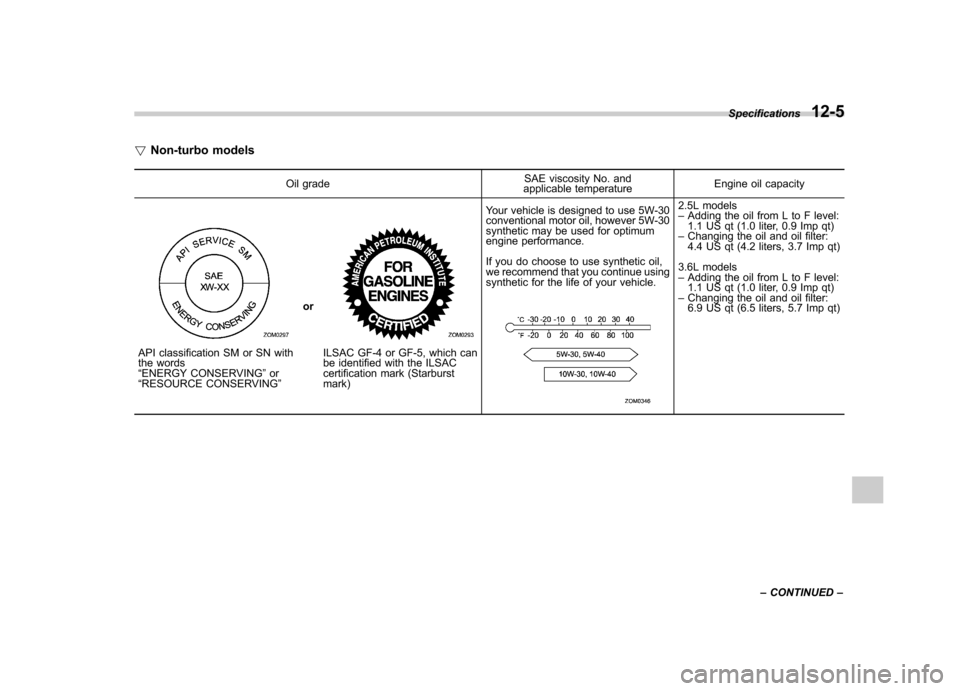
!Non-turbo models
Oil grade SAE viscosity No. and
applicable temperature Engine oil capacity
API classification SM or SN with
the words “
ENERGY CONSERVING ”or
“ RESOURCE CONSERVING ”orILSAC GF-4 or GF-5, which can
be identified with the ILSAC
certification mark (Starburstmark) Your vehicle is designed to use 5W-30
conventional motor oil, however 5W-30
synthetic may be used for optimum
engine performance.
If you do choose to use synthetic oil,
we recommend that you continue using
synthetic for the life of your vehicle.
2.5L models –
Adding the oil from L to F level:
1.1 US qt (1.0 liter, 0.9 Imp qt)
– Changing the oil and oil filter:
4.4 US qt (4.2 liters, 3.7 Imp qt)
3.6L models– Adding the oil from L to F level:
1.1 US qt (1.0 liter, 0.9 Imp qt)
– Changing the oil and oil filter:
6.9 US qt (6.5 liters, 5.7 Imp qt) Specifications
12-5
– CONTINUED –