2012 SUBARU FORESTER parking brake
[x] Cancel search: parking brakePage 359 of 438
11-20Maintenance and service
Automatic transmission fluid &Checking the fluid level
The automatic transmission fluid expands
largely as its temperature rises; the fluid
level differs according to fluid temperature.
Therefore, there are two different scales
for checking the level of hot fluid and cold
fluid on the level gauge.
Though the fluid level can be checked
without warming up the fluid on the“ COLD ”range, it is recommended to
check the fluid level when the fluid is at
operating temperature. ! Checking the fluid level when the
fluid is hot
1. Drive the vehicle several miles to raise
the temperature of the transmission fluid
up to normal operating temperature; 158
to 176 8F (70 to 80 8C) is normal.
2. Park the vehicle on a level surface and
set the parking brake.
3. First shift the select lever in each
position. Then shift it in the “P ” position,
and run the engine at idling speed.
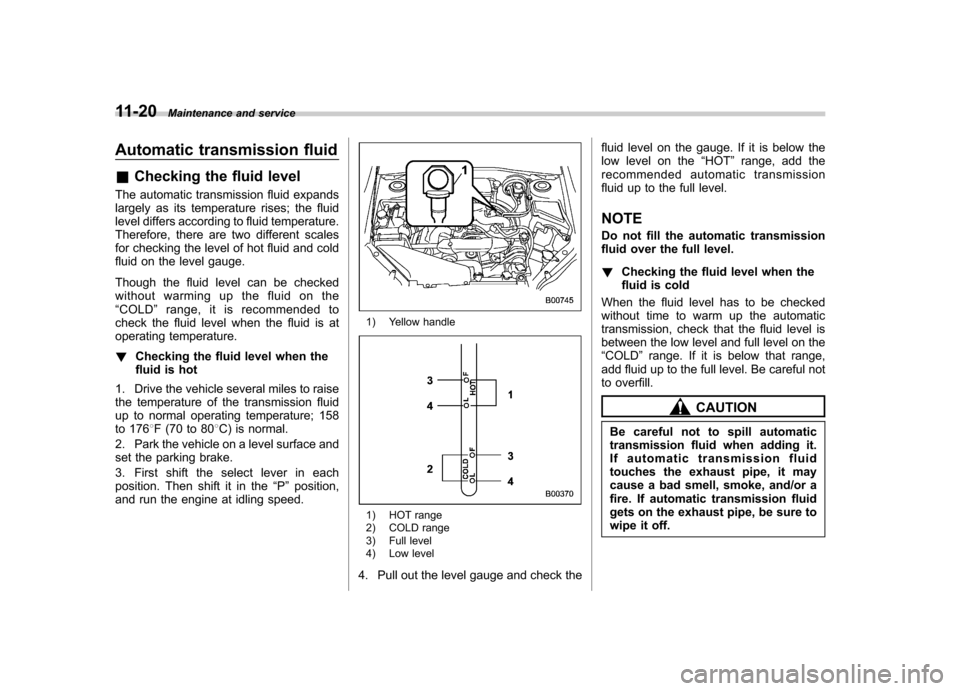
1) Yellow handle
1) HOT range
2) COLD range
3) Full level
4) Low level
4. Pull out the level gauge and check the fluid level on the gauge. If it is below the
low level on the
“HOT ”range, add the
recommended automatic transmission
fluid up to the full level.
NOTE
Do not fill the automatic transmission
fluid over the full level. ! Checking the fluid level when the
fluid is cold
When the fluid level has to be checked
without time to warm up the automatic
transmission, check that the fluid level is
between the low level and full level on the“ COLD ”range. If it is below that range,
add fluid up to the full level. Be careful not
to overfill.
CAUTION
Be careful not to spill automatic
transmission fluid when adding it.
If automatic transmission fluid
touches the exhaust pipe, it may
cause a bad smell, smoke, and/or a
fire. If automatic transmission fluid
gets on the exhaust pipe, be sure to
wipe it off.
Page 367 of 438

11-28Maintenance and service
Replacement of brake pad
and lining
Each disc brake has audible wear indica-
tors on the brake pads. If the brake pads
wear close to their service limit, the wear
indicator makes a very audible scraping
noise when the brake pedal is applied.
If you hear this scraping noise each time
you apply the brake pedal, have the brake
pads serviced by your SUBARU dealer as
soon as possible.
CAUTION
If you continue to drive despite the
scraping noise from the audible
wear indicator, it will result in the
need for costly brake rotor repair or replacement.
& Breaking-in of new brake
pads and linings
When replacing the brake pad or lining,
use only genuine SUBARU parts. After
replacement, the new parts must be
broken in as follows.
WARNING
A safe location and situation should
be selected for break-in driving.
! Brake pad and lining
While maintaining a speed of 30 to 40
mph (50 to 65 km/h), step on the brake
pedal lightly. Repeat this five or moretimes. ! Parking brake lining
CAUTION
Pulling the parking brake lever too
forcefully may cause the rear
wheels to lock. To avoid this, be
certain to pull the lever up slowly
and gently.
1. Drive the vehicle at a speed of approximately 22 mph (35 km/h).
2. With the parking brake release button
pushed in, pull the parking brake lever
SLOWLY and GENTLY (pulling with a
force of approximately 34 lbf [150 N,
15.3 kgf]).
3. Drive the vehicle for approximately
220 yards (200 meters) in this condition.
4. Wait 5 to 10 minutes for the parking
brake to cool down. Repeat this proce-dure.
5. Check the parking brake stroke. If the
parking brake stroke is out of the specified
range, adjust it by turning the adjusting nut
located on the parking brake lever.
Parking brake stroke: 7–8 notches / 45 lbf (200 N, 20.4 kgf)
Page 368 of 438

Parking brake stroke
Check the parking brake stroke according
to the maintenance schedule in the“Warranty and Maintenance Booklet ”.
When the parking brake is properly
adjusted, braking power is fully applied
by pulling the lever up 7 to 8 notches
gently but firmly (approximately 45 lbf [200
N, 20.4 kgf]). If the parking brake lever
stroke is not within the specified range,
have the brake system checked and
adjusted at your SUBARU dealer. Tires and wheels &
Types of tires
You should be familiar with type of tires
present on your vehicle.
The factory-fitted tires are all-season tires. ! All season tires
All season tires are designed to provide
an adequate measure of traction, handling
and braking performance in year-round
driving including snowy and icy road
conditions. However all season tires do
not offer as much traction performance as
winter (snow) tires in heavy or loose snow
or on icy roads.
All season tires are identified by “ALL
SEASON ”and/or “M+S ”(Mud & Snow) on
the tire sidewall. ! Summer tires
Summer tires are high-speed capability
tires best suited for highway driving under
dry conditions.
Summer tires are inadequate for driving
on slippery roads such as on snow-
covered or icy roads.
If you drive your vehicle on snow-covered
or icy roads, we strongly recommend the
use of winter (snow) tires.
When installing winter tires, be sure to
replace all four tires. !
Winter (snow) tires
Winter tires are best suited for driving on
snow-covered and icy roads. However
winter tires do not perform as well as
summer tires and all season tires on roads
other than snow-covered and icy roads. & Tire pressure monitoring
system (TPMS) (U.S.-spec.models)
The tire pressure monitoring system pro-
vides the driver with a warning message
by sending a signal from a sensor that is
installed in each wheel when tire pressure
is severely low. The tire pressure monitor-
ing system will activate only when the
vehicle is driven. Also, this system may
not react immediately to a sudden drop in
tire pressure (for example, a blow-out
caused by running over a sharp object).
If you adjust the tire pressures in a warm
garage and will then drive the vehicle in
cold outside air, the resulting drop in tire
pressures may cause the low tire pressure
warning light to illuminate. To avoid this
problem when adjusting the tire pressures
in a warm garage, inflate the tires to
pressures higher than those shown on the
tire placard. Specifically, inflate them by an
extra 1 psi (6.9 kPa, 0.07 kgf/cm
2) for
every difference of 10 8F (5.6 8C) between
Maintenance and service
11-29
– CONTINUED –
Page 428 of 438

Parking........................................................ 7-29, 11-29
Pedal .................................................................. 11-26
System ................................................................. 7-22
Brake pedal Free play ............................................................. 11-26
Reserve distance .................................................. 11-26
Brake system ............................................................ 7-22
Warning light ......................................................... 3-20
Braking ..................................................................... 7-22
Tips...................................................................... 7-22
Breaking-in of new brake pads and linings ................... 11-28
Bulb Chart .................................................................. 12-15
Replacing ............................................................. 11-45
C
Cargo area Cover ................................................................... 6-14
Light ............................................................. 6-3, 11-50
Tie-down hooks ..................................................... 6-15
Cargo tray ................................................................. 10-6
Catalytic converter ....................................................... 8-3
Center
Console .................................................................. 6-5
Changing Flat tire ................................................................... 9-6
Oil and oil filter ..................................................... 11-11
Charge warning light .................................................. 3-17
CHECK ENGINE warning light/Malfunction indicator light ....................................................................... 3-16 Checking
Brake pedal free play ............................................ 11-26
Brake pedal reserve distance ................................. 11-26
Clutch function ..................................................... 11-27
Clutch pedal free play ........................................... 11-27
Coolant level ........................................................ 11-14
Fluid level (automatic transmission fluid) .................. 11-20
Fluid level (brake fluid) .......................................... 11-23
Fluid level (clutch fluid) .......................................... 11-24
Fluid level (power steering fluid) .. ........................... 11-22
Fluid level (washer fluid) ........................................ 11-37
Oil level (engine oil) ................................................ 11-9
Oil level (front differential gear oil) .......................... 11-21
Oil level (manual transmission oil) .......................... 11-19
Child restraint systems ................................................ 1-22
Installation of a booster seat .................................... 1-28
Installation with A/ELR seatbelt ... ............................. 1-25
Lower and tether anchorages ................................... 1-29
Top tether anchorages ............................................ 1-32
Child safety ................................................................... 5
Locks .................................................................... 2-19
Chime
Key........................................................................ 3-5Light ..................................................................... 3-29
Seatbelt. ................................................................ 3-13
Cleaning Aluminum wheels ................................................... 10-3
Interior .................................................................. 10-5
Ventilation grille ...................................................... 4-10
Climate control system Automatic ............................................................... 4-6 Index
14-3
Page 432 of 438

Rear combination.................................................. 11-48
Turn signal ................................................... 3-31, 11-48
Loading your vehicle .................................................. 8-12
Low fuel warning light ......................................... 3-11, 3-21
Low tire pressure warning light .................................... 3-18
Lower and tether anchorage ........................................ 1-29
M Maintenance Precautions ........................................................... 11-3
Schedule .............................................................. 11-3
Seatbelt ................................................................ 1-20
Tools ...................................................................... 9-4
Malfunction indicator light (check engine warning light) ... 3-16Manual Climate control system ............................................. 4-8
Seat ....................................................................... 1-3
Transmission ......................................................... 7-13
Transmission oil ............................................ 11-19, 12-8
Map light ........................................................... 6-3, 11-50
Maximum load limits ................................................... 8-18
Meters and gauges ...................................................... 3-6
Mirror defogger .......................................................... 3-45
Mirrors ...................................................................... 3-36
Moonroof .......................................................... 2-24, 9-19
N
New vehicle break-in driving .......................................... 8-2
O
Odometer/Trip meter .................................................... 3-8 Oil filter
................................................................... 11-11
Oil level Engine .................................................................. 11-9
Front differential gear ............................................ 11-21
Manual transmission ............................................. 11-19
Rear differential gear ............................................ 11-22
Oil pressure warning light ............................................ 3-17
On-road and off-road driving ...................................... 9, 8-6
Outside
Mirror defogger ...................................................... 3-45
Mirrors .................................................................. 3-44
Temperature indicator .............................................. 3-27
Overhead console ....................................................... 6-6
Overheating engine .................................................... 9-13
PParking Brake .................................................................... 7-29
Brake stroke ........................................................ 11-29
Tips ...................................................................... 7-29
Periodic inspections ..................................................... 8-4
Petrol fuel ................................................................... 7-2
Power Door locking switch .................................................. 2-6
Outside mirrors ...................................................... 3-44
Seat ....................................................................... 1-4
Steering ................................................................ 7-21
Steering fluid ................................................ 11-22, 12-9
Precautions against vehicle modification ................ 1-22, 1-60
Preparing to drive ........................................................ 7-7 Index
14-7