2012 SKODA ROOMSTER steering
[x] Cancel search: steeringPage 151 of 194

Note
■ We recommend that any work on the wheels or tyres is carried out by a ŠKODA
Service Partner. ■ We recommend that you use wheel rims, tyres, full wheel trims and snow chains
from
ŠKODA Original Accessories. ÐService life of tyres
Fig. 122
Tyre tread with wear indicators/Open fuel filler flap with a table de-
tailing the tyre size and tyre inflation pressure
First read and observe the introductory information and safety warn-
ings on page 148.
Wear indicators
The base of the tread of the tyres has 1.6 mm high wear indicators installed.
These wear indicators are located multiple times depending on the make and are
evenly spaced around the circumference of the tyre » Fig. 122 - . Markings on
the walls of the tyres through the letters
“TWI”, triangular symbols or other sym-
bols identify the position of the wear indicators.
The life of your tyres very much depends on the following points:
Tyre pressure
The working life of tyres will be shortened considerably if the tyres are insuffi-
ciently or over-inflated and this will have an adverse effect on the handling of
your vehicle. Therefore check the tyre pressure, including that of the spare wheel,
at least once a month and also before setting off on a long journey.
ä The tyre inflation pressures for
summer tyres are indicated on the inside of the
fuel filler flap » Fig. 122 - . The inflation pressures for winter tyres are 20 kPa
(0.2
bar) higher than those for summer tyres.
Always check the inflation pressure when the tyres are cold. Do not reduce the
higher pressure of warm tyres. If the load varies greatly, adjust the tyre inflation
pressure accordingly.
Tyre inflation pressure - Tyre size 185/55 R15
The same inflation pressure values apply to tyres of the tyre size 195/55 R15 as to
tyres of the tyre size 185/55 R15 which are intended to be used with snow chains.
The tyres of the tyre size 185/55 R15, which are intended to be used with snow
chains and are fitted on models Roomster Scout, have the following inflation
pressure values in kPa.
Engine Half payload Full payload
1.2/63 kW TSI 220/210
230/320
1.4/63 kW
220/210
1.2/77 kW TSI 220/210
1.6/77 kW 220/210
1.2/55 kW TDI CR 220/220
1.6/55 kW TDI CR 220/220
1.6/66 kW TDI CR 220/220
1.6/77 kW TDI CR 220/210 Driving style
Fast cornering, sharp acceleration and braking increase the wear of your tyres.
Balancing wheels
The wheels of a new vehicle are balanced. There are a wide range of influences
when driving which may result in an imbalance and which makes themselves felt
through vibration in the steering.
Have the wheels rebalanced after replacing the tyres.
Wheel alignment errors
Incorrect wheel alignment at the front and rear will not only increase wear-and-
tear on the tyres but will also has an adverse effect on vehicle safety. In the
event of any unusual tyre wear, seek assistance from a
ŠKODA specialist garage.£
149
Wheels and Tyres
Page 155 of 194

Tyre control display
Fig. 127
Button for setting the tyre infla-
tion pressure control value
First read and observe the introductory information and safety warn-
ings on page 148.
The tyre control display compares the speed and thus the rolling circumference of
the individual wheels with the help of the ABS sensors. If the rolling circumfer-
ence of a wheel is changed, the warning light
in the instrument clus-
ter » page 23, Tyre control display and an audible signal sounds.
The rolling circumference of the tyre can change if: › the tyre inflation pressure is too low;
› the structure of the tyre is damaged;
› the vehicle is loaded on one side;
› the wheels of an axle are loaded heavily (e.g. when towing a trailer or when
driving uphill or downhill);
› snow chains are mounted;
› the temporary spare wheel is mounted;
› one wheel per axle was changed.
Basic setting of the system
After changing the tyre inflation pressure, after changing one or several wheels,
the position of a wheel on the vehicle (e.g. exchanging the wheels between the
axles) or when the warning light lights up while driving, a basic setting of the sys-
tem must be carried out as follows:
› Inflate all of the tyres to the specified inflation pressure
» page 149, Service life
of tyres .
› Switch on the ignition.
ä
›
Press and hold the button
» Fig. 127
for longer than 2 seconds. While
pressing the button, the warning light illuminates. At the same time the sys-
tem memory is erased and the new calibration is started, which is confirmed
with an audible signal and then the warning light goes out.
› If the warning light
does not go out after the basic setting, this indicates a
system fault. Seek help from a ŠKODA specialist garage.
The warning light is lit
If the tyre inflation pressure of at least one wheel is insufficiently inflated in com-
parison to the stored basic value, the warning light » lights up.
The warning light flashes
If the warning light flashes, there is a system fault. Seek help from a
ŠKODA spe-
cialist garage to correct the fault. WARNING
■ When the warning light illuminates, immediately reduce the speed and
avoid sudden steering and brake manoeuvres. Stop the vehicle as soon as
possible and inspect the tyres and their inflation pressure.
■ Under certain circumstances (e.g. sporty style of driving, wintry or unpaved
roads) the warning light can be delayed or does not light up at all.
■ The tyre control display does not absolve the driver of the responsibility to
ensure the correct tyre inflation pressure. For this reason, the tyre inflation
pressure must be checked regularly. Note
■ The tyre control display does therefore not replace the regular tyre inflation
pressure control, as the system cannot detect an even loss of pressure. ■ The tyre control display cannot provide a warning in the event of very rapid tyre
inflation pressure loss, e.g. in the case of sudden tyre damage. In this case care-
fully bring the vehicle to a standstill without sudden steering movements or
sharp braking.
■ To ensure a proper functioning of the tyre control display, it is necessary to re-
peat the basic setting every 10 000 km or once a year. Ð
153
Wheels and Tyres
Page 166 of 194

›
Attach the other end 4
to a solid metal part which is connected firmly to the
engine block, or to the engine block itself.
Starting engine
› Start the engine on the vehicle providing the power and allow it to idle.
› Now start the engine of the vehicle with the discharged battery.
› If the engine does not start, terminate the attempt to start the engine after
10 seconds and wait for about 30 seconds before repeating the process.
› Disconnect the cables in exactly the
reverse order to the one described above. ÐJump-starting in vehicles with the START-STOP system
Fig. 136
Jump-starting - START-STOP
system
First read and observe the introductory information and safety warn-
ings on page 163.
On vehicles with the START-STOP system, the jump-start cable of the charger
must never be connected directly to the negative pole of the vehicle battery, but
only to the engine earth » Fig. 136. ÐTowing the vehicle
ä
Introduction
This chapter contains information on the following subjects:
Front towing eye 165
Rear towing eye 165
Vehicles with manual transmission can be towed in with a tow bar or a tow rope
or with the front or rear wheels raised.
ä Vehicles with automatic transmission can be towed in with a tow bar or a tow
rope or with the front wheels raised. If the vehicle is raised at rear, the automatic
gearbox is damaged!
A tow bar
is the safest way of towing a vehicle and also minimises any shocks.
Only use a tow rope if a suitable tow bar is not available.
When towing, the following guidelines must be observed.
Driver of the tow vehicle
› Release the clutch particularly gently when starting off or depress the accelera-
tor particularly gently if the vehicle is fitted with an automatic gearbox.
› On vehicles with a manual transmission, only push down on the accelerator
pedal once the rope is taught.
The maximum towing speed is 50 km/h.
Driver of the towed vehicle
› Switch on the ignition so that the steering wheel is not blocked and so that the
turn signal lights, horn, windscreen wipers and windscreen washer system can
be switched on.
› Take the vehicle out of gear or move the selector lever into position
N if the
vehicle is fitted with an automatic gearbox.
Please note that the brake servo unit and power steering only operate if the en-
gine is running. If the engine is not running, significantly more physical force is re-
quired to depress the brake pedal and steer the vehicle.
If using a tow rope, ensure that it is always kept taught. CAUTION
■ Do not tow start the engine - danger of damaging the engine! On vehicles with
a catalytic converter, unburnt fuel may get into the catalytic converter where it
may ignite. This in turn may damage or destroy the catalytic converter. The bat-
tery from another vehicle can be used as a jump-start aid » page 163, Jump-start-
ing .
■ If the gearbox of your vehicle no longer contains any oil because of a defect,
your vehicle must only be towed in with the driven wheels raised clear of the
ground, or on a special vehicle transporter or trailer.
■ The vehicle must be transported on a special vehicle or trailer if it is not possible
to tow in the vehicle in the way described or if the towing distance is greater than
50 km. ■ To protect both vehicles when tow-starting or towing, the tow rope should be
elastic. Thus one should only use plastic fibre rope or a rope made out of a simi-
larly elastic material. £
164 Do-it-yourself
Page 169 of 194
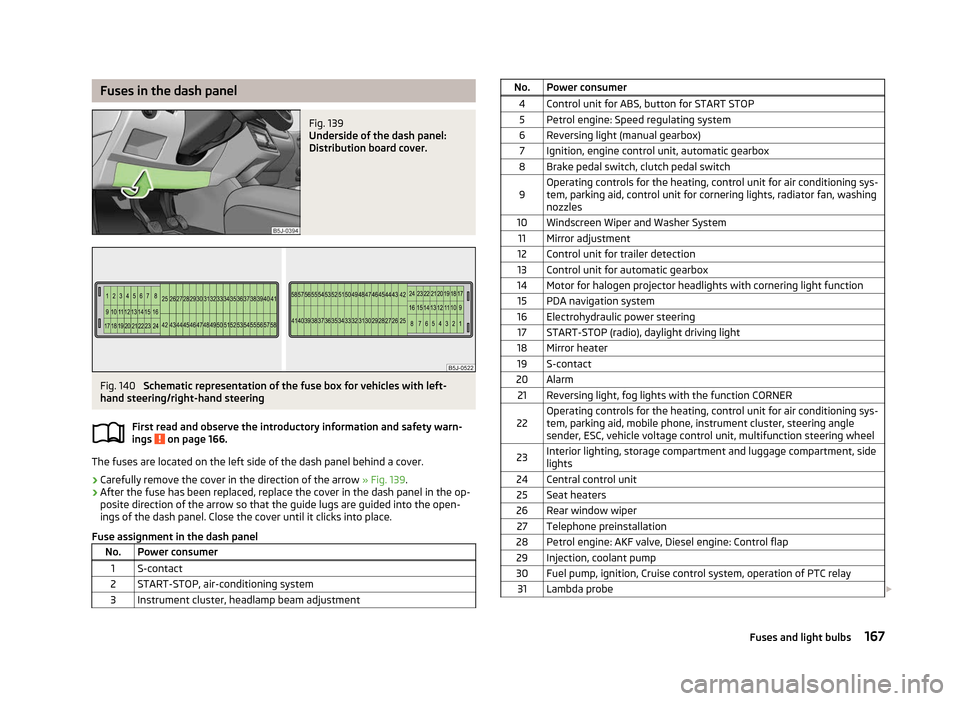
Fuses in the dash panel
Fig. 139
Underside of the dash panel:
Distribution board cover. Fig. 140
Schematic representation of the fuse box for vehicles with left-
hand steering/right-hand steering
First read and observe the introductory information and safety warn-
ings on page 166.
The fuses are located on the left side of the dash panel behind a cover.
›
Carefully remove the cover in the direction of the arrow
» Fig. 139.
› After the fuse has been replaced, replace the cover in the dash panel in the op-
posite direction of the arrow so that the guide lugs are guided into the open-
ings of the dash panel. Close the cover until it clicks into place.
Fuse assignment in the dash panel No. Power consumer
1 S-contact
2 START-STOP, air-conditioning system
3 Instrument cluster, headlamp beam adjustment ä No. Power consumer
4 Control unit for ABS, button for START STOP5 Petrol engine: Speed regulating system
6 Reversing light (manual gearbox) 7 Ignition, engine control unit, automatic gearbox
8 Brake pedal switch, clutch pedal switch
9 Operating controls for the heating, control unit for air conditioning sys-
tem, parking aid, control unit for cornering lights, radiator fan, washing
nozzles
10 Windscreen Wiper and Washer System 11 Mirror adjustment
12 Control unit for trailer detection
13 Control unit for automatic gearbox
14 Motor for halogen projector headlights with cornering light function 15 PDA navigation system
16 Electrohydraulic power steering 17 START-STOP (radio), daylight driving light
18 Mirror heater 19 S-contact
20 Alarm 21 Reversing light, fog lights with the function CORNER
22 Operating controls for the heating, control unit for air conditioning sys-
tem, parking aid, mobile phone, instrument cluster, steering angle
sender, ESC, vehicle voltage control unit, multifunction steering wheel
23 Interior lighting, storage compartment and luggage compartment, side
lights
24 Central control unit 25 Seat heaters
26 Rear window wiper 27 Telephone preinstallation
28 Petrol engine: AKF valve, Diesel engine: Control flap 29 Injection, coolant pump
30 Fuel pump, ignition, Cruise control system, operation of PTC relay 31 Lambda probe £ 167
Fuses and light bulbs
Page 171 of 194

No. Power consumer
6 Glow plugs, radiator fan7 Electrohydraulic power steering
8 ABS or TCS or ESC 9 Radiator fan
10 Automatic gearbox 11 ABS or TCS or ESC
12 Central control unit
13 Electrical auxiliary heating system Note
Fuses 1 - 7 are replaced by a specialist ŠKODA garage. ÐBulbs
ä
Introduction
This chapter contains information on the following subjects:
Headlights 170
Replacing a bulb for low beam and main beam (halogen headlights) 170
Replacing the bulb for the low beam (Halogen projector headlights) 171
Replacing the bulb for the main beam (Halogen projector headlights) 171
Changing the bulb for the front turn signal light 171
Changing the light bulb for the front parking light 171
Fog lights and daytime running lights 172
Fog lights - Roomster Scout 172
Changing the bulb for the licence plate light 173
Tail lamp assembly 173
Some manual skills are required to change a bulb. For this reason, if uncertain, we
recommend that bulbs are replaced by a ŠKODA specialist garage or other expert
help is sought. ›
Switch off the ignition and all of the lights before replacing a bulb.
› Faulty bulbs must only be replaced with the same type of bulbs. The designa-
tion is located on the light socket or the glass bulb.
› A stowage compartment for replacement bulbs is located in a plastic box in the
spare wheel or underneath the floor covering in the boot. WARNING
■ Accidents can be caused if the road in front of the vehicle is not sufficiently
illuminated and the vehicle cannot or can only be seen with difficulty by other
road users.
■ Always read and observe the warnings before completing any work in the
engine compartment » page 136, Engine compartment .
■ Bulbs H7 and H4 are pressurised and may burst when changing the bulb -
risk of injury! We therefore recommended wearing gloves and safety glasses
when changing a bulb. CAUTION
■ Do not take hold of the glass bulb with naked fingers (even the smallest
amount of dirt reduces the working life of the light bulb). Use a clean cloth, nap-
kin, or similar. ■ When removing and installing the tail light make sure that the paintwork of the
vehicle and the tail light are not damaged. Note
■ This Owner's Manual only describes the replacement of bulbs where it is possi-
ble to replace the bulbs on your own without any complications arising. Other
light bulbs should be changed by a
ŠKODA specialist garage.
■ We recommend that a box of replacement bulbs be always carried in the vehi-
cle. Replacement bulbs can be purchased from
ŠKODAOriginal Accessories.
■ We recommend that the headlight settings are checked by a ŠKODA specialist
garage after replacing a bulb in the main or low beam.
■ LED diodes should be changed by a specialist ŠKODA garage. Ð
169
Fuses and light bulbs
Page 189 of 194

O
Oil refer to Engine oil 139
Onboard computer see Multifunction display 12
Operation in winter De-icing windows 130
Diesel fuel 136
Vehicle battery 145
Outside temperature 13
Overview Engine compartment 138
Warning lights 17
P
Paint see Paint damage 129
Paint damage 129
Panorama roof 35
Parking Parking aid 82
Parking ticket holder 66
Passive Safety 100
Periodic wiping 43
Petrol refer to Fuel 135
Polishing the paintwork refer to Taking care of your vehicle 129
Power steering 77
Preservation refer to Taking care of your vehicle 129
R
Radiator fan 142
Radio reception Aerial 130
Functional fault 130Raise vehicle 159
Rear mirror Exterior mirror 45
Manual dimming interior mirror 45
Recirculated air mode Manual air conditioning system 72
Recommended gear 11
Refuelling 134
Fuel 134
Regulation Headlight beam 39
Remote control 29
Synchronisation process 30
Remote control key Replacing the battery 25
Replacement of parts 155
Replacing bulbs 169
Fuses 166
Vehicle battery 146
Windscreen wiper blade 44
Replenishing Coolant 141
Engine oil 139
Windscreen washer fluid 143
Running in Brake pads 119
Engine 119
The first 1 500 km 119
Tyres 119
S
Safe securing system 27
Safety 100
Child safety 115
Child safety seats 115
Head restraints 48
ISOFIX 117
TOP TETHER 118
Save electrical energy 120Seat
Adjusting 47
Seat belt Warning light 18
Seat belt height adjuster 107
Seat belts 104
Cleaning 133
fastening and unfastening 106
Height adjustment 107
Seats folding forward 49
Head restraints 48
Heating 48
Removing seats 50
Selector lever see selector lever positions 88
Selector lever positions 88
Service display 10
Setting Manual air conditioning system 72
Manual dimming interior mirror 45
Steering wheel 77
Setting temperature Heating 68
Setting the clock Clock 11
Shifting Diving economically 120
Gearshift lever 82
Side airbag 111
Snow chains 154
Spare wheel 151
Speedometer 9
START/STOP Function 85
Starting and stopping the engine 76
Starting engine Jump-starting 163
START STOP Jump-starting 164
187
Index
Page 190 of 194

Steering force assistance 77
Steering wheel 77
Storage 61
Storage compartment Lighting 41
Storage compartments 61
Sun visors 42
Switching lights on and off 36
T
Taking care of the vehicle Artificial leather 132
Material coverings 132
Materials 132
Natural leather 132
Seat belts 133
Taking care of your vehicle 127
Automatic car wash system 128
Chrome parts 129
Cleaning the wheels 131
Door lock cylinders 130
Headlight lenses 130
High-pressure cleaner 128
Plastic parts 129
Polishing the paintwork 129
Preservation 129
Rubber seals 130
Washing 128
Washing by hand 128
Wash system 128
TCS 81
Warning light 21
Technical data 176
Telephone 92
Tiptronic 87
see automatic gearbox 89
Tool 156
TOP TETHER 118
Towing 164
Towing a trailer 125Towing eye 165
Towing protection 31
Traction control system (TCS) 81
Trailer 125
Towing a trailer 125
Transport Boot 51
Roof rack system 58
Transporting children safely 115
Two-way radio systems 92
Type plate 176
Tyre repair 160
Tyres see Wheels and tyres 150
U
Underbody protection 131
unlock Central locking system 28
Unlocking Remote control 29
without central locking 26
Uphill start assist 80
V
Vehicle battery Automatic load deactivation 147
Charging 146
Checking the electrolyte level 145
Operation in winter 145
Replacing 146
Safety instructions 143
Vehicle Condition see Auto Check Control 16
Vehicle data sticker 176
Vehicle dimensions 178
Vehicle key 25
Vehicle tool kit 156Visors 42
W
Warning lights 17
Warning symbols see Warning lights 17
Warning triangle 156
Washing 127
Automatic car wash system 128
by hand 128
Chrome parts 129
High-pressure cleaner 128
Weights 176
Wheel bolts Anti-theft wheel bolt 160
Caps 152
Loosening and tightening 159
Wheels 148
Wheels and tyres Changing a wheel 157
Full wheel trim 152
General information 148
Handling wheels and tyres 150
new tyres 150
Service life of tyres 149
Snow chains 154
Spare wheel 151
Wheel bolts 154
Winter tyres 154
Window convenience operation 35
Windows De-icing 130
See Electrical power windows 33
Windscreen washer fluid Checking 143
Replenishing 143
Warning light 23
Winter 143
Windscreen washer system 143
Windscreen wipers 43
188 Index