2012 SKODA ROOMSTER belt
[x] Cancel search: beltPage 56 of 194

›
Unhook the support straps 1
» Fig. 47.
› Fold the luggage compartment cover forwards a little.
› Remove the cover from the holders 2
by pulling towards the rear, or by lightly
knocking on the underside of the cover in the area between the holders.
› To reinstall, first of all push the luggage compartment cover into the holders 2
and then hook the support straps 1
on the boot lid.
The luggage compartment cover can also be put into the lower position on the
supporting elements » Fig. 47 - .
The procedure of installing or removing is identical.
In this position you can store smaller objects up on the luggage compartment
cover up to a total weight of 2.5 kg. WARNING
No objects should be placed on the boot cover, the vehicle occupants could be
endangered if there is sudden braking or the vehicle collides with something. CAUTION
Please ensure that the heating elements for the rear window heater are not dam-
aged as a result of objects placed in this area. Note
When opening the boot lid, the luggage compartment cover is lifted up at the
same time- risk that objects placed in this area can slip forward! Ð Net partition
Fig. 48
Using the net partition behind the front/rear seats
First read and observe the introductory information and safety warn-
ings on page 51.
The net partition can either be installed behind the rear seats or behind the front
seats.
Installing the net partition behind the rear seats
›
Remove the boot cover » page 53, Boot cover.
› Remove the net partition from the bag.
› Unfold both parts of the cross rod until they are heard to engage.
› First of all insert the cross rod into the mount B
» Fig. 48
on one side and push
it forward. In the same way, insert the cross rod into the mount B
on the other
side of the vehicle.
› Hang the carabines C
at the ends of the belt into the lashing eyes behind the
rear seats.
› Pull the belt through the tensioning clasp on both sides- first of all on the one
side and then on the other side.
Removing the net partition
› Undo the belts on both sides and unhook the carabines C
» Fig. 48.
› Push the cross rod first of all on the one side and then on the other side to-
wards the rear.
› Remove the cross rod from the mounts B
.
Packing the net partition
› Press the red button of the joint A
» Fig. 48
- the joint becomes loose.
› Put the net partition folded together in the bag and close it.
› Attach the bag with the aid of the plastic carabines to the eyes on the left and
right boot trim panel. £
ä
54 Using the system
Page 57 of 194

Installing and removing the net partition behind the rear seats is carried out anal-
ogously as behind the rear seats. Use the lower fixing eyes on the carrier rails in
order to attach the carabines. To enlarge the boot, the rear seats can be removed.
Installing and removing the net partition behind the rear seats with variable load-
ing floor » page 55 is carried out analogously as behind the rear seats without
variable loading floor. To attach the carabines, use the lower eyes at the fixing
wedges on the front part of the variable loading floor.
The opening D
» Fig. 48
in the net partition is designed to feed through the
three-point seat belt » page 107, Seat belt for the rear middle seat .ÐVariable loading floor in the boot
Introductory information
The variable loading floor makes handling of bulky items of luggage easier. CAUTION
The maximum permissible load of the variable loading floor is 75 kg.Note
The room under the variable loading floor can be used to stow objects. ÐDividing the boot with variable loading floor
Fig. 49
Dividing the boot
› Lift up the part with the holder and secure it by sliding it into the grooves
marked with the arrows »
Fig. 49. Ð Removing/installing the variable loading floor
Fig. 50
Fold up variable loading floor/remove
Removing › Unhook the loops A
» Fig. 50 of the elastic partition out of the fixing points.
› Unlock the variable loading floor by turning the locking bolts B
to the left by
around 180°.
› Fold up the variable loading floor by moving it in the direction of the arrow C
.
› Fold up the variable loading floor in the direction of the arrow 1
and remove
by pulling in the direction of the arrow 2
.
Install
› Fold up the variable loading floor and place it on the carrier rails.
› Fold out the variable loading floor.
› Lock the variable loading floor by turning the locking bolts B
» Fig. 50 to the
right by around 180°.
› Secure the loops A
of the elastic partition to the fixing points.
WARNING
Ensure that the carrier rails and variable loading floor are correctly fastened
when installing the variable loading floor. If this is not the case, there is a risk
of injury for the occupants. Ð
55
Seats and Stowage
Page 58 of 194

Removing/installing the carrier rails
Fig. 51
Boot: Slacken check points/remove carrier rails
Removing
› Slacken the check points B
» Fig. 51
on the carrier rails using the vehicle key or
a flat screwdriver.
› Remove the carrier rail A
and remove by pulling in the direction of arrow 1
.
The carrier rail on the other side of the luggage compartment can be removed in
the same way.
Install
› Position the carrier rails on the sides of the boot.
› Press the check point on each carrier rail B
» Fig. 51
up to the stop.
› Check the attachment of the carrier rails by pulling it. WARNING
Ensure that the carrier rails and variable loading floor are correctly fastened
when installing the variable loading floor. If this is not the case, there is a risk
of injury for the occupants. Ð Removing/installing the lateral carrier rail and fixing wedges
Fig. 52
Boot: Take out lateral carrier rail/Take out fixing wedges
Removing
› Remove the lateral carrier rail
»
Fig. 52 - and remove by pulling in the direc-
tion of arrow.
› Remove the fixing wedge
» Fig. 52 - and remove by pulling in the direction of
arrow. To remove the fixing wedge on the other side of the luggage compart-
ment, proceed in the same way.
Install
› Put the fixing wedge on the fixing points and press in the direction of the sides
of the luggage compartment up to the stop.
› Insert the lateral carrier rail at an angle to the fixing wedges and press it up to
the stop.
› Check how well the lateral carrier rail is fastened by pulling on it. Ð Bicycle carrier in the luggage compartment
ä
Introduction
This chapter contains information on the following subjects:
Install cross member 57
Install bicycle carrier 57
Put bicycle into the bicycle carrier 58
Secure the stability of the bicycles with a belt 58
£
56 Using the system
Page 60 of 194

Put bicycle into the bicycle carrier
Fig. 55
Put in the bicycle/example fastening the front wheel
First read and observe the introductory information and safety warn-
ings on page 56.
›
Remove the front wheel of the bicycle before installing it.
› Slacken the quick tension jack on the fixing axle of the bicycle carrier and ad-
just according to the width of the bicycle fork.
› Fit the bicycle fork onto the fixing axle and tighten with the quick tension
jack »
Fig. 55 - .
› Position the left pedal of the bicycle forward, in order to attach the front wheel
more easily.
› Undo the screw A
» Fig. 54 on page 57
and push the bicycle carrier to the left
together with the fastened bicycle to prevent a collision between the steering
wheel and the side window of the luggage compartment.
› Carefully guide the boot lid downwards without letting go of it. Check whether
there is sufficient room between the steering bars and the rear window. If nec-
essary, adjust the position of the movable part of the bicycle carrier to prevent a
collision » page 57 .
› It is best to store the removed front wheel between the crank of the left pedal
and the bicycle frame, attach it with a strap to the front fork » Fig. 55 - and/or
to one of the fixing points.
› The second carrier is installed and the bicycle is secured in a similar way. Ð
ä Secure the stability of the bicycles with a belt
Fig. 56
Securing bicycles
First read and observe the introductory information and safety warn-
ings on page 56.
›
To slacken the rubber part of the clamp, push both parts against each other
and open the clamp.
› Position the clamp with the rubber part to the front (in direction of travel) as far
as possible below the saddle support and close the clamp » Fig. 56
- .
› When transporting two bicycles, clamp the belt
» Fig. 56 - between the sad-
dles by moving the bicycles apart.
› Hang the carabines at the ends of the belt into the lashing eyes behind the rear
seats » Fig. 56 - .
› Pull the belt through the tensioning clasps on both sides in turn.
› If necessary, you can correct the position of the bicycles in the vehicle. Ð Roof rack system
Roof rail
Roof load
The maximum permissible roof load (including roof rack system) of 75 kg and the
maximum permissible total weight of the vehicle should not be exceeded.
The full permissible roof load cannot be used if a roof rack system with a lower
load carrying capacity is used. In this case, the roof rack system must only be loa-
ded up to the maximum weight limit specified in the fitting instructions. £
ä
58 Using the system
Page 66 of 194

Front armrest with storage compartment
Fig. 68
Armrest: Storage compartment/open storage compartment
Fold the armrest forwards
› Press the bottom button on the face end of the armrest
» Fig. 68 - .
› Fold the arm rest forward and release the button again.
Opening the storage compartment
› Press the top button and fold the cover of the stowage compartment up-
wards » Fig. 68 - . Note
The moving space of the arms can be restricted if the armrest is folded forwards.
In city traffic the armrest should not be folded forwards. ÐFolding table on the medium seat rest
Fig. 69
Rear seats: Armrest The medium seat rest can be used after folding the
»
page 49, Folding the seat
backrest forwards and folding the seat fully forwards armrest forward or the ta-
ble with the cup holder » Fig. 69.
Two beverage containers can be placed into the recesses. WARNING
■ Never put hot beverage containers in the cup holder. If the vehicle moves,
they may spill - risk of scalding!
■ Do not use any cups or beakers which are made of brittle material (e.g. glass,
porcelain). This could lead to injuries in the event of an accident. CAUTION
■ Do not leave open beverage containers in the cup holder during the journey.
There is a risk of spilling e.g. when braking which may cause damage to the elec-
trical components or seat upholstery.
■ If the middle rear seat backrest should be folded forward for lengthy periods,
then make sure that the belt locks are not located below it - this can warp the
upholstery or fabric. Ð Storage compartments in the doors
Fig. 70
Storage compartment: in the front door/in the rear door
A bottle holder is located in the area B
» Fig. 70 of the storage compartment for
the front doors. £
64 Using the system
Page 87 of 194
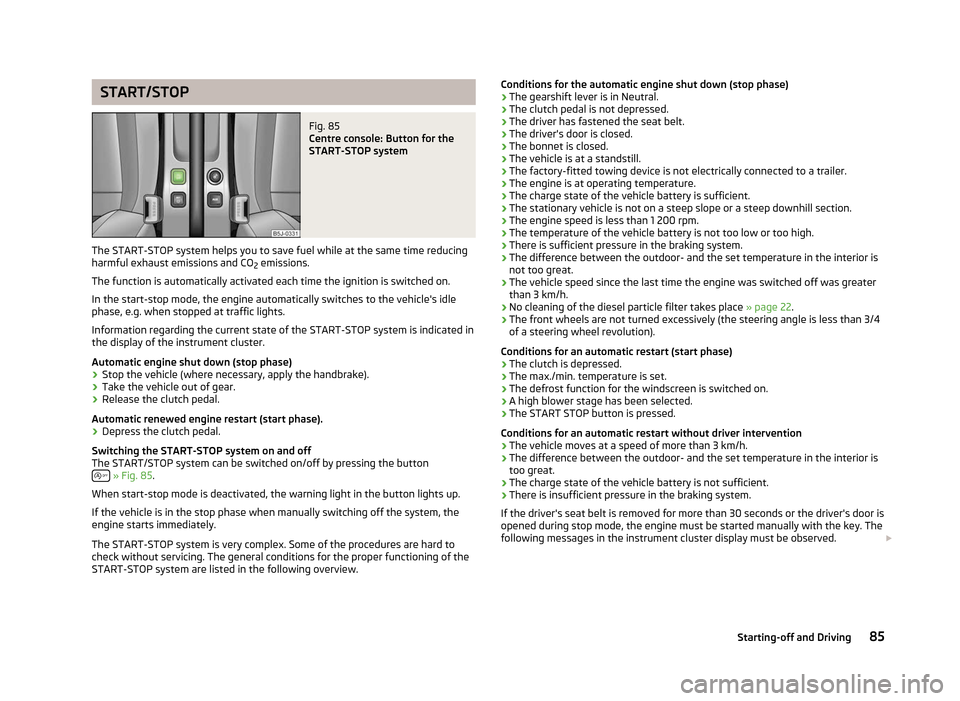
START/STOP
Fig. 85
Centre console: Button for the
START-STOP system
The START-STOP system helps you to save fuel while at the same time reducing
harmful exhaust emissions and CO 2 emissions.
The function is automatically activated each time the ignition is switched on.
In the start-stop mode, the engine automatically switches to the vehicle's idle
phase, e.g. when stopped at traffic lights.
Information regarding the current state of the
START-STOP system is indicated in
the display of the instrument cluster.
Automatic engine shut down (stop phase)
› Stop the vehicle (where necessary, apply the handbrake).
› Take the vehicle out of gear.
› Release the clutch pedal.
Automatic renewed engine restart (start phase).
› Depress the clutch pedal.
Switching the
START-STOP system on and off
The START/STOP system can be switched on/off by pressing the button » Fig. 85.
When start-stop mode is deactivated, the warning light in the button lights up.
If the vehicle is in the stop phase when manually switching off the system, the
engine starts immediately.
The
START-STOP system is very complex. Some of the procedures are hard to
check without servicing. The general conditions for the proper functioning of the
START-STOP system are listed in the following overview. Conditions for the automatic engine shut down (stop phase)
› The gearshift lever is in Neutral.
› The clutch pedal is not depressed.
› The driver has fastened the seat belt.
› The driver's door is closed.
› The bonnet is closed.
› The vehicle is at a standstill.
› The factory-fitted towing device is not electrically connected to a trailer.
› The engine is at operating temperature.
› The charge state of the vehicle battery is sufficient.
› The stationary vehicle is not on a steep slope or a steep downhill section.
› The engine speed is less than 1
200 rpm.
› The temperature of the vehicle battery is not too low or too high.
› There is sufficient pressure in the braking system.
› The difference between the outdoor- and the set temperature in the interior is
not too great.
› The vehicle speed since the last time the engine was switched off was greater
than 3 km/h.
› No cleaning of the diesel particle filter takes place
» page 22.
› The front wheels are not turned excessively (the steering angle is less than 3/4
of a steering wheel revolution).
Conditions for an automatic restart (start phase)
› The clutch is depressed.
› The max./min. temperature is set.
› The defrost function for the windscreen is switched on.
› A high blower stage has been selected.
› The START STOP button is pressed.
Conditions for an automatic restart without driver intervention
› The vehicle moves at a speed of more than 3 km/h.
› The difference between the outdoor- and the set temperature in the interior is
too great.
› The charge state of the vehicle battery is not sufficient.
› There is insufficient pressure in the braking system.
If the driver's seat belt is removed for more than 30 seconds or the driver's door is
opened during stop mode, the engine must be started manually with the key. The
following messages in the instrument cluster display must be observed. £
85
Starting-off and Driving
Page 102 of 194

Safety
Passive Safety
General information
ä
Introduction
This chapter contains information on the following subjects:
Safety equipment 100
Before setting off 100
What influences the driving safety? 101
In this section you will find important information, tips and notes on the subject
of passive safety in your vehicle. We have combined everything here which you
should be familiar with, for example, regarding seat belts, airbags, child seats and
safety of children. It is therefore important, in particular, to comply with the notes
and warnings in this section for your own interest and in the interest of those
travelling with you. WARNING
■ This chapter contains important information on how to use the vehicle for
the driver and his occupants. You will find further information on safety, which
concerns you and those travelling with you, in the following chapters of this
Owner's Manual.
■ The complete on-board literature should always be in the vehicle. This ap-
plies in particular, if you rent out or sell the vehicle. ÐSafety equipment
First read and observe the introductory information and safety warn-
ings on page 100.
The following list contains part of the safety equipment in your vehicle:
› three-point seat belts for all the seats;
› belt force limiters for the front seats;
ä ›
belt tensioners for front seats;
› seat belt height adjusters for front seats;
› Front airbag for the driver and the front seat passenger;
› side airbags;
› head airbags;
› anchoring points for child seat using the
ISOFIX system;
› anchoring points for child seat using the TOP TETHER system;
› head restraints adjustable for height;
› adjustable steering column.
The specified safety equipment works together, in order to optimally protect you
and those travelling with you in accident situations. The safety equipment does
not protect you or the people travelling with you, if you or your occupants adopt
an incorrect seated position or the equipment is not correctly adjusted or used. Ð Before setting off
First read and observe the introductory information and safety warn-
ings on page 100.
For your own safety and the safety of the people travelling with you, please pay
attention to the following points before setting off.
›
Ensure that the lighting and the turn signal system are functioning properly.
› Check the tyre inflation pressure.
› Ensure that all of the windows offer good visibility to the outside.
› Secure all items of luggage
» page 51, Boot.
› Ensure that no objects can obstruct the pedals.
› Adjust the mirrors, the front seat and head restraint to your body size.
› Advise your passengers to adjust the head restraints to their body size.
› Protect children in suitable child seats with correctly fastened seat
belts
» page 115, Transporting children safely .
› Adopt the correct seated position
» page 101. Tell your passengers to assume
the correct seated position.
› Correctly fasten the seat belt. Also inform passengers to fasten the seat belt
correctly » page 104 , Seat belts. Ð
ä
100 Safety
Page 103 of 194

What influences the driving safety?
First read and observe the introductory information and safety warn-
ings on page 100.
The driver is fully responsible for himself and his occupants. If your driving safety
is effected, you place yourself and the oncoming traffic at risk.
The following guidelines must therefore be observed. › Do not get distracted from concentrating on the traffic situation, e.g. by your
passengers or mobile phone calls.
› Never drive when your driving ability is impaired, e.g. through medication, alco-
hol, drugs.
› Keep to the traffic regulations and the permissible speed limit.
› Always adjust the driving speed to the road, traffic and weather conditions.
› Take regular breaks on long journeys – at least every two hours. ÐCorrect seated position
ä
Introduction
This chapter contains information on the following subjects:
Correct seated position for the driver 102
Correct seated position for the front passenger 102
Correct seated position for the occupants on the rear seats 102
Examples of an incorrect seated position 102
WARNING
■ The front seats and the head restraints must always be adjusted to match
the body size of the seat occupant as well as the seat belts must always be
correctly fastened in order to provide an optimal protection for you and your
occupants.
■ Always assume the correct seated position before setting off and do not
change this position while driving. Also advise your passengers to adopt the
correct seated position and not to change this position while the car is mov-
ing.
ä WARNING (Continued)
■ If the occupant adopts an incorrect seated position, he is exposed to life-
threatening injuries, in case he is hit by a deployed airbag.
■ If the occupants on the rear seats are not sitting upright, the risk of injury is
increased due to incorrect routing of the seat belt.
■ The driver must maintain a distance of at least 25 cm to the steering wheel.
The front passenger must maintain a distance of at least 25 cm to the dash
panel. Not maintaining this minimum distance will mean that the airbag sys-
tem will not be able to properly protect you - hazard!
■ When driving, hold the steering wheel with both hands firmly on the outer
edge in the 9
o'clock and 3 o'clock position. Never hold the steering wheel in
the 12 o'clock position or in any other way (e.g. in the middle or inner edge of
the steering wheel). In such cases, you could severely injure the arms, hands
and head when the driver airbag is deployed.
■ The seat backrests must not be angled too far back when driving otherwise
this will affect proper operation of the seat belts and of the airbag system -
risk of injury!
■ Ensure that there are no objects in the driver's footwell as they may get
caught behind the pedals when driving or applying the braking. You would
then no longer be able to operate the clutch, brake or accelerate.
■ Always keep your feet in the footwell when the car is being driven - never
place your feet on the instrument panel, out of the window or on the surfaces
of the seats. You will be exposed to increased risk of injury if it becomes nec-
essary to apply the brake or in the event of an accident. If an airbag is de-
ployed, you may suffer fatal injuries when adopting an incorrect seated posi-
tion! Ð
101
Passive Safety