2012 SKODA OCTAVIA towing
[x] Cancel search: towingPage 175 of 222

We recommend maintaining the oil level within the range A, but not above , if
the engine has been operating at high loads, for example, during a lengthy motor-
way trip during the summer months, towing a trailer or negotiating a high moun- tain pass.
The warning light in the instrument cluster will indicate whether the oil level is too low » page 15 . Check the oil level using the dipstick as soon as possible. Add
oil accordingly.WARNINGDo not continue your journey if for some reason it is not possible to top up
the engine oil under the prevailing conditions! Switch off the engine and seek
assistance from a ŠKODA specialist garage.
CAUTION
The oil level must on no account extend beyond the range A » Fig. 149 - Risk of
damaging the exhaust system!
Replenishing the engine oil
First read and observe the introductory information and safety warn-
ings
on page 169.
›
Check the engine oil level » page 172.
›
Unscrew the cap of the engine oil filler opening » Fig. 148 on page 172.
›
Replenish the oil in portions of 0.5 litres in accordance with the correct specifi-
cations » page 209 .
›
Check the oil level » page 172.
›
Carefully screw on the oil filler opening cap and push the dipstick in fully.
Changing engine oil
First read and observe the introductory information and safety warn-
ings
on page 169.
The engine oil must be changed at the intervals stated in the Service schedule or
according to the service interval indicator » page 11.
CAUTION
Do not pour any additives into the engine oil - Risk of serious engine damage!
Damage, which results from such product, are excluded from the warranty.
Note
If your skin has come into contact with oil, it must be washed thoroughly.
Coolant
First read and observe the introductory information and safety warn-ings
on page 169.
The coolant consists of water with a concentration of coolant additive. This mix-
ture guarantees antifreeze protection, protects the cooling/heater system
against corrosion and prevents the formation of scale.
Vehicles exported to countries with a mild climate are already factory-filled with
a coolant which offers antifreeze protection down to about -25 ℃. In these coun-
tries the concentration of coolant additive should be at least 40 %.
Vehicles exported to countries with a cold climate are already factory-filled with a
coolant which offers antifreeze protection down to about -35 °C. In these coun-
tries the concentration of coolant additive should be at least 50 %.
If a higher concentration of antifreeze is required for climatic reasons, the amount
of coolant additive can only be increased up to a maximum of 60 % (antifreeze
protection down to approx. -40 °C).
When refilling, only use the same antifreeze written on the antifreeze expansion tank » Fig. 150 on page 174.
173Inspecting and replenishing
Page 188 of 222

While pressing the button, the warning light lights up. At the same time the
system memory is erased and the new calibration is started, which is confirmed
with an audible signal and then the warning light goes out.
If the warning light does not go out after the calibration, this indicates a sys-
tem fault. Seek help from a ŠKODA specialist garage.
The rolling circumference of the tyre can change if: › the tyre inflation pressure is too low;
› the structure of the tyre is damaged;
› the vehicle is loaded on one side;
› the wheels of an axle are loaded heavily (e.g. when towing a trailer or when
driving uphill or downhill);
› snow chains are mounted;
› the spare wheel is mounted;
› one wheel per axle was changed.WARNING■
When the warning light illuminates, immediately reduce the speed and
avoid sudden steering and brake manoeuvres. Stop the vehicle as soon as
possible and inspect the tyres and their inflation pressure.■
Under certain circumstances (e.g. sporty style of driving, wintry or unpaved
roads) the warning light can be delayed or does not light up at all.
Wheel bolts
First read and observe the introductory information and safety warn-ings
on page 181.
Wheels and wheel bolts are matched to each other in terms of design. Each time
you fit other wheels, e.g. light alloy wheels or wheels with winter tyres, you must
also use the matching wheel bolts of the correct length and shape of spherical cap. This is essential to ensure that the wheels are tightly fitted and that the
brake system operates properly.
Winter tyres
First read and observe the introductory information and safety warn-
ings
on page 181.
The handling of your vehicle will be significantly improved when driving on wintry roads if you fit winter tyres. Summer tyres on ice, snee and at temperatures be-
low 7 °C have less grip. This is especially true of low-profile tyres or high-speed
tyres .
To achieve the best possible handling properties, winter tyres must be fitted on
all 4 wheels, the minimum tread depth must be 4 mm and tyres must be no older than 4 years.
Winter tyres of a lower speed category can be used provided that the permissible
maximum speed of these tyres is not exceeded even if the possible maximum
speed of the vehicle is higher.
The winter tyres speed limit is set in the menu » operating instructions for Info-
tainment , chapter Setting vehicle systems (CAR button) .
For the sake of the environment
Fit the summer tyres on again in good time as they provide better handling prop-
erties, a shorter braking distance, less tyre noise, and reduced tyre wear on roadswhich are free of snow and ice as well as at temperatures above 7 °C. The fuelconsumption is also lower.
Snow chains
First read and observe the introductory information and safety warn-
ings
on page 181.
When driving on wintry roads, snow chains improve not only traction, but also the
braking performance.
Snow chains must only be mounted on the front wheels.
For technical reasons, it is only permissible to fit snow chains with the following wheel/tyre combinations.
Wheel sizeDepth (D)Tyre size6J x 15 a)43 mm195/65 R156J x 16 b)48 mm205/55 R166J x 17b)48 mm205/50 R17a)
Only fit snow chains with links and locks not larger than 13 mm.
b)
Only fit snow chains with links and locks not larger than 12 mm.
Remove the full wheel trims before installing the snow chains.
186General Maintenance
Page 191 of 222
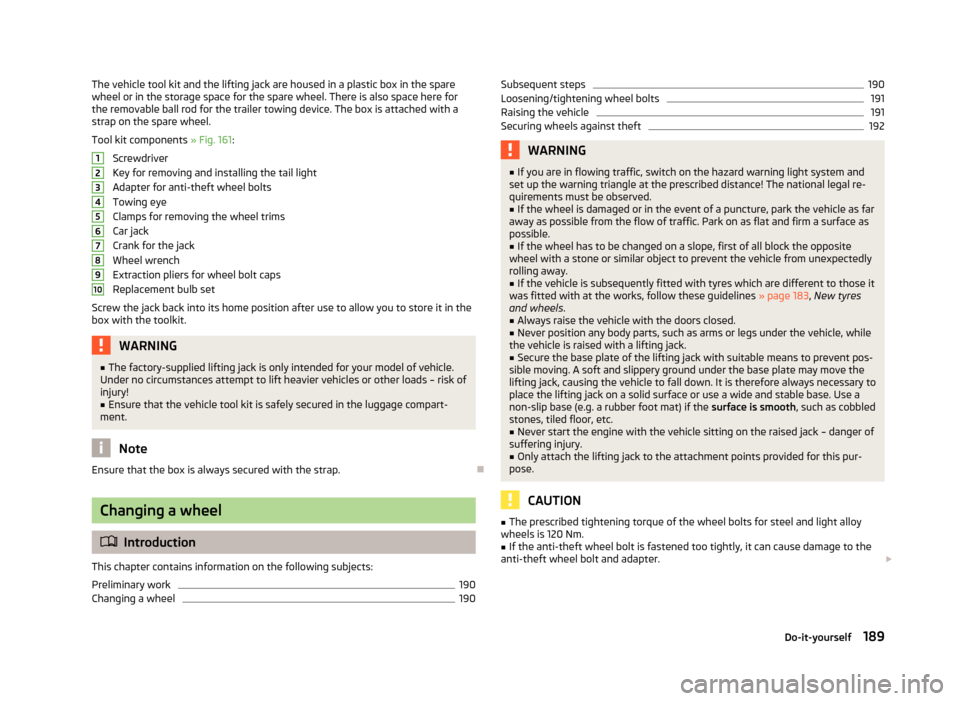
The vehicle tool kit and the lifting jack are housed in a plastic box in the sparewheel or in the storage space for the spare wheel. There is also space here for
the removable ball rod for the trailer towing device. The box is attached with a
strap on the spare wheel.
Tool kit components » Fig. 161:
Screwdriver
Key for removing and installing the tail light
Adapter for anti-theft wheel bolts
Towing eye
Clamps for removing the wheel trims
Car jack
Crank for the jack
Wheel wrench
Extraction pliers for wheel bolt caps
Replacement bulb set
Screw the jack back into its home position after use to allow you to store it in the
box with the toolkit.WARNING■ The factory-supplied lifting jack is only intended for your model of vehicle.
Under no circumstances attempt to lift heavier vehicles or other loads – risk of
injury!■
Ensure that the vehicle tool kit is safely secured in the luggage compart-
ment.
Note
Ensure that the box is always secured with the strap.
Changing a wheel
Introduction
This chapter contains information on the following subjects:
Preliminary work
190
Changing a wheel
19012345678910Subsequent steps190Loosening/tightening wheel bolts191
Raising the vehicle
191
Securing wheels against theft
192WARNING■ If you are in flowing traffic, switch on the hazard warning light system and
set up the warning triangle at the prescribed distance! The national legal re-
quirements must be observed.■
If the wheel is damaged or in the event of a puncture, park the vehicle as far
away as possible from the flow of traffic. Park on as flat and firm a surface as
possible.
■
If the wheel has to be changed on a slope, first of all block the opposite
wheel with a stone or similar object to prevent the vehicle from unexpectedly
rolling away.
■
If the vehicle is subsequently fitted with tyres which are different to those it
was fitted with at the works, follow these guidelines » page 183, New tyres
and wheels .
■
Always raise the vehicle with the doors closed.
■
Never position any body parts, such as arms or legs under the vehicle, while
the vehicle is raised with a lifting jack.
■
Secure the base plate of the lifting jack with suitable means to prevent pos-
sible moving. A soft and slippery ground under the base plate may move the
lifting jack, causing the vehicle to fall down. It is therefore always necessary to
place the lifting jack on a solid surface or use a wide and stable base. Use a
non-slip base (e.g. a rubber foot mat) if the surface is smooth, such as cobbled
stones, tiled floor, etc.
■
Never start the engine with the vehicle sitting on the raised jack – danger of
suffering injury.
■
Only attach the lifting jack to the attachment points provided for this pur-
pose.
CAUTION
■ The prescribed tightening torque of the wheel bolts for steel and light alloy
wheels is 120 Nm.■
If the anti-theft wheel bolt is fastened too tightly, it can cause damage to the
anti-theft wheel bolt and adapter.
189Do-it-yourself
Page 198 of 222

›If the engine does not start, terminate the attempt to start the engine after
10 seconds and wait for about 30 seconds before repeating the process.›
Disconnect the cables in exactly the reverse order to the one described above.
Jump-starting in vehicles with the START-STOP system
Fig. 168
Engine compartment: Earth
First read and observe the introductory information and safety warn-
ings on page 195.
On vehicles with the START-STOP system, the jump-start cable of the charger
must never be connected directly to the negative pole of the vehicle battery, but
only to the engine earth » Fig. 168.
Towing the vehicle
Introduction
This chapter contains information on the following subjects:
Front towing eye
197
Rear towing eye
197
Vehicles a towing device
198
Vehicles with manual transmission may be towed in with a tow bar or a tow rope
or with the front or rear wheels raised.
Vehicles with automatic transmission may be towed in with a tow bar or a tow
rope or with the front wheels raised. If the vehicle is raised at rear, the automatic
gearbox is damaged!
A tow bar is the safest way of towing a vehicle and also minimises any shocks.
Only use a tow rope if a suitable tow bar is not available.
The following guidelines must be observed.
Driver of the tow vehicle›
Release the clutch particularly gently when starting off or depress the accelera-
tor particularly gently if the vehicle is fitted with an automatic gearbox.
›
On vehicles with a manual transmission, only push down on the accelerator pedal once the rope is taught.
The maximum towing speed is 50 km/h.
Driver of the towed vehicle
›
Switch on the ignition so that the steering wheel is not blocked and so that the
turn signal lights, horn, windscreen wipers and windscreen washer system can be switched on.
›
Take the vehicle out of gear or move the selector lever into position N if the ve-
hicle is fitted with an automatic gearbox.
Please note that the brake servo unit and power steering only operate if the en-
gine is running. If the engine is not running, significantly more physical force is re- quired to depress the brake pedal and steer the vehicle.
If using a tow rope, ensure that it is always kept taught.
CAUTION
■ Do not tow start the engine - danger of damaging the engine! On vehicles with
a catalytic converter, unburnt fuel may get into the catalytic converter where it
may ignite. This in turn may damage or destroy the catalytic converter. The bat-
tery from another vehicle can be used as a jump-start aid » page 195, Jump-start-
ing .■
If the gearbox of your vehicle no longer contains any oil because of a defect,
your vehicle must only be towed in with the driven wheels raised clear of the
ground, or on a special vehicle transporter or trailer.
■
The vehicle must be transported on a special vehicle or trailer if it is not possible
to tow in the vehicle in the way described or if the towing distance is greater than
50 km.
■
To protect both vehicles when tow-starting or towing, the tow rope should be
elastic. Thus one should only use plastic fibre rope or a rope made out of a simi-
larly elastic material.
196Do-it-yourself
Page 199 of 222
■While towing, take care to avoid impermissibly high tensile forces or jerky loads.
There is always a risk of excessive stresses and damage resulting at the points to which you attach the tow rope or tow bar when you attempt to tow a vehicle
which is not standing on a paved road.■
Attach the tow rope or the tow bar to the towing eyes » page 197 , Front tow-
ing eye or » page 197 , Rear towing eye to the detachable ball head of the tow-
ing device » page 106 .
Note
■
We recommend using a tow rope from ŠKODA Original Accessories available
from a ŠKODA Partner.■
Towing another vehicle requires a certain amount of practice. Both drivers
should be familiar with the particular points about towing a vehicle. Unskilled
drivers should not attempt to tow in another vehicle or to be towed in.
■
When towing, respect the national legal provisions, especially those which re-
late to the identification of the towing vehicle and the vehicle being towed.
■
The tow rope must not be twisted as it may in certain circumstances result in
the front towing eye being unscrewed out of your vehicle.
Front towing eye
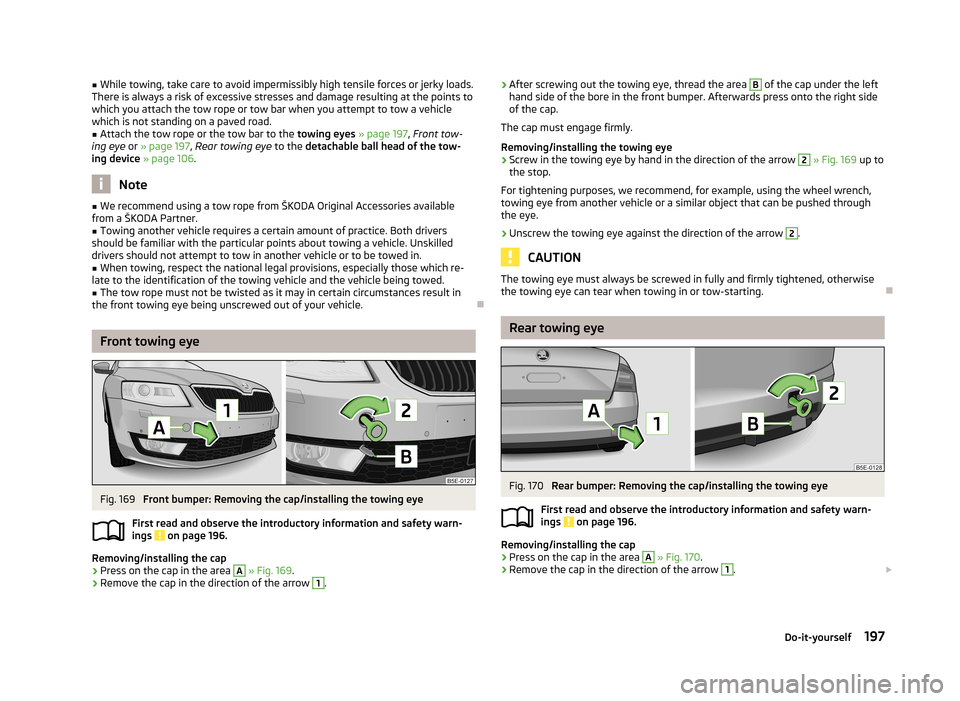
Fig. 169
Front bumper: Removing the cap/installing the towing eye
First read and observe the introductory information and safety warn- ings
on page 196.
Removing/installing the cap
›
Press on the cap in the area
A
» Fig. 169 .
›
Remove the cap in the direction of the arrow
1
.
›After screwing out the towing eye, thread the area B of the cap under the left
hand side of the bore in the front bumper. Afterwards press onto the right side
of the cap.
The cap must engage firmly.
Removing/installing the towing eye›
Screw in the towing eye by hand in the direction of the arrow
2
» Fig. 169 up to
the stop.
For tightening purposes, we recommend, for example, using the wheel wrench,
towing eye from another vehicle or a similar object that can be pushed through
the eye.
›
Unscrew the towing eye against the direction of the arrow
2
.
CAUTION
The towing eye must always be screwed in fully and firmly tightened, otherwise
the towing eye can tear when towing in or tow-starting.
Rear towing eye
Fig. 170
Rear bumper: Removing the cap/installing the towing eye
First read and observe the introductory information and safety warn- ings
on page 196.
Removing/installing the cap
›
Press on the cap in the area
A
» Fig. 170 .
›
Remove the cap in the direction of the arrow
1
.
197Do-it-yourself
Page 200 of 222

›After screwing out the towing eye, thread the area B of the cap under the up-
per hand side of the bore in the rear bumper. Afterwards press onto the lower side of the cap.
The cap must engage firmly.
Removing/installing the towing eye›
Screw in the towing eye by hand in the direction of the arrow
2
» Fig. 170 up to
the stop.
For tightening purposes, we recommend, for example, using the wheel wrench,
towing eye from another vehicle or a similar object that can be pushed through
the eye.
›
Unscrew the towing eye against the direction of the arrow
2
.
On vehicles with a factory-fitted towing device, there is no mount for the screw-
in towing eye behind the cap » page 198, Vehicles a towing device .
CAUTION
The towing eye must always be screwed in fully and firmly tightened, otherwise
the towing eye can tear when towing in or tow-starting.
Vehicles a towing device
First read and observe the introductory information and safety warn-
ings
on page 196.
On vehicles with a factory-fitted towing device, there is no mount for the screw-
in towing eye behind the cap.
Use the detachable ball rod for towing » page 106, Towing device .
Towing the vehicle using the towing device is a viable alternative solution to us-
ing the towing eye.
If the towing device is removed completely, it must be replaced with the standard
reinforcement of the rear bumper which is part of the mount for the towing eye.
If this procedure is not observed, the vehicle may not meet the national legal pro- visions.
CAUTION
The detachable ball rod and the vehicle can be damaged if an unsuitable tow bar
is used.NoteThe detachable ball rod must always be in the vehicle so that it can be used for
towing, if necessary.
198Do-it-yourself
Page 202 of 222

Fuses in the dash panelFig. 171
Storage compartment in the dash panel/schematic diagram of the
fuse box
First read and observe the introductory information and safety warn-
ings
on page 199.
The fuse box can be found behind the stowage compartment in the left-hand
part of the dash panel.
Replacing fuses
›
Opening the stowage compartment » page 73.
›
Grab hold of the stowage compartment in the area of the arrows » Fig. 171.
›
Fold out the stowage compartment by pulling in the direction of arrow
1
.
›
Replace the appropriate fuse.
›
Fold back the stowage compartment by pressing into the secured position in
the dash panel in the direction of arrow
2
.
›
Close the stowage compartment.
Fuse assignment in the dash panel
No.Power consumer1Not assigned2Not assigned3Not assigned4Not assigned5Data bus control unit6Alarm sensorNo.Power consumer
7
Control unit for the air conditioning system, heating, receiver for re-
mote control for the auxiliary heating, selector lever for the automatic gearbox, relay for the rear window heater, replay for the windscreen
heater8Light switch, rain sensor, diagnostic socket9Haldex clutch10Touchscreen11Heated rear seats12Radio13Heated rear seats14Air blower for air conditioning,heating15Electric steering lock16Signal amplifier for telephone, telephone preinstallation17Instrument cluster18Not assigned19KESSY control unit20Steering wheel module21Radio accessories22Luggage compartment door opening23Light - right24Panorama roof25Control unit for central locking front door right, power windows - left26Heated front seats27Music amplifier28Towing device29Not assigned30Belt tensioner - driver's side31Headlight - left32Parking aid (Park Assist)33Airbag 200Do-it-yourself
Page 203 of 222

No.Power consumer
34
TCS button, ESC, tyre control display, pressure sensor for air-condi-tioning, reverse light switch, dimming rear view mirror, START-STOPbutton, telephone preinstallation, control for heating of rear seats,sensor for air-conditioning, 230 V power socket, sound actuator35Headlight, headlamp beam adjustment, diagnostic connector, camera,
radar36Headlight right37Headlight left38Towing device39Control unit for central locking front door - right, power windows -
front and rear right4012-Volt power socket41CNG relay42Control unit for central locking rear door - left, right, headlight clean-
ing system, windscreen wipers43Visor for gas discharge bulbs, interior lighting44Towing device45Control unit for control of seat adjustment46230-Volt power socket47Rear window wiper48Not assigned49Coil on starter relay, clutch pedal switch50Not assigned51Belt tensioner - front passenger side52Not assigned53Relay for rear window heater
Note
On right-hand drive vehicles, the fuse box is located on the front passenger's side
behind the stowage compartment in the left-hand section of the dash panel.
Fuses in the engine compartmentFig. 172
Fuse box cover in engine compartment/Schematic diagram of the
fuse box
Fig. 173
Cover for the fuse box in the en-
gine compartment: Plastic clip
for fuses
First read and observe the introductory information and safety warn-
ings on page 199.
Replacing fuses
›
Press together the interlocks of the cover simultaneously in the direction of the
arrow
1
» Fig. 172 .
›
Remove the cover in the direction of the arrow
2
.
›
Replace the appropriate fuse.
›
Place the cover on top of the fusebox.
›
Push in the interlocks on the cover and lock.
201Fuses and light bulbs