2012 SKODA CITIGO light
[x] Cancel search: lightPage 73 of 157

If a lower gear is selected, the gearbox does not shift down until there is no risk
of the engine overrevving.
If you operate the kickdown function, the gearbox shifts into a lower gear in line
with the vehicle speed and engine speed.
Note
The kickdown function is also available when manually shifting gears. ÐKickdown function
First read and observe the introductory information and safety warn-
ings on page 69.
The kickdown function provides you with maximum acceleration power.
When the accelerator pedal is fully depressed, the kickdown function is activated
in the desired driving program. This function has precedence over the driving pro-
gramme and serves for maximum acceleration of the vehicle when exploiting the
maximum power potential of the engine without taking into account the current
selector lever position ( D or Tiptronic M). The gearbox shifts down to one or sev-
eral gears in line with the driving state and the vehicle accelerates. The gearbox
does not shift up into the highest gear until the engine has reached its maximum
revolutions for this gear range. ÐDynamic shift programme
First read and observe the introductory information and safety warn-
ings on page 69.
The automatic gearbox of your car is controlled electronically. Shifting up and
down through the gears is performed automatically on the basis of pre-defined
driving programmes.
Adopting a moderate style of driving
will cause the gearbox to select the most
economical driving programme. Shifting up into a higher gear as soon as possible
and shifting down as late as possible will have a favourable effect on your fuel
consumption. ä
ä When adopting a
sporty style of driving with rapid movements of the accelerator
pedal combined with sharp acceleration, frequent changes in speed and exploit-
ing the top speed of the car, the gearbox will adjust to this style of driving once
the accelerator pedal (kickdown function) is depressed and will shift down earlier,
frequently by several gears in comparison to a moderate style of driving.
Selecting the most appropriate driving programme for the particular style of driv-
ing is a continuous process. Irrespective of this it is, however, possible to switch
or shift down into a dynamic shift programme by depressing the accelerator rap-
idly. The gearbox shifts down into a lower gear in accordance with the speed,
therefore enabling rapid acceleration (e.g. when overtaking) without the accelera-
tor pedal having to be depressed into the kickdown range. The original pro-
gramme will be reactivated to match your particular style of driving once the
gearbox has shifted up again.
When driving in hilly regions, the gears are selected to match uphill and downhill
sections. This avoids the gearbox frequently shifting up and down when negoti-
ating an uphill stretch. When driving downhill, it is possible to shift down into the
Tiptronic position M, in order to exploit the engine brake torque. Ð Operational faults
First read and observe the introductory information and safety warn-
ings on page 69.
Faults in the automatic gearbox
In the event of a fault in the automatic gearbox, warning lights may light up in the
instrument panel » page 18, Automatic gearbox .
In some instances, the gear may run in emergency mode. In this case, the vehicle
can only be driven at reduced speed.
The vehicle does not start off after engaging the selector lever position
If the vehicle does not start off, the problem may be that the selector lever is not
completely in the selected position. In such an instance, press the brake pedal
and put the selector lever into the required position. Note
If the automatic gearbox has a fault, seek help from a ŠKODA specialist garage
and fix the fault. Ð ä
71
Automatic gearbox
Page 75 of 157

Installing the cradle for the navigation unit
›
Place the cradle into the opening of the centre section of the dash panel from
above, press it down until it latches » .
Installing the multifunctional device
› Firstly, place the multifunction device into the top holder B
» Fig. 77 and press
it on the underside of the cradle until it latches » .
Setting the tilt of the multifunction device
› You can set the tilt to the required position by moving the multifunction device
in the direction of the arrows » Fig. 77 » .
Removing the multifunction device
› With one hand, secure the multifunction device on the upper and lower edge.
› Using the other hand, press the release button C
» Fig. 77 and remove the de-
vice.
› Store the multifunction device in a safe place to avoid damaging it.
Removing the cradle on the multifunction device
› Grab hold of the cradle with one hand.
› With the other hand, press the release button A
» Fig. 77
.
› Remove the cradle from the dash panel from above.
› Seal the opening for the cradle in the dash panel with the cover
» Fig. 76.
Loading the user manual
› Switch on the multifunction device by pressing button D
» Fig. 77
.
› Press the button
more on the screen.
› Press the button
Manual on the screen.
› Call up the required chapter by pressing the appropriate button.
Functions of the multifunction device
› Navigation.
› Operating the radio using multimedia devices connected via Bluetooth ®
.
› Displaying information from the MFD, rev counter and coolant tempera-
ture » page 8.
› Hands-free device for mobile phones coupled with the multifunction device via
Bluetooth ®
.
› Indicator for opened bonnet, doors and luggage compartment lid.
› Display from the visual parking system (OPS).
› Image viewer. WARNING
■ Concentrate fully at all times on your driving! As the driver you are fully re-
sponsible for the operation of your vehicle. Only use the system so that you
are in full control of your vehicle in every traffic situation - risk of accident!
■ The multifunction device must always slot securely into the cradle or be
safely stored in the vehicle.
■ Unsecured or incorrectly secured multifunction devices may be thrown
through the interior of the vehicle and cause injuries in a sudden driving or
braking manoeuvre or accident. ■ Adjust the volume to ensure that acoustic signals from outside, e.g. sirens
from vehicles which have the right of way, such as police, ambulance and fire
brigade vehicles, can be heard at all time. ■ High volumes can cause hearing damage. CAUTION
■ Improper tilt settings can damage both the multifunction device and the cradle.
■ Always take the multifunction device with you when leaving the vehicle to pro-
tect it from extreme temperatures and strong sunlight. Extreme ambient temper-
atures can impair the functioning of the multifunction device and may damage
the device.
■ Moisture can damage the electrical contacts in the dash panel for the portable
multifunction device.
■ Never use water when cleaning the navigation unit cradle. Always use a dry
cloth instead. ■ Install/remove the multifunction device cradle without the multifunction device
in it.
■ Do not install/remove the multifunction device until the cradle for the multi-
function device has been installed into the dash panel. Note
The range of the Bluetooth ®
connection to the hands-free system is restricted to
the vehicle interior. The range is dependent on local factors, e.g. obstacles be-
tween the devices and mutual interferences with other devices. If your mobile
phone is e.g. in a jacket pocket, this can lead to difficulties when establishing the
Bluetooth ®
connection with the hands-free system or the data transfer. Ð
73
Communication
Page 76 of 157

Safety
Passive Safety
General information
ä
Introduction
This chapter contains information on the following subjects:
Safety equipment 74
Before setting off 74
What influences the driving safety? 75
In this section you will find important information, tips and notes on the subject
of passive safety in your vehicle. We have combined everything here which you
should be familiar with, for example, regarding seat belts, airbags, child seats and
safety of children. It is therefore important, in particular, to comply with the notes
and warnings in this section for your own interest and in the interest of those
travelling with you. WARNING
■ This chapter contains important information on how to use the vehicle for
the driver and his occupants. You will find further information on safety, which
concerns you and those travelling with you, in the following chapters of this
Owner's Manual.
■ The complete on-board literature should always be in the vehicle. This ap-
plies in particular, if you rent out or sell the vehicle. ÐSafety equipment
First read and observe the introductory information and safety warn-
ings on page 74.
The following list contains part of the safety equipment in your vehicle:
› three-point seat belts for all the seats;
› belt force limiters for the front seats;
ä ›
belt tensioners for front seats;
› Front airbag for the driver and the front seat passenger;
› Head-Thorax
- driver and front seat passenger side airbag with head restraint
function;
› anchoring points for child seat using the ISOFIX system;
› anchoring points for child seat using the TOP TETHER system;
› rear head restraints adjustable for height;
› steering column adjustable for height.
The specified safety equipment works together, in order to optimally protect you
and those travelling with you in accident situations. The safety equipment does
not protect you or the people travelling with you, if you or your occupants adopt
an incorrect seated position or the equipment is not correctly adjusted or used. Ð Before setting off
First read and observe the introductory information and safety warn-
ings on page 74.
For your own safety and the safety of the people travelling with you, please pay
attention to the following points before setting off.
›
Ensure that the lighting and the turn signal system are functioning properly.
› Check the tyre inflation pressure.
› Ensure that all of the windows offer good visibility to the outside.
› Secure all items of luggage
» page 41, Luggage compartment.
› Ensure that no objects can obstruct the pedals.
› Adjust the rear mirror and the front seat to your body size.
› Advise your passengers on the back seats to adjust the head restraints to their
body size.
› Protect children in suitable child seats with correctly fastened seat
belts
» page 87, Transporting children safely .
› Adopt the correct seated position
» page 75, Correct seated position . Tell your
passengers to assume the correct seated position.
› Correctly fasten the seat belt. Also inform passengers to fasten the seat belt
correctly » page 80 , Fastening and unfastening seat belts .Ð
ä
74 Safety
Page 78 of 157

Correct seated position for the driver
Fig. 78
The correct distance of the driv-
er to the steering wheel
First read and observe the introductory information and safety warn-
ings on page 75.
For your own safety and to reduce the risk of injury in the event of an accident,
we recommend the following setting.
› Adjust the steering wheel so that the distance A
» Fig. 78 between the steer-
ing wheel and your chest is at least 25
cm.
› Adjust the driver’s seat in the forward/back direction so that the pedals can be
fully depressed with slightly bent legs.
› Adjust the seat backrest so that the highest point of the steering wheel can be
reached with your arms at a slight angle.
› Correctly fasten the seat belt
» page 80.
Driver seat adjustment » page 38, Adjusting the front seats .ÐCorrect seated position for the front passenger
First read and observe the introductory information and safety warn-
ings on page 75.
For the safety of the front passenger and to reduce the risk of injury in the event
of an accident, we recommend the following setting.
› Position the front passenger seat back as far as possible. The front passenger
must maintain a distance of at least 25 cm to the dash panel so that the airbag
offers the greatest possible safety if it is deployed.
› Correctly fasten the seat belt
» page 80.
In exceptional cases the front passenger airbag can be deactivated »
page 85,
Switching off the airbags .
ä
ä Front passenger adjustment
» page 38, Adjusting the front seats .Ð Correct seated position for the occupants on the rear seats
First read and observe the introductory information and safety warn-
ings on page 75.
To reduce the risk of injury in the event of a sudden braking manoeuvre or an ac-
cident, the occupants on the rear seats must observe the following.
› Adjust the head restraint so that the top edge of the head restraint is at the
same level as the upper part of your head.
› Correctly fasten the seat belt
» page 80.
› Use a suitable child restraint system if transporting children in the vehi-
cle
» page 87, Transporting children safely .Ð Examples of an incorrect seated position
First read and observe the introductory information and safety warn-
ings on page 75.
Seat belts offer their optimum protection only if the webbing of the seat belts is
properly routed. Incorrect seated positions considerably reduce the protective
functions of the seat belts and therefore increase the risk of injury due to an in-
correct routing of the seat belt. The driver is fully responsible for himself and pas-
sengers, especially children. Never allow a passenger to adopt an incorrect seated
position when the car is moving.
The following list contains examples of which seated positions can cause serious
injuries or death. This list is not complete, however we would like you to familiar-
ise yourself with this subject.
Therefore, while the car is moving never:
› stand up in the vehicle;
› stand up on the seats;
› kneel on the seats;
› tilt the seat backrest fully to the back;
› lean against the dash panel;
› lie on the rear seat bench;
› only sit on the front area of the seat;
› sit to the side;
› lean out of the window;
£
ä
ä
76 Safety
Page 84 of 157

Airbag system
Description of the airbag system
Introductory information
The operational readiness of the airbag system is monitored electronically. The
airbag warning light comes on for a few seconds each time the ignition is
switched on »
page 18.
The airbags inflate in fractions of a second and at a high speed to offer additional
protection in the event of an accident.
The airbag system (according to vehicle equipment) consists of: › an electronic control unit;
› Front airbags for the driver and front seat passenger
» page 83;
› side airbags Head-Thorax » page 84;
› an airbag warning light in the instrument cluster
» page 18, Airbag system ;
› a key switch for the front seat passenger airbag
» page 86;
› an warning light in the middle of the dash panel to indicate the front seat pas-
senger airbag is switched off » Fig. 86 on page 86 - .
A fault in the airbag system exists if:
› the warning light
does not illuminate when the ignition is switched on;
› the warning light
does not go out 3 seconds after the ignition is switched on;
› the warning light
comes on when driving;
› the warning light showing a switched-off front passenger airbag in the middle
of the dash panel flashes;
› the warning light showing a switched-off front passenger airbag in the middle
of the dash panel flashes together with the warning light
. WARNING
■ The airbag is not a substitute for the seat belt, but instead forms part of the
complete passive vehicle safety concept. Please note that an airbag can only
offer you optimal protection in combination with a seat belt which is fas-
tened.
■ To ensure passengers are protected with the greatest possible effect when
the airbag is deployed, the front seats must be correctly adjusted to match
the body size »
page 75, Correct seated position .
■ If you do not fasten the seat belts when driving, lean too far forward or
adopt an incorrect seated position, you are exposing yourself to increased risk
of injury in the event of an accident.
■ If there is a fault, have the airbag system checked immediately by a ŠKODA
specialist garage. Otherwise, there is a risk of the airbag not being activated in
the event of an accident. ■ No modifications of any kind must be made to parts of the airbag system.
Any work on the airbag system including the installation and removal of sys-
tem components due to other repair work (e.g. removal of the steering wheel)
must only be carried out by a
ŠKODA specialist garage.
■ Never make any changes to the front bumper or bodywork.
■ It is prohibited to manipulate individual parts of the airbag system as this
might result in the airbag being deployed.
■ The protective function of the airbag system is sufficient for only one acci-
dent. The airbag system must then be replaced if the airbag has been de-
ployed. ■ The airbag system needs no maintenance during its working life.
■ If you sell your vehicle, provide the complete vehicle documentation to the
new owner. Please note that the information relating to the possibility of de-
activating the front passenger airbag must be included!
■ When disposing of vehicle or parts of the airbag system, it is important to
comply with the national legal requirements. Ð When are the airbags deployed?
The airbag system is only functional when the ignition is switched on.
In special accident situations, both the front and the side airbags may be trig-
gered at the same time.
The airbags are not deployed in the case of minor frontal and side collisions, rear-
end collisions, tilting of the vehicle and vehicle rollover. £
82 Safety
Page 85 of 157
Deployment factors
It is not possible to generally determine which deployment conditions apply to
the airbag system in every situation. An important role is played by factors such
as the type of object that the vehicle hits (hard, soft), the impact angle, vehicle
speed, etc.
A decisive factor for the deployment of the airbags is the deceleration which oc-
curs. The control unit analyses the nature of the collision and activates the rele-
vant restraint system. If the vehicle deceleration which occurs and is measured
during the collision remains below the prescribed reference values specified in
the control unit, the airbags are not deployed although the vehicle may well suf-
fer severe damage to the bodywork as a consequence of the accident.
The following will be deployed in the event of a severe frontal collision:
› driver’s front airbag;
› passenger’s front airbag.
The following will be deployed in the event of a severe side collision: › Side airbags on the side of the accident.
In the event of an accident in which the airbags are deployed:
› the interior lighting comes on (if the switch for the interior light is in the door
contact position),
› the hazard warning light is switched on;
› all the doors are unlocked;
› the fuel supply to the engine is interrupted. Note
A grey white or red, non-harmful gas is released when the airbag is inflated. This
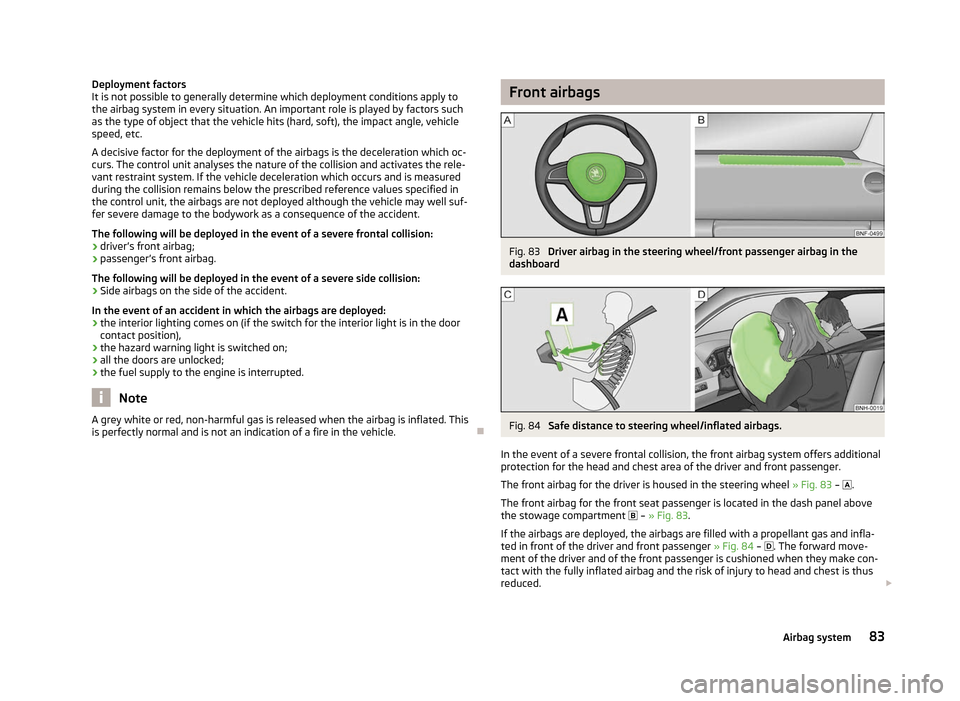
is perfectly normal and is not an indication of a fire in the vehicle. Ð Front airbags
Fig. 83
Driver airbag in the steering wheel/front passenger airbag in the
dashboard Fig. 84
Safe distance to steering wheel/inflated airbags.
In the event of a severe frontal collision, the front airbag system offers additional
protection for the head and chest area of the driver and front passenger.
The front airbag for the driver is housed in the steering wheel » Fig. 83 – .
The front airbag for the front seat passenger is located in the dash panel above
the stowage compartment
– » Fig. 83.
If the airbags are deployed, the airbags are filled with a propellant gas and infla-
ted in front of the driver and front passenger » Fig. 84 – . The forward move-
ment of the driver and of the front passenger is cushioned when they make con-
tact with the fully inflated airbag and the risk of injury to head and chest is thus
reduced. £
83
Airbag system
Page 87 of 157

WARNING (Continued)
■ If children adopt an incorrect seated position when travelling, they may be
exposed to an increased risk of injury in the event of an accident. This can re-
sult in serious injuries » page 87, Child seat.
■ The airbag control unit operates with pressure sensors located in the front
doors. For this reason no adjustments must be carried out to the doors and
door panels (e.g. additional installation of loudspeakers). Resulting damages
can have a negative affect on the operation of the airbag system. All work on
the front doors and their panels must only be carried out by a
ŠKODA special-
ist garage.
■ In the event of a side collision, the side airbags will not function properly, if
the sensors cannot measure the increasing air pressure inside the doors, be-
cause the air can escape through large, non-sealed openings in the door pan-
el. ■Never drive with removed inner door panels.
■ Never drive, if parts of the inner door panel have been removed and the
remaining openings have not been properly sealed.
■ Never drive, if the loudspeakers in the doors have been removed, only if
the loudspeaker openings have been properly sealed.
■ Always make sure that the openings are covered or filled, if additional
loudspeakers or other equipment parts are installed in the inner door pan-
els. ■ Always have work completed by a ŠKODA
Service Partner or a competent
ŠKODA specialist garage.
■ Only hang light items of clothing on the hooks fitted in the vehicle. Never
leave any heavy or sharp-edged objects in the pockets of the items of cloth-
ing.
■ Ensure that there are no excessive forces, such as violent knocks, kicks etc.,
impact on the backrests of the seats otherwise the system may be damaged.
The side airbags would not be deployed in such a case!
■ Any seat or protective covers which you fit to the driver or front passenger
seats must only be of the type expressly authorized by
ŠKODA. In view of the
fact that the airbag inflates out of the backrest of the seat, use of non-ap-
proved seat or protective covers would considerably impair the protective
function of the side airbag.
■ Any damage to the original seat covers in the area of the side airbag module
must be repaired without delay by your
ŠKODA specialist garage.
■ The airbag modules in the front seats must not display any damage, cracks
or deep scratches. It is not permissible to use force in order to open the mod-
ules. Ð Switching off the airbags
Deactivating airbags
Deactivation of airbags is envisaged only for particular instances, such as if: › using a child seat on the front passenger seat, in which the child has its back to
the vehicle's direction of travel (in some countries this must be in the direction
of travel due to different legal regulations applying)
» page 87, Transporting
children safely ;
› not being able to maintain a distance of at least 25 cm between the middle of
the steering wheel and chest, despite the driver's seat being correctly adjusted;
› special attachments are required in the area of the steering wheel because of a
physical disability;
› other seats have been installed (e.g. orthopaedic seats without side airbags).
The front passenger airbag can be switched off with the key-operated
switch » page 86.
We recommend that you ask a
ŠKODA Service Partner to switch off any other air-
bags.
Monitoring the airbag system
The functionality of the airbag system is also monitored electronically when one
airbag has been switched off.
If the airbag was switched off using diagnostic equipment:
› The airbag warning light
lights up for 3 seconds each time the ignition is
switched on and then flashes after that for about 12 seconds.
If the airbag was switched off using the key switch on the side of the dash pan-
el:
› The airbag warning light
comes on for 3 seconds after the ignition has been
switched on;
› The deactivated airbag is indicated by the illumination of the warning light
in the middle of the dash panel » Fig. 86 on page 86 - . Note
■ The national regulations for switching off airbags must be observed.
■ A ŠKODA Service Partner will be able to inform you which airbags in your vehicle
can/must be deactivated. Ð
85
Airbag system
Page 88 of 157

Key switch for the front seat passenger airbag
Fig. 86
Key switch/ - warning light
Only the front passenger airbag is deactivated with the key switch.
Deactivating an airbag › Switch off the ignition.
› Use the key to turn the slot of the key switch into the position (
OFF) » Fig. 86 -
.
› Check whether the warning light
in the middle of the dash
panel lights up when the ignition is switched on » Fig. 86 - .
Activating an airbag
› Switch off the ignition.
› Use the key to turn the slot of the key switch into the position (
ON) » Fig. 86 -
.
› Check that the warning light
in the middle of the dash pan-
el does not light up when the ignition is switched on » Fig. 86 - .
Warning light (front passenger airbag switched off)
In cases where the front passenger airbag is switched off the airbag warning
light comes on for a few seconds after switching on the ignition, goes out for
about a second and then comes on again.
There is a system fault in the deactivated airbag » if the airbag warning light
flashes. Immediately visit a ŠKODA specialist garage. WARNING
■ The driver is responsible for whether the airbag is switched on or switched
off.
■ Only switch off the airbag when the ignition is switched off! Otherwise a
fault can occur in the system for deactivating the airbag. ■ If the warning light
flashes, the front passenger airbag
will not be deployed in the event of an accident! Have the airbag system
checked by a ŠKODA specialist garage immediately. Ð86
Safety