2012 SKODA CITIGO oil
[x] Cancel search: oilPage 114 of 157

Changing engine oil
First read and observe the introductory information and safety warn-
ings on page 108.
The engine oil must be changed at the intervals stated in the Service schedule or
according to the service interval indicator
» page 10, Service Interval Display.CAUTION
Additives must not be added to the engine oil – risk of causing considerable dam-
age to parts of the engine! Damage, which results from such product, are exclu-
ded from the warranty. Note
If your skin has come into contact with oil, it must be washed thoroughly. ÐCoolant
First read and observe the introductory information and safety warn-
ings on page 108.
The cooling system is filled with a coolant in the factory.
The coolant consists of water with a concentration of coolant additive of 40 %.
This mixture provides antifreeze protection down to -25
°C and also protects the
cooling and heating system from corrosion. It also prevents the formation of scale
and significantly increases the boiling point of the coolant.
The concentration of coolant must therefore not be reduced by adding water dur-
ing the summer months or in countries with a warm climate. The concentration of
coolant additive in the coolant must be at least 40 %.
If a higher concentration of antifreeze is required for climatic reasons, the amount
of coolant additive can only be increased up to 60 % (antifreeze protection down
to approx. -40 °C). The antifreeze protection tails off above that concentration.
Vehicles exported to countries with a cold climate are already factory-filled with a
coolant which offers antifreeze protection down to about -35 °C. In these coun-
tries the concentration of coolant additive should be at least 50 %.
When refilling, we only recommend you use the same antifreeze written on the
antifreeze expansion tank » Fig. 101 on page 112.
ä
ä
Coolant capacity
Petrol engines Capacities (in litres)
1.0 ltr./44 kW MPI 4.2
1.0 ltr./55 kW MPI 4.2
1.0 l/50 kW - CNG 4.2 CAUTION
■ Other coolant additives that do not comply with the correct specifications can
above all significantly reduce the anticorrosion effect.
■ Any faults resulting from corrosion may cause a loss of coolant and can conse-
quently result in major engine damage! Ð Checking the coolant level
Fig. 101
Engine compartment: Coolant
expansion reservoir
First read and observe the introductory information and safety warn-
ings on page 108.
The coolant expansion bottle is located in the engine compartment.
›
Switch off the engine.
› Open the bonnet
» page 110.
› Check the level of coolant in the coolant expansion bottle
» Fig. 101. The cool-
ant level when the engine is cold must lie between the
“MIN” and “MAX” mark-
ings. The level may also rise slightly above the “MAX” marking when the engine
is warm.
If the coolant level in the coolant expansion tank is too low, this is indicated by
the warning light lighting up in the instrument cluster » page 16, Coolant tem-
perature/coolant level . We still recommend inspecting the coolant level directly
at the reservoir from time to time. £
ä
112 General Maintenance
Page 116 of 157
There may be an indication of a leak in the brake system, however, if the fluid lev-
el drops significantly within a short time or if it drops below the
“MIN” marking. If
the brake fluid level is too low, this is indicated by the warning light lighting up
in the instrument cluster » page 15, Brake system .WARNING
If the fluid level has dropped below the MIN marking, do not continue your
journey – risk of accident! Seek help from a
ŠKODA specialist garage.ÐChanging the brake fluid
First read and observe the introductory information and safety warn-
ings on page 108.
Brake fluid absorbs moisture. Over time it therefore absorbs moisture from the
environment. Excessive water in the brake fluid may be the cause of corrosion in
the brake system. The water content also lowers the boiling point of the brake
fluid.
The brake fluid must comply with the following standards or specifications:
› VW 50114;
› FMVSS 116 DOT4. WARNING
Using old brake fluid can result in severe stress on the brakes because of the
formation of vapour bubbles in the brake system. This greatly impairs the
braking efficiency and thus also the safety of your vehicle. CAUTION
Brake fluid damages the paintwork of the vehicle. Ð
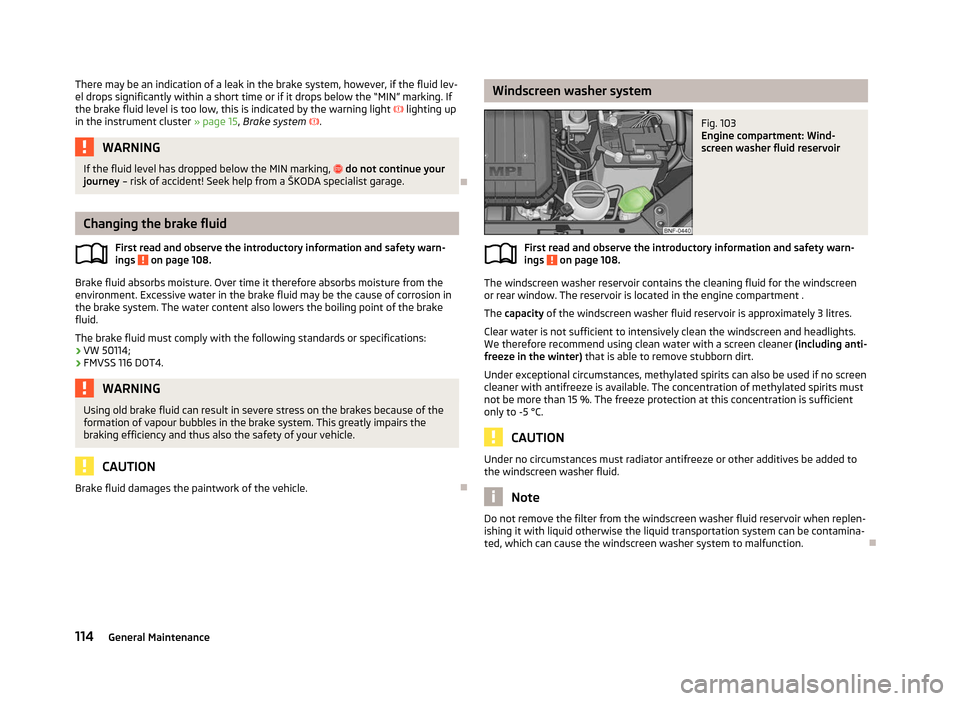
ä Windscreen washer system
Fig. 103
Engine compartment: Wind-
screen washer fluid reservoir
First read and observe the introductory information and safety warn-
ings on page 108.
The windscreen washer reservoir contains the cleaning fluid for the windscreen
or rear window. The reservoir is located in the engine compartment .
The capacity
of the windscreen washer fluid reservoir is approximately 3
litres.
Clear water is not sufficient to intensively clean the windscreen and headlights.
We therefore recommend using clean water with a screen cleaner (including anti-
freeze in the winter) that is able to remove stubborn dirt.
Under exceptional circumstances, methylated spirits can also be used if no screen
cleaner with antifreeze is available. The concentration of methylated spirits must
not be more than 15 %. The freeze protection at this concentration is sufficient
only to -5 °C. CAUTION
Under no circumstances must radiator antifreeze or other additives be added to
the windscreen washer fluid. Note
Do not remove the filter from the windscreen washer fluid reservoir when replen-
ishing it with liquid otherwise the liquid transportation system can be contamina-
ted, which can cause the windscreen washer system to malfunction. Ð
ä
114 General Maintenance
Page 121 of 157

Wheels and Tyres
Tyres
ä
Introduction
This chapter contains information on the following subjects:
Service life of tyres 120
Handling wheels and tyres 121
New wheels and tyres 121
Unidirectional tyres 121
Spare wheel 122
Full wheel trim 122
Wheel bolts 123
Wheel bolts 123
Winter tyres 123
Snow chains 123
WARNING
■ During the first 500 km, new tyres do not offer optimum grip and appropri-
ate care should therefore be taken when driving – risk of accident!
■ Never drive with damaged tyres – risk of accident!
■ Only use those tyres or wheel rims which have been approved by ŠKODA for
your model of vehicle. Failure to observe this instruction will adversely affect
the road safety of your vehicle – risk of accident! ■ The maximum permissible speed for your tyres must not be exceeded under
any circumstances – risk of an accident resulting from tyre damage and loss of
control of the vehicle.
■ If the inflation pressure is too low, the tyre must perform a higher rolling re-
sistance. At higher speeds the tyre will warm up as a result of this. This can
result in tread separation and a tyre blowout.
■ Do not, where possible, replace individual tyres but at least replace them on
both wheels of a given axle at the same time. Always fit the tyres with the
deeper tread depth to the front wheels. ■ Never use tyres if you do not know anything about the condition and age. WARNING (Continued)
■ You must have your tyres replaced with new ones at the latest when the
wear indicators have been worn down.
■ Worn tyres do not provide the necessary adhesion to the road surface at
high speeds on wet roads. One could experience
“aquaplaning” (uncontrolled
movements of the vehicle – “swimming” on a wet road surface).
■ Immediately replace damaged wheel rims or tyres.
■ Do not use summer or winter tyres that are older than 6 years or 4 years re-
spectively.
■ The wheel bolts must be clean and must turn easily. However, they must
never be treated with grease or oil.
■ If the wheel bolts are tightened to a too low tightening torque, the rim can
come loose when the car is moving – risk of accident! A tightening torque
which is too high can damage the bolts and threads and this can result in per-
manent deformation of the contact surfaces on the rim.
■ In case of incorrect treatment of the wheel bolts, the wheel can loosen
when the car is moving – risk of accident! ■ Observe the national legal regulations relating to the use of tyres and snow
chains. CAUTION
■ If a spare wheel is used that is not identical to the fitted tyres, the following
must be observed » page 122, Spare wheel.
■ The prescribed tightening torque of the wheel bolts for steel and light alloy
wheels is 110
Nm.
■ Protect the tyres from contact with oil, grease and fuel.
■ Replace any lost valve caps immediately. For the sake of the environment
Tyres which are insufficiently inflated increase your fuel consumption. Note
■ We recommend that any work on the wheels or tyres is carried out by a
ŠKODA
Service Partner. ■ We recommend that you use wheel rims, tyres, full wheel trims and snow chains
from
ŠKODA Original Accessories. Ð
119
Wheels and Tyres
Page 131 of 157

›
Let all of the occupants get out.
While changing a tyre, the occupants of the
vehicle should not stand on the road (instead they should remain behind a crash
barrier).
› Switch off the engine and move the gearshift lever into
Neutral or move the
selector lever for the automatic gearbox into position N.
› Firmly apply the
handbrake.
› Remove the vehicle tool kit
» page 127 and the spare wheel » page 122, Spare
wheel from the luggage compartment. ÐChanging a wheel
First read and observe the introductory information and safety warn-
ings on page 128.
Always change a wheel on a level surface as far as possible.
›
Remove the full wheel trim
» page 122 or caps »
page 123.
› First of all slacken the anti-theft wheel bolt and then the other wheel
bolts » page 130.
› Jack up the vehicle until the wheel that needs changing is clear of the
ground » page 131 .
› Unscrew the wheel bolts and place them on a clean surface (cloth, paper, etc.).
› Remove the wheel.
› Attach the spare wheel and slightly screw on the wheel bolts.
› Lower the vehicle.
› Alternately tighten the wheel bolts opposite each other using the wheel
wrench (crosswise) and then tighten the anti-theft wheel bolt » page 130.
› Reinstall the wheel trim/wheel trim cap or the caps. Note
■ All bolts must be clean and must turn easily.
■ Under no circumstances grease or oil the wheel bolts!
■ When fitting unidirectional tyres, ensure that the direction of rotation is cor-
rect »
page 121, Unidirectional tyres . ÐSubsequent steps
First read and observe the introductory information and safety warn-
ings on page 128.
The following steps must also be performed after changing the wheel.ä
ä ›
Stow and attach the replaced wheel in the spare wheel well using a special
screw » page 122, Spare wheel.
› Stow the vehicle tool kit in the space provided.
› Check
the tyre pressure
on the installed spare wheel as soon as possible.
› Have the
tightening torque of the wheel bolts checked with a torque wrench
as soon as possible.
› Change the damaged wheel or consult a ŠKODA specialist garage about repair
possibilities. Note
■ If it is determined that the wheel bolts are corroded and difficult to turn when
changing the wheel, the bolts must be replaced before checking the tightening
torque. ■ Drive cautiously and only at a moderate speed until the tightening torque has
been checked. Ð
129
Do-it-yourself
Page 138 of 157

Jump-starting in vehicles with the START-STOP system
Fig. 117
Engine compartment: Engine
earth
First read and observe the introductory information and safety warn-
ings on page 134.
On vehicles with the START-STOP system, the jump-start cable of the charger
must never be connected directly to the negative pole of the vehicle battery, but
only to the engine earth
» Fig. 117. ÐTowing the vehicle
ä
Introduction
This chapter contains information on the following subjects:
Front towing eye 137
Vehicles with manual transmission can be towed in with a tow bar or a tow rope
or with the front or rear wheels raised.
Vehicles with automated transmission can be towed with a tow bar or a tow rope
or with the front wheels raised. If the vehicle is raised at rear, the automatic gear-
box is damaged!
A tow bar is the safest way of towing a vehicle and also minimises any shocks.
Only use a tow rope if a suitable tow bar is not available.
When towing, the following guidelines must be observed.
Driver of the tow vehicle
› Release the clutch particularly gently when starting off or depress the accelera-
tor particularly gently if the vehicle is fitted with an automated transmission.
ä
›
On vehicles with a manual transmission, only push down on the accelerator
pedal once the rope is taught.
The maximum towing speed is 50 km/h.
Driver of the towed vehicle
› Switch on the ignition so that the steering wheel is not blocked and so that the
turn signal lights, horn, windscreen wipers and windscreen washer system can
be switched on.
› Take the vehicle out of gear or move the selector lever into position
N if the
vehicle is fitted with an automated transmission.
Please note that the brake servo unit and power steering only operate if the en-
gine is running. If the engine is not running, significantly more physical force is re-
quired to depress the brake pedal and steer the vehicle.
If using a tow rope, ensure that it is always kept taught. CAUTION
■ Do not tow start the engine - danger of damaging the engine! On vehicles with
a catalytic converter, unburnt fuel may get into the catalytic converter where it
may ignite. This in turn may damage or destroy the catalytic converter. The bat-
tery from another vehicle can be used as a jump-start aid » page 134, Jump-start-
ing .
■ If the gearbox of your vehicle no longer contains any oil because of a defect,
your vehicle must only be towed in with the driven wheels raised clear of the
ground, or on a special vehicle transporter or trailer.
■ The vehicle must be transported on a special vehicle or trailer if it is not possible
to tow in the vehicle in the way described or if the towing distance is greater than
50 km. ■ To protect both vehicles when tow-starting or towing, the tow rope should be
elastic. Thus one should only use plastic fibre rope or a rope made out of a simi-
larly elastic material.
■ One should be constantly vigilant not to allow impermissibly high towing forces
or jerky loadings. There is always a risk of excessive stresses and damage result-
ing at the points to which you attach the tow rope or tow bar when you attempt
to tow a vehicle which is not standing on a paved road.
■ Attach the tow rope or the tow bar only to the towing eye » page 137. £
136 Do-it-yourself
Page 148 of 157

In the extra-urban driving cycle, the vehicle is accelerated and decelerated in all
gears, corresponding to daily routine driving conditions. The driving speed varies
between 0 and 120 km/h.
The calculation of the combined fuel consumption considers a weighting of about
37
% for the intra-urban cycle and 63 % for the extra-urban cycle. WARNING
Do not exceed the specified maximum permissible weights - risk of accident
and damage. Note
■ If required, you can find out the precise weight of your vehicle by contacting a
ŠKODA
Service Partner.
■ Depending on the range of equipment, style of driving, traffic situation, weather
influences and vehicle condition, consumption values may deviate from the indi-
cated values. ÐDimensions
Dimensions (mm) Length 3563
Width 1641/1645a)
Width including exterior mirror 1910
Height 1478/1463b)
Clearance 136/121b)
Wheel base 2420
Track gauge front/rear 1428/1424a)
Valid for vehicles with rear side doors.
b) The value corresponds to the status with the Green tec package. ÐSpecifications and engine oil capacity
The engine has been factory-filled with a high-grade oil that can be use through-
out the year - except in extreme climate zones. Various oils can be mixed together when refilling.
Engine oils are, of course, undergoing continuous further development. Thus the
information stated in this Owner's Manual is only correct at the time of publica-
tion.
ŠKODA Service Partners are informed about the latest changes by
ŠKODA. We
therefore recommend that the oil change is completed by a ŠKODA Service Part-
ner.
The specifications (VW standards) stated in the following can be indicated sepa-
rately or together with other specifications on the bottle.
The oil capacities include oil filter change. Check the oil level when filling; do not
over fill. The oil level must be between the markings » page 111, Checking the en-
gine oil level .
Specifications and capacity (in l) Engine SpecificationFilling level
1.0 l/44 kW VW 502 00, VW 504 00a)
3.4
1.0 l/55 kW VW 502 00, VW 504 00a)
3.4
1.0 l/50 kW - CNG VW 502 003.4 a)
The use of an engine oil with the VW 504 00 specification requires the use of a fuel according to the
EN 228 standard » page 105, Unleaded petrol or a fuel of comparable quality. Note
■ Before a long drive we recommend that you purchase and carry with you engine
oil which complies with the specification for your vehicle. ■ We recommend that you use oils from ŠKODA Original Accessories. Ð146
Technical data
Page 150 of 157

Index
A
ABS 61
Warning light 17
Accessories 125
Adjusting Exterior mirror 36
Interior mirror 35
Adjusting seats 75
Adjustment Seat 38
Aerial 98
Airbag Deployment 82
Front airbag 83
Side airbag Head-Thorax 84
Switching off 85
System description 82
Air conditioning system 53
Recirculated air mode 55
Antilock brake system 61
Ash tray 45
Assistance systems ESC 60
Assist systems ABS 17, 61
City Safe Drive 66
Cruise control systems (CCS) 63
EDL 61
ESC 17
Parking aid 62
START/STOP 65
TCS 61
Traction Control System (TCS) 17
Visual parking system 63Automatic gearbox 69
Dynamic shift programme 71
Information for driving 69
Kickdown 71
Operational faults 71
Parking 69
Selector lever positions 70
Starting off 69
Stopping 69
Tiptronic 70
Automatic load deactivation 118
Avoiding damage to your vehicle 95
B
Before setting off 74
Belts 78
Belt tensioners 80
Bonnet Closing 110
Opening 110
Brake assist 60
Brake booster 60
Brake fluid Checking 113
Brakes Handbrake 60
Running in 91
Warning light 15
Braking Brake fluid 113
Breakdown kit 132
Bulbs Replacing 141
Button in the driver's door Electrical power windows 26
C
Car computer see Multifunction display 11Car jack 127
Carrier 44
Catalytic converter 91
Central locking button 23
Central locking system 21
lock 22
unlock 22
Changes 125
Changing Engine oil 112
Wheel 128
Charging a vehicle battery 117
Checking Battery electrolyte level 116
Brake fluid 113
Coolant level 112
Engine oil 111
Oil level 111
Windscreen washer fluid 114
Children and safety 87
Child safety Side airbag 88
Child safety lock 21
Child seat Classification 88
ISOFIX 89
on the front passenger seat 87
Suitability 89
TOP TETHER 90
Chrome parts refer to Taking care of your vehicle 99
Cigarette lighter 46
City Safe Drive 66
Warning light 19
Cleaning 97
Artificial leather 101
Headlight lenses 100
Material coverings 102
Materials 101
Natural leather 102
148 Index
Page 151 of 157

Plastic parts 99
Wheels 101
Clock 12
Clothes hooks 50
CNG 106
Fuel gauge 9
Refuelling 106
Cockpit 12-volt power socket 46
Ash tray 45
Cigarette lighter 46
Cup holder 45
General view 7
Light 32
Storage compartments 47
Compartments 47
Compressed natural gas see CNG 106
Computer see Multifunction display 11
Coolant Checking 112
Replenishing 113
Correct seated position 75
Counter for distance driven 10
Cruise control system (CCS) 63
Cup holder 45
D
Dash panel insert 8
Daytime running light 30
Defrsoting rear window 33
Digital clock 12
Dipstick 111
Display Fuel level 9
Service interval 10
Distance driven 10Door
Child safety lock 21
Door opening lever locking of 22
Door opening leverl unlocking of 22
Doors Emergency locking 25
Driving Abroad 95
Driving through water on the street 96
Emissions 145
Fuel consumption 145
Towing a trailer 126
E
Economical and environmentally friendly driving 92
EDL 61
Electrical power windows Button in the driver's door 26
Electronic differential lock 61
Electronic immobiliser 57
Emergency Changing a wheel 128
Hazard warning light system 31
Jump-starting 134
locking of the doors 25
Towing the vehicle 136
Tyre repair 132
Unlocking the luggage compartment lid 26
Emissions 145
Engine Running in 91
Starting and stopping the engine 56
Engine compartment Brake fluid 113
Coolant 112
Overview 110
Vehicle battery 115Engine oil
Capacity 146
Changing 112
Checking 111
Replenishing 111
Specification 146
Engine revolutions counter 9
Environment 92
Environmental compatibility 94
Environmentally friendly driving 92
ESC Function 60
Warning light 17
F
Fire extinguisher 127
First-aid kit 127
Floor mats 62
Front airbag 83
Front seats 38
Fuel 104
Fuel gauge 9
refer to Fuel 104
Refuelling 104
Unleaded petrol 105
Fuel consumption 92
Fuses Assignment 138
Replacing 138
G
Gear Recommended gear 10
General view Cockpit 7
H
Handbrake 60
149
Index