2012 SKODA CITIGO heating
[x] Cancel search: heatingPage 41 of 157

Adjusting height of seat
›
To lift the seat, pull or pump the lever 2
» Fig. 35 upwards.
› To lower the seat, push or pump the lever 2
downwards.
Adjusting the angle of the seat backrest
› Remove the load on the seat backrest (do not lean on it), pull the lever 3
» Fig. 35 or 4 1)
towards the rear and set the desired angle of the seat back-
rest with the back.
Folding the front seat forwards and moving it 1
)
› Pull the lever 3
» Fig. 35
or 4
and fold the seat backrest fully forwards. At the
same time, move the seat forwards.
Moving seats into the initial position 1
)
› Move the seat towards the rear until the lock is heard to engage.
› Then push the seat backrest back into the upright position until the unlocking
button clicks into place - check by pulling on the seat backrest. ÐFront seat heating
Fig. 36
Heated front seats
First read and observe the introductory information and safety warn-
ings on page 38.
The front seats can be heated electrically. In some seat versions, the seat back-
rest is heated as well.
The seat heating can only be switched on when the engine is running.
› Heating on the driver's and front passenger's seat can be switched on and
regulated by pressing the button or
» Fig. 36.
ä Pressing once switches the seat heating on at its maximum level.
With repeated pressing of the switch, the level of the seat heating is down-regu-
lated up to the switch-off. The level of the seat heating is indicated by the num-
ber of illuminated warning lights in the switch. WARNING
If, as an occupant, you have a subdued pain and/or temperature sensitivity,
e.g. through medication, paralysis or because of chronic illness (e.g. diabetes),
we recommend you do not use seat heating on the driver or front passenger
seat. This can lead to burns on the back, the posterior and the legs which are
difficult to heal. If the seat heating is used, we recommend to make regular
breaks in your journey when driving long distances, so that the body can recu-
perate from the stress of the journey. Please consult your doctor, who can
evaluate your specific condition. CAUTION
■ Do not kneel on the seats or otherwise apply pressure at specific points to
avoid damaging the heating elements for the seat heaters.
■ Do not use the seat heaters if the seats are not occupied by persons or if ob-
jects, such as a child seat, bag, etc., are fastened or stored on them. A fault of the
heating elements in the seat heating can occur.
■ Do not clean the seats using moisture » page 102, Fabric covers on electrically
heated seats. Note
If the on-board voltage drops, the seat heating is switched off automatically, in
order to provide sufficient electrical energy for the engine control »
page 118,
Automatic load deactivation . Ð1)
Applies to front seats with the Easy Entry system.
39
Seats and Stowage
Page 43 of 157

CAUTION
Ensure that the seat belts are not damaged when operating the seat backrests.
Under no circumstances must the rear seat belts be jammed by the folded back
seat backrests. ÐLuggage compartment
ä
Introduction
This chapter contains information on the following subjects:
Lashing eyes 42
Bag hooks 42
Fixing nets 43
Luggage compartment cover 43
Please observe the following for the purpose of maintaining good handling char-
acteristics of your vehicle:
› Distribute loads as evenly as possible.
› Place heavy objects as far forward as possible.
› Attach the items of luggage to the lashing eyes or using the fixing
net » page 42 .
In the event of an accident, there is such a high kinetic energy which is produced
by small and light objects that they can cause severe injuries. The magnitude of
the kinetic energy is dependent on the speed at which the vehicle is travelling
and the weight of the object. The speed at which the vehicle is travelling is in this
case the more significant factor.
Example: In the event of a frontal collision at a speed of 50 km/h, an unsecured
object with a weight of 4.5 kg produces an energy, which corresponds to 20 times
its own weight. This means that it results in a weight of approx. 90 kg “ ”. You can
imagine the injuries that can occur, if this “object” flies through the interior com-
partment and hits an occupant. WARNING
■ Store the objects in the luggage compartment and attach them to the lash-
ing eyes.
■ Loose objects in the passenger compartment can be thrown forward during
a sudden manoeuvre or in case of an accident and can injure the occupants or
other oncoming traffic. This risk is still increased, if the objects which are fly-
ing around are hit by a deployed airbag. In this case, the objects which are
thrown back can injure the occupants – hazard.
■ Please note that the handling properties of the vehicle may be affected
when transporting heavy objects as the centre of gravity can be displaced –
risk of accident! The speed and style of driving must be adjusted accordingly. ■ If the items of luggage or objects are attached to the lashing eyes with un-
suitable or damaged lashing straps, injuries can occur in the event of braking
manoeuvres or accidents. To prevent items of luggage from being thrown for-
ward, always use suitable lashing straps which must be firmly attached to the
lashing eyes. ■ The items carried in the luggage compartment must be stored in such a way
that no objects are able to slip forward if any sudden driving or braking ma-
noeuvres are undertaken – risk of injury!
■ When transporting fastened objects which are sharp and dangerous in the
luggage compartment that has been enlarged by folding the rear seats for-
ward, ensure the safety of the passengers transported on the other rear
seats »
page 76, Correct seated position for the occupants on the rear seats .
■ If the rear seat next to the folded forward seat is occupied, ensure maxi-
mum safety, e.g. by placing the goods to be transported in such a way that the
seat is prevented from folding back in case of a rear collision.
■ Never drive with the luggage compartment lid fully opened or slightly ajar
otherwise exhaust gases may get into the interior of the vehicle – risk of poi-
soning! ■ Under no circumstances, should the permissible axle loads and permissible
gross weight of the vehicle be exceeded – risk of accident! ■ Never transport people in the luggage compartment! CAUTION
Please ensure that the heating elements for the rear window heater are not dam-
aged as a result of abrasive objects. Note
The tyre pressure must be adjusted to the load . Ð
41
Seats and Stowage
Page 53 of 157

Heating and air conditioning system
Heating and air conditioning system
Introductory information
The heating effect is dependent upon the coolant temperature, thus full heat
output only occurs when the engine has reached its operating temperature.
If the cooling system is switched on, the temperature and air humidity drops in
the vehicle. The well-being of the occupants of the car is enhanced as a result of
this particularly at high outside temperatures and a high air humidity. The system
prevents the windows misting up during the cold season of the year.
It is possible to briefly activate recirculated air mode to enhance the cooling ef-
fect.
Please refer to the information regarding the recalculated air mode for air-condi-
tioning » page 55.
The air inlet in front of the windscreen must be free of ice, snow or leaves to en-
sure that the heating and cooling system operates properly.
After switching on the cooling Condensation from the evaporator of the air condi-
tioning may drip down and form a puddle below the vehicle. This is quite normal
and not an indication of a leak! WARNING
■ For your own safety and that of other road users, ensure that all the win-
dows are free of ice, snow and misting. Please familiarize yourself about how
to correctly operate the heating and ventilation systems, how to demist and
defrost the windows, as well as with the cooling mode.
■ Do not leave recirculated air mode on over a longer period of time, as “stale”
air can cause fatigue of the driver and passengers, reduce attention levels and
also cause the windows to mist up. The risk of having an accident increases.
Switch off recirculated air mode as soon as the windows start to mist up. Note
■ The used air streams out through the vents in the luggage compartment.
■ We recommend that you do not smoke in the vehicle when the recirculating air
mode is operating since the smoke which is drawn at the evaporator from the in-
terior of the vehicle forms deposits in the evaporator of the air conditioning sys-
tem. This produces a permanent odour when the air conditioning system is oper-
ating which can only be eliminated through considerable effort and expense (re-
placement of compressor).
■ To ensure that the heating and air conditioning systems work properly, do not
block up the air outlet vents with any objects. Ð Using the air conditioning system economically
The compressor on the air conditioning system uses power from the engine when
in cooling mode which will effect the fuel consumption.
It recommended to open the windows or the doors of a vehicle for which the inte-
rior has been strongly heated through the effect of direct sunlight in order to al-
low the heated air to escape.
The cooling system should not be switched on while travelling when the window
is open.
If the desired interior temperature can also be achieved without activating the
cooling system, fresh air mode should be selected. For the sake of the environment
Pollutant emissions are also reduced when fuel is saved. Ð Operational problems
If the cooling system does not operate at outside temperatures higher than +5 °C,
there is a problem in the system. The reasons for this may be.
› One of the fuses has blown. Check the fuse and replace if necessary
»
page 138.
› The cooling system has switched off automatically for a short time because the
coolant temperature of the engine is too hot » page 13.
If you cannot rectify the functional fault yourself, or the cooling capacity decrea-
ses, the cooling system must be switched off. Visit a ŠKODA specialist garage. Ð
51
Heating and air conditioning system
Page 54 of 157
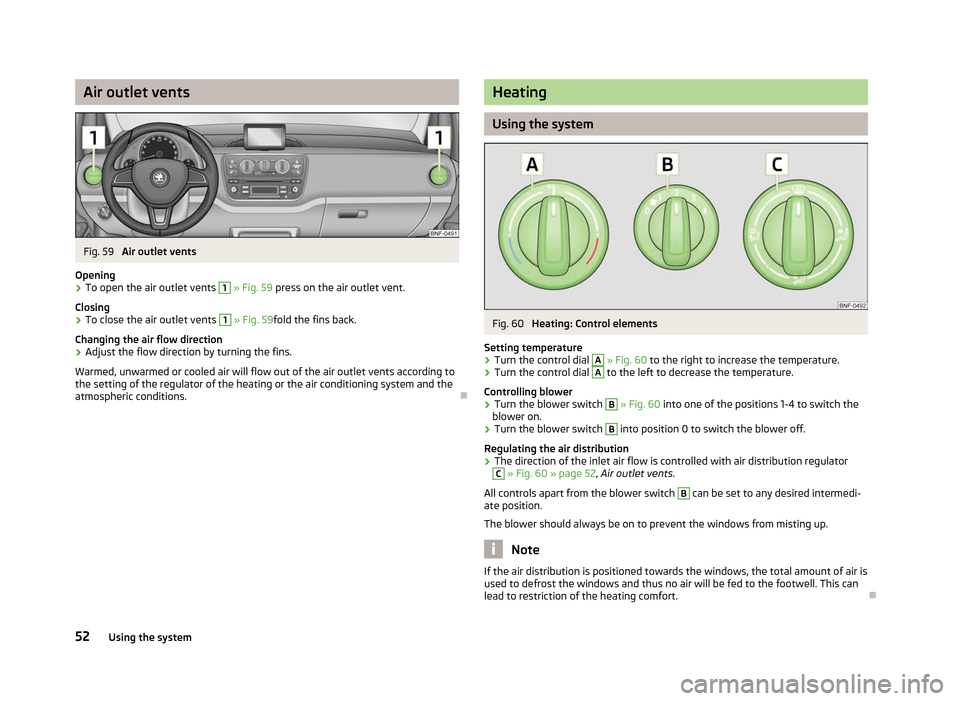
Air outlet vents
Fig. 59
Air outlet vents
Opening
› To open the air outlet vents 1
» Fig. 59 press on the air outlet vent.
Closing
› To close the air outlet vents 1
» Fig. 59
fold the fins back.
Changing the air flow direction
› Adjust the flow direction by turning the fins.
Warmed, unwarmed or cooled air will flow out of the air outlet vents according to
the setting of the regulator of the heating or the air conditioning system and the
atmospheric conditions. Ð Heating
Using the system
Fig. 60
Heating: Control elements
Setting temperature › Turn the control dial A
» Fig. 60 to the right to increase the temperature.
› Turn the control dial A
to the left to decrease the temperature.
Controlling blower
› Turn the blower switch B
» Fig. 60 into one of the positions 1-4 to switch the
blower on.
› Turn the blower switch B
into position 0 to switch the blower off.
Regulating the air distribution
› The direction of the inlet air flow is controlled with air distribution regulator C
» Fig. 60
» page 52, Air outlet vents.
All controls apart from the blower switch B
can be set to any desired intermedi-
ate position.
The blower should always be on to prevent the windows from misting up. Note
If the air distribution is positioned towards the windows, the total amount of air is
used to defrost the windows and thus no air will be fed to the footwell. This can
lead to restriction of the heating comfort. Ð
52 Using the system
Page 55 of 157

Setting heating
Recommended basic settings of the heating controls for the respective operating
modes:
Set-up Setting of the control dial
Air outlet vents 1
A B C
Defrosting the windscreen and side windows To the right up to the stop
3
Open and align with the side window
Free windscreen and side windows from mist Desired temperature 2 or 3
Open and align with the side window
The fastest heating To the right up to the stop3
Opening
Comfortable heating Desired temperature2 or 3
Opening
Fresh air mode – ventilation To the left up to the stop Desired position
OpeningNote
■ Control elements A
, B
, C
» Fig. 60
on page 52.
■ Air outlet vents 1
» Fig. 59
on page 52. ÐAir conditioning system
Introductory information
The cooling system only operates if the button AC E
» Fig. 61 on page 54 is
pressed, and the following conditions are met:
› engine running;
› outside temperature above approx. +2 °C;
› blower switch switched on (positions 1-4). Under certain circumstances, air at a temperature of about 5 °C can flow out of
the vents when the cooling system is switched on. Lengthy and uneven distribu-
tion of the air flow out of the vents and large differences in temperature between
inside and outside, for example when getting out of the vehicle, can result in
chills in sensitive persons. Note
We recommend that you have the air conditioning system cleaned by a ŠKODA
specialist garage once every year. Ð
53
Heating and air conditioning system
Page 56 of 157
Using the system
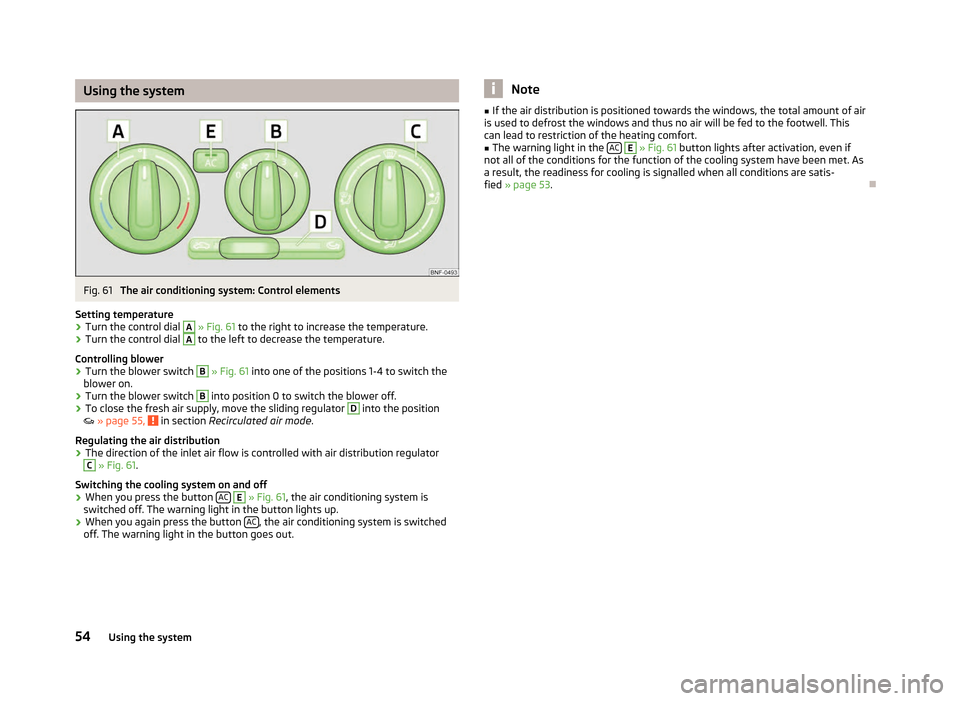
Fig. 61
The air conditioning system: Control elements
Setting temperature
› Turn the control dial A
» Fig. 61 to the right to increase the temperature.
› Turn the control dial A
to the left to decrease the temperature.
Controlling blower
› Turn the blower switch B
» Fig. 61 into one of the positions 1-4 to switch the
blower on.
› Turn the blower switch B
into position 0 to switch the blower off.
› To close the fresh air supply, move the sliding regulator D
into the position
»
page 55, in section
Recirculated air mode .
Regulating the air distribution
› The direction of the inlet air flow is controlled with air distribution regulator C
» Fig. 61.
Switching the cooling system on and off
› When you press the button
AC E
» Fig. 61
, the air conditioning system is
switched off. The warning light in the button lights up.
› When you again press the button
AC , the air conditioning system is switched
off. The warning light in the button goes out. Note
■ If the air distribution is positioned towards the windows, the total amount of air
is used to defrost the windows and thus no air will be fed to the footwell. This
can lead to restriction of the heating comfort. ■ The warning light in the AC E
» Fig. 61 button lights after activation, even if
not all of the conditions for the function of the cooling system have been met. As
a result, the readiness for cooling is signalled when all conditions are satis-
fied » page 53. Ð54
Using the system
Page 57 of 157

Setting the air conditioning system
Recommended basic settings of the control elements of the air conditioning sys-
tem for the respective operating modes:
Set-up Setting of the control dial
Button
Air outlet vents 1
A B C D E
Defrost/defog windscreen and
side windows
a) Desired tempera-
ture 3 or 4
ActivatedOpen and align with the side
window
The fastest heating To the right up to
the stop 3
Brief
,
then Switched off
Opening
Comfortable heating Desired tempera-
ture 2 or 3
Switched off
Opening
The fastest cooling To the left up to
the stop briefly 4, then
2 or 3 Brief
,
then Activated
Opening
Optimal cooling Desired tempera-
ture 1, 2 or 3
Activated Open and align to the roof
Fresh air mode – ventilation To the left up to
the stop Desired position
Switched off
Openinga)
We recommend that you do not use this setting in countries with high humidity levels. This can result in heavy cooling of the window glass and the following fogging from outside. Note
■ Controls A
, B
, C
, D
and the button E
» Fig. 61 on page 54.
■ Air outlet vents 1
» Fig. 59
on page 52. ÐRecirculated air mode
Recirculated air mode prevents polluted air outside the vehicle from getting into
the vehicle, for example when driving through a tunnel or when standing in a
traffic jam.
Switching on
› Move the sliding regulator D
» Fig. 61
on page 54 into position . Switching off
›
Move the sliding regulator D
»
Fig. 61
on page 54 into position . WARNING
Do not leave recirculated air mode on over a longer period of time, as “stale”
air can cause fatigue of the driver and passengers, reduce attention levels and
also cause the windows to mist up. The risk of having an accident increases.
Switch off recirculated air mode as soon as the windows start to mist up. Ð 55
Heating and air conditioning system
Page 61 of 157

WARNING (Continued)
■ If a front spoiler, full wheel trim, etc. is mounted retrospectively, it must be
ensured that the air supply to the front wheel brakes is not reduced. Other-
wise, the functionality of the brake system could be impaired – risk of acci-
dent!
■ Please note that the handbrake must be fully released. A handbrake which
is only partially released can result in the rear brakes overheating, which can
have a negative effect on the operation of the brake system – risk of accident!
■ Never leave children unattended in the vehicle. The children might, for ex-
ample, release the handbrake or take the vehicle out of gear. The vehicle
might then move off – risk of accident!
■ A lack of fuel can cause irregular engine running or cause the engine to shut
down. The brake assist systems would then be without function – risk of acci-
dent!
■ Adjust the speed and driving style to the current visibility, weather, road and
traffic conditions. The increased safety offered by the brake assist systems
must not tempt you to take greater risks than otherwise – risk of an accident! ■ The normal braking system is still fully functional if there is an ABS fault.
Visit a ŠKODA specialist garage immediately and adjust your style of driving
according to the damage to the ABS as you will not know how great the dam-
age is and the limitation it is placing on the braking efficiency. CAUTION
■ Observe the recommendations on the new brake pads » page 91.
■ Never let the brakes slip with light pressure on the pedal if braking is not neces-
sary. This causes the brakes to overheat and can also result in a longer braking
distance and excessive wear. ■ All four wheels must be fitted with the same tyres approved by the manufactur-
er to ensure the brake assist systems operate correctly. Note
■ If the brakes are applied in full and the control unit for the braking system con-
siders the situation to be dangerous for the following traffic, the brake light
flashes automatically. After the speed was reduced below around 10
km/h or the
vehicle was stopped, the brake light stops flashing and the hazard warning light
system switches on. The hazard warning light system is switched off automatical-
ly after accelerating or driving off again. ■ Before negotiating a steep downhill section, reduce the speed, shift down into
the next lower gear (manual gearbox) or select a lower drive position (automatic
gearbox). As a result, the braking effect of the engine will be used, reducing the
load on the brakes. Any additional braking should be completed intermittently,
not continuously. ■ Changes to the vehicle (e.g. to the engine, brakes, chassis or another combina-
tion of tyres and wheels) can influence the functionality of the brake assist sys-
tems »
page 125, Accessories, changes and replacement of parts .
■ If a fault occurs in the ABS system, the ESC, TCS and EDL also do not work. A
warning light » page 17 comes on if a fault occurs in the ABS system. Ð Information for braking
First read and observe the introductory information and safety warn-
ings on page 58.
Wear-and-tear
The wear of the brake pads is dependent on the operating conditions and driving
style. The brake pads wear more quickly if a lot of journeys are completed in
towns and over short distances or if a very sporty style of driving is adopted. If
operated under severe conditions, the thickness of the brake pads must be
checked by a ŠKODA specialist garage before the next service appointment.
Wet roads or road salt
The performance of the brakes can be delayed as the brake discs and brake pads
may be moist or have a coating of ice or layer of salt on them in winter. The
brakes are cleaned and dried by applying the brakes several times.
Corrosion
Corrosion on the brake discs and dirt on the bake pads occur if the vehicle has
been parked for a long period and if you do not make much use of the braking
system. If the brake system is not used much or if there is corrosion on the sur-
face, we recommend cleaning the brake discs by firmly applying the brakes from a
high speed. £
ä
59
Starting-off and Driving