2012 Seat Ibiza 5D wiper blades
[x] Cancel search: wiper bladesPage 6 of 280

Accessories, replacement of parts and
modifications . . . . . . . . . . . . . . . . . . . . . . . . . . . . . 185
Accessories and spare parts . . . . . . . . . . . . . . . . 185
Technical modifications . . . . . . . . . . . . . . . . . . . . 185
Roof aerial* . . . . . . . . . . . . . . . . . . . . . . . . . . . . . . 186
Mobile telephones and two-way radios . . . . . . . . 186
Fitting a towing bracket* . . . . . . . . . . . . . . . . . . . 187
Checking and refilling levels . . . . . . . . . . . . . . . 189
Refuelling . . . . . . . . . . . . . . . . . . . . . . . . . . . . . . . 189
LPG system* . . . . . . . . . . . . . . . . . . . . . . . . . . . . . 191
Petrol . . . . . . . . . . . . . . . . . . . . . . . . . . . . . . . . . . . 194
Diesel . . . . . . . . . . . . . . . . . . . . . . . . . . . . . . . . . . . 194
Working in the engine compartment . . . . . . . . . . 195
Engine oil . . . . . . . . . . . . . . . . . . . . . . . . . . . . . . . . 198
Coolant . . . . . . . . . . . . . . . . . . . . . . . . . . . . . . . . . 202
Washer fluid and windscreen wiper blades . . . . 204
Brake fluid . . . . . . . . . . . . . . . . . . . . . . . . . . . . . . . 208
Vehicle battery . . . . . . . . . . . . . . . . . . . . . . . . . . . 209
Wheels . . . . . . . . . . . . . . . . . . . . . . . . . . . . . . . . . . 211
If and when . . . . . . . . . . . . . . . . . . . . . . . . . . . . . . . 218
Vehicle tools, spare wheel . . . . . . . . . . . . . . . . . . 218
Wheel change . . . . . . . . . . . . . . . . . . . . . . . . . . . . 219
Tyre repair kit* (Tyre Mobility-System) . . . . . . . . . 224
Fuses . . . . . . . . . . . . . . . . . . . . . . . . . . . . . . . . . . . 226
Bulb change . . . . . . . . . . . . . . . . . . . . . . . . . . . . . 229
Single headlight bulb change . . . . . . . . . . . . . . . 231
Double headlight bulb change . . . . . . . . . . . . . . . 233
Changing the bulbs of AFS headlights . . . . . . . . 237
Changing the fog light bulbs . . . . . . . . . . . . . . . . 238
Changing the rear, side and interior light bulbs . 239
Jump-starting . . . . . . . . . . . . . . . . . . . . . . . . . . . . . 242
Towing and tow-starting . . . . . . . . . . . . . . . . . . . . 246 Technical Specifications
. . . . . . . . . . . 249
Description of specifications . . . . . . . . . . . . . . . 249
Important information . . . . . . . . . . . . . . . . . . . . . 249
Information on fuel consumption . . . . . . . . . . . . 251
Towing a trailer . . . . . . . . . . . . . . . . . . . . . . . . . . . 251
Wheels . . . . . . . . . . . . . . . . . . . . . . . . . . . . . . . . . . 252
Technical specifications . . . . . . . . . . . . . . . . . . . . 253
Checking fluid levels . . . . . . . . . . . . . . . . . . . . . . . 253
Petrol engine 1.2 44 kW (60 PS) . . . . . . . . . . . . . 254
Petrol engine 1.2 51 kW (70 PS) . . . . . . . . . . . . . 255
Petrol engine 1.2 TSI 63 kW (85 PS) . . . . . . . . . . 256
Petrol engine/LPG 1.6 60 kW (81 PS) . . . . . . . . . 257
Petrol engine 1.4 63 kW (85 PS) . . . . . . . . . . . . . 258
Petrol engine 1.2 TSI 77 kW (105 PS) . . . . . . . . . 259
Petrol engine 1.2 TSI 77 kW (105 PS) Start-Stop 260
Petrol engine 1.6 77 kW (105 PS) . . . . . . . . . . . . 261
Petrol engine 1.4 110 kW (150 PS) . . . . . . . . . . . 262
Diesel engine 1.2 TDI CR 55 kW (75 PS) DPF
Start-Stop Ecomotive . . . . . . . . . . . . . . . . . . . . . . 263
Diesel engine 1.2 TDI CR 55 kW (75 PS) DPF . . . . 264
Diesel engine 1.6 TDI CR 66 kW (90 PS) DPF . . . . 265
Diesel engine 1.6 TDI CR 77 kW (105 PS) with/
without DPF . . . . . . . . . . . . . . . . . . . . . . . . . . . . . . 266
Diesel engine 2.0 TDI CR 105 kW (143 PS) DPF . 267
Dimensions and capacities . . . . . . . . . . . . . . . . . 268
Index . . . . . . . . . . . . . . . . . . . . . . . . . . . . . . . . . . . 269
4Table of Contents
Page 110 of 280
108Lights and visibility
WARNING
● Worn and dirty wiper blades reduce visibility and safety levels while
driving.
● In cold conditions, you should not use the wash/wipe system unless
you have warmed the windscreen with the heating and ventilation sys-
tem. The windscreen washer fluid could otherwise freeze on the wind-
screen and obscure your view of the road.
● Always note the corresponding warnings on ⇒ page 205.
CAUTION
In icy conditions, always check that the wiper blades are not frozen to the
glass before using the wipers for the first time. If you switch on the wind-
screen wipers when the wiper blades are frozen to the windscreen, you
could damage both the wiper blades and the wiper motor.
Note
● The windscreen wipers will only work when the ignition is switched on.
● The heat output of the heated jets* is controlled automatically when the
ignition is switched on, depending upon the outside temperature.
● In certain versions of vehicles with alarms, the windscreen wiper will on-
ly work in interval/rain sensor mode when the ignition is on and the bonnet
closed.
● When the interval wipe function is on, the intervals are directly propor-
tional to the speed. This way, the higher the vehicle speed the shorter the
intervals.
● If you stop the vehicle with the windscreen wiper in position 1 or 2, it
will automatically change to a lower speed. The set speed will be resumed
when the vehicle pulls away.
● The windscreen will be wiped again after approximately five seconds
once the “automatic wipe/wash system” has been operated, provided the
vehicle is in transit (drip function). If you activate the wipers less than three seconds after the drip function, a new wash sequence will begin without the
last wipe. For the “drip” function to work again, you have to turn the ignition
off and then on again.
Rain sensor*
The rain sensor controls the frequency of the windscreen
wiper intervals, depending on the amount of rain.
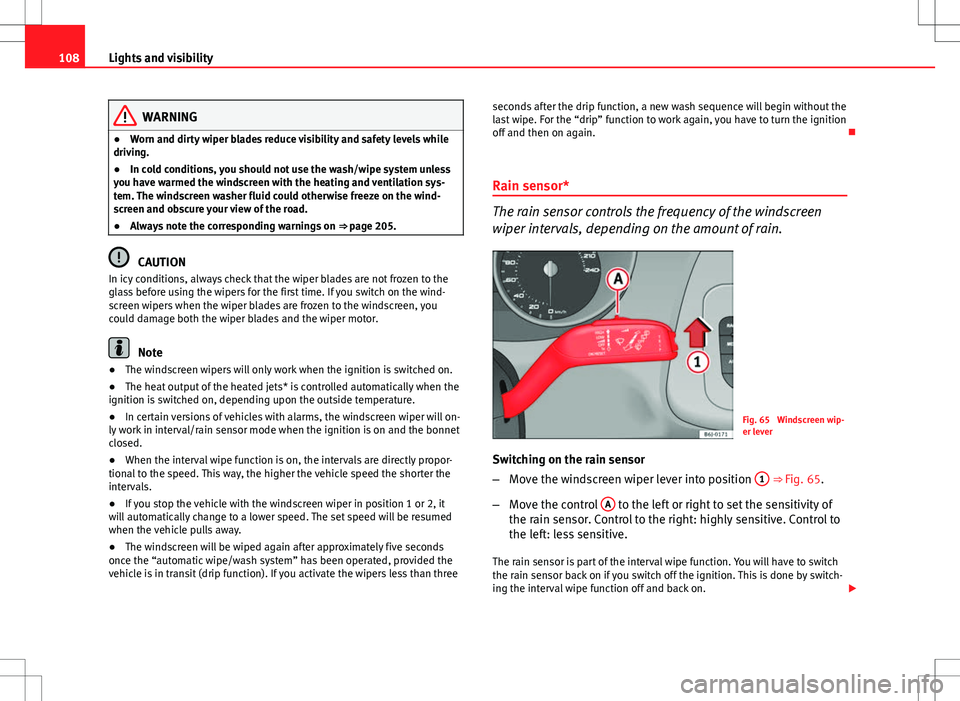
Fig. 65 Windscreen wip-
er lever
Switching on the rain sensor
– Move the windscreen wiper lever into position 1
⇒ Fig. 65.
– Move the control A
to the left or right to set the sensitivity of
the rain sensor. Control to the right: highly sensitive. Control to
the left: less sensitive.
The rain sensor is part of the interval wipe function. You will have to switch
the rain sensor back on if you switch off the ignition. This is done by switch-
ing the interval wipe function off and back on.
Page 182 of 280
180Vehicle maintenance and cleaning
If possible, use a de-icing spray to remove ice. If you use an ice scraper,
push it in one direction only without swinging it.
Use window cleaner or a silicone remover to clean rubber, oil, grease and
silicone deposits off.
Wax deposits can be removed with a special cleaner available in your Tech-
nical Services. Wax deposits on the windscreen could cause the wiper
blades to judder. Adding a window cleaner that dissolves wax to the wind-
screen washer fluid prevents wiper blades from juddering, but wax deposits
are not removed.
CAUTION
● Never use warm or hot water to remove snow and ice from windows and
mirrors. This could cause the glass to crack!
● The heating element for the rear window is located on the inner side of
the window. To prevent damage, do not put stickers over the heating ele-
ments on the inside of the window.
Cleaning windscreen wiper blades
Clean wiper blades improve visibility.
1. Use a soft cloth to remove dust and dirt from the windscreen wiper blades.
2. Use window cleaner to clean the windscreen wiper blades. Use a sponge or a cloth to remove stubborn dirt. Rubber seals maintenance
If rubber seals are well looked after, they will not freeze so
quickly.
1. Use a soft cloth to remove dust and dirt from the rubber seals.
2. Apply a specialist care product to the rubber seals.
The rubber strips on the doors, windows, bonnet and rear lid will remain
pliable and last longer if they are treated with a suitable care product (for
example silicone spray).
Caring for rubber seals will also prevent premature ageing and leaks. The
doors will be easier to open. If rubber seals are well looked after, they will
not freeze so quickly in winter.
Door lock cylinders
The door lock cylinders can freeze up in winter.
To de-ice the lock cylinders you should only use spray with lubricating and
anti-corrosive properties.
Cleaning chrome parts
1. Clean chrome parts with a damp cloth.
2. Polish chrome parts with a soft, dry cloth. If this does not provide satisfying results, use a specialist chrome cleaning
product. Chrome cleaning products will remove stains from the surface.
Page 206 of 280

204Checking and refilling levels
Topping up coolant
–Only use new coolant liquid.
– Do not fill above the “MAX” mark.
Closing the coolant expansion tank
– Screw the cap on again tightly.
The position of the coolant expansion reservoir is shown in the correspond-
ing engine compartment illustration ⇒ page 253.
Ensure the coolant conforms to the required specifications. Do not use a dif-
ferent type of additive if additive G 12++ is not available. In this case use
only water and bring the coolant concentration back up to the correct level
as soon as possible by putting in the specified additive.
Always top up with new coolant.
Do not fill above the “MAX” mark. Otherwise the excess coolant will be
forced out of the cooling system when the engine is hot.
The additive G 12++ can be mixed with the G 12+ in any proportion.
WARNING
Any work carried out in the engine compartment or on the engine must
be carried out cautiously.
● When working in the engine compartment, always observe the safety
warnings ⇒ page 195.
● When the engine is warm or hot, the cooling system is pressurised!
Do not unscrew the cap on the coolant expansion tank when the engine
is hot. This is a burn injury risk.
CAUTION
● If you notice a change in the colour of the liquid because it has been in
use for a long time, it is recommended to change it, as it will have lost some
of its properties and could cause damage to the vehicle.
● If a lot of coolant fluid has been lost, wait for the engine to cool down
before putting in cold coolant. This avoids damaging the engine. Large cool-
ant losses are an indication of leaks in the cooling system. See a special-
ised workshop immediately and have the cooling system checked. Other-
wise, there is a risk of engine damage.
Washer fluid and windscreen wiper blades Topping up washer fluid
The water for cleaning the windscreen should always be
mixed with washer fluid.
Fig. 128 In the engine
compartment: Cap of
windscreen washer fluid
reservoir.
Page 207 of 280

205
Checking and refilling levels
The windscreen washer and the headlight washers are supplied with fluid
from the windscreen washer fluid container in the engine compartment. The
container holds approx. 2 litres; in vehicles with headlight washers* it holds
approx. 4.5 litres.
The tank is in the engine compartment.
Plain water is not enough to clean the windscreen and headlights. We rec-
ommend that you always add a product to the windscreen washer fluid. Ap-
proved windscreen cleaning products exist on the market with high deter-
gent and anti-freeze properties, these may be added all-year-round. Please
follow the dilution instructions on the packaging.
WARNING
Any work carried out in the engine compartment or on the engine must
be carried out cautiously.
● When working in the engine compartment, always observe the safety
warnings ⇒ page 195.
CAUTION
● Never put radiator anti-freeze or other additives into the windscreen
washer fluid.
● Always use approved windscreen cleansing products diluted as per in-
structions. If you use other washer fluids or soap solutions, the tiny holes in
the fan-shaped nozzles could become blocked. Changing windscreen wiper blades
If the windscreen wiper blades are in perfect condition, you
will benefit from an improved visibility. Damaged wiper
blades should be replaced immediately.
Fig. 129 Windscreen
wipers in service position
Fig. 130 Change wind-
screen wiper blade
Safety FirstOperating InstructionsPractical TipsTechnical Specifications
Page 208 of 280
206Checking and refilling levels
To change the blades it is necessary to change the rest position of
the wipers to the service position.
Do not change the windscreen wipers when out of the service posi-
tion, as it could cause paint to flake off the bonnet due to friction
with the windscreen wiper arm.
Service position (For changing wiper blades)
–Ensure that the wiper blades are not frozen.
– Turn ignition on and off and then (before approx. 9 sec.) move
the windscreen wiper lever to the intermittent wipe position.
The windscreen wipers will move to the service position
⇒ Fig. 129.
Removing the wiper blade
– Lift the windscreen wiper arm.
– Press on the securing tab ⇒ Fig. 130.
– Extract the wiper blade from the wiper arm.
Fitting the wiper blade
– Insert the wiper blade onto the windscreen wiper arm until it
clicks into place.
– Place the windscreen wiper arms to their initial position.
If the windscreen wipers smear , they should be replaced if they are dam-
aged, or cleaned if they are soiled.
If this does not produce the desired results, the setting angle of the wind-
screen wiper arms might be incorrect. They should be checked by a special-
ised workshop and corrected if necessary.
WARNING
Do not drive unless you have good visibility through all windows!
● Clean the windscreen wiper blades and all windows regularly.
● The wiper blades should be changed once or twice a year.
CAUTION
● Damaged or dirty windscreen wipers could scratch the windscreen.
● Never use fuel, nail varnish remover, paint thinner or similar products to
clean the windows. This could damage the windscreen wiper blades.
● Never move the windscreen wiper or windscreen wiper arm manually.
This could cause damage.
● To avoid damage to the bonnet and the windscreen wiper arms, the lat-
ter should only be lifted off the windscreen when in service position.
Note
● The windscreen wiper arms can be moved to the service position only
when the bonnet is properly closed.
● You can also use the service position, for example, if you want to fix a
cover over the windscreen in the winter to keep it clear of ice.
Page 209 of 280
207
Checking and refilling levels
Changing the rear wiper blade
A good rear wiper blade is essential for clear rear vision.
Damaged wiper blades should be replaced immediately.
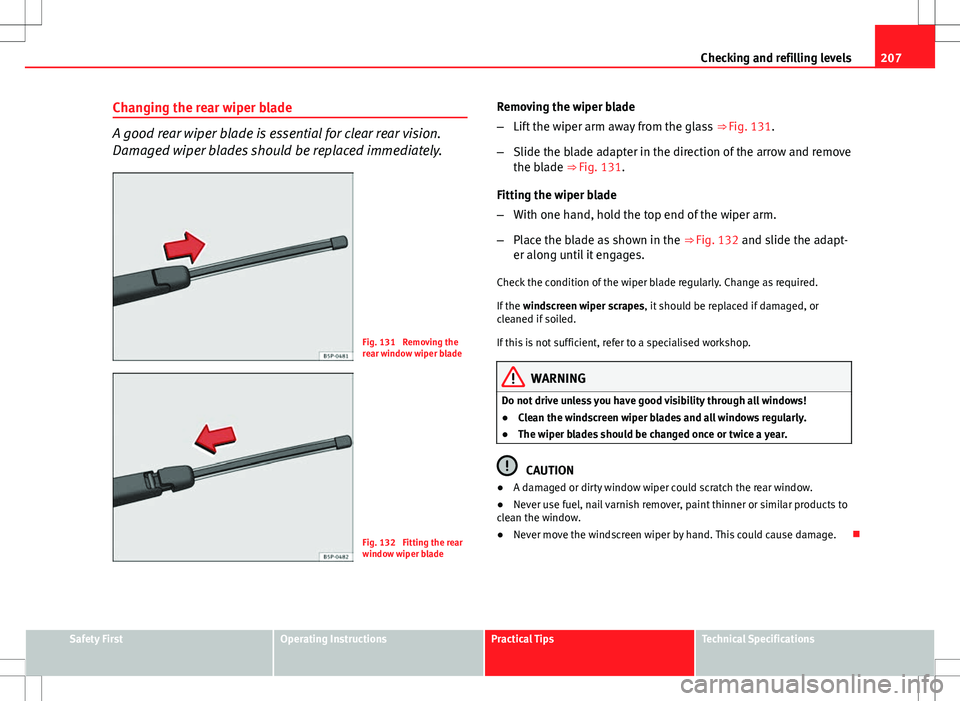
Fig. 131 Removing the
rear window wiper blade
Fig. 132 Fitting the rear
window wiper blade Removing the wiper blade
–
Lift the wiper arm away from the glass ⇒ Fig. 131.
– Slide the blade adapter in the direction of the arrow and remove
the blade ⇒ Fig. 131.
Fitting the wiper blade
– With one hand, hold the top end of the wiper arm.
– Place the blade as shown in the ⇒ Fig. 132 and slide the adapt-
er along until it engages.
Check the condition of the wiper blade regularly. Change as required.
If the windscreen wiper scrapes, it should be replaced if damaged, or
cleaned if soiled.
If this is not sufficient, refer to a specialised workshop.
WARNING
Do not drive unless you have good visibility through all windows!
● Clean the windscreen wiper blades and all windows regularly.
● The wiper blades should be changed once or twice a year.
CAUTION
● A damaged or dirty window wiper could scratch the rear window.
● Never use fuel, nail varnish remover, paint thinner or similar products to
clean the window.
● Never move the windscreen wiper by hand. This could cause damage.
Safety FirstOperating InstructionsPractical TipsTechnical Specifications
Page 272 of 280

Central lock buttonLocking . . . . . . . . . . . . . . . . . . . . . . . . . . . . . 83
Unlocking . . . . . . . . . . . . . . . . . . . . . . . . . . . 83
Central locking . . . . . . . . . . . . . . . . . . . . . . . . . . 80 Automatic speed-dependent locking . . . . . 82
Emergency unlocking system . . . . . . . . . . . 82
Locking system for involuntary unlocking . 82
Selective unlocking system . . . . . . . . . . . . . 81
Unlocking system . . . . . . . . . . . . . . . . . . . . . 82
Cetane number . . . . . . . . . . . . . . . . . . . . . . . . . 194
Changing bulbs interior light and reading light . . . . . . . . . 241
Changing bulbs on tail lights . . . . . . . . . 239, 240
Changing gear see Manual gearbox . . . . . . . . . . . . . . . . . . 147
Changing gear in tiptronic mode . . . . . . . . . . 151
Changing single headlight bulbs Turn signal bulb . . . . . . . . . . . . . . . . . . . . . 231
Changing the AFS headlight bulbs Xenon lights . . . . . . . . . . . . . . . . . . . . . . . . 237
Changing the bulbs AFS headlight bulbs . . . . . . . . . . . . . . . . . . 237
fog light bulbs . . . . . . . . . . . . . . . . . . . . . . 238
luggage compartment light . . . . . . . . . . . . 242
number plate light . . . . . . . . . . . . . . . . . . . 241
Side turn signal lights . . . . . . . . . . . . . . . . 240
Changing the main headlight bulb turn signal lights . . . . . . . . . . . . . . . . . . . . 235
Changing the main headlight bulbs turn signal lights . . . . . . . . . . . . . . . . . . . . 237 Changing the single headlight bulbs
Dipped/main beam . . . . . . . . . . . . . . . . . . 232
Side light . . . . . . . . . . . . . . . . . . . . . . . . . . 232
Changing windscreen wiper blades . . . . . . . . 205
Chassis number . . . . . . . . . . . . . . . . . . . . . . . . 250
Checking . . . . . . . . . . . . . . . . . . . . . . . . . . . . . . 210
Checking battery electrolyte level . . . . . . . . . . 210
Checking engine oil level . . . . . . . . . . . . . . . . . 200
Child safety . . . . . . . . . . . . . . . . . . . . . . . . . . . . . 42
Child seat Categorisation in groups . . . . . . . . . . . . . . . 44
Group 1 . . . . . . . . . . . . . . . . . . . . . . . . . . . . . 45
Group 2 . . . . . . . . . . . . . . . . . . . . . . . . . . . . . 45
Group 3 . . . . . . . . . . . . . . . . . . . . . . . . . . . . . 45
Groups 0 and 0+ . . . . . . . . . . . . . . . . . . . . . . 44
Safety notes . . . . . . . . . . . . . . . . . . . . . . . . . 42
Securing . . . . . . . . . . . . . . . . . . . . . . . . . . . . 47
Child seats . . . . . . . . . . . . . . . . . . . . . . . . . . . . . 44 ISOFIX system . . . . . . . . . . . . . . . . . . . . . . . . 48
on the front passenger seat . . . . . . . . . . . . . 30
Top Tether system . . . . . . . . . . . . . . . . . . . . 49
Cigarette lighter . . . . . . . . . . . . . . . . . . . . . . . . 124
Cleaning alloy wheel rims . . . . . . . . . . . . . . . . 181
Cleaning chrome . . . . . . . . . . . . . . . . . . . . . . . 180
Cleaning engine compartment . . . . . . . . . . . . 182
Cleaning steel wheel rims . . . . . . . . . . . . . . . . 181
Cleaning windows . . . . . . . . . . . . . . . . . . . . . . 179
Climatronic automatic mode . . . . . . . . . . . . . . . . . . . . . 135
controls . . . . . . . . . . . . . . . . . . . . . . . . . . . . 134
General notes . . . . . . . . . . . . . . . . . . . . . . . 136
manual mode . . . . . . . . . . . . . . . . . . . . . . . 135 Clock . . . . . . . . . . . . . . . . . . . . . . . . . . . . . . . . . . 58
Cloth seat covers cleaning . . . . . . . . . . . . . . . . 183
Cockpit . . . . . . . . . . . . . . . . . . . . . . . . . . . . . . . . 53
Coming Home function . . . . . . . . . . . . . . . . . . 102
Compartment for on-board documentation . . 120
Control
Exterior mirrors . . . . . . . . . . . . . . . . . . . . . . 111
control lamp . . . . . . . . . . . . . . . . . . . . . . . . . . . . 30
Control lamps . . . . . . . . . . . . . . . . . . . . . . . . . . . 63
Control lighting . . . . . . . . . . . . . . . . . . . . . . . . . . 53
Controls Electric windows . . . . . . . . . . . . . . . . . . . . . . 93
Convenience closing Sliding/tilting sunroof . . . . . . . . . . . . . . . . . 97
Windows . . . . . . . . . . . . . . . . . . . . . . . . . . . . 95
Convenience opening Windows . . . . . . . . . . . . . . . . . . . . . . . . . . . . 95
Coolant . . . . . . . . . . . . . . . . . . . . . . . . . . . 202, 203
Coolant level . . . . . . . . . . . . . . . . . . . . . . . . . . . 203 control lamp . . . . . . . . . . . . . . . . . . . . . . . . . 73
Coolant loss . . . . . . . . . . . . . . . . . . . . . . . . . . . 203
Coolant temperature control lamp . . . . . . . . . . . . . . . . . . . . . . . . . 73
Safety instructions . . . . . . . . . . . . . . . . . . . . 74
Correct adjustment of front head restraints . . . 13
Correct sitting position front passenger . . . . . . . . . . . . . . . . . . . . . . 11
Incorrect sitting position . . . . . . . . . . . . . . . 14
passenger . . . . . . . . . . . . . . . . . . . . . . . . . . . 12
Cruise control Control lamp . . . . . . . . . . . . . . . . . . . . . . . . . 71
Cruise control system . . . . . . . . . . . . . . . . . . . . 159
270 Index