2012 Seat Ibiza 5D coolant level
[x] Cancel search: coolant levelPage 6 of 280

Accessories, replacement of parts and
modifications . . . . . . . . . . . . . . . . . . . . . . . . . . . . . 185
Accessories and spare parts . . . . . . . . . . . . . . . . 185
Technical modifications . . . . . . . . . . . . . . . . . . . . 185
Roof aerial* . . . . . . . . . . . . . . . . . . . . . . . . . . . . . . 186
Mobile telephones and two-way radios . . . . . . . . 186
Fitting a towing bracket* . . . . . . . . . . . . . . . . . . . 187
Checking and refilling levels . . . . . . . . . . . . . . . 189
Refuelling . . . . . . . . . . . . . . . . . . . . . . . . . . . . . . . 189
LPG system* . . . . . . . . . . . . . . . . . . . . . . . . . . . . . 191
Petrol . . . . . . . . . . . . . . . . . . . . . . . . . . . . . . . . . . . 194
Diesel . . . . . . . . . . . . . . . . . . . . . . . . . . . . . . . . . . . 194
Working in the engine compartment . . . . . . . . . . 195
Engine oil . . . . . . . . . . . . . . . . . . . . . . . . . . . . . . . . 198
Coolant . . . . . . . . . . . . . . . . . . . . . . . . . . . . . . . . . 202
Washer fluid and windscreen wiper blades . . . . 204
Brake fluid . . . . . . . . . . . . . . . . . . . . . . . . . . . . . . . 208
Vehicle battery . . . . . . . . . . . . . . . . . . . . . . . . . . . 209
Wheels . . . . . . . . . . . . . . . . . . . . . . . . . . . . . . . . . . 211
If and when . . . . . . . . . . . . . . . . . . . . . . . . . . . . . . . 218
Vehicle tools, spare wheel . . . . . . . . . . . . . . . . . . 218
Wheel change . . . . . . . . . . . . . . . . . . . . . . . . . . . . 219
Tyre repair kit* (Tyre Mobility-System) . . . . . . . . . 224
Fuses . . . . . . . . . . . . . . . . . . . . . . . . . . . . . . . . . . . 226
Bulb change . . . . . . . . . . . . . . . . . . . . . . . . . . . . . 229
Single headlight bulb change . . . . . . . . . . . . . . . 231
Double headlight bulb change . . . . . . . . . . . . . . . 233
Changing the bulbs of AFS headlights . . . . . . . . 237
Changing the fog light bulbs . . . . . . . . . . . . . . . . 238
Changing the rear, side and interior light bulbs . 239
Jump-starting . . . . . . . . . . . . . . . . . . . . . . . . . . . . . 242
Towing and tow-starting . . . . . . . . . . . . . . . . . . . . 246 Technical Specifications
. . . . . . . . . . . 249
Description of specifications . . . . . . . . . . . . . . . 249
Important information . . . . . . . . . . . . . . . . . . . . . 249
Information on fuel consumption . . . . . . . . . . . . 251
Towing a trailer . . . . . . . . . . . . . . . . . . . . . . . . . . . 251
Wheels . . . . . . . . . . . . . . . . . . . . . . . . . . . . . . . . . . 252
Technical specifications . . . . . . . . . . . . . . . . . . . . 253
Checking fluid levels . . . . . . . . . . . . . . . . . . . . . . . 253
Petrol engine 1.2 44 kW (60 PS) . . . . . . . . . . . . . 254
Petrol engine 1.2 51 kW (70 PS) . . . . . . . . . . . . . 255
Petrol engine 1.2 TSI 63 kW (85 PS) . . . . . . . . . . 256
Petrol engine/LPG 1.6 60 kW (81 PS) . . . . . . . . . 257
Petrol engine 1.4 63 kW (85 PS) . . . . . . . . . . . . . 258
Petrol engine 1.2 TSI 77 kW (105 PS) . . . . . . . . . 259
Petrol engine 1.2 TSI 77 kW (105 PS) Start-Stop 260
Petrol engine 1.6 77 kW (105 PS) . . . . . . . . . . . . 261
Petrol engine 1.4 110 kW (150 PS) . . . . . . . . . . . 262
Diesel engine 1.2 TDI CR 55 kW (75 PS) DPF
Start-Stop Ecomotive . . . . . . . . . . . . . . . . . . . . . . 263
Diesel engine 1.2 TDI CR 55 kW (75 PS) DPF . . . . 264
Diesel engine 1.6 TDI CR 66 kW (90 PS) DPF . . . . 265
Diesel engine 1.6 TDI CR 77 kW (105 PS) with/
without DPF . . . . . . . . . . . . . . . . . . . . . . . . . . . . . . 266
Diesel engine 2.0 TDI CR 105 kW (143 PS) DPF . 267
Dimensions and capacities . . . . . . . . . . . . . . . . . 268
Index . . . . . . . . . . . . . . . . . . . . . . . . . . . . . . . . . . . 269
4Table of Contents
Page 66 of 280
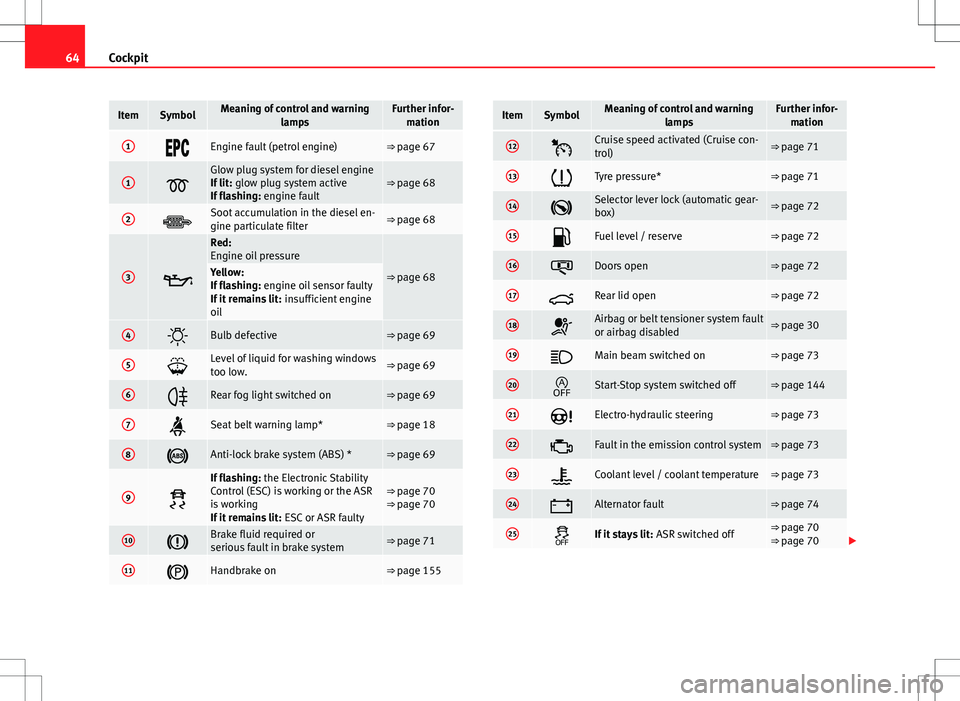
64Cockpit
ItemSymbolMeaning of control and warning
lampsFurther infor-mation
1Engine fault (petrol engine)⇒ page 67
1
Glow plug system for diesel engine
If lit: glow plug system active
If flashing: engine fault⇒ page 68
2Soot accumulation in the diesel en-
gine particulate filter⇒ page 68
3
Red:
Engine oil pressure
⇒ page 68Yellow:
If flashing: engine oil sensor faulty
If it remains lit: insufficient engine
oil
4Bulb defective⇒ page 69
5Level of liquid for washing windows
too low.⇒ page 69
6Rear fog light switched on⇒ page 69
7Seat belt warning lamp*⇒ page 18
8Anti-lock brake system (ABS) *⇒ page 69
9
If flashing: the Electronic Stability
Control (ESC) is working or the ASR
is working
If it remains lit: ESC or ASR faulty⇒ page 70
⇒ page 70
10Brake fluid required or
serious fault in brake system⇒ page 71
11Handbrake on⇒ page 155
ItemSymbolMeaning of control and warning
lampsFurther infor-mation
12Cruise speed activated (Cruise con-
trol)⇒ page 71
13Tyre pressure*⇒ page 71
14Selector lever lock (automatic gear-
box)⇒ page 72
15Fuel level / reserve⇒ page 72
16Doors open⇒ page 72
17Rear lid open⇒ page 72
18Airbag or belt tensioner system fault
or airbag disabled⇒ page 30
19Main beam switched on⇒ page 73
20Start-Stop system switched off⇒ page 144
21Electro-hydraulic steering⇒ page 73
22Fault in the emission control system⇒ page 73
23Coolant level / coolant temperature⇒ page 73
24Alternator fault⇒ page 74
25If it stays lit: ASR switched off⇒ page 70
⇒ page 70
Page 75 of 280

73
Cockpit
Main beam headlights
This control lamp lights up when the main beams are on.
The warning lamp is switched on once main beams are on or once the
headlight flasher is operating.
For further information see ⇒ page 104.
Electro-hydraulic steering*
The level of steering assistance depends on the vehicle speed and on the
steering wheel turning speed.
The control lamp should light up for a few seconds when the ignition is
switched on. It should go out once the engine is started.
There is a fault in the electro-hydraulic steering system if the lamp does not
go out or lights up whilst the vehicle is in motion. Take the vehicle to the
Technical Service as soon as possible.
Note
When towing the vehicle with the engine stopped or due to a fault in the
power steering, this will not operate. The vehicle can still be steered, but it
will require greater force to turn the steering wheel. Emission control system*
This warning lamp monitors the exhaust system.
Control lamp flashes:
When there is misfiring that can damage the catalytic converter. Reduce
speed and drive carefully to the nearest specialised workshop to have the
engine checked.
Control lamp is lit:
If a fault has developed during driving which has reduced the quality of the
exhaust gas (e.g. lambda probe fault). Reduce speed and drive carefully to
the nearest specialised workshop to have the engine checked.
Coolant level*/temperature
The warning lamp lights up if the coolant temperature is too
high or if the coolant level is too low.
There is a fault if:
● The warning symbol does not go out again after a few seconds.
● The warning lamp lights up or flashes while the vehicle is moving, and
three acoustic warning signals ⇒
are emitted.
This means that either the coolant level is too low or the coolant tempera-
ture is too high.
Coolant temperature too high
If the warning light comes on, stop the vehicle, switch off the engine and
wait for it to cool down. Check the coolant level.
If the coolant level is correct, the overheating may be caused by a malfunc-
tion of the radiator fan. Check the radiator fan fuse and have it replaced if
necessary ⇒ page 226.
Safety FirstOperating InstructionsPractical TipsTechnical Specifications
Page 76 of 280

74Cockpit
If the control lamp lights up again after driving on for a short distance, stop
the vehicle and switch the engine off . Contact a Technical Service or a spe-
cialised workshop.
Coolant level too low
If the warning light comes on, stop the vehicle, switch off the engine and
wait for it to cool down First check the coolant level. If the level of the cool-
ant is below the “MIN” mark, top up with coolant liquid ⇒
.
WARNING
● If your vehicle is immobilised for technical reasons, move it to a safe
distance from traffic. Turn the engine off, turn the hazard lights on and
place the warning triangle.
● Never open the bonnet if you can see or hear steam or coolant escap-
ing from the engine compartment. Risk of scalding. Wait until you can no
longer see or hear escaping steam or coolant.
● The engine compartment is a dangerous area! Before carrying out any
work in the engine compartment, switch off the engine and allow it to
cool down. Always note the corresponding warnings ⇒ page 195.
Alternator
This warning lamp signals a fault in the alternator.
The warning lamp lights up when the ignition is switched on. It should
go out when the engine has started running.
If the warning lamp lights up while driving, the alternator is no longer
charging the battery. You should immediately drive to the nearest special-
ised workshop. You should avoid using electrical equipment that is not absolutely necessa-
ry because this will drain the battery.
If the indicator flashes the voltage is insufficient for normal vehicle opera-
tion.
Turn signals
The control lamp flashes when the turn signals are in opera-
tion.
Depending on which turn signal is operating, either the left or right
turn signal lamp flashes. Both control lamps will flash at the same time
when the hazard warning lights are switched on.
If any of both turn signals fails, the warning lamp will start flashing twice
faster than normal.
For further information on the turn signals, please see ⇒ page 104.
“Safe” Electronic immobiliser*
This warning lamp flashes if an unauthorised key is used.
Inside the key there is a chip that deactivates the electronic immobiliser au-
tomatically when the key is inserted into the ignition. The electronic immo-
biliser will be activated again automatically as soon as you pull the key out
of the ignition lock.
The instrument panel displays the following message 1)
: SAFE. The vehicle
cannot be started in this case
1)
Depending on the version of the model.
Page 197 of 280

195
Checking and refilling levels
Winter driving
Diesel can thicken in winter.
Winter-grade diesel
When using “summer-grade diesel fuel”, difficulties may be experienced at
temperatures below 0 °C because the fuel thickens due to wax separation.
Therefore, “winter-grade diesel fuel” is available in some countries during
the cold months. It can be used at temperatures as low as -22 °C.
In countries with different climatic conditions the diesel fuel generally sold
has different temperature characteristics. Check with the Technical Services
or filling stations in the country concerned regarding the type of diesel fuels
available.
Filter pre-heater
Your vehicle is fitted with a fuel filter glow plug system, making it well
equipped for operation in winter. This ensures that the fuel system remains
operational to approx. -24 °C, provided you use winter-grade diesel which is
safe to -15 °C.
However, if the fuel has waxed to such an extent that the engine will not
start at temperatures of under -24 °C, simply place the vehicle in a warm
place for a while.
CAUTION
Do not mix fuel additives (thinners or similar products) with diesel fuel. Working in the engine compartment
Safety instructions on working in the engine compartment
Any work carried out in the engine compartment or on the
engine must be carried out cautiously.
Before starting any work on the engine or in the engine compart-
ment:
1. Switch off the engine and remove the key from the ignition.
2. Apply the handbrake.
3. Move the gear lever to neutral or the selector lever to position P.
4. Wait for the engine to cool down.
5. Keep children away from the vehicle.
6. Raise the bonnet ⇒ page 197.
You should not do any work in the engine compartment unless you know ex-
actly how to carry out the jobs and have the correct tools! Have the work car-
ried out by a specialised workshop if you are uncertain.
All service fluids and consumables, e.g. coolant, engine oil, spark plugs
and batteries, are under constant development. SEAT provides a constant
flow of information to the Technical Services concerning modifications. For
this reason, we recommend you to have service fluids and consumables re-
placed by a Technical Service. Please observe the relevant instructions
⇒ page 185. The engine compartment of the vehicle is a hazardous area
⇒
.
Safety FirstOperating InstructionsPractical TipsTechnical Specifications
Page 198 of 280

196Checking and refilling levels
WARNING
All work on the engine or in the engine compartment, e.g. checking and
refilling fluids, involves the danger of injury and scalding as well as the
risk of accident or fire.
● Never open the bonnet if you see steam, smoke or coolant escaping
from the engine compartment. Otherwise, there is a risk of sustaining
burns. Wait until no more steam or coolant is emitted, then allow the en-
gine to cool before carefully opening the bonnet.
● Switch off the engine and remove the key from the ignition.
● Apply the handbrake and move the gear lever to neutral or selector
lever to position P.
● Keep children away from the vehicle.
● Never touch hot engine parts. There is a risk of burns.
● Never spill liquids on a hot engine or on a hot exhaust gas system.
This is a fire hazard.
● Avoid causing short-circuits in the electrical system, particularly at
the points where the jump leads are attached ⇒ page 243. The battery
could explode.
● Never touch the radiator fan. It is temperature controlled and could
start automatically, even when the engine has been switched off and the
key removed from the ignition!
● Do not unscrew the cap on the coolant expansion tank when the en-
gine is hot. If the coolant is hot, the cooling system will be pressurised!
● Protect face, hands and arms by covering the cap with a large, thick
cloth to protect against escaping coolant and steam.
● Always make sure you have not left any objects, such as cleaning
cloths and tools, in the engine compartment.
● If you have to work underneath the vehicle, you must use suitable
stands additionally to support the vehicle, there is a risk of accident!. A
hydraulic jack is insufficient for securing the vehicle and there is a risk of
injury.WARNING (Continued)
● If any work has to be performed when the engine is started or with
the engine running, there is an additional, potentially fatal, safety risk
from the rotating parts, such as the drive belts, alternator, radiator fan,
etc., and from the high-voltage ignition system. You should also observe
the following points:
–Never touch the electrical wiring of the ignition system.
– Ensure that jewellery, loose clothing and long hair do not get trap-
ped in rotating engine parts. Danger of death. Before starting any
work remove jewellery, tie back and cover hair, and wear tight-fitting
clothes.
– Never accelerate with a gear engaged without taking the necessary
precautions. The vehicle could move, even if the handbrake is ap-
plied. Danger of death.
● If work has to be carried out on the fuel system or on electrical com-
ponents, you must observe the following safety notes in addition to the
above warnings:
–Always disconnect the battery from the on-board network. The ve-
hicle must be unlocked when this is done, otherwise the alarm will be
triggered.
– Do not smoke.
– Never work near naked flames.
– Always have a fire extinguisher on hand.
CAUTION
When topping up service fluids, make sure not to mistake them. Using the
wrong fluids could cause serious malfunctions and engine damage!
Page 199 of 280

197
Checking and refilling levels
For the sake of the environment
Service fluids leaks are harmful to the environment. For this reason you
should make regular checks on the ground underneath your vehicle. If you
find spots of oil or other fluids, have your vehicle inspected in a specialised
workshop.
Opening the bonnet
The bonnet is released from inside the vehicle.
Fig. 123 Bonnet opening
lever
Fig. 124 Bonnet support
rod
Before opening the bonnet ensure that the windscreen wipers are
in rest position.
– To release the bonnet, pull the lever under the dash panel
⇒ Fig. 123 in the direction indicated (arrow). The bonnet will be
released by a spring action ⇒
.
– Lift the bonnet using the release lever (arrow) and open the
bonnet.
– Release the bonnet stay and secure it in fixture designed for
this in the bonnet.
WARNING
Hot coolant can scald!
● Never open the bonnet if you see steam, smoke or coolant escaping
from the engine compartment.
Safety FirstOperating InstructionsPractical TipsTechnical Specifications
Page 200 of 280

198Checking and refilling levels
WARNING (Continued)
● Wait until no more steam, smoke or coolant is emitted from the bon-
net, then carefully open the bonnet.
● When working in the engine compartment, always observe the safety
warnings ⇒ page 195.
Closing the bonnet
– Slightly raise the bonnet
– Release the bonnet stay and replace it in its support.
– At a height of about 30 cm let it fall so it is locked.
If the bonnet does not close, do not press downwards. Open it once more
and let it fall as before.
WARNING
If the bonnet is not closed properly, it could open while you are driving
and completely obscure your view of the road. Risk of accident.
● After closing the bonnet, always check that it is properly secured. The
bonnet must be flush with the surrounding body panels.
● If you notice that the bonnet latch is not secured when the vehicle is
moving, stop the vehicle immediately and close the bonnet properly.
Risk of accident.
Engine oil
General notes
The engine comes with a special, multi-grade oil that can be used all year
round.
Because the use of high-quality oil is essential for the correct operation of
the engine and its long useful life, when topping up or changing oil, use on-
ly those oils that comply with VW standards.
The specifications (VW standards) set out in the following page should ap-
pear on the container of the service oil; when the container displays the
specific standards for petrol and diesel engines together, it means that the
oil can be used for both types of engines.
We recommend that the oil change, indicated in the Maintenance Pro-
gramme, be performed by a Technical Service or a specialised workshop.
The correct oil specifications for your engine are listed in ⇒ page 199, Oil
properties.
Service intervals
Service intervals can be flexible (LongLife service) or fixed (dependent on
time/distance travelled).
If the PR code that appears on the back of the “Maintenance Programme”
booklet is QG1, this means that your vehicle has the LongLife service pro-
grammed. If it has the codes QG0 or QG2 the interval service is dependent
on time/distance travelled.
Flexible service intervals (LongLife service intervals*)
Special oils and processes have been developed which, depending on the
characteristics and individual driving profiles, enable the extension of the
oil change service (LongLife service intervals).