Page 235 of 280
233
If and when
– Move the loop ⇒ Fig. 145 1
in the direction of the arrow and
remove the cover.
– Remove the bulb holder 4
⇒ Fig. 147 outwards.
– Replace the bulb by pulling it out and inserting the replace-
ment.
– Installation is done in the reverse order.
Double headlight bulb change Double headlight
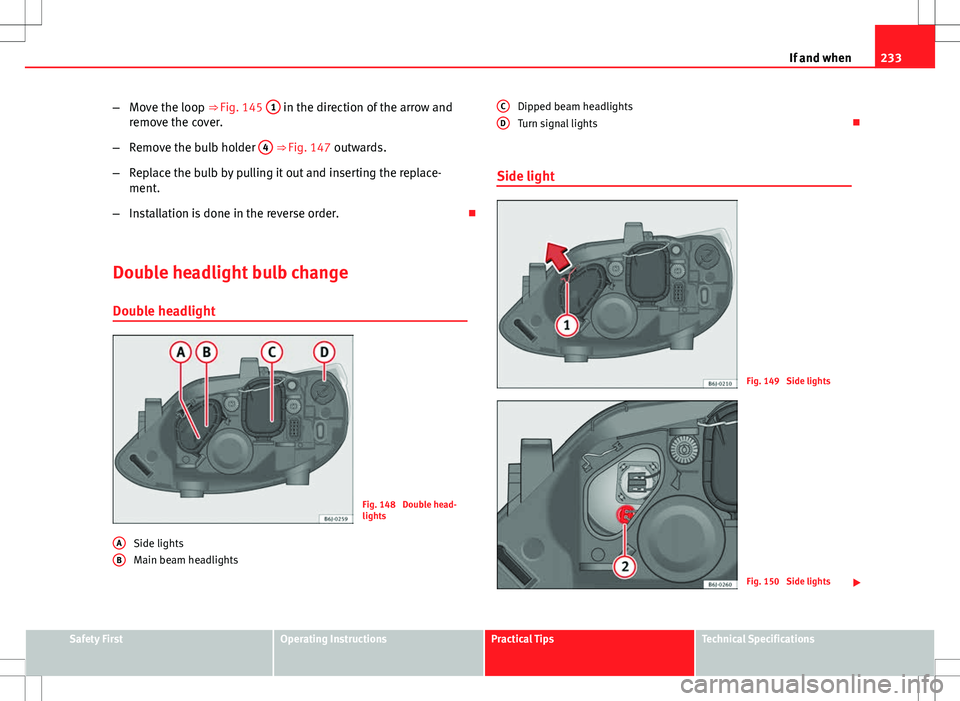
Fig. 148 Double head-
lights
Side lights
Main beam headlights
A
B
Dipped beam headlights
Turn signal lights
Side light
Fig. 149 Side lights
Fig. 150 Side lights
C
D
Safety FirstOperating InstructionsPractical TipsTechnical Specifications
Page 236 of 280
234If and when
–Raise the bonnet.
– Move the loop 1
in the direction of the arrow and remove the
cover ⇒ Fig. 149.
– Remove connector ⇒ Fig. 150 2
by pulling outward.
– Remove the bulb by pulling it out and fitting the new one.
– Installation involves the above steps in reverse sequence.
– Fit the cover and close the strap. Make sure that the gasket sits
well on the casing cover during the operation.
– Check whether the new bulb is working.
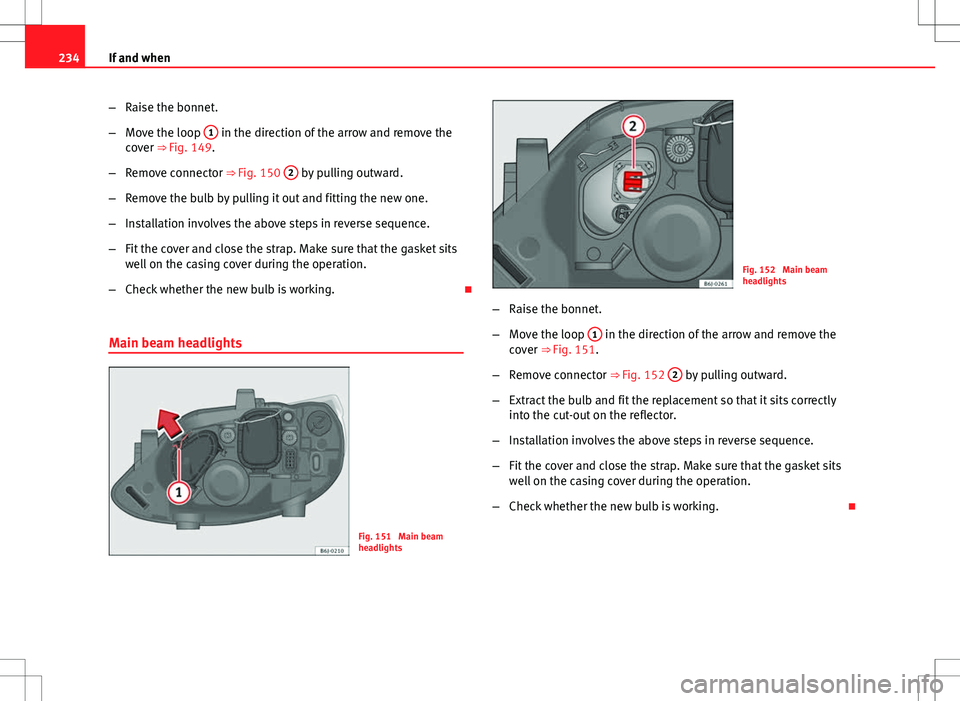
Main beam headlights
Fig. 151 Main beam
headlights
Fig. 152 Main beam
headlights
– Raise the bonnet.
– Move the loop 1
in the direction of the arrow and remove the
cover ⇒ Fig. 151.
– Remove connector ⇒ Fig. 152 2
by pulling outward.
– Extract the bulb and fit the replacement so that it sits correctly
into the cut-out on the reflector.
– Installation involves the above steps in reverse sequence.
– Fit the cover and close the strap. Make sure that the gasket sits
well on the casing cover during the operation.
– Check whether the new bulb is working.
Page 237 of 280
235
If and when
Dipped beam headlights
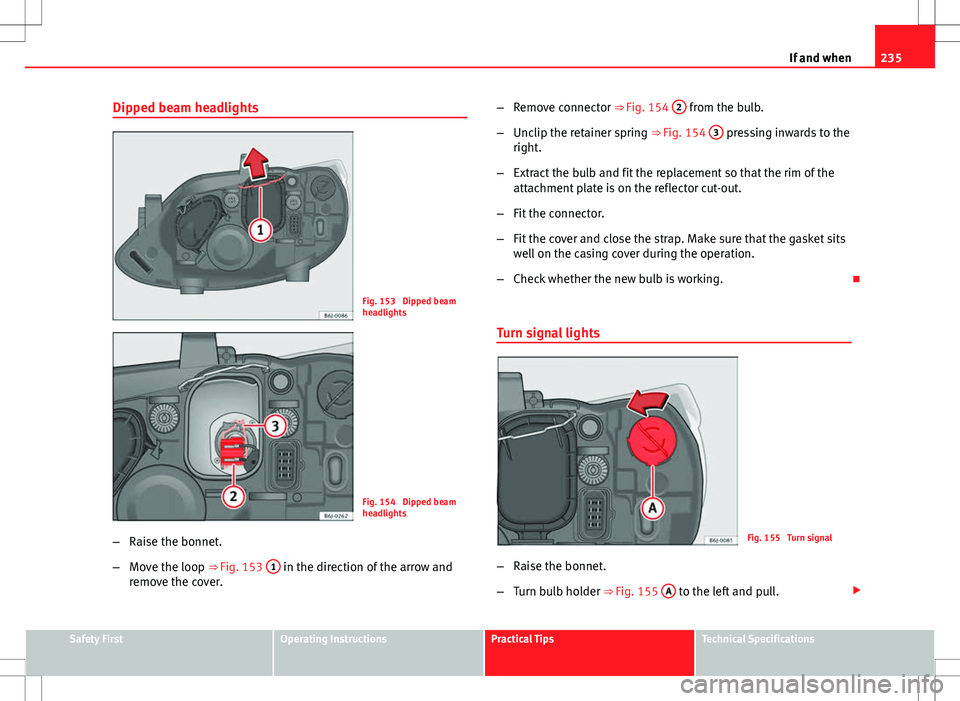
Fig. 153 Dipped beam
headlights
Fig. 154 Dipped beam
headlights
– Raise the bonnet.
– Move the loop ⇒ Fig. 153 1
in the direction of the arrow and
remove the cover. –
Remove connector ⇒ Fig. 154 2
from the bulb.
– Unclip the retainer spring ⇒ Fig. 154 3
pressing inwards to the
right.
– Extract the bulb and fit the replacement so that the rim of the
attachment plate is on the reflector cut-out.
– Fit the connector.
– Fit the cover and close the strap. Make sure that the gasket sits
well on the casing cover during the operation.
– Check whether the new bulb is working.
Turn signal lights
Fig. 155 Turn signal
– Raise the bonnet.
– Turn bulb holder ⇒ Fig. 155 A
to the left and pull.
Safety FirstOperating InstructionsPractical TipsTechnical Specifications
Page 239 of 280
237
If and when
Changing the bulbs of AFS headlights
AFS headlight bulbs
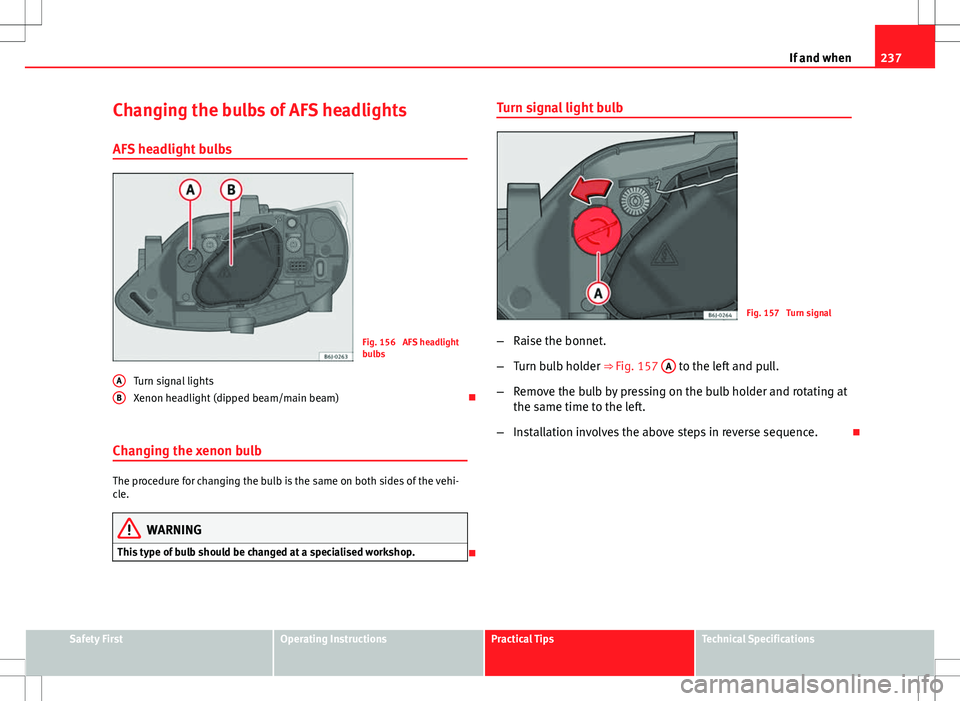
Fig. 156 AFS headlight
bulbs
Turn signal lights
Xenon headlight (dipped beam/main beam)
Changing the xenon bulb
The procedure for changing the bulb is the same on both sides of the vehi-
cle.
WARNING
This type of bulb should be changed at a specialised workshop.
A
B
Turn signal light bulb
Fig. 157 Turn signal
– Raise the bonnet.
– Turn bulb holder ⇒ Fig. 157 A
to the left and pull.
– Remove the bulb by pressing on the bulb holder and rotating at
the same time to the left.
– Installation involves the above steps in reverse sequence.
Safety FirstOperating InstructionsPractical TipsTechnical Specifications
Page 241 of 280
239
If and when
– Installation involves the above steps in reverse sequence.
– Check that the bulb works properly.
Changing the rear, side and interior light
bulbs Summary of LED tail lights
LEDS
● Brake lights
● Side lights
Bulbs
● Rear fog light
● Reversing light
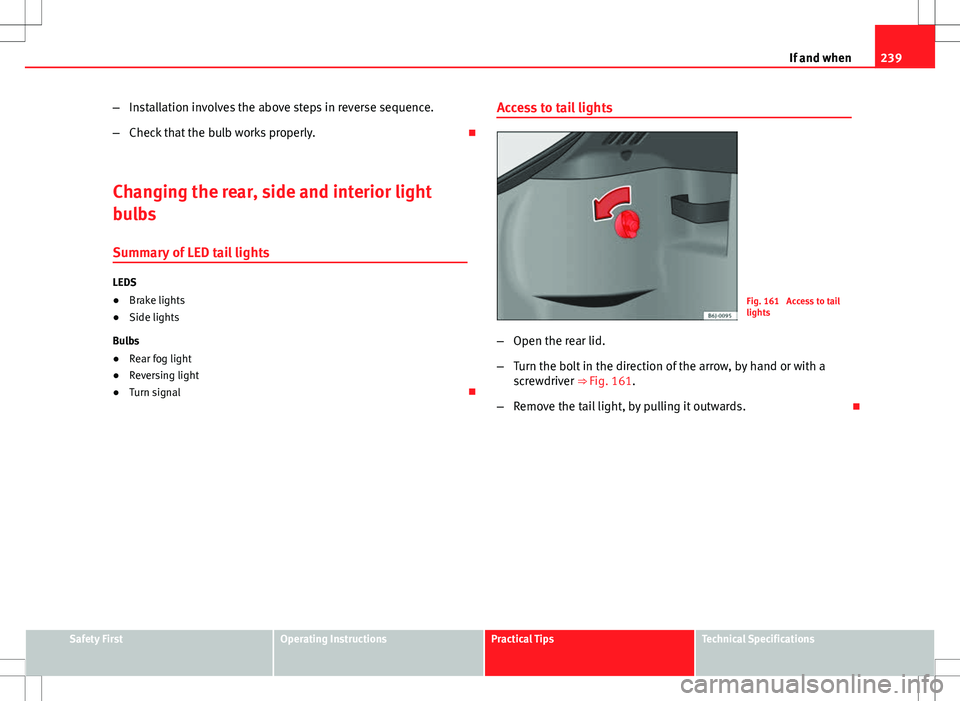
● Turn signal Access to tail lightsFig. 161 Access to tail
lights
– Open the rear lid.
– Turn the bolt in the direction of the arrow, by hand or with a
screwdriver ⇒ Fig. 161.
– Remove the tail light, by pulling it outwards.
Safety FirstOperating InstructionsPractical TipsTechnical Specifications
Page 242 of 280
240If and when
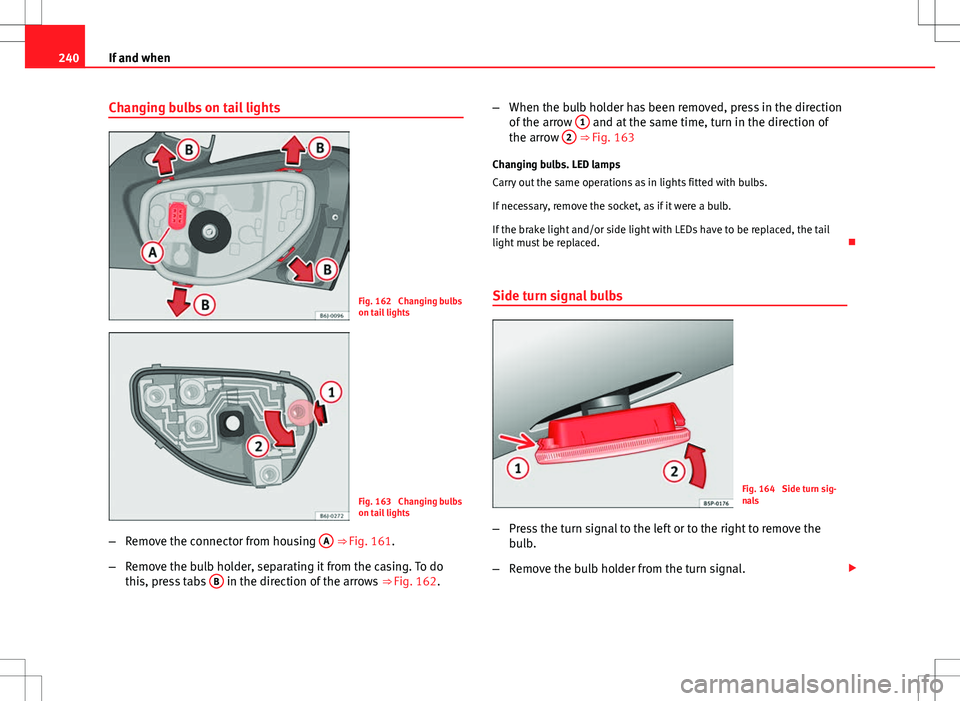
Changing bulbs on tail lights
Fig. 162 Changing bulbs
on tail lights
Fig. 163 Changing bulbs
on tail lights
– Remove the connector from housing A
⇒ Fig. 161.
– Remove the bulb holder, separating it from the casing. To do
this, press tabs B
in the direction of the arrows
⇒ Fig. 162.–
When the bulb holder has been removed, press in the direction
of the arrow 1
and at the same time, turn in the direction of
the arrow 2 ⇒ Fig. 163
Changing bulbs. LED lamps
Carry out the same operations as in lights fitted with bulbs.
If necessary, remove the socket, as if it were a bulb.
If the brake light and/or side light with LEDs have to be replaced, the tail
light must be replaced.
Side turn signal bulbs
Fig. 164 Side turn sig-
nals
– Press the turn signal to the left or to the right to remove the
bulb.
– Remove the bulb holder from the turn signal.
Page 246 of 280
244If and when
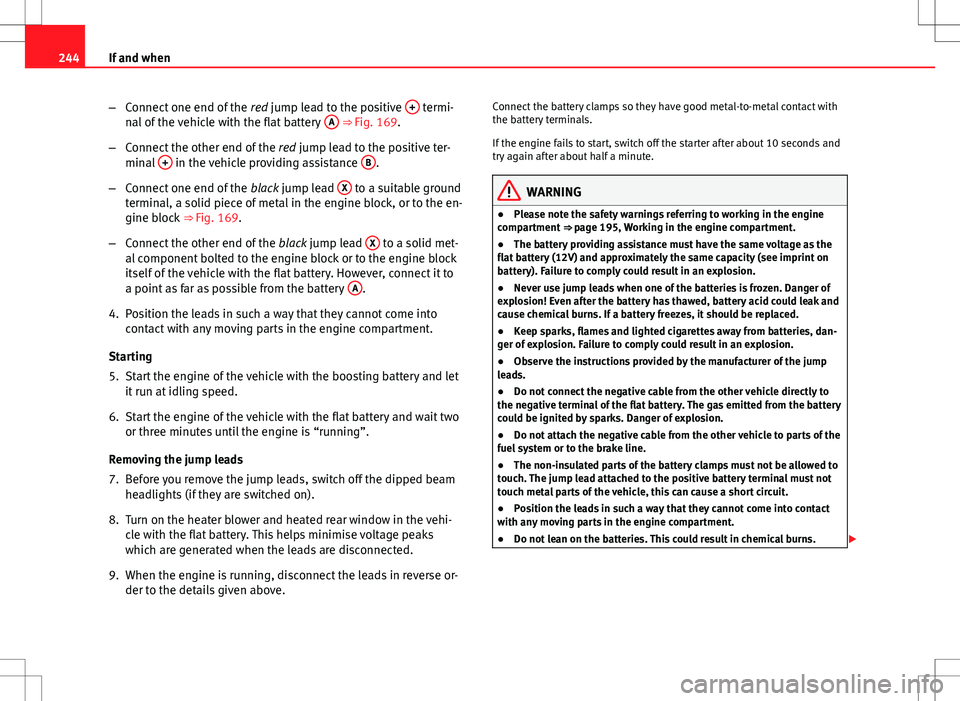
–Connect one end of the red jump lead to the positive +
termi-
nal of the vehicle with the flat battery A ⇒ Fig. 169.
– Connect the other end of the red jump lead to the positive ter-
minal +
in the vehicle providing assistance B.
– Connect one end of the black jump lead X
to a suitable ground
terminal, a solid piece of metal in the engine block, or to the en-
gine block ⇒ Fig. 169.
– Connect the other end of the black jump lead X
to a solid met-
al component bolted to the engine block or to the engine block
itself of the vehicle with the flat battery. However, connect it to
a point as far as possible from the battery A
.
4. Position the leads in such a way that they cannot come into contact with any moving parts in the engine compartment.
Starting
5. Start the engine of the vehicle with the boosting battery and let it run at idling speed.
6. Start the engine of the vehicle with the flat battery and wait two or three minutes until the engine is “running”.
Removing the jump leads
7. Before you remove the jump leads, switch off the dipped beam headlights (if they are switched on).
8. Turn on the heater blower and heated rear window in the vehi- cle with the flat battery. This helps minimise voltage peaks
which are generated when the leads are disconnected.
9. When the engine is running, disconnect the leads in reverse or- der to the details given above. Connect the battery clamps so they have good metal-to-metal contact with
the battery terminals.
If the engine fails to start, switch off the starter after about 10 seconds and
try again after about half a minute.
WARNING
● Please note the safety warnings referring to working in the engine
compartment ⇒ page 195, Working in the engine compartment.
● The battery providing assistance must have the same voltage as the
flat battery (12V) and approximately the same capacity (see imprint on
battery). Failure to comply could result in an explosion.
● Never use jump leads when one of the batteries is frozen. Danger of
explosion! Even after the battery has thawed, battery acid could leak and
cause chemical burns. If a battery freezes, it should be replaced.
● Keep sparks, flames and lighted cigarettes away from batteries, dan-
ger of explosion. Failure to comply could result in an explosion.
● Observe the instructions provided by the manufacturer of the jump
leads.
● Do not connect the negative cable from the other vehicle directly to
the negative terminal of the flat battery. The gas emitted from the battery
could be ignited by sparks. Danger of explosion.
● Do not attach the negative cable from the other vehicle to parts of the
fuel system or to the brake line.
● The non-insulated parts of the battery clamps must not be allowed to
touch. The jump lead attached to the positive battery terminal must not
touch metal parts of the vehicle, this can cause a short circuit.
● Position the leads in such a way that they cannot come into contact
with any moving parts in the engine compartment.
● Do not lean on the batteries. This could result in chemical burns.
Page 249 of 280
247
If and when
Do not pull too hard with the towing vehicle and take care to avoid jerking
the tow rope. When towing on an unpaved road, there is always a risk of
overloading and damaging the anchorage points.
The ignition of the vehicle being towed must be switched on to prevent the
steering wheel from locking and also to allow the use of the turn signals,
horn, windscreen wipers and washers.
As the brake servo does not work if the engine is not running, you must ap-
ply considerably more pressure to the brake pedal than you normally would.
As the power assisted steering does not work if the engine is not running,
you will need more strength to steer than you normally would.
Towing vehicles with an automatic gearbox
● Put the selector lever into position “N”.
● Do not drive faster than 50 km/h (30 mph).
● Do not tow further than 50 km (30 miles).
● If a breakdown vehicle is used, the vehicle must be towed with the front
wheels raised.
Note
● Observe legal requirements when towing or tow-starting.
● Switch on the hazard warning lights of both vehicles. However, observe
any regulations to the contrary.
● For technical reasons, vehicles with an automatic gearbox must not be
tow-started.
● If damage to your vehicle means that there is no lubricant in the gear-
box, you must raise the driven wheels while the vehicle is being towed.
● If the vehicle has to be towed more than 50 km (30 miles), the front
wheels should be raised during towing, and towing should be carried out by
a qualified person. ●
The steering wheel is locked when the vehicle has no electrical power.
The vehicle must then be towed with the front wheels raised. Towing should
be carried out by a qualified person.
● The towline anchorage should always be kept in the vehicle.
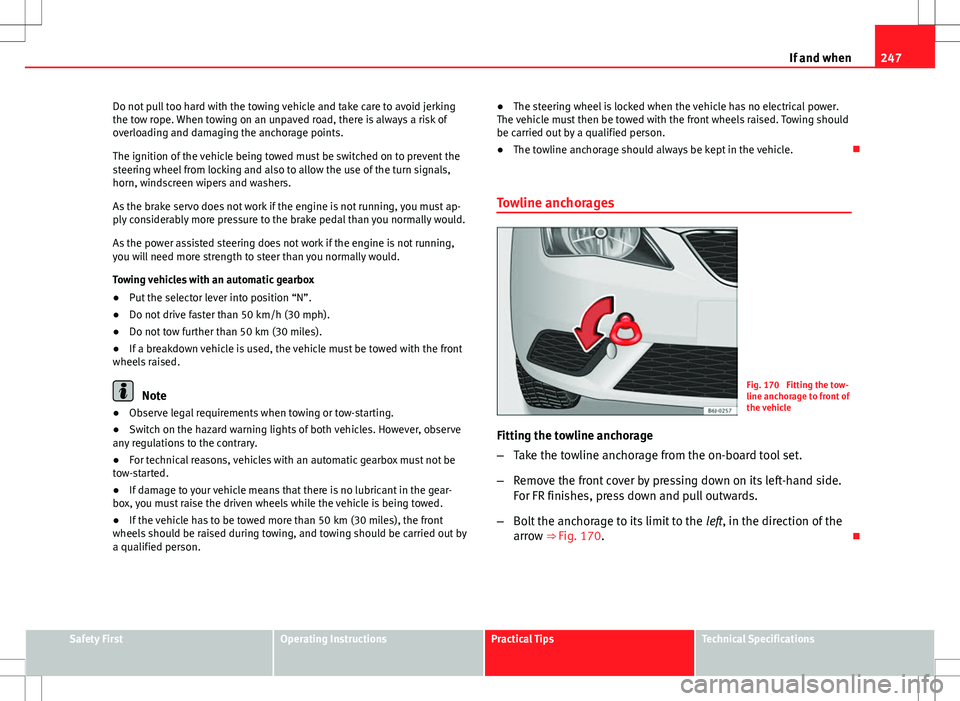
Towline anchoragesFig. 170 Fitting the tow-
line anchorage to front of
the vehicle
Fitting the towline anchorage
– Take the towline anchorage from the on-board tool set.
– Remove the front cover by pressing down on its left-hand side.
For FR finishes, press down and pull outwards.
– Bolt the anchorage to its limit to the left, in the direction of the
arrow ⇒ Fig. 170.
Safety FirstOperating InstructionsPractical TipsTechnical Specifications