2012 Seat Exeo trailer
[x] Cancel search: trailerPage 205 of 317

203
Trailer towing
Fitting the ball joint (step 1)
Fig. 155 Rear bumper:
Open the cover piece
– Remove the cover piece 2
⇒ Fig. 155 on the mounting fixture
1 below the bumper as far as it will go. The cover piece is held
automatically in the open position.
– Make sure the mounting fixture is clean. If not, clean it ⇒
.
Cont ⇒ page 203, Fitting the ball joint (step 2).
WARNING
It is important to keep the mounting fixture clean. Otherwise the ball
joint may fail to engage safely and securely. This could lead to an acci-
dent.
Fitting the ball joint (step 2)
Fig. 156 Removable tow-
ing bracket: Ball joint
Fig. 157 Removable tow-
ing bracket: Ball joint
Make sure the ball joint is clean and undamaged
– Check the locking pin A
, release pin B, shaft section C and
knob D ⇒ Fig. 156 on the ball joint to make sure they are clean
and undamaged.
Safety FirstOperating InstructionsPractical TipsTechnical Specifications
Page 206 of 317

204Trailer towing
The spring mechanism inside the ball joint must be in the ready
position
–Check that the red marking A
⇒ Fig. 157 on the knob is inside
the black zone marked on the ball joint.
– Check that the locking pin B
is inside the holes in the shaft
section of the ball joint.
– Check that the knob protrudes visibly from the ball joint, so that
there is a clear gap C
between the knob and the ball joint.
The ball joint can only be installed if the internal spring mechanism is in the
ready position.
Cont ⇒ page 204, Fitting the ball joint (step 3).
Fitting the ball joint (step 3)
Fig. 158 Removable tow-
ing bracket: Setting the
spring mechanism to the
"ready" position
Fig. 159 Removable tow-
ing bracket: Inserting the
ball joint
Setting the spring mechanism to the ready position (if required)
– Insert the key 1
⇒ Fig. 158 in the lock on the knob and turn it
towards the red marking.
– Pull out the knob in direction A
, hold and turn in direction Buntil the locking pin 2 engages and the release pin 3 moves
out visibly ⇒ .
Inserting the ball joint
– With the spring mechanism in the ready position, insert the ball
joint into the mounting fixture and push it upwards ⇒ Fig. 159
in the direction indicated (arrow) ⇒
. It should lock into posi-
tion automatically. You should now clearly hear it click into
place.
– Lock the ball joint by turning the key to the green marking.
– Remove the key.
Cont ⇒ page 205, Fitting the ball joint (step 4).
Page 207 of 317
205
Trailer towing
WARNING
● If it is not possible to set the spring mechanism to the ready position
as described above, do not use the ball joint. Please contact a special-
ised workshop.
● To avoid injury, keep your hands away from the knob or cover piece
when inserting the ball joint in the mounting fixture. Otherwise, you
could be injured.
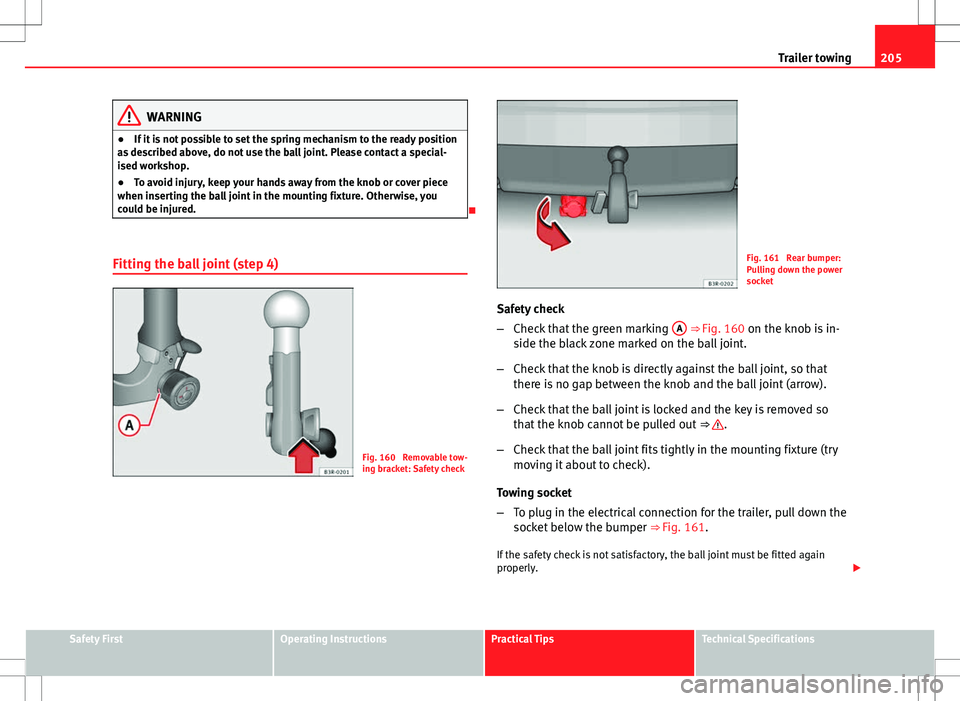
Fitting the ball joint (step 4)
Fig. 160 Removable tow-
ing bracket: Safety check
Fig. 161 Rear bumper:
Pulling down the power
socket
Safety check
– Check that the green marking A
⇒ Fig. 160 on the knob is in-
side the black zone marked on the ball joint.
– Check that the knob is directly against the ball joint, so that
there is no gap between the knob and the ball joint (arrow).
– Check that the ball joint is locked and the key is removed so
that the knob cannot be pulled out ⇒
.
– Check that the ball joint fits tightly in the mounting fixture (try
moving it about to check).
Towing socket
– To plug in the electrical connection for the trailer, pull down the
socket below the bumper ⇒ Fig. 161.
If the safety check is not satisfactory, the ball joint must be fitted again
properly.
Safety FirstOperating InstructionsPractical TipsTechnical Specifications
Page 208 of 317

206Trailer towing
WARNING
To avoid accidents, the ball joint must meet all the safety requirements
listed in the safety check. The towing bracket must not be used if any one
of these requirements is not met. If this is the case, you should contact a
specialised workshop.
Removing the ball joint
Fig. 162 Removable tow-
ing bracket: Removing
the ball joint
Fig. 163 Rear bumper:
fitting the cover piece
– Insert the key in the lock 1
⇒ Fig. 162 on the knob.
– Unlock the ball joint by turning the key to the red marking.
– Take hold of the ball joint and pull out the knob in direction A
.
– Keep hold of the knob and turn it as far as it will go in direction
B
.
– Release the knob. The spring mechanism will remain in the
ready position ⇒
.
– Pull the ball joint down out of the mounting fixture 1
⇒ Fig. 163. The cover piece will cover the mounting fixture auto-
matically 2.
– Put away the ball joint attachment under the floor panel in the
luggage compartment.
– Move the socket back up to its original position.
Page 209 of 317

207
Trailer towing
WARNING
● To avoid injury, keep your hands away from the locking pin and the
release pin when releasing the locking mechanism.
● Make sure that the cover piece is properly engaged on the mounting
fixture on the vehicle. Otherwise the ball joint may fail to engage secure-
ly if dirt accumulates in the mounting fixture.
Fitting a towing bracket*
It is possible to fit a towing bracket to the rear of the vehicle.
Fig. 164 Attachment
points for towing bracket
If a towing bracket is to be fitted after the vehicle is purchased, this must be
completed according to the instructions of the towing bracket manufacturer.
Safety FirstOperating InstructionsPractical TipsTechnical Specifications
Page 210 of 317

208Trailer towing
The attachment points for the towing bracket A
are on the lower part of the
vehicle.
The distance between the centre of the ball coupling and the ground should
never be lower than the indicated value, even with a fully loaded vehicle
and including the maximum drawbar load.
Elevation values for securing the towing bracket:
65 mm (minimum)
403
629 mm
1112 mm (vehicle with max. load)
from 350 to 420 mm (vehicle with max. load)
1000 mm
Fitting a towing bracket
● Driving with a trailer involves an extra effort for the vehicle. Therefore,
before fitting a towing bracket, please contact a Technical Service to check
whether your cooling system needs modification.
● The legal requirements in your country must be observed (e.g. the fitting
of a separate warning lamp).
● Certain vehicle components, e.g. the rear bumper, must be removed and
reinstalled. The towing bracket securing bolts must be tightened using a
torque wrench, and a power socket must be connected to the vehicle's elec-
trical system. This requires specialised knowledge and tools.
● Figures in the illustration show the elevation value and the attachment
points which must be considered if you are retrofitting a towing bracket. B
CDEFG
WARNING
The towing brackets should be fitted at a specialised workshop.
● If the towing bracket is incorrectly installed, there is serious danger
of accident.
● For your own safety, please observe the instructions provided by the
manufacturer of the towing bracket.
CAUTION
● If the power socket is incorrectly installed, this could cause damage to
the vehicle's electrical system.
Note
For the Sport finish, fitting a trailer bracket is not recommended due to the
design of the bumpers.
Page 255 of 317

253
If and when
wheels fitted on the vehicle because of the wheel/tyre dimensions, rubber
composition, tread pattern, etc. Therefore, note the following restrictions:
● The spare steel wheel is designed only for your vehicle model. Do not
attempt to mount the wheel on any vehicle but your own.
● Your vehicle will have different driving characteristics when the spare
steel rim wheel is mounted ⇒
.
● The spare wheel is only intended for temporary use after having a flat
tyre. Replace the spare wheel with a normal wheel that has the proper tyre
dimensions as soon as possible.
● If the size of the spare steel rim wheel is different to that of the other
wheels, it is unlikely that snow chains suitable for the other wheels will fit it.
WARNING
● After mounting the spare steel rim wheel, the tyre pressure must be
checked and corrected as soon as possible. The tyre pressure must corre-
spond to the vehicle load (consult the table containing the inflation pres-
sures). Otherwise there is danger of causing an accident. Use the highest
tyre pressure as indicated in the table.
● Do not drive faster than 80 km/h, as higher speeds can cause an acci-
dent.
● Avoid heavy acceleration, hard braking and fast cornering, as this
could cause an accident.
Changing a wheel
Preparation work
What you must do before changing a wheel. – If you have a flat tyre or puncture, park the vehicle as far away
from the flow of traffic as possible. Choose a location that is as
level as possible.
– All passengers should leave the vehicle. They should wait in a
safe place (e.g. behind the roadside crash barrier).
– Apply the handbrake firmly.
– Engage first gear .
– When towing a trailer: Unhitch the trailer from your vehicle.
– Take the tools and the spare wheel ⇒ page 251 out of the lug-
gage compartment.
WARNING
If you have a puncture in heavy traffic, switch on the hazard warning
lights and place the warning triangle in a visible location. This is for your
own safety and also warns other road users.
CAUTION
If you have to change the tyre on a gradient, block the wheel opposite the
wheel being changed by placing a stone or similar object under it to prevent
the vehicle from rolling away.
Safety FirstOperating InstructionsPractical TipsTechnical Specifications
Page 265 of 317

263
If and when
Fuse assignment
This list shows the fuses which can be replaced relatively
easily by the owner.
No.ConsumerAmps1Air conditioner102Footwell lamps53Heated washer jets54Radiator fan55Parking aid, automatic gearbox106Air conditioner (air purity sensor), pressure sensor5
7Electronic Stability Control (ESC), brake light switch,
clutch pedal switch, steering angle sensor10
8Telephone59Lambda probe heater1010Adaptive headlights right5
11Airbag and disconnection of the front passenger air-
bag5
12Diagnostic socket1013Steering column unit1014Brake lights1015Instrument panel1016Vacant 17Tyre pressure control, rain/light sensor1018Adaptive headlights left519Start-Stop control unit1020Engine management1521Start/Stop battery power management522Vacant 23Vacant
No.ConsumerAmps24Central electrics unit for convenience equipment2025Heater blower3026Rear window heater3027Power socket for trailer (control unit)3028Fuel pump, auxiliary pump for diesel2029Radio, amplifier (with Start-Stop)2030Sliding/tilting sunroof20
31Diagnosis connection, automatic anti-dazzle interior
mirror, reverse light, automatic gearbox15
32Towing socket1533Lighter2034Rear electric windows3035Luggage compartment power socket*2036Wiper system30
37Pump for windscreen washer and headlight washer
system30
38Luggage compartment illumination, alarm1539Radio, amplifier (without Start-Stop)2040Horn2541230 volt socket3042Electronic Stability Control (ESC)2543Front electric windows3044Seat heating35
Some of the electrical items listed in the table are only fitted on certain
models or are optional extras.
Safety FirstOperating InstructionsPractical TipsTechnical Specifications