2012 Seat Alhambra ECU
[x] Cancel search: ECUPage 51 of 388

49
Child safety
Seat belt guide handle
● Secure the seat belt guide handle to the side head restraint on the win-
dow side. The guide handle is secured by a button.
● Open the upper button on the seat belt guide handle and pass the belt
webbing below the side head restraint and through the guide handle.
● Close the button again.
Adjusting the belt routing
● Guide the automatic three-point seat belt below the side head restraint.
● Pull the latch plate and slowly place the belt webbing across the child's
chest and lap.
● Insert the latch plate into the buckle for the appropriate seat and push it
down until it is securely locked with an audible click.
● Pull the belt to ensure that the latch plate is securely engaged in the
buckle.
WARNING
The seat belt only offers maximum protection from severe or fatal injuries
when it is correctly positioned.
● Children must assume the proper sitting position and be properly bel-
ted in while travelling.
● The shoulder belt must be positioned against the middle of the
shoulder.
● The seat belt must lie flat and fit comfortably.
● Allow the belt to retract until it fits tightly over the child's seat.
● The lap part of the seat belt must lie across the pelvis, never across
the stomach.
● Only one child may occupy a child seat.
Removing the seat belt
Fig. 33 Integrated
child seats. lowering
the cushion.
Lowering the cushion
● Pull the unlock lever ⇒ fig. 33 A
on the cushion in the direction of the
arrow 1.
● Push the cushion down through the central area B in the direction of
the arrow 2 until it safely engages
⇒ . The side supports fold away auto-
matically.
Removing the side head restraint
● Open the seat belt guide handle.
● Guide the seat belt by hand to pull the belt back in more easily and not
damage the trim.
● Push the head restraint up as far as it will go.
● Fold the backrest of the rear seat forwards ⇒ page 117.
● Remove the head restraint along with the side head restraint.
● Remove the head restraint and side head restraint by pulling on it.
● Fitting the head restraint.
Safety FirstOperating instructionsPractical tipsTechnical Specifications
Page 79 of 388

77
Unlocking and locking
Locking and unlocking the vehicle from the inside
Fig. 47 In the driver
door: central locking but-
ton.
Push the button ⇒ fig. 47:Unlocking the vehicle.Lock the vehicle.
The central locking button is still operative when the ignition is switched off.
The central locking button is only deactivated if the "Safe" security system
is activated ⇒ page 77.
Please note the following when you use the central locking button to lock
your vehicle:
● Do not turn on the "Safe" security system ⇒ page 77.
● Do not turn on the anti-theft alarm.
● It will not be possible to open the doors or the tailgate from the outside
this may offer extra safety, when stopped at traffic lights for example. ●
The doors can be opened and unlocked individually from the inside by
pulling the inside door handle. If necessary, pull the door release lever
twice.
● The driver's door cannot be locked when it is still open. This avoids lock-
ing the vehicle key inside the vehicle when there is nobody inside.
"Safe" security system
FunctionNecessary operationsLocks the vehicle with the
"Safe" security system.Press the button once on the vehicle
key.
Locks the vehicle without the
"Safe" security system.Press the button twice on the vehicle
key.
Press the central locking button on
the driver's door once.
When the vehicle is locked, the "Safe" security system deactivates the door
handles and the central locking button making the vehicle difficult to open.
The doors cannot be opened from inside ⇒
.
When the "Safe" security system is turned off:
● The vehicle can be opened and unlocked from the inside using an inside
door handle.
● The vehicle may be unlocked from the inside by pushing the central
locking button.
● The anti-theft alarm will be activated.
● The vehicle interior monitoring system and the anti-tow system are de-
activated.
Safety FirstOperating instructionsPractical tipsTechnical Specifications
Page 80 of 388
78Unlocking and locking
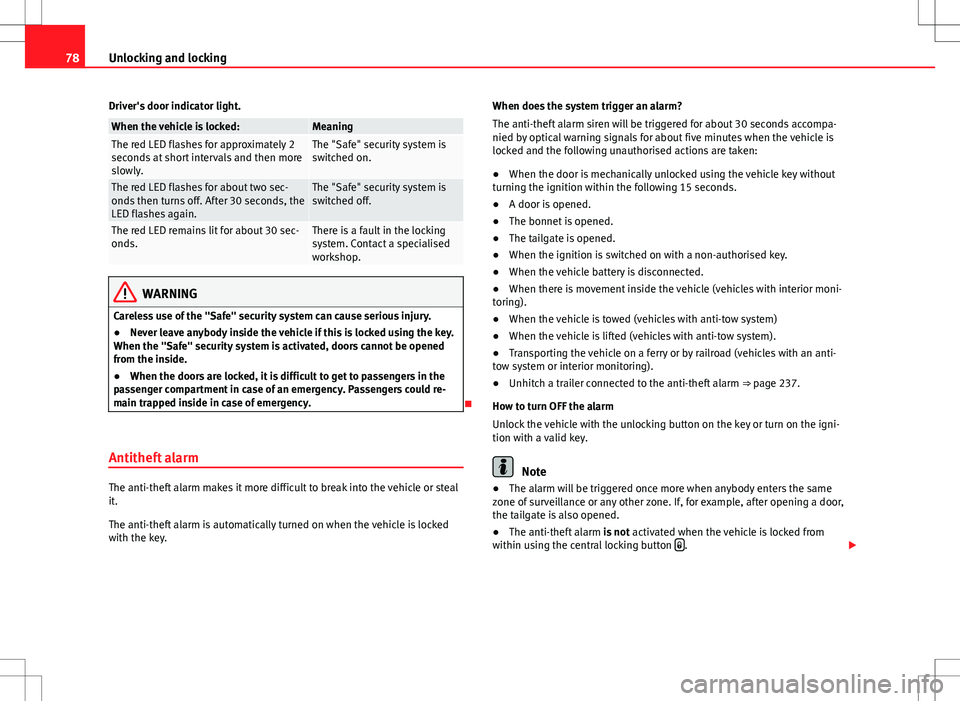
Driver's door indicator light.
When the vehicle is locked:MeaningThe red LED flashes for approximately 2
seconds at short intervals and then more
slowly.The "Safe" security system is
switched on.
The red LED flashes for about two sec-
onds then turns off. After 30 seconds, the
LED flashes again.The "Safe" security system is
switched off.
The red LED remains lit for about 30 sec-
onds.There is a fault in the locking
system. Contact a specialised
workshop.
WARNING
Careless use of the "Safe" security system can cause serious injury.
● Never leave anybody inside the vehicle if this is locked using the key.
When the "Safe" security system is activated, doors cannot be opened
from the inside.
● When the doors are locked, it is difficult to get to passengers in the
passenger compartment in case of an emergency. Passengers could re-
main trapped inside in case of emergency.
Antitheft alarm
The anti-theft alarm makes it more difficult to break into the vehicle or steal
it.
The anti-theft alarm is automatically turned on when the vehicle is locked
with the key. When does the system trigger an alarm?
The anti-theft alarm siren will be triggered for about 30 seconds accompa-
nied by optical warning signals for about five minutes when the vehicle is
locked and the following unauthorised actions are taken:
●
When the door is mechanically unlocked using the vehicle key without
turning the ignition within the following 15 seconds.
● A door is opened.
● The bonnet is opened.
● The tailgate is opened.
● When the ignition is switched on with a non-authorised key.
● When the vehicle battery is disconnected.
● When there is movement inside the vehicle (vehicles with interior moni-
toring).
● When the vehicle is towed (vehicles with anti-tow system)
● When the vehicle is lifted (vehicles with anti-tow system).
● Transporting the vehicle on a ferry or by railroad (vehicles with an anti-
tow system or interior monitoring).
● Unhitch a trailer connected to the anti-theft alarm ⇒ page 237.
How to turn OFF the alarm
Unlock the vehicle with the unlocking button on the key or turn on the igni-
tion with a valid key.Note
● The alarm will be triggered once more when anybody enters the same
zone of surveillance or any other zone. If, for example, after opening a door,
the tailgate is also opened.
● The anti-theft alarm is not activated when the vehicle is locked from
within using the central locking button
.
Page 106 of 388

104Lights and visibility
● Pull the sun blind by the handle ⇒ fig. 64 A
up to the top.
● Hook both rings of the fastening rod in the spaces provided B. Check
that the sun blind is securely hooked into the spaces provided when it has
been lowered B
.
● To put the sun blind away, unhook it at the top and lower by hand ⇒ .
CAUTION
To prevent damage to the blind or the interior trim, do not lower the sun
blind “quickly”.
Page 122 of 388

120Seats and storage compartments
Convenient entry function for the third row of seats
Fig. 81 Second row of
seats: convenient entry
function controls.
The outer seats of the second row can be folded to make it easier to get in
and out of the third row of seats.
Folding down the seat of the second row
● If necessary, open the belt loop and wind up the seat belt by hand.
● If necessary, remove the side head restraint of the integrated child seat
⇒ page 45.
● If necessary, raise the armrests.
● Remove any objects located in the floor area of the second row of seats,
where applicable ⇒
.
● Push the head restraint down as far as it will go ⇒ page 10.
● Push the lever ⇒ fig. 81 1
forwards and fold the backrest of the rear
seat. The seat can still be moved forwards when rear seat is folded com-
pletely forwards ⇒
.
● Always take care when entering and leaving the vehicle ⇒ .Repositioning the seat of the second row
●
Lift the backrest of the rear seat in an upright position. The entire seat
folds backwards ⇒
.
● Make sure that the rear seat is securely engaged so that the seat belts
can provide proper protection in the rear seats. The red mark 2
should no
longer be visible ⇒ in Folding down rear seats to create load space on
page 129.
Emergency exit function
If the lever 1
does not work, e.g. after an accident, the seats on the second
row can be folded forwards from the third row to allow occupants of the
third row of seats to get out of the vehicle ⇒
.
● Pull handle 3
back and fold the backrest of the rear seat. The complete
rear seat folds forward ⇒ .
WARNING
Careless or uncontrolled use of the convenient entry assistant may result
in severe injury and accident.
● Never use the convenient entry function when the vehicle is in mo-
tion.
● Avoid trapping or damaging the seat belt when folding the rear seats
back.
● Keep your hands, fingers, feet and other body parts out of the hinges
and the seat locking mechanism when folding and unfolding.
● Mats or other objects can be caught in the hinges of the backrests or
rear seat. This could prevent the backrest from locking safely when posi-
tioned upright.
● All backrests must engage correctly for the seat belts on the rear
seats to work properly. When the backrest of an occupied seat is not cor-
rectly locked in place, the passenger can be thrust forward with the back-
rest in case of sudden braking, sudden manoeuvres or an accident.
Page 125 of 388

123
Seats and storage compartments
Head restraints Adjusting the head restraints
Fig. 84 A: Adjust the head restraints with no possibili-
ty of lengthways direction adjustment, B: Adjust the
head restraints with lengthways direction adjustment.
Fig. 85 Adjust the head
restraints in the second
or third row of seats.
All seats are equipped with a head restraint. Adjusting height
●
Raise the head restraint in the direction of the arrow or lower it ⇒ fig. 84
or ⇒ fig. 85 1
with the button pressed ⇒ .
● The head restraint must engage securely in position. There are three
possible positions on the second row of seats and two possible positions
on the third row of seats.
Adjusting the front head restraints
● Push the head restraint forward in the direction of the arrow or backward
⇒ fig. 84 1
B with the button pressed.
● The head restraint must engage securely in position.
Correct adjustment of head restraints
Adjust the head restraint so that its upper edge is at the same level as the
top of your head, or as close as possible to the same level as the top of your
Safety FirstOperating instructionsPractical tipsTechnical Specifications
Page 127 of 388

125
Seats and storage compartments
Fig. 87 Fitting the head
restraints in the second
or third row of seats.
All seats are equipped with a head restraint.
Removing the front head restraints in vehicles without the lengthways
direction adjustment of the head restraints
● If necessary, adjust the backrest so that the head restraint can be fitted.
● Push the head restraint up as far as it will go ⇒
.
● Pull out the head restraint pressing the button completely ⇒ fig. 86 1
A.
Fitting the front head restraints in vehicles without the lengthways
direction adjustment of the head restraints
●
Correctly place the head restraint into the guides on the backrest and in-
sert it.
● Completely press the button 1
A and push the head restraint down-
wards.
● Adjust the head restraint according to the correct seat position and se-
cure it ⇒ page 123. Removing the front head restraints in vehicles with the lengthways
direction adjustment of the head restraints
●
If necessary, adjust the backrest so that the head restraint can be fitted.
● Push the head restraint up and backward as far as it will go ⇒
.
● Place a flat object, e.g. a plastic card 2 B, on both sides between the
backrest cover and the end protector of the backrest retaining bar and un-
lock the retaining bars with a little pressure.
● Completely pull out the head restraint.
Fitting the front head restraints in vehicles with the lengthways direction
adjustment of the head restraints
● Pull out the two retaining bars from the head restraint as far as possible.
● Correctly place the head restraint into the guides on the backrest and in-
sert it.
● Push the head restraint down as far as possible until the two retaining
bars are secured.
● Adjust the head restraint according to the correct seat position and se-
cure it ⇒ page 123.
Removing the head restraints from the second and third row of seats
● Fold the backrest of the rear seat forwards ⇒ page 126.
● Push the head restraint up as far as it will go ⇒
.
● Pull out the head restraint ⇒ fig. 87 1 with the button pressed.
● Fold the backrest of the rear seat backwards until it is engaged.
Installing the head restraints for the second and third row of seats
● Fold the backrest of the rear seat forwards ⇒ page 126.
● Insert the head restraint into the guides on the backrest.
● Push the head restraint down while pressing the button 1
.
● Fold the backrest of the rear seat backwards until it is engaged.
● Adjust the head restraint to the correct position ⇒ page 123.
Safety FirstOperating instructionsPractical tipsTechnical Specifications
Page 129 of 388

127
Seats and storage compartments
WARNING
When the vehicle is not in use or being watched, always lock the doors
and the tailgate to reduce the risk of serious injury or death.
● Do not leave children unwatched, especially when the tailgate is
open. Children could climb into the luggage compartment, close the tail-
gate from inside and be unable to escape themselves. This could lead to
serious injury or death.
● Never allow children to play in or around the vehicle.
● Never transport people in the luggage compartment.
WARNING
Unsecured or incorrectly secured objects can cause serious injury in case
of a sudden manoeuvring or breaking or in case of an accident. This is es-
pecially true when objects are struck by a detonating airbag and fired
through the vehicle interior. To reduce the risks, please note the follow-
ing:
● Secure all objects in the vehicle. Always keep equipment and heavy
objects in the luggage compartment.
● Always secure objects with suitable rope or straps so that they can-
not enter the areas around the frontal or side airbags in case of sudden
braking or an accident.
● While driving, always keep object compartments closed.
WARNING (Continued)
● Do not place hard, heavy or sharp objects inside the passenger com-
partment, in open storage compartments, the rear shelf or on the dash-
board.
● Remove hard, heavy and sharp objects from clothes and pockets in-
side the vehicle and store securely.
WARNING
The transport of heavy object changes vehicle handling and increases
braking distance. Heavy loads that have not been stored or secured cor-
rectly could cause loss of control and result in serious injury.
● The vehicle handling changes when transporting heavy objects due
to a change in the centre of gravity.
● Distribute the load as uniformly and as low down on the vehicle as
possible.
● Store heavy objects in the luggage compartment as far from the rear
axle as possible.
CAUTION
● Hard objects on the shelf could chafe the wires of the heating element
and antenna of the rear window and cause damage.
● The side window antenna could be damaged due to chafing from ob-
jects.
Note
The ventilating slits between the heated rear window and the shelf must not
be covered so that used air can escape from the vehicle.
Safety FirstOperating instructionsPractical tipsTechnical Specifications