2012 Seat Alhambra service
[x] Cancel search: servicePage 309 of 388

307
Wheels and tyres
Tyre code (example)MeaningTWIThis identifies the position of the Tread Wear In-
dicator ⇒ page 302.
MAX LOAD 615 KG
(1356 LBS)US load rating, indicating maximum permitted
load per tyre.
MAX INFLATION 350 KPA
(51 PSI)US limit, indicating maximum permitted tyre
pressure.
SIDEWALL 1 PLY RAYONInformation about tyre wall components:
1 layer of rayon (artificial silk).
TREAD 4 PLIES
1 RAYON + 2 STEEL +
1 NYLONInformation about tread components:
In the example, there are 4 layers below the
tread: 1 layer of rayon (artificial silk), 2 layers of
steel reinforcement and 1 layer of nylon.
Information for the end consumer concerning the comparative values of
the established base tyres (standardised test procedures) :
TREADWEAR 280Relative service life of the tyre, with respect to
specific US standard test.
TRACTION AABraking capacity of tyre on wet surface (AA, A, B
or C).
TEMPERATURE ATyre temperature resistance at higher test
speeds (A, B or C).
If there are different letters, they are specific codes of the tyre manufac-
turer or specific national codes.
a)
The letters TIN refer to the tyre serial number.
Tyres with directional tread pattern
Tyres with directional tread pattern have been designed to operate best
when rotating in only one direction. An arrow on the tyre sidewall indicates
the direction of rotation on tyres with directional tread. Always observe the
direction of rotation indicated when mounting the wheel. This guarantees
optimum grip and helps to avoid aquaplaning, excessive noise and wear. Tyre load rating
The load rating code indicates the maximum load in kilogrammes each
wheel can carry (load capacity).
615 kg (1356 pounds)
650 kg (1433 pounds)
690 kg (1521 pounds)
730 kg (1609 pounds)
775 kg (1709 pounds)
Speed rating
The speed rating indicates the maximum speed permitted for the tyres.
max. 150 km/h (93 mph)
max. 160 km/h (99 mph)
max. 170 km/h (106 mph)
max. 180 km/h (112 mph)
max. 190 km/h (118 mph)
max. 200 km/h (124 mph)
max. 210 km/h (130 mph)
max. 240 km/h (149 mph)
max. 240 km/h (149 mph)
max. 270 km/h (168 mph)
max. 300 km/h (186 mph)
Some manufacturers use the letters “ZR” for tyres with a maximum author-
ised speed above 240 km/h (149 miles).
91
93
95
97
99
P
Q
R
S
T
U
H
V
Z
W
Y
Safety FirstOperating instructionsPractical tipsTechnical Specifications
Page 322 of 388

320If and when
Note
The anti-theft alarm is not activated when the vehicle is locked manually us-
ing the key ⇒ page 74.
Locking the passenger side door and sliding doors
manually
Fig. 191 To the front of
the passenger side door:
Emergency lock, hidden
by a rubber cap.
Fig. 192 Emergency
locking of the vehicle us-
ing the vehicle key.
The passenger side door and the sliding doors can be locked manually. The
anti-theft alarm is not activated in this case.
● Door open.
● Remove the rubber cap to the front of the door. The rubber cap is
marked with a lock symbol ⇒ fig. 191.
● Unfold the key shaft ⇒ page 71.
● Insert the key shaft horizontally into the opening and moved the colour
lever forwards ⇒ fig. 192.
● Replace the rubber cap and close the door.
● Check if the door is locked.
● Carry out the same operation on the other doors if necessary.
● Have the vehicle checked by a Technical Service.
Note
The doors can be opened and unlocked individually from the inside by pull-
ing the inside door handle. To open, pull the inner door release lever twice
⇒ page 74.
Page 328 of 388

326If and when
Fuses
Introduction
Due to the constant update of vehicles, fuse assignments depending on
equipment and the use of the same fuse for various electrical components,
at the time of printing this manual it is not possible to provide an up-to-date
summary of the electrical components fuse positions. For detailed informa-
tion about the fuse positions, please consult a Technical Service.
In general, a fuse can be assigned to various electrical components. Like-
wise, an electrical component can be protected by several fuses.
Only replace fuses when the cause of the problem has been solved. If a
newly inserted fuse blows after a short time, you must have the electrical
system checked by a qualified dealership as soon as possible.
Additional information and warnings:
● Working in the engine compartment ⇒ page 279
WARNING
The high voltages in the electrical system can give serious electrical
shocks, causing burns and even death!
● Never touch the electrical wiring of the ignition system.
● Take care not to cause short circuits in the electrical system.
WARNING
Using unsuitable fuses, repairing fuses or bridging a current circuit with-
out fuses can cause a fire and serious injury.
● Never use a fuse with a higher value. Only replace fuses with a fuse of
the same amperage (same colour and markings) and size.
● Never repair a fuse.
● Never replace a fuse by a metal strip, staple or similar.
CAUTION
● To avoid damage to the vehicles electric system, before replacing a fuse
turn off the ignition, the lights and all electrical elements and remove the
keys from the ignition.
● If you replace a fuse with higher-rating fuse, you could cause damage to
another part of the electrical system.
● Protect the fuse boxes when open to avoid the entry of dust or humidity.
Dirt and humidity inside fuse boxes can cause damage to the electrical sys-
tem.
Note
● One single consumer could have more than one fuse.
● Several consumers could run over one single fuse.
Page 332 of 388

330If and when
Changing bulbs
Introduction
Changing bulbs requires a certain amount of manual skill. If you are unsure,
SEAT recommends that you consult an Technical Service or request assis-
tance from a specialist. In general, a specialist is required if other vehicle
components must be removed or if the discharge lamps must be replaced.
You should store spare light bulbs in the vehicle for safety-relevant lights.
Spare bulbs may be obtained from the Technical Services. In some coun-
tries, it is a legal requirement to carry spare bulbs in the vehicle.
Driving with faults and blown bulbs on the vehicle exterior lighting is
against the law.
Additional bulb specifications
The specifications of some headlamp bulbs and bulbs for the tail lamps fit-
ted at the factory may be different to those of conventional bulbs. Bulb in-
formation is displayed on the bulb socket or on the bulb itself.
Additional information and warnings:
● Lights and visibility ⇒ page 95
● Working in the engine compartment ⇒ page 279
● Vehicle tools ⇒ page 324
● Fuses ⇒ page 326
WARNING
If the road is not well-lit and the vehicle is not clearly visible to other
drivers, there is a risk of accident.
WARNING
Failure to replace bulbs correctly may cause serious accidents.
● Before carrying out any work in the engine compartment please read
and observe the warnings ⇒ page 279. In any vehicle, the engine com-
partment is a hazardous area and could cause severe injury.
● Discharge lamps work with high-voltage and can cause serious or fa-
tal injury if handled incorrectly.
● H7 and discharge lamps are highly pressurised and could explode
when being changed.
● Only replace the bulbs concerned when they have cooled.
● Never replace bulbs alone if you are not familiar with the operations
necessary. If you are not sure about procedures then visit a Technical
Service to carry out the necessary work.
● Never touch the bulb glass directly. Fingerprints will be evaporated by
the heat of the operating bulb thus “fogging” up the reflector.
● The headlamp frameworks in the engine compartment and the tail
lamps contain sharp elements. Always protect your hands when chang-
ing bulbs.
CAUTION
After changing a bulb, if the rubber covers and plastic caps are not replaced
correctly on the headlamp framework, the electrical installation may be
damaged, especially if water is allowed to enter.
Indicator
lights upPossible causeSolution
A vehicle exterior lighting
bulb is not working.Replace the faulty bulb.
Page 353 of 388

351
Description of specifications
Towing a trailer Trailer weights
Trailer weight
The trailer weights and drawbar loads approved are selected in intensive tri-
als according to precisely defined criteria. The approved trailer weights are
valid for vehicles in the EU for maximum speeds of 80 km/h (in certain cir-
cumstances up to 100 km/h). The figures may be different in other coun-
tries. All data in the official vehicle documents take precedence over these
data ⇒
.
Drawbar load
The maximum permitted weight exerted by the trailer drawbar on the ball
joint of the towing bracket must not exceed 100 kg.
In the interest of road safety, we recommend that you always tow approach-
ing the maximum drawbar load. The response of the trailer on the road will
be poor if the drawbar load is too small.
If the maximum permissible drawbar load cannot be met (e.g. with small,
empty and light-weight single axle trailers or tandem axle trailers with a
wheelbase of less than 1 metre), a minimum of 4% of the actual trailer
weight is legally required for the drawbar load.
WARNING
● For safety reasons, do not exceed the 80 km/h limit. This is also valid
in countries where higher speeds are permitted.
● Never exceed the maximum trailer weights or the drawbar load. If the
permissible axle load or the permissible total weight is exceeded, the
driving characteristics of the vehicle may change, leading to accidents,
injuries and damage to the vehicle.
Wheels
Tyre pressure, snow chains, wheel bolts
Tyre pressures
The sticker with the tyre pressure values can be found on the inside of the
tank flap. The tyre pressure values given there are for cold tyres. The slightly
raised pressures of warm tyres must not be reduced. ⇒
Snow chains
Snow chains may be fitted only to the front wheels.
Consult the chapter “wheels” of this manual.
Wheel bolts
After the wheels have been changed, the tightening torque of the wheel
bolts should be checked as soon as possible with a torque wrench ⇒
.
The tightening torque for steel and alloy wheels is 140 Nm.
WARNING
● Check the tyre pressure at least once per month. Checking the tyre
pressure is very important. If the tyre pressure is too high or too low,
there is an increased danger of accidents, particularly at high speeds.
● If the torque of the wheel bolts is too low, they could loosen while the
vehicle is in motion. Risk of accident! If the tightening torque is too high,
the wheel bolts and threads can be damaged.
Note
We recommend that you ask your Technical Service for information about
appropriate wheel, tyre and snow chain size.
Safety FirstOperating instructionsPractical tipsTechnical Specifications
Page 354 of 388
352Technical specifications
Technical specifications
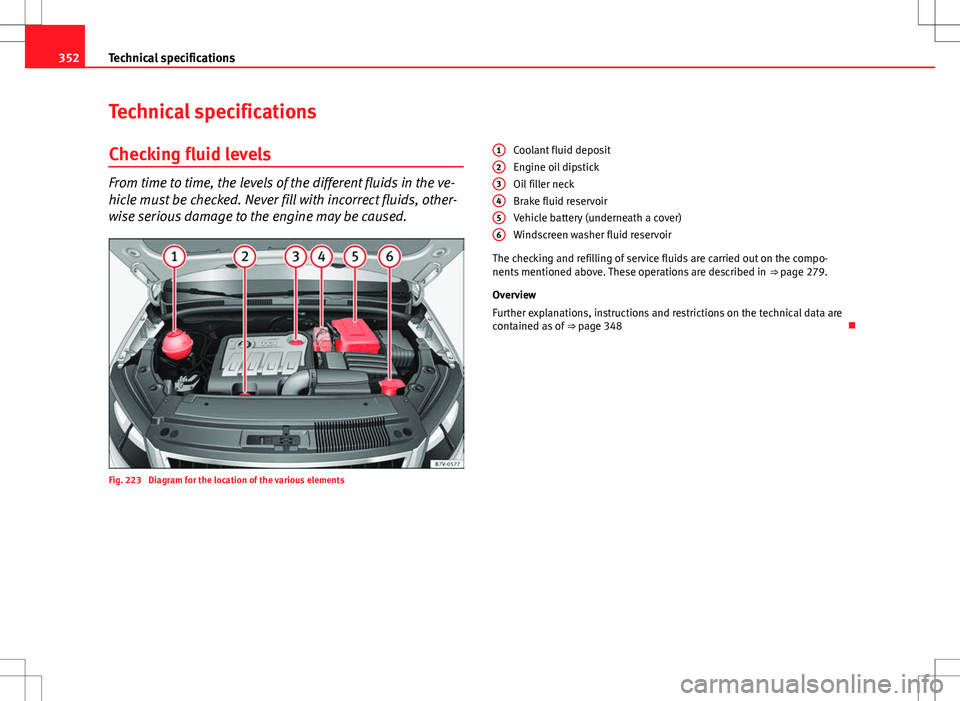
Checking fluid levels
From time to time, the levels of the different fluids in the ve-
hicle must be checked. Never fill with incorrect fluids, other-
wise serious damage to the engine may be caused.
Fig. 223 Diagram for the location of the various elements Coolant fluid deposit
Engine oil dipstick
Oil filler neck
Brake fluid reservoir
Vehicle battery (underneath a cover)
Windscreen washer fluid reservoir
The checking and refilling of service fluids are carried out on the compo-
nents mentioned above. These operations are described in ⇒ page 279.
Overview
Further explanations, instructions and restrictions on the technical data are
contained as of ⇒ page 348
1
23456
Page 372 of 388

Antitheft alarm systemAnti-tow system . . . . . . . . . . . . . . . . . . . . . . 79
Interior monitoring . . . . . . . . . . . . . . . . . . . . 79
Armrests . . . . . . . . . . . . . . . . . . . . . . . . . . . . . . 126
Ashtray . . . . . . . . . . . . . . . . . . . . . . . . . . . 151, 152
ASR See "Brake assist systems" . . . . . . . . . . . . 193
See "Braking assist" . . . . . . . . . . . . . . . . . 192
Turning on and off . . . . . . . . . . . . . . . . . . . 193
Assistance systems . . . . . . . . . . . . . . . . . . . . . 214 Cruise control . . . . . . . . . . . . . . . . . . . . . . . 214
Electronic differential lock system (EDL andXDS) . . . . . . . . . . . . . . . . . . . . . . . . . . . . . 192
Electronic Stability Control (ESC) . . . . . . . 191
Assist systems Anti-lock brake system (ABS) . . . . . . . . . . 191
Auto Hold . . . . . . . . . . . . . . . . . . . . . . . . . . 196
Braking assist . . . . . . . . . . . . . . . . . . . . . . . 192
Lane Assist . . . . . . . . . . . . . . . . . . . . . . . . . 217
Lane Assist system . . . . . . . . . . . . . . . . . . . 217
Optical parking system . . . . . . . . . . . . . . . 202
Park assist . . . . . . . . . . . . . . . . . . . . . . . . . 201
Park Assist . . . . . . . . . . . . . . . . . . . . . . . . . 204
Park Assist system . . . . . . . . . . . . . . . . . . . 204
Parking sensor system . . . . . . . . . . . . . . . . 201
Rear Assist . . . . . . . . . . . . . . . . . . . . . . . . . 209
Rear assist system . . . . . . . . . . . . . . . . . . . 209
Sign Assist . . . . . . . . . . . . . . . . . . . . . . . . . 220
Start-Stop . . . . . . . . . . . . . . . . . . . . . . . . . . 198
Start assist . . . . . . . . . . . . . . . . . . . . . . . . . 196
Traction control system (ASR) . . . . . . . . . . 193
Traction control when accelerating (ASR) . 192
Tyre monitoring indicator . . . . . . . . . . . . . . 227 Auto Hold . . . . . . . . . . . . . . . . . . . . . . . . . . . . . 196
Automatic belt retainer . . . . . . . . . . . . . . . . . . . 26
Automatic car wash . . . . . . . . . . . . . . . . . . . . . 247
Switching Auto Hold off . . . . . . . . . . . . . . . 197
Switching the start assist off . . . . . . . . . . . 197
Automatic consumer disconnection . . . . . . . . 295
Automatic dipped beam control . . . . . . . . . . . . 99
Automatic gearbox . . . . . . . . . . . . . . . . . . . . . . 176 Changing gear . . . . . . . . . . . . . . . . . . . . . . 180
Driving . . . . . . . . . . . . . . . . . . . . . . . . . . . . . 182
DSG automatic gearbox . . . . . . . . . . . . . . . 182
Ignition key lock . . . . . . . . . . . . . . . . . . . . . 174
Kickdown system . . . . . . . . . . . . . . . . . . . . 182
Launch-Control programme . . . . . . . . . . . . 182
Malfunction . . . . . . . . . . . . . . . . . . . . . . . . 183
Manually unlocking the gear selection lev-er . . . . . . . . . . . . . . . . . . . . . . . . . . . . . . . 323
Please also see "Changing gears" . . . . . . 176
See "Automatic gearbox" . . . . . . . . . . . . . . 176
Towing . . . . . . . . . . . . . . . . . . . . . . . . . . . . . 345
AUX-IN connection . . . . . . . . . . . . . . . . . . . . . . 142
Auxiliary heater . . . . . . . . . . . . . . . . . . . . 165, 273 Automatic off . . . . . . . . . . . . . . . . . . . . . . . 269
Operating instructions . . . . . . . . . . . . . . . . 168
Programming . . . . . . . . . . . . . . . . . . . . . . . 167
Remote control . . . . . . . . . . . . . . . . . . . . . . 166
Remote control range . . . . . . . . . . . . . . . . . 167
Remote control: Replacing the battery . . . 166
Switching off . . . . . . . . . . . . . . . . . . . . . . . . 165
Switching on . . . . . . . . . . . . . . . . . . . . . . . . 165
Things to note . . . . . . . . . . . . . . . . . . . 165, 168
Auxiliary heater remote control Replacing the battery . . . . . . . . . . . . . . . . . 166 Axle loads . . . . . . . . . . . . . . . . . . . . . . . . . . . . . . 15
B
BAS See "Brake assist systems" . . . . . . . . . . . . 192
Battery Discharge . . . . . . . . . . . . . . . . . . . . . . . . . . 168
Discharging . . . . . . . . . . . . . . . . . . . . . . . . 317
See Vehicle battery . . . . . . . . . . . . . . . . . . 292
Battery acid . . . . . . . . . . . . . . . . . . . . . . . . . . . . 294
Before starting out . . . . . . . . . . . . . . . . . . . . . . . . 7
Belt height adjustment . . . . . . . . . . . . . . . . . . . 26
Belt tension device . . . . . . . . . . . . . . . . . . . . . . . 26 Disposal . . . . . . . . . . . . . . . . . . . . . . . . . . . . 27
Service and disposal . . . . . . . . . . . . . . . . . . 27
Belt tension limiter . . . . . . . . . . . . . . . . . . . . . . . 26
Bicycle carrier Installing a bicycle carrier . . . . . . . . . . . . . 239
Maximum load . . . . . . . . . . . . . . . . . . . . . . 239
Biodiesel . . . . . . . . . . . . . . . . . . . . . . . . . . . . . . 274
Bonnet Closing . . . . . . . . . . . . . . . . . . . . . . . . . . . . 282
Opening . . . . . . . . . . . . . . . . . . . . . . . . . . . 282
Bottle capacity Windscreen washer water bottle . . . . . . . . 109
Bottle holders . . . . . . . . . . . . . . . . . . . . . . . . . . 150
Brake . . . . . . . . . . . . . . . . . . . . . . . . . . . . . . . . . 185 Brake servo . . . . . . . . . . . . . . . . . . . . . . . . . 189
Electronic parking brake . . . . . . . . . . . . . . 187
Emergency braking function . . . . . . . . . . . 188
Parking brake . . . . . . . . . . . . . . . . . . . . . . . 187
370 Index
Page 378 of 388

Preparation before replacing . . . . . . . . . . . 328
Replacement . . . . . . . . . . . . . . . . . . . . . . . . 328
G G 12 plus . . . . . . . . . . . . . . . . . . . . . . . . . . . . . 289
G 12 plus-plus . . . . . . . . . . . . . . . . . . . . . . . . . 289
General overview of the engine compartment 352
Glove compartment . . . . . . . . . . . . . . . . . . . . . 146
Glove compartment lighting . . . . . . . . . . . . . . 102
H Handbrake See "Parking brake" . . . . . . . . . . . . . . . . . . 187
Hazard warning lights . . . . . . . . . . . . . . . . . . . 316
Hazard warning triangle . . . . . . . . . . . . . . . . . 318
Headlamp range adjustment . . . . . . . . . . . . . . . 53
Headlight adjustment . . . . . . . . . . . . . . . . . . . . 99
Headlight range control . . . . . . . . . . . . . . . . . . 101
Headlights Adaptive headlights . . . . . . . . . . . . . . . . . . . 99
Dipped beam headlights . . . . . . . . . . . . . . . 97
Driving abroad . . . . . . . . . . . . . . . . . . . . . . 100
Headlight control . . . . . . . . . . . . . . . . . . . . . 97
Headlight washers . . . . . . . . . . . . . . . . . . . 107
Side light . . . . . . . . . . . . . . . . . . . . . . . . . . . 97
Turning lights . . . . . . . . . . . . . . . . . . . . . . . . 99
Head restraint . . . . . . . . . . . . . . . . . . . . . . . . . . 124
Head restraints . . . . . . . . . . . . . . . . . . . . . . . . . 123
Heated rear window . . . . . . . . . . . . . . . . . . . . . 160
Heated seats . . . . . . . . . . . . . . . . . . . . . . . . . . . 117 Heated windscreen . . . . . . . . . . . . . . . . . . . . . 160
High pressure cleaning equipment . . . . . . . . . 248
Hitch ball
Electric release . . . . . . . . . . . . . . . . . . . . . . 238
Horn . . . . . . . . . . . . . . . . . . . . . . . . . . . . . . . . . . 53
I
Ignition See "Engine and ignition" . . . . . . . . . . . . . 172
Ignition lock . . . . . . . . . . . . . . . . . . . . . . . . . . . 173 Key removal lock . . . . . . . . . . . . . . . . . . . . 174
Unauthorised vehicle key . . . . . . . . . . . . . 173
Immobiliser . . . . . . . . . . . . . . . . . . . . . . . . . . . . 176 Operating fault . . . . . . . . . . . . . . . . . . . . . . 172
In case of a breakdown Securing the vehicle . . . . . . . . . . . . . . . . . 316
In case of an emergency Checklist . . . . . . . . . . . . . . . . . . . . . . . . . . . 316
Hazard warning lights . . . . . . . . . . . . . . . . 316
In case of a breakdown . . . . . . . . . . . . . . . 316
Protecting yourself and securing the vehi-cle . . . . . . . . . . . . . . . . . . . . . . . . . . . . . . . 316
In case of emergency . . . . . . . . . . . . . . . . . . . . 316
Indication on display Sign Assist . . . . . . . . . . . . . . . . . . . . . . . . . 221
Indicator Changing bulbs . . . . . . . . . . . . . . . . . . . . . 330
Checking the engine oil level . . . . . . . . . . 283
Engine oil pressure . . . . . . . . . . . . . . . . . . 283
Vehicle key . . . . . . . . . . . . . . . . . . . . . . . . . . 73
Information on consumption . . . . . . . . . . . . . . 274 Initial operations
Changing bulbs . . . . . . . . . . . . . . . . . . . . . 331
Instrument panel . . . . . . . . . . . . . . . . . . . . . 57, 63 Airbag system . . . . . . . . . . . . . . . . . . . . . . . 257
Display . . . . . . . . . . . . . . . . . . . . . . . 57, 58, 63
Instruments . . . . . . . . . . . . . . . . . . . . . . . . . 57
Lamps . . . . . . . . . . . . . . . . . . . . . . . . . . . . . . 54
Menus . . . . . . . . . . . . . . . . . . . . . . . . . . . . . . 65
Service interval display . . . . . . . . . . . . . . . . 61
Integrated child seat . . . . . . . . . . . . . . . . . . . . . 45 Seat belt routing . . . . . . . . . . . . . . . . . . . . . . 48
Setting up . . . . . . . . . . . . . . . . . . . . . . . . . . . 47
Integrated seat belt Removing . . . . . . . . . . . . . . . . . . . . . . . . . . . 49
Interior monitoring . . . . . . . . . . . . . . . . . . . . . . . 79
ISOFIX . . . . . . . . . . . . . . . . . . . . . . . . . . . . . . . . . 44
J Jack . . . . . . . . . . . . . . . . . . . . . . . . . . . . . . . . . . 309 Raising the vehicle . . . . . . . . . . . . . . . . . . . 313
K
Keys . . . . . . . . . . . . . . . . . . . . . . . . . . . . . . . . . . . 71 Assigning a key . . . . . . . . . . . . . . . . . . . . . . 71
Changing the battery (vehicle key) . . . . . . . 73
Indicator . . . . . . . . . . . . . . . . . . . . . . . . . . . . 73
Remote control . . . . . . . . . . . . . . . . . . . . . . . 71
Spare key . . . . . . . . . . . . . . . . . . . . . . . . . . . 71
Vehicle key . . . . . . . . . . . . . . . . . . . . . . . . . . 71
Key switch Deactivating the front passenger airbag . . 35
376 Index