2012 RENAULT SANDERO warning light
[x] Cancel search: warning lightPage 79 of 183
JauneNoirNoir texte
2.15
ENG_UD22554_10
Boîte automatique (B90 - L90 Ph2 - F90 Ph2 - R90 Ph2 - Dacia)
ENG_NU_817-9_B90_Dacia_2
AUTOMATIC TRANSMISSION (2/3)
1
4
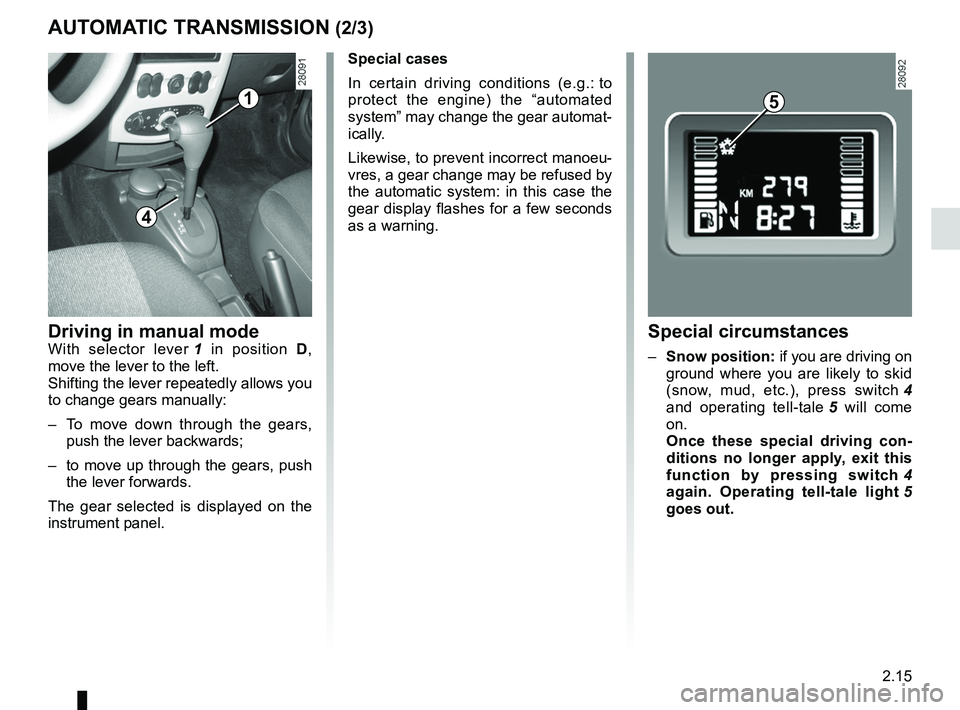
Driving in manual modeWith selector lever 1 in position D,
move the lever to the left.
Shifting the lever repeatedly allows you
to change gears manually:
– To move down through the gears,
push the lever backwards;
– to move up through the gears, push
the lever forwards.
The gear selected is displayed on the
instrument panel.
5
Special circumstances
– Snow position: if you are driving on
ground where you are likely to skid
(snow, mud, etc.), press switch 4
and operating tell-tale 5 will come
on.
Once these special driving con -
ditions no longer apply, exit this
function by pressing switch 4
again. Operating tell-tale light 5
goes out.
Special cases
In certain driving conditions (e.g.:
to
protect the engine) the “automated
system” may change the gear automat-
ically.
Likewise, to prevent incorrect manoeu -
vres, a gear change may be refused by
the automatic system: in this case the
gear display flashes for a few seconds
as a warning.
Page 84 of 183
air conditioning ..................................... (up to the end of the DU)
heating and air conditioning system ..... (up to the end of the DU)
heating system ..................................... (up to the end of the DU)
air conditioning ..................................... (up to the end of the DU)
ventilation ............................................. (up to the end of the DU)
temperature regulation ......................... (up to the end of the DU)
3.4
ENG_UD25116_1
Chauffage - Ventilation - Air conditionné (B90 - L90 Ph2 - Dacia)
ENG_NU_817-9_B90_Dacia_3
Jaune NoirNoir texte
Heating, Ventilation, Air conditioning
HEATING, VENTILATION, AIR CONDITIONING (1/2)
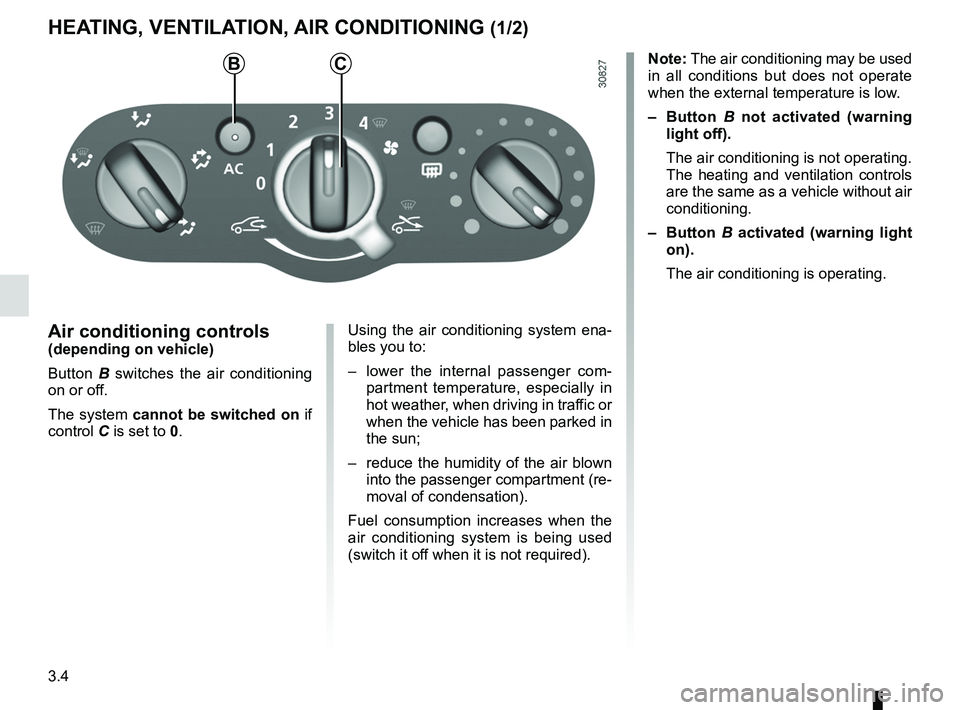
Air conditioning controls(depending on vehicle)
Button B switches the air conditioning
on or off.
The system cannot be switched on if
control C is set to 0. Using the air conditioning system ena-
bles you to:
–
lower the internal passenger com -
partment temperature, especially in
hot weather, when driving in traffic or
when the vehicle has been parked in
the sun;
– reduce the humidity of the air blown
into the passenger compartment (re-
moval of condensation).
Fuel consumption increases when the
air conditioning system is being used
(switch it off when it is not required). Note: The air conditioning may be used
in all conditions but does not operate
when the external temperature is low.
–
Button B not activated (warning
light off).
The air conditioning is not operating.
The heating and ventilation controls
are the same as a vehicle without air
conditioning.
– Button B activated (warning light
on).
The air conditioning is operating.
CB
Page 85 of 183
JauneNoirNoir texte
3.5
ENG_UD25116_1
Chauffage - Ventilation - Air conditionné (B90 - L90 Ph2 - Dacia)
ENG_NU_817-9_B90_Dacia_3
HEATING, VENTILATION, AIR CONDITIONING (2/2)
In very hot weather or when the vehicle
has been parked in the sun, open the
doors for a few moments to let the hot
air escape before starting the engine.
Use the passenger compartment isola -
tion function to lower the temperature
as quickly as possible to the required
comfort level. Switch off the air recircu-
lation function once a comfortable level
has been reached. When the air conditioning system is op-
erating, all windows must be closed for
maximum efficiency.
If there is an operating fault, contact an
approved dealer.
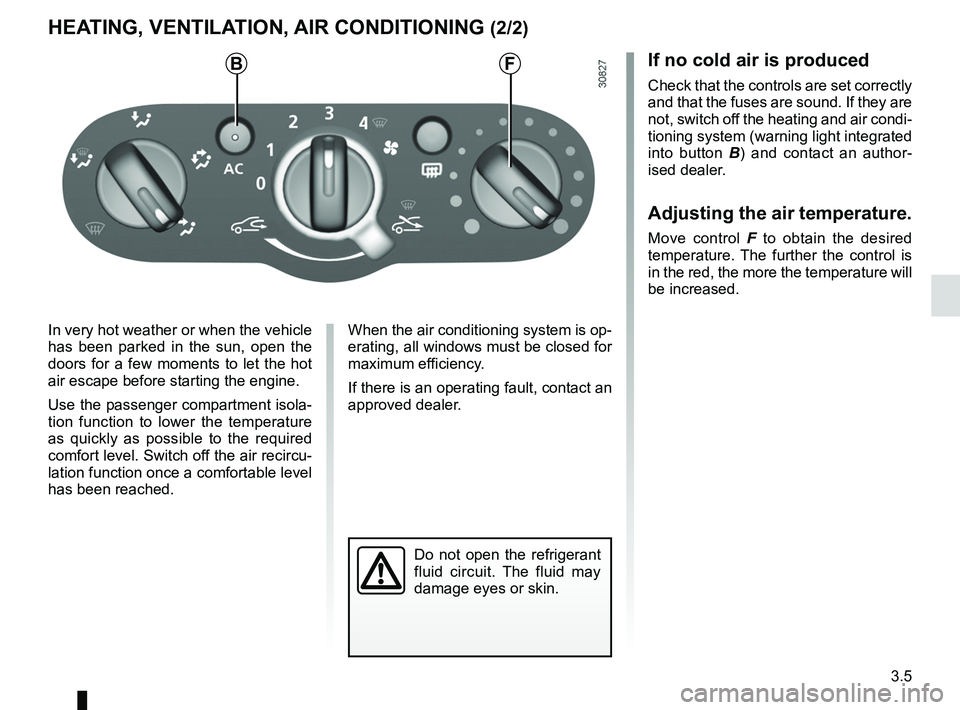
If no cold air is produced
Check that the controls are set correctly
and that the fuses are sound. If they are
not, switch off the heating and air condi
-
tioning system (warning light integrated
into button B ) and contact an author -
ised dealer.
Adjusting the air temperature.
Move control F to obtain the desired
temperature. The further the control is
in the red, the more the temperature will
be increased.
Do not open the refrigerant
fluid circuit. The fluid may
damage eyes or skin.
BF
Page 87 of 183
demistingrear screen ....................................................... (current page)
rear screen demisting ......................................................... (current page)
JauneNoirNoir texte
3.7
ENG_UD25103_1
air conditionné manuel (B90 - L90 Ph2 - Dacia)
ENG_NU_817-9_B90_Dacia_3
MANuAL AIR CONDITIONING (2/3)
GThe air flow is directed towards
the dashboard vents and the
footwells.
JAll the air flow is directed to the
dashboard vents.
This selection is not appropriate if all
the air vents are closed.
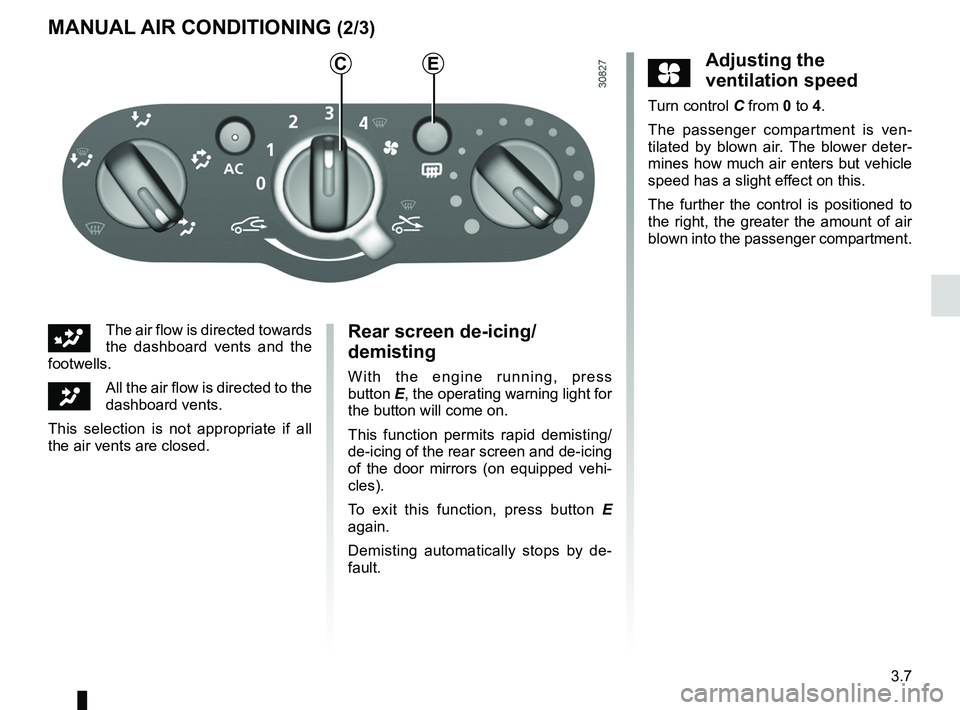
Rear screen de-icing/
demisting
W i t h t h e e n g i n e r u n n i n g , p r e s s
button E, the operating warning light for
the button will come on.
This function permits rapid demisting/
de-icing of the rear screen and de-icing
of the door mirrors (on equipped vehi -
cles).
To exit this function, press button E
again.
Demisting automatically stops by de -
fault.
yAdjusting the
ventilation speed
Turn control C from 0 to 4.
The passenger compartment is ven -
tilated by blown air. The blower deter -
mines how much air enters but vehicle
speed has a slight effect on this.
The further the control is positioned to
the right, the greater the amount of air
blown into the passenger compartment.
EC
Page 108 of 183
filteroil filter ............................................................. (current page)
oil change .............................................................. (current page)
4.6
ENG_UD19757_10
Niveau huile moteur : appoint / remplissage (B90 - L90 Ph2 - Dacia)
ENG_NU_817-9_B90_Dacia_4
Engine oil change
ENGINE OIL LEVEL: topping up/filling (2/2)
Oil change
S e r v i c e i n t e r v a l : r e f e r t o t h e
Maintenance Service Booklet for your
vehicle.
Average capacities for oil change oil
filter included.
(for information)
1.2 16V engines: 4.00 litres
1.4 engines : 3.30 litres
1.6 engines : 3.30 litres
1.6 16V engines: 4.80 litres
1.5 dCi engines : 4.10 litres
Engine oil grade
Refer to the Maintenance Service
Booklet for your vehicle.
Filling: take care when
topping up the oil that
no oil drips onto engine
components - risk of fire.
Remember to refit the cap securely
as there is a risk of fire if oil splashes
onto hot engine components.
Engine oil change: if you
are changing the oil when
the engine is hot, be careful
not to scald yourself if the
oil overflows.
The engine may be hot
during operations in close
proximity. In addition, the
engine cooling fan may
come on at any moment.
Risk of injury.
Consult an approved dealer at once
if you notice an abnormal or re -
peated drop in any of the fluid levels.
Resetting the alert after an oil
change
(depending on the vehicle)
If you change the oil yourself, you will
need to reset the oil change warning.
To do this, after switching on the igni -
tion, for ten seconds you must:
– Depress the accelerator pedal fully,
– with your foot on the accelerator, de-
press the brake pedal three times in
succession.
Reinitialisation is complete when the
# indicator light goes out. If this is
not the case, repeat the operation.
Special case : if you change the oil
before the oil change interval exceeded
warning is displayed, it will also be nec-
essary to reset the display. In this case,
the
# warning light comes on for
approximately 5 seconds to confirm the
reset.
Never run the engine in an
enclosed space as exhaust
gases are poisonous.
Page 125 of 183

ENG_NU_817-9_B90_Dacia_5
TYRE INFLATION KIT (2/3)
Depending on the vehicle, in")
JauneNoirNoir texte
5.5
ENG_UD22290_8
Kit de gonflage des pneumatiques (B90 - L90 Ph2 - F90 Ph2 - R90 Ph2 - D\
acia)
ENG_NU_817-9_B90_Dacia_5
TYRE INFLATION KIT (2/3)
Depending on the vehicle, in the event
of a puncture, use the kit located in the
boot. –
press switch 5 to inflate the tyre to
the recommended pressure (check
the label affixed to the edge of the
driver’s door);
– after a maximum of 5 minutes, stop
inflating and read the pressure (on
the pressure gauge 4);
Note: while the bottle is emptying
(approximately 30 seconds), pres -
sure gauge 4 will briefly indicate a
pressure of 6 bar, then the pressure
will drop.
– adjust the pressure: to increase
it, continue inflating with the kit, to
reduce it, turn button 7 located on
the inflation adapter.
If a minimum pressure of 1.8 bar is
not reached after 15 minutes, repair
is not possible; do not drive the vehi-
cle but contact an approved dealer .
1234
5
6
Before using this kit, park
the vehicle at a sufficient
distance from traffic, switch
on the hazard warning
lights, apply the handbrake, ask all
passengers to leave the vehicle and
keep them away from traffic.
8
Open the kit, remove caps 1 and 3 (it is
essential not to remove the cap from
the bottle) then screw bottle 2 to its sup-
port 3.
With the engine running and the
handbrake applied,
– unscrew the valve cap on the wheel
concerned and screw the inflation
adapter 6 onto valve;
– connect adapter 8 to accessories
socket 9 on the dashboard of the ve-
hicle;
9
7
Page 129 of 183
changing a wheel.................................. (up to the end of the DU)
practical advice ..................................... (up to the end of the DU)
jack ....................................................... (up to the end of the DU)
puncture ................................................ (up to the end of the DU)
lifting the vehicle changing a wheel ............................ (up to the end of the DU)
5.9
ENG_UD20462_6
Changement de roue (B90 - Dacia)
ENG_NU_817-9_B90_Dacia_5
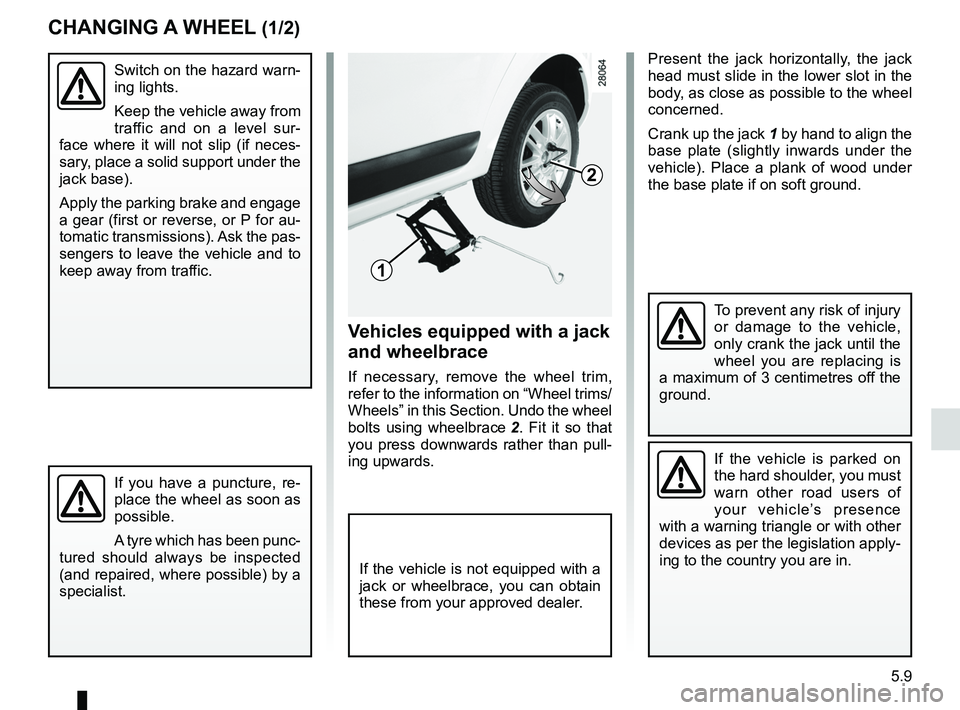
Present the jack horizontally, the jack
head must slide in the lower slot in the
body, as close as possible to the wheel
concerned.
Crank up the jack 1 by hand to align the
base plate (slightly inwards under the
vehicle). Place a plank of wood under
the base plate if on soft ground.
Changing a wheel
Switch on the hazard warn-
ing lights.
Keep the vehicle away from
traffic and on a level sur -
face where it will not slip (if neces -
sary, place a solid support under the
jack base).
Apply the parking brake and engage
a gear (first or reverse, or P for au-
tomatic transmissions). Ask the pas-
sengers to leave the vehicle and to
keep away from traffic.
If you have a puncture, re -
place the wheel as soon as
possible.
A tyre which has been punc-
tured should always be inspected
(and repaired, where possible) by a
specialist.
2
1
Vehicles equipped with a jack
and wheelbrace
If necessary, remove the wheel trim,
refer to the information on “Wheel trims/
Wheels” in this Section. Undo the wheel
bolts using wheelbrace 2 . Fit it so that
you press downwards rather than pull -
ing upwards.
To prevent any risk of injury
or damage to the vehicle,
only crank the jack until the
wheel you are replacing is
a maximum of 3 centimetres off the
ground.
If the vehicle is parked on
the hard shoulder, you must
warn other road users of
your vehicle’s presence
with a warning triangle or with other
devices as per the legislation apply-
ing to the country you are in.
CHANGING A WHEEL (1/2)
If the vehicle is not equipped with a
jack or wheelbrace, you can obtain
these from your approved dealer.
Page 149 of 183
towing hitch........................................... (up to the end of the DU)
practical advice ..................................... (up to the end of the DU)
towing breakdown ...................................... (up to the end of the DU)
5.29
ENG_UD17944_4
Remorquage : dépannage (B90 - Dacia)
ENG_NU_817-9_B90_Dacia_5
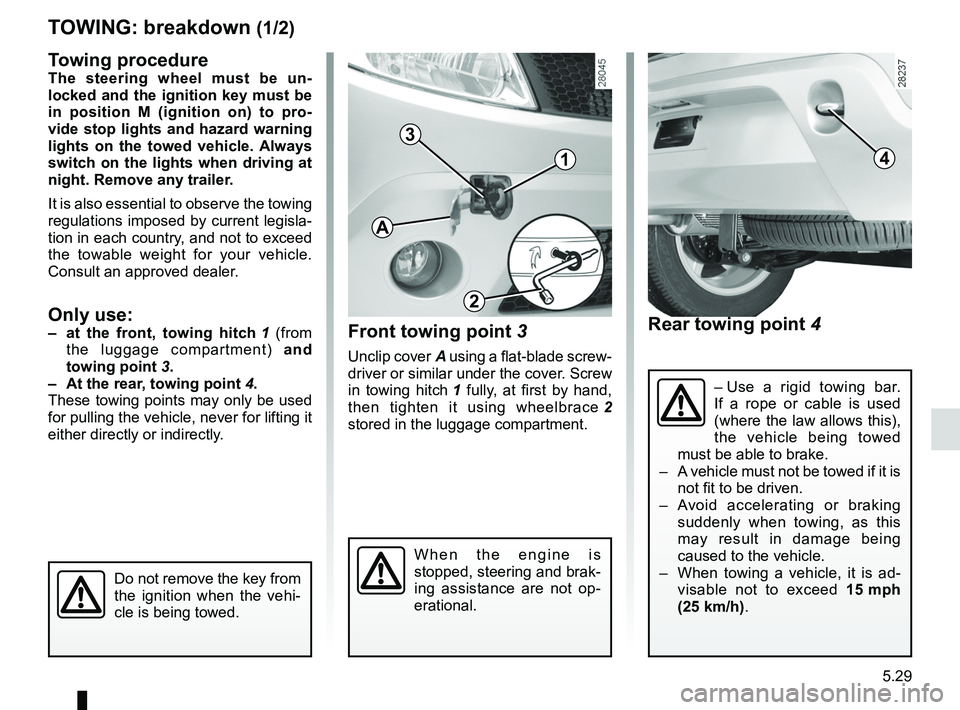
Rear towing point 4
Front towing point 3
Unclip cover A using a flat-blade screw-
driver or similar under the cover. Screw
in towing hitch 1 fully, at first by hand,
then tighten it using wheelbrace 2
stored in the luggage compartment.
Towing: breakdown
W h e n t h e e n g i n e i s
stopped, steering and brak-
ing assistance are not op -
erational.
41
3
Towing procedureThe steering wheel must be un -
locked and the ignition key must be
in position M (ignition on) to pro -
vide stop lights and hazard warning
lights on the towed vehicle. Always
switch on the lights when driving at
night. Remove any trailer.
It is also essential to observe the towing
regulations imposed by current legisla -
tion in each country, and not to exceed
the towable weight for your vehicle.
Consult an approved dealer.
Only use:– at the front, towing hitch 1 (from
the luggage compartment) and
towing point 3.
– At the rear, towing point 4.
These towing points may only be used
for pulling the vehicle, never for lifting it
either directly or indirectly.
Do not remove the key from
the ignition when the vehi -
cle is being towed.
– Use a rigid towing bar.
If a rope or cable is used
(where the law allows this),
the vehicle being towed
must be able to brake.
– A vehicle must not be towed if it is
not fit to be driven.
– Avoid accelerating or braking
suddenly when towing, as this
may result in damage being
caused to the vehicle.
– When towing a vehicle, it is ad -
visable not to exceed 15 mph
(25 km/h).
T OWING : breakdown (1/2)
A
2