2012 RENAULT SANDERO steering
[x] Cancel search: steeringPage 132 of 183
tyre pressure.......................................................... (current page)
5.12
ENG_UD19769_10
Pneumatiques (B90 - U90 - L90 Ph2 - F90 Ph2 - R90 Ph2 - Dacia)ENG_NU_817-9_B90_Dacia_5
Jaune NoirNoir texte
Changing wheels around
This practice is not recommended.
Emergency spare wheel
Refer to the information on the
“ E m e r g e n c y s p a r e w h e e l ” a n d
“Changing a wheel” in Section 5.
Fitting new tyres
TYRES (2/3)
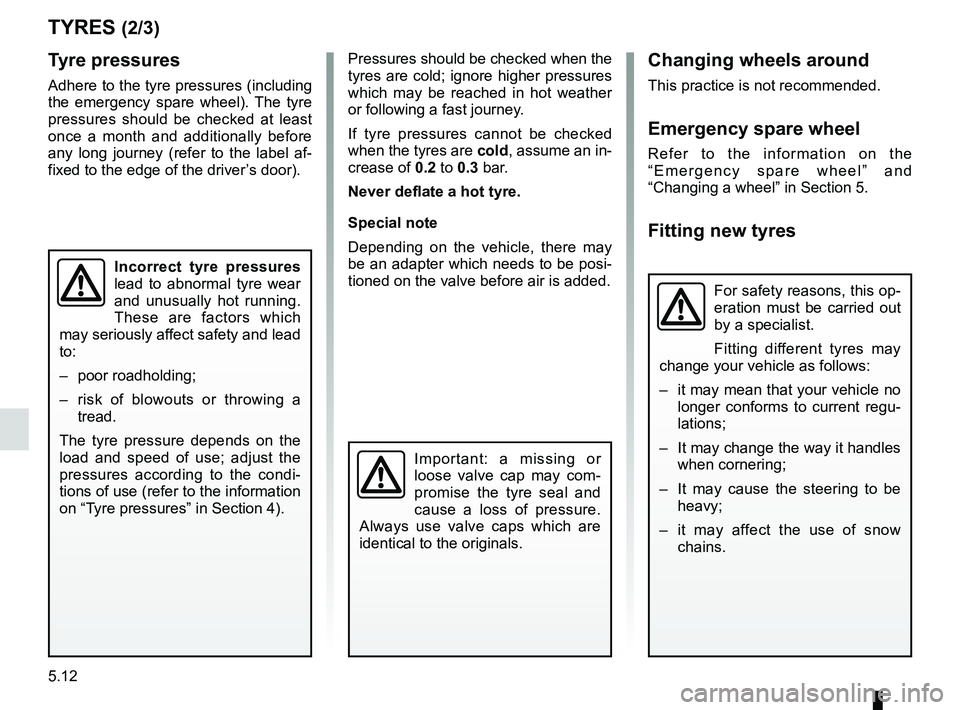
Tyre pressures
Adhere to the tyre pressures (including
the emergency spare wheel). The tyre
pressures should be checked at least
once a month and additionally before
any long journey (refer to the label af -
fixed to the edge of the driver’s door).
Incorrect tyre pressures
lead to abnormal tyre wear
and unusually hot running.
These are factors which
may seriously affect safety and lead
to:
– poor roadholding;
– risk of blowouts or throwing a
tread.
The tyre pressure depends on the
load and speed of use; adjust the
pressures according to the condi -
tions of use (refer to the information
on “Tyre pressures” in Section 4).
Pressures should be checked when the
tyres are cold; ignore higher pressures
which may be reached in hot weather
or following a fast journey.
If tyre pressures cannot be checked
when the tyres are cold, assume an in-
crease of 0.2 to 0.3 bar.
Never deflate a hot tyre.
Special note
Depending on the vehicle, there may
be an adapter which needs to be posi-
tioned on the valve before air is added.
For safety reasons, this op-
eration must be carried out
by a specialist.
Fitting different tyres may
change your vehicle as follows:
– it may mean that your vehicle no
longer conforms to current regu-
lations;
– It may change the way it handles
when cornering;
– It may cause the steering to be
heavy;
– it may affect the use of snow
chains.
Important: a missing or
loose valve cap may com -
promise the tyre seal and
cause a loss of pressure.
Always use valve caps which are
identical to the originals.
Page 144 of 183

ENG_NU_817-9_B90_Dacia_5
FUSES (3/3)
Allocation of fuses
(the presence of certain fuses DEPENDS ON THE VEHICLE EQUIPMENT LEVEL)\
Symbol Allocation
QLeft-hand")
5.24
ENG_UD22587_8
Fusibles (B90 - Dacia)
ENG_NU_817-9_B90_Dacia_5
FUSES (3/3)
Allocation of fuses
(the presence of certain fuses DEPENDS ON THE VEHICLE EQUIPMENT LEVEL)\
Symbol Allocation
QLeft-hand main beam
headlight
LLeft-hand dipped beam
headlight
TRight-hand dipped
beam headlight
VRight-hand side light
YLeft-hand side light
FRear fog light
ḼElectric rear windows
SymbolAllocation
qEngine immobiliser
ËReversing light
uPower-assisted steering
iAutomatic gearbox
GAS fuel
Page 149 of 183
towing hitch........................................... (up to the end of the DU)
practical advice ..................................... (up to the end of the DU)
towing breakdown ...................................... (up to the end of the DU)
5.29
ENG_UD17944_4
Remorquage : dépannage (B90 - Dacia)
ENG_NU_817-9_B90_Dacia_5
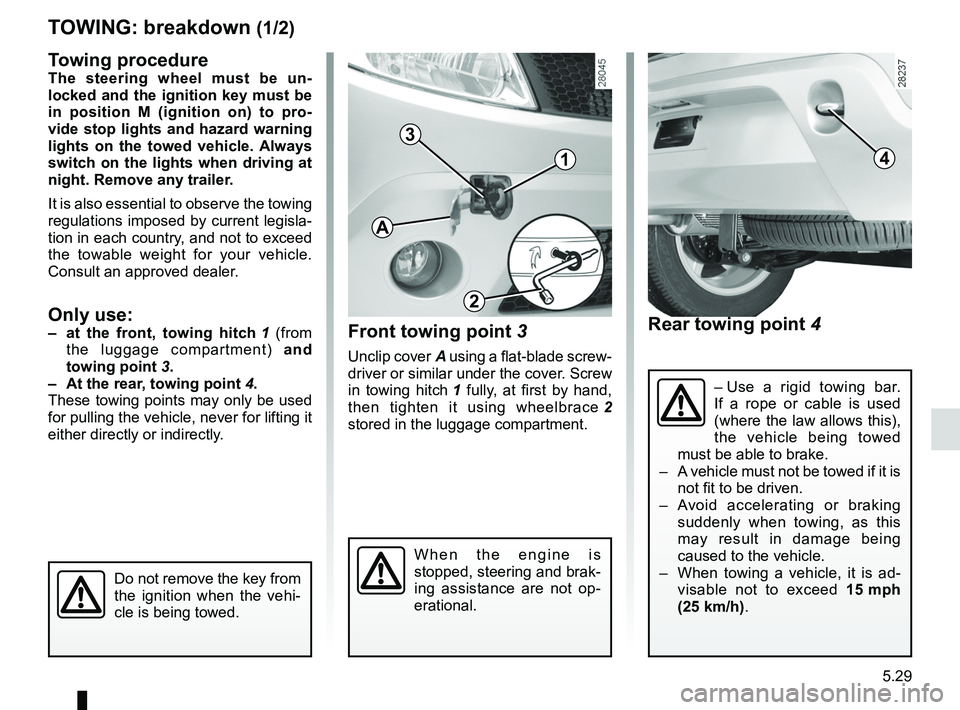
Rear towing point 4
Front towing point 3
Unclip cover A using a flat-blade screw-
driver or similar under the cover. Screw
in towing hitch 1 fully, at first by hand,
then tighten it using wheelbrace 2
stored in the luggage compartment.
Towing: breakdown
W h e n t h e e n g i n e i s
stopped, steering and brak-
ing assistance are not op -
erational.
41
3
Towing procedureThe steering wheel must be un -
locked and the ignition key must be
in position M (ignition on) to pro -
vide stop lights and hazard warning
lights on the towed vehicle. Always
switch on the lights when driving at
night. Remove any trailer.
It is also essential to observe the towing
regulations imposed by current legisla -
tion in each country, and not to exceed
the towable weight for your vehicle.
Consult an approved dealer.
Only use:– at the front, towing hitch 1 (from
the luggage compartment) and
towing point 3.
– At the rear, towing point 4.
These towing points may only be used
for pulling the vehicle, never for lifting it
either directly or indirectly.
Do not remove the key from
the ignition when the vehi -
cle is being towed.
– Use a rigid towing bar.
If a rope or cable is used
(where the law allows this),
the vehicle being towed
must be able to brake.
– A vehicle must not be towed if it is
not fit to be driven.
– Avoid accelerating or braking
suddenly when towing, as this
may result in damage being
caused to the vehicle.
– When towing a vehicle, it is ad -
visable not to exceed 15 mph
(25 km/h).
T OWING : breakdown (1/2)
A
2
Page 154 of 183
operating faults ..................................... (up to the end of the DU)
practical advice ..................................... (up to the end of the DU)
faults operating faults ............................... (up to the end of the DU)
5.34
ENG_UD19739_7
Anomalies de fonctionnement (B90 - U90 - L90 Ph2 - F90 Ph2 - R90 Ph2 - \
Dacia)
ENG_NU_817-9_B90_Dacia_5
Jaune NoirNoir texte
Operating faults
OPERATING FAULTS (1/5)
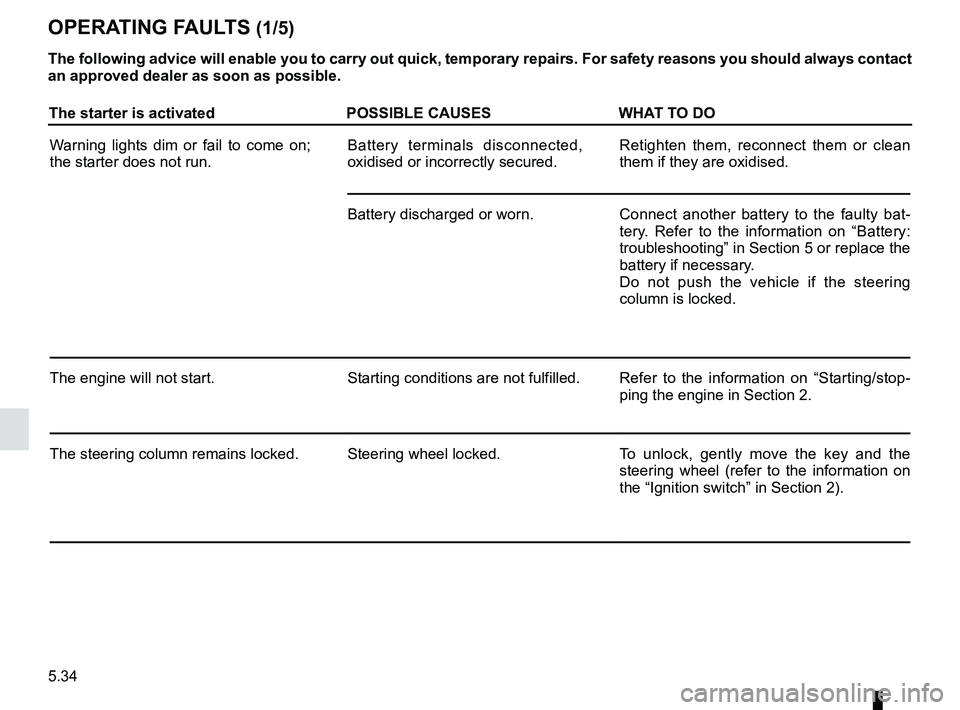
The following advice will enable you to carry out quick, temporary repairs. For safety reasons you should always contact
an approved dealer as soon as possible.
The starter is activated POSSIBLE CAUSESWHAT TO DO
Warning lights dim or fail to come on;
the starter does not run. Battery terminals disconnected,
oxidised or incorrectly secured.Retighten them, reconnect them or clean
them if they are oxidised.
Battery discharged or worn. Connect another battery to the faulty bat -
tery. Refer to the information on “Battery:
troubleshooting” in Section 5 or replace the
battery if necessary.
Do not push the vehicle if the steering
column is locked.
The engine will not start. Starting conditions are not fulfilled.Refer to the information on “Starting/stop -
ping the engine in Section 2.
The steering column remains locked. Steering wheel locked.To unlock, gently move the key and the
steering wheel (refer to the information on
the “Ignition switch” in Section 2).
Page 156 of 183

ENG_NU_817-9_B90_Dacia_5
Jaune NoirNoir texte
OPERATING FAULTS (3/5)
On the road POSSIBLE CAUSES WHAT")
5.36
ENG_UD19739_7
Anomalies de fonctionnement (B90 - U90 - L90 Ph2 - F90 Ph2 - R90 Ph2 - \
Dacia)
ENG_NU_817-9_B90_Dacia_5
Jaune NoirNoir texte
OPERATING FAULTS (3/5)
On the road POSSIBLE CAUSES WHAT TO DO
Abnormal white smoke from the ex-
haust Mechanical fault: damaged cylinder
head gasket.
or Stop the engine.
Contact an approved dealer.
This is not necessarily a fault.
Smoke may be caused by
regeneration of the particle filter. Refer to the information on “Special
features of diesel versions” in Section 2.
The power-assisted steering be -
comes heavy. Belt broken.
Have the belt replaced.
No power-assisted steering oil For maintenance operations on the power-
assisted steering, contact an approved
dealer.
Radiator: If there is a significant lack of coolant, remember that it must never be topped up using cold coolant while
the engine is very warm. After any procedure on the vehicle which has involved even partial draining of the cooling
system, it must be refilled with a new mixture prepared in the correct proportions. Reminder: only products approved
by the Technical Department may be used for this purpose.
Page 179 of 183
JauneNoirNoir texte
7.3
FRA_UD25177_11
Index (B90 - Dacia)
ENG_NU_817-9_B90_Dacia_7
AlphAbeticAl index (3/4)
lights ...................................................................... 1.49 → 1.51
additional ..................................................................... 5.15
adjustment ................................................................... 1.51
lights: adjusting ...................................................................... 1.51
brake lights ....................................................... 5.16 – 5.17
dipped beam headlights ...................................... 1.49, 5.14
direction indicators .............................................. 1.52, 5.14
fog lights ............................................................. 1.50, 5.15
hazard warning ............................................................ 1.52
main beam headlights ......................................... 1.49, 5.14
reversing lights .................................................. 5.16 – 5.17
side lights ............................................................ 1.49, 5.14
locking the doors .......................................................... 1.4, 1.6
M
maintenance: bodywork ......................................................... 4.13 → 4.15
interior trim ........................................................ 4.16 – 4.17
mechanical ....................... 4.4, 4.7 → 4.9, 4.12, 6.8 → 6.13
mileage before service ....................................... 6.8 → 6.13
methods of restraint in addition to the front seat belts ..............
1.15 → 1.18, 1.20
mirrors ........................................................................\
....... 3.13
O
oil change ........................................................................\
.... 4.6
opening the doors ................................................................ 1.6
operating faults ...................................................... 5.34 → 5.38
overspeed buzzer .............................................................. 1.43
p
paintwork maintenance ................................................................ 4.13
reference ........................................................................ 6.2
power-assisted steering .............................................. 2.11, 4.9power-assisted steering pump
.............................................4.9
practical advice ............................... 1.58, 5.2 – 5.3, 5.7 → 5.38
puncture ............................................................. 5.3, 5.9 – 5.10
R
radio fitting a radio ................................................................ 5.32
radio frequency remote control/key use ................................................................................. 1.2
rear bench seat .................................................................. 3.18
rear parcel shelf ................................................................. 3.21
rear screen demisting ............................................ 1.37, 1.42, 1.54, 3.7
rear view mirrors ................................................................ 1.35
remote control door locking unit ................................1.2 → 1.4
replacement parts ................................................................ 6.7
reverse gear selecting ....................................................................... 2.10
roof bars ........................................................................\
.... 3.20
roof rack roof bars ....................................................................... 3.20
running in ........................................................................\
..... 2.2
S
seat belts ............................................................... 1.14 → 1.20
service sheets .......................................................... 6.8 → 6.13
signals and lights .................................................... 1.49 – 1.50
speakers location ........................................................................ 5.32
special features of diesel versions .......................................2.5
special features of petrol vehicles ....................................... 2.4
starting ........................................................................\
2.2 – 2.3
starting the engine ............................................................... 2.3
steering wheel adjustment ................................................................... 1.10
storage compartment .............................................. 3.15 – 3.16