2012 RENAULT MEGANE RS seats
[x] Cancel search: seatsPage 59 of 239

JauneNoirNoir texte
1.53
ENG_UD18927_5
Tableau de bord : témoins lumineux (X95 - B95 - D95 - Renault)
ENG_NU_837-6_BDK95_Renault_1
ßf ront seat belt reminder
warning light
This lights up on the central display
when starting the engine then, if the
driver’s or front passenger’s seat belt
(if this seat is occupied) is not fastened
and the vehicle has reached approxi -
mately 12 mph (20 km/h), it flashes and
a bleep sounds for around 120 sec -
onds.
Note: an object placed on the passen-
ger seat base may activate the warning
light in some cases.
Rear seat belt reminder (depending
on vehicle)
the
ß warning light on the cen -
tral display lights up accompanied by a
message on the instrument panel indi -
cating the number of seat belts buck -
led for approximately 30 seconds each
time:
– the vehicle is started;
– a door is opened;
– a rear seat belt is fastened or unfas-
tened.
Check that the rear passengers are
wearing seat belts and that the number
of seat belt shown as fastened corre -
sponds to the number of rear bench
seat places occupied.
WARNINg LIgHTs (4/4)
ðHeated seats operating indi -
cator
This indicates that one of the heated
seats is in operation.
MLow fuel level warning light
This comes on when the igni -
tion is switched on and goes out after a
few seconds. If it comes on when driv-
ing accompanied by a beep, fill up with
fuel as soon as possible. There is only
approximately 30 miles (50 km) worth
of fuel left after the warning light first
comes on.
Üparticle filter
Refer to the information on
“Special features of diesel versions” in
Section 2.
The presence and operation of the warning lights dEpENd ON THE EQUIpmENT ANd cOUNTRY.
Page 134 of 239

electric windows ................................... (up to the end of the DU)
child safety ............................................................. (current page)
children (safety) ..................................................... (current page)
sunroof .................................................. (up to the end of the DU)
3.12
ENG_UD18900_4
Lève-vitres électriques (X95 - B95 - D95 - Renault)
ENG_NU_837-6_BDK95_Renault_3
Jaune NoirNoir texte
These systems operate with the igni -
tion on or off, until one of the front doors
is opened (limited to about 3 minutes).
From the driver’s seat, use switch:
1 for the driver’s side;
2 for the front passenger side;
3 and 5 for the rear passenger win-
dows.
From the passenger seats, use
switch 6.
Note: if the window detects resistance
when closing (e.g.: fingers, branch of
a tree, etc.) it stops and then lowers
again by a few centimetres.
Electric windows/Electric sunroof
ElEcTRIc wINDowS/ElEcTRIc PANoRAMIc SuNRooF (1/3)
Electric windows
Press or pull the switch to raise or lower
a window to the desired height (the rear
windows do not open fully);
one-touch mode
This mode works in addition to the
operation of the electric windows de -
scribed previously. It either operates on
the front windows only, or on all the win-
dows.
Briefly press or pull the window switch
fully: the window is fully lowered or
raised. Pressing the switch again stops
the window moving.
1
2
34
5
6
Safety of rear occupants
The driver can disable op -
eration of the electric win -
dows and, depending on
the vehicle, the rear doors, by
pressing switch 4 . The indicator
light integrated in the switch lights
up to confirm that the locks have
been activated.
Driver’s responsibility
Never leave your vehicle with the
RENAULT card inside and never
leave a child (or a pet) unsuper -
vised, even for a short while. They
may pose a risk to themselves or to
others by starting the engine, acti -
vating equipment such as the elec-
tric windows or by locking the doors.
If any part of the body becomes
trapped, reverse the direction of the
window immediately by pressing the
relevant switch.
Risk of serious injury.
Avoid resting any objects against
a half-open window: there is a risk
that the electric window could be
damaged.
Page 144 of 239

rear bench seat..................................... (up to the end of the DU)
rear seats functions ......................................... (up to the end of the DU)
3.22
ENG_UD17358_5
Banquette arrière (X95 - B95 - D95 - Renault)
ENG_NU_837-6_BDK95_Renault_3
Jaune NoirNoir texte
P r e s s b u t t o n 1 a n d l o w e r t h e
seatback(s) A.
Rear bench seat
To fold down the seatback
Ensure that the front seats are far
enough forward.
Lower the rear headrests (refer to the
information on the “Rear headrests” in
Section 1).
Place the seat belts 2 in their guides 3.Sport tourer versions
Depending on the vehicle, seatback A
can be folded down on its own to allow
long or bulky objects to be transported.
REAR BENch SEAT (1/3)
1A23
For safety reasons, carry
out any adjustments when
the vehicle is not being
driven.
Before moving the seat -
back, put seat belt 2 in belt
guide 3 to avoid damaging
it.
Page 146 of 239

3.24
ENG_UD17358_5
Banquette arrière (X95 - B95 - D95 - Renault)
ENG_NU_837-6_BDK95_Renault_3
w hen refitting the seat -
back , make sure it is cor -
rectly locked in place.
If seat covers are fitted ,
make sure these do not prevent the
seatback latch from locking in.
Make sure that the seat belts are
positioned correctly.
Reposition the headrests.
The seat and the seatback may be
folded away to allow bulky objects to be
carried.
To fold away the seat base
Tilt seat base B against the front seats.
To fold down the seatback
After folding the seat base down,
remove the rear headrests (refer to the
section on “rear headrests”) then press
button 1 and lower the seatback(s) C.
In all situations, remove the rear
headrests (refer to the informa-
tion on the “Rear headrests” in
Section 1).
For safety reasons, carry
out any adjustments when
the vehicle is not being
driven.
1
cB
REAR BENch SEAT (3/3)
When moving the rear
bench seat, ensure that
nothing obstructs the an -
chorage points (part of the
body, a pet, gravel, cloth, toys, etc.).
Page 154 of 239

transporting objectsin the luggage compartment ........... (up to the end of the DU)
towing rings .......................................... (up to the end of the DU)
towing towing equipment ............................ (up to the end of the DU)
towing equipment fitting ............................................... (up to the end of the DU)
towing a caravan .................................. (up to the end of the DU)
3.32
ENG_UD10820_2
Transport d’objets dans le coffre (X95 - B95 - D95 - Renault)
ENG_NU_837-6_BDK95_Renault_3
Transporting objects in the luggage compartment/Towing (towing equipment)
TRANSPoRTINg oBjEcTS IN ThE luggAgE coMPARTMENT/TowINg (towing equipment)
A
Always position the heavi -
est items directly on the
floor. Use the lashing points
on the floor of the luggage
compartment, if these are fitted to
the vehicle. The luggage should be
loaded in such a way that no items
will be thrown forward and strike the
occupants if the driver has to brake
suddenly. Fasten the rear seat belts,
even if the seats are not occupied.
c
Always place the objects to be trans -
ported so that their largest side rests
against the back of the rear bench
seat, for normal loads (Example A), or
against the back of the front seats when
the rear bench seatbacks are folded
down.
If you have to place objects on the folded
seat back, it is vital that you remove the
headrests before folding the seat back
so that it can be folded as flat as possi-
ble against the seat. Three-door version
C = 875 mm
Five-door version c = 867 mm
Permissible nose weight, maximum
permissible towing weight, braked
and unbraked: refer to the information
on “Weights” in Section 6.
Page 155 of 239

luggage retaining net ............................ (up to the end of the DU)
tailgate .................................................. (up to the end of the DU)
transporting objects in the luggage compartment ........... (up to the end of the DU)
transporting objects luggage net ..................................... (up to the end of the DU)
3.33
ENG_UD12949_1
Transport d’objets : filet de séparation (X95 - K95 - Renault)
ENG_NU_837-6_BDK95_Renault_3
Luggage net
TRANSPoRTINg oBjEcTS: luggage net (1/2)
luggage net A
On equipped vehicles, this can be used
when transporting animals or luggage,
to separate them from the passenger
section.
It can be positioned:
– behind the front seats;
– behind the rear bench seat.
Fitting the luggage net
behind the front seats
Inside the vehicle on each side:
– lift cover 1 to access the upper
mounting ring of the net;
– fix the net belt hook onto the ring;
– to access the lower mounting 2 for
the net the first time you use it, con-
tact an approved Dealer;
– once you have accessed the lower
mounting, attach the hook 2 of the
net strap to the ring;
– adjust the net strap so that it is taut.
A
2
1
The luggage net must not
be used to restrain or hold
objects.
Risk of injury.
Page 233 of 239

7.1
FRA_UD19033_8
Index (X95 - B95 - D95 - Renault)
ENG_NU_837-6_BDK95_Renault_7
AlphAbeticAl index (1/5)
A
ABS .............................................................. 1.51, 2.19 → 2.22
accessories........................................................................\
5.29
accessories socket ............................................................ 3.21
additional methods of restraint .....................1.25 → 1.28, 1.31
side protection ............................................................. 1.30
to the front seat belts ....................................... 1.25 → 1.28
to the rear seat belts ........................................ 1.25 → 1.29
adjusting your driving position ....................... 1.15 – 1.16, 1.22
advice on antipollution ........................................... 2.12 → 2.14
air bag ........................................................... 1.25 → 1.31, 1.51
activating the front passenger air bags ........................ 1.45
deactivating the front passenger air bags .................... 1.43
air conditioning ........................................................ 3.4 → 3.11
air vents ...................................................................... 3.2 – 3.3
anti-corrosion check .............................................. 6.17 → 6.22
anti-corrosion protection ......................................... 4.12 – 4.13
anti-lock braking system: ABS ...............................2.19 → 2.22
antipollution advice .......................................................................... 2.12
armrest: front .............................................................................. 3.18
ashtray ........................................................................\
....... 3.21
ASR (traction control) ............................................ 2.19 → 2.22
audible and visual signals .................................................. 1.70
automatic gearbox (use) ........................................ 2.33 → 2.35
automatic gearbox selector lever ...........................2.33 → 2.35
b
battery ....................................................................... 1.52, 4.11
troubleshooting ................................................. 5.25 – 5.26
bonnet ........................................................................\
.......... 4.2
brake fluid ........................................................................\
.... 4.8
bulbs changing .......................................................... 5.12 → 5.20c
catalytic converter
....................................................... 2.6 – 2.7
central door locking ........................................ 1.8, 1.12 → 1.14
changing a bulb ..................................................... 5.12 → 5.20
changing a wheel ........................................................ 5.7 – 5.8
changing gear ................................................. 2.8, 2.33 → 2.35
child restraint/seat ............................. 1.32 – 1.33, 1.35 → 1.45
child safety .........1.2, 1.6, 1.11, 1.32 – 1.33, 1.35 → 1.45, 3.12
child seats .......................................... 1.32 – 1.33, 1.35 → 1.42
children ...................................... 1.10 – 1.11, 1.32 – 1.33, 1.33
children (safety) .......................................... 1.2, 1.6, 1.11, 3.12
cigar lighter ........................................................................\
3.21
clock ........................................................................\
.......... 1.68
closing the doors ................................................... 1.10 → 1.13
control instruments ................................................ 1.50 → 1.65
controls .................................................................. 1.46 → 1.49
coolant ........................................................................\
1.54, 4.7
courtesy light ...................................... 3.15 – 3.16, 5.21 – 5.22
courtesy mirrors ................................................................. 3.16
cruise control ................................................ 1.51, 2.23 → 2.29
cruise control-speed limiter.................................... 2.23 → 2.29
customised vehicle settings ............................................... 1.66
customising the vehicle settings ........................................ 1.66
d
dashboard .............................................................. 1.46 → 1.49
daytime running lights ........................................................ 1.71
deadlocking the doors ......................................................... 1.8
dimensions ................................................................ 6.5 → 6.7
dipstick........................................................................\
......... 4.4
display ................................................................... 1.50 → 1.55
doors .............................................................. 1.10 – 1.11, 1.14
doors/tailgate .......................................... 1.8, 1.10 – 1.11, 1.14
driver’s position ..................................................... 1.46 → 1.53
driving ................................ 2.2 – 2.4, 2.6 → 2.14, 2.16 → 2.35
Page 234 of 239
7.2
FRA_UD19033_8
Index (X95 - B95 - D95 - Renault)
ENG_NU_837-6_BDK95_Renault_7
Jaune NoirNoir texte
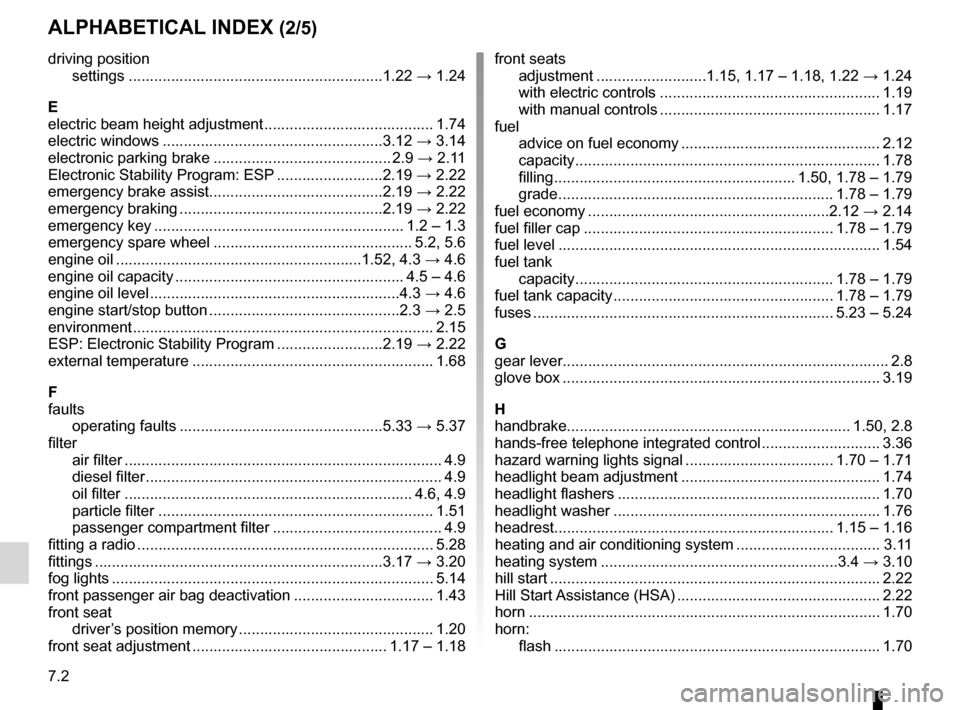
AlphAbeticAl index (2/5)
driving position
settings ............................................................ 1.22 → 1.24
e
electric beam height adjustment ........................................ 1.74
electric windows .................................................... 3.12 → 3.14
electronic parking brake .......................................... 2.9 → 2.11
Electronic Stability Program: ESP .........................2.19 → 2.22
emergency brake assist ......................................... 2.19 → 2.22
emergency braking ................................................ 2.19 → 2.22
emergency key ........................................................... 1.2 – 1.3
emergency spare wheel ............................................... 5.2, 5.6
engine oil .......................................................... 1.52, 4.3 → 4.6
engine oil capacity ...................................................... 4.5 – 4.6
engine oil level ........................................................... 4.3 → 4.6
engine start/stop button ............................................. 2.3 → 2.5
environment ....................................................................... 2.15
ESP: Electronic Stability Program .........................2.19 → 2.22
external temperature ......................................................... 1.68
F
faults operating faults ................................................ 5.33 → 5.37
filter air filter ........................................................................... 4.9
diesel filter ...................................................................... 4.9
oil filter .................................................................... 4.6, 4.9
particle filter ................................................................. 1.51
passenger compartment filter ........................................ 4.9
fitting a radio ...................................................................... 5.28
fittings .................................................................... 3.17 → 3.20
fog lights ........................................................................\
.... 5.14
front passenger air bag deactivation ................................. 1.43
front seat driver’s position memory .............................................. 1.20
front seat adjustment .............................................. 1.17 – 1.18front seats
adjustment ..........................1.15, 1.17 – 1.18, 1.22 → 1.24
with electric controls .................................................... 1.19
with manual controls .................................................... 1.17
fuel advice on fuel economy ............................................... 2.12
capacity ........................................................................ 1.78
filling ......................................................... 1.50, 1.78 – 1.79
grade ................................................................. 1.78 – 1.79
fuel economy ......................................................... 2.12 → 2.14
fuel filler cap ........................................................... 1.78 – 1.79
fuel level ........................................................................\
.... 1.54
fuel tank capacity ............................................................. 1.78 – 1.79
fuel tank capacity .................................................... 1.78 – 1.79
fuses ....................................................................... 5.23 – 5.24
G
gear lever ........................................................................\
..... 2.8
glove box ........................................................................\
... 3.19
h
handbrake ................................................................... 1.50, 2.8
hands-free telephone integrated control ............................ 3.36
hazard warning lights signal ................................... 1.70 – 1.71
headlight beam adjustment ............................................... 1.74
headlight flashers .............................................................. 1.70
headlight washer ............................................................... 1.76
headrest .................................................................. 1.15 – 1.16
heating and air conditioning system .................................. 3.11
heating system ........................................................ 3.4 → 3.10
hill start ........................................................................\
...... 2.22
Hill Start Assistance (HSA) ................................................ 2.22
horn ........................................................................\
........... 1.70
horn: flash ............................................................................. 1.70