2012 RENAULT MEGANE RS service
[x] Cancel search: servicePage 98 of 239

driving ................................................... (up to the end of the DU)
fuel economy ........................................ (up to the end of the DU)
advice on antipollution .......................... (up to the end of the DU)
antipollution advice .............................................................. (current page)
fuel advice on fuel economy ................................... (current page)
2.12
ENG_UD18947_5
Conseils antipollution, économie de carburant, conduite (X45 - H45 -\
X85 - B85 - C85 - S85 - X83 - X61 - F61 - K61 - K85 - X95 - B95 - D95 -\
J95 - R95 - L38 - X61 BUp
ENG_NU_837-6_BDK95_Renault_2
Jaune NoirNoir texte
Advice: antipollution and fuel economy
ADVICE: antipollution, fuel economy and driving (1/3)
Your vehicle complies with criteria for
recycling and recovering vehicles at the
end of their service life which will come
into force in 2015.
Some parts of your vehicle have there-
fore been designed to facilitate future
recycling.
These parts are easy to remove so
that they can be recovered and reproc-
essed by recycling companies.
By virtue of its design, moderate fuel
consumption and initial settings, your
vehicle also conforms to current anti-
pollution regulations. The manufac -
turer is actively striving to reduce pol -
lutant exhaust gas emissions and to
save energy. But the fuel consumption
of your vehicle and the level of pollutant
exhaust gas emissions are also your
responsibility. Ensure that it is main -
tained and used correctly.Aiding fuel economy
Depending on the vehicle, in order to
optimise consumption, an indicator light
on the instrument panel will inform you
of the best moment to upshift or down -
shift gears:
\ shift up a gear;
[ shift down a gear.
Maintenance
It is important to remember that failure to
respect antipollution regulations could
lead to legal action being taken against
the vehicle owner. In addition, replacing
engine, fuel supply system and exhaust
components with parts other than those
originally recommended by the manu -
facturer may alter your vehicle so that
it no longer complies with antipollution
regulations. Have your vehicle adjusted and
checked by an approved Dealer, in ac-
cordance with the instructions given in
your maintenance schedule: they will
have all the equipment necessary for
ensuring that your vehicle is maintained
to its original standard.
Engine adjustments–
ignition: this does not require ad -
justment.
– spark plugs: for optimum fuel econ-
omy, efficiency and performance
the specifications laid down by our
Design Department must be strictly
applied.
If the spark plugs have to be
changed, use the make, type and
gap specified for your vehicle’s
engine. Contact an approved dealer
for this.
– idle: this does not require adjust -
ment.
– air filter, diesel filter: a clogged ele-
ment reduces performance. It must
be replaced.
Page 101 of 239

environment .......................................... (up to the end of the DU)
2.15
ENG_UD16012_2
Environnement (X95 - E95 - E33 - X33 - X62 - Renault)
ENG_NU_837-6_BDK95_Renault_2
Environment
ENVIRONMENT
Emissions
Your vehicle has been designed to
emit fewer greenhouse gases (CO2)
while in use, and therefore to consume
less fuel (eg. 140 g/km, equivalent to
5.3 l/100 km for a diesel vehicle).
Our vehicles are also equipped with a
particle filter system including a cata -
lytic converter, an oxygen sensor and
an active carbon filter (the latter pre -
vents vapour from the fuel tank being
released into the open air).
Please make your own
contribution towards
protecting the environment
too.
– Worn parts replaced in the course of
routine vehicle maintenance (vehi -
cle battery, oil filter, air filter, batter -
ies, etc.) and oil containers (empty or
filled with used oil) must be disposed
of through specialist organisations.
– At the end of the vehicle’s service
life, it should be sent to approved
centres to ensure that it is recycled.
– In all cases, comply with local legis -
lation.
Recycling
Your vehicle is 85% recyclable and
95% recoverable.
To achieve these objectives, many of
the vehicle components have been de-
signed to enable them to be recycled.
The materials and structures have
been carefully designed to allow these
components to be easily removed and
reprocessed by specialist companies.
In order to preserve raw material re -
sources, this vehicle incorporates nu -
merous parts made from recycled plas-
tics or renewable materials (vegetable
or animal-derived materials such as
cotton or wool).
Your vehicle has been designed with
respect for the
environment in mind for
its entire service life: during production,
use and at the end of its life.
This commitment is illustrated by the
Renault eco² group signature.
Manufacture
Your vehicle has been manufactured at
an industrial site which uses a progress
policy to reduce environmental impacts
on rivers and natural areas (reduc -
tion of water and energy consumption,
visual and noise pollution, atmospheric
emissions and waste water, sorting and
reusing waste).
Page 133 of 239

air conditioning ..................................... (up to the end of the DU)
heating and air conditioning system ...................... (current page)
air conditioning ..................................... (up to the end of the DU)
3.11
ENG_UD10081_2
Air conditionné : informations et conseils d’utilisation (X91 - B\
91 - K91 - Renault)
ENG_NU_837-6_BDK95_Renault_3
Air conditioning: information and advice on use
AIR coNDITIoNINg: information and advice on use
Fuel consumption
You will normally notice an increase
in fuel consumption (especially
when driving in town) when the air
conditioning is operating.
For vehicles fitted with manual air
conditioning, switch off the system
when it is not required.
Advice for reducing
consumption and therefore
helping to preserve the
environment:
Drive with the air vents open and
the windows closed.
If the vehicle has been parked in
the sun, open the doors for a few
moments to let the hot air escape
before starting the engine.
Maintenance
Refer to the Maintenance Service
Booklet for your vehicle for the in -
spection frequency.operating faults
As a general rule, contact your ap-
proved Dealer in the event of an op-
erating fault:
– reduction in de-icing, demist -
ing or air conditioning perform-
ance. This may be caused by the
passenger compartment filter
cartridge becoming clogged;
– no cold air is being produced.
Check that the controls are set
correctly and that the fuses are
sound. Otherwise, switch off the
system.
Advice on use
In some situations, (air conditioning
off, air recirculation activated, venti-
lation speed at zero or low, etc.) you
may notice that condensation starts
to form on the windows and wind -
screen.
If there is condensation, use the
“clear View” function to remove it,
then use the air conditioning in auto-
matic mode to stop it forming again.
If the condensation does not clear,
use the FAST programme.
Do not open the refriger -
ant fluid circuit. The fluid
may damage eyes or skin.
Note
Presence of water under the ve -
hicle. After prolonged use of the air
conditioning system, it is normal for
water to be present under the ve -
hicle. This is caused by condensa -
tion.
Page 163 of 239

engine oil .............................................. (up to the end of the DU)
oil change ............................................. (up to the end of the DU)
engine oil level ...................................... (up to the end of the DU)
engine oil capacity ................................ (up to the end of the DU)
4.5
ENG_UD16901_4
Niveau huile moteur : appoint/remplissage (X95 - B95 - D95 - Renault)
ENG_NU_837-6_BDK95_Renault_4
topping up/filling
engine Oil level: topping up/filling (1/2)
t opping up/filling
The vehicle must be parked on level
ground and the engine should be cold
(for instance, before the engine is
started up for the first time in the day).
engine oil grade
Refer to the Maintenance Service
Booklet for your vehicle. –
Unscrew cap 1;
– top up the level (as a guide, the ca-
pacity between the minimum and
maximum reading on the dipstick 2
is between 1.5 and 2 litres, depend-
ing on the engine);
– wait for approximately 10 minutes to
allow the oil to flow into the engine;
– check the level using the dipstick 2
(as described above).
Once the operation has been com -
pleted, ensure that the dipstick is
pushed in as far as it will go or that the
cap-type dipstick is completely screwed
in.
Do not exceed the max level and
do not forget to refit cap 1 and dip-
stick 2.
1
2
21
12
1
1
2
Page 164 of 239
filteroil filter ............................................ (up to the end of the DU)
4.6
ENG_UD16901_4
Niveau huile moteur : appoint/remplissage (X95 - B95 - D95 - Renault)
ENG_NU_837-6_BDK95_Renault_4
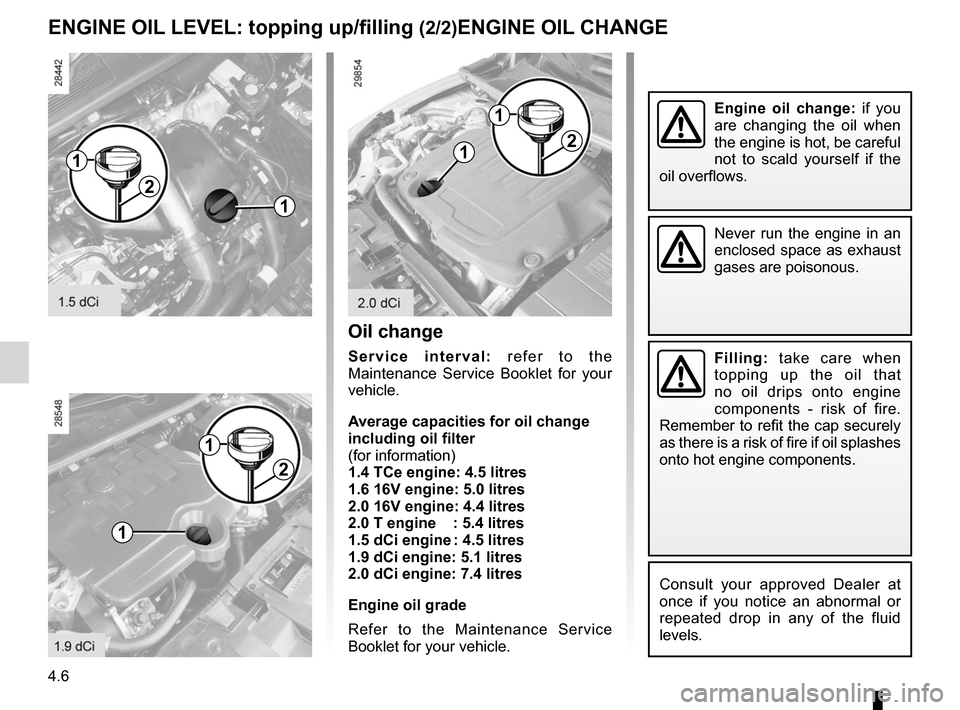
Engine oil change
engine Oil level: topping up/filling (2/2)engine Oil CHAnge
Oil change
S e r v i c e i n t e r v a l : r e f e r t o t h e
Maintenance Service Booklet for your
vehicle.
Average capacities for oil change
including oil filter
(for information)
1.4 tCe engine: 4.5 litres
1.6 16v engine: 5.0 litres
2.0 16v engine: 4.4 litres
2.0 t engine : 5.4 litres
1.5 dCi engine : 4.5 litres
1.9 dCi engine: 5.1 litres
2.0 dCi engine: 7.4 litres
engine oil grade
Refer to the Maintenance Service
Booklet for your vehicle.
e ngine oil change: if you
are changing the oil when
the engine is hot, be careful
not to scald yourself if the
oil overflows.
Filling: take care when
topping up the oil that
no oil drips onto engine
components - risk of fire.
Remember to refit the cap securely
as there is a risk of fire if oil splashes
onto hot engine components.
Never run the engine in an
enclosed space as exhaust
gases are poisonous.
Consult your approved Dealer at
once if you notice an abnormal or
repeated drop in any of the fluid
levels.
1
1
1
1
2
2
1
21
Page 165 of 239

levels:coolant ............................................................. (current page)
tanks and reservoirs coolant ............................................................. (current page)
coolant ................................................................... (current page)
4.7
ENG_UD18903_5
Niveaux / filtres (X95 - B95 - D95 - Renault)
ENG_NU_837-6_BDK95_Renault_4
Levels:
engine coolant
levelS (1/3)
Coolant
With the engine switched off and on
level ground, the level when cold must
be between the “MINI" and "MAXI"
marks on coolant reservoir 1.
Top this level up when cold before it
reaches the MINI mark. Checking intervals
Check the coolant level regularly
(very severe damage is likely to be
caused to the engine if it runs out of
coolant).
If the level needs to be topped up, only
use products approved by our Technical
Department which ensure:
–
protection against freezing;
– anticorrosion protection of the cool -
ing system.
No operations should be
carried out on the cooling
circuit when the engine is
hot.
Risk of burns.
Consult your approved dealer at
once if you notice an abnormal or
repeated drop in any of the fluid
levels.
1Replacement intervals
Refer to the Maintenance Service
Booklet for your vehicle.
The engine may be hot
when carrying out opera -
tions in close proximity. In
addition, the engine cooling
fan can come on at any moment.
Risk of injury.
Page 166 of 239

brake fluid .............................................................. (current page)
levels: brake fluid ........................................................ (current page)
tanks and reservoirs brake fluid ........................................................ (current page)
4.8
ENG_UD18903_5
Niveaux / filtres (X95 - B95 - D95 - Renault)
ENG_NU_837-6_BDK95_Renault_4
Jaune NoirNoir texte
brake fluid
levelS (2/3)
Brake fluid level
The level should be read with the engine
switched off and on level ground. This
should be checked frequently, and any
time you notice even the slightest loss
in braking efficiency. level 1
It is normal for the level to drop as
the linings become worn, but it should
never drop below the
Min line.
If you wish to check the disc and drum
wear yourself, you should obtain the
document explaining the checking pro-
cedure from our network or from the
manufacturer’s website. t
opping up
After any operation on the hydraulic cir-
cuit, a specialist must replace the fluid.
Only use fluids approved by our
Technical Department (and taken from
a sealed container).
Replacement intervals
Refer to the Maintenance Service
Booklet for your vehicle.
1
The engine may be hot
when carrying out opera -
tions in close proximity. In
addition, the engine cooling
fan can come on at any moment.
Risk of injury.
Consult your approved dealer at
once if you notice an abnormal or
repeated drop in any of the fluid
levels.
Page 167 of 239

levels:windscreen washer reservoir ........................... (current page)
windscreen washer ................................................ (current page)
filter air filter ............................................................. (current page)
filter passenger compartment filter .......................... (current page)
filter oil filter ............................................................. (current page)
filter diesel filter ........................................................ (current page)
tanks and reservoirs: windscreen washer .......................................... (current page)
JauneNoirNoir texte
4.9
ENG_UD18903_5
Niveaux / filtres (X95 - B95 - D95 - Renault)
ENG_NU_837-6_BDK95_Renault_4
windscreen/headlight washer reservoir
Filters
levelS (3/3)FilteRS
Windscreen/headlight washer
reservoir
t opping up
With the engine switched off, open
cap 1 , fill until you can see the fluid,
then refit the cap. liquid
Screen wash product (product with an-
tifreeze in winter).
Jets
Use a tool such as a needle to adjust
the height of the windscreen washer
jets.
nOte
Depending on the vehicle, to find
out the fluid level, open cap
1 and
pull out the dipstick.
Filters
The replacement of filter elements (air
filter, passenger compartment filter,
diesel filter, etc.) is scheduled in the
maintenance operations for your vehi -
cle.
Replacement intervals for filter el -
ements: refer to the Maintenance
Service Booklet for your vehicle.
1