2012 RENAULT MEGANE RS Running lights
[x] Cancel search: Running lightsPage 85 of 239

JauneNoirNoir texte
1.79
ENG_UD18917_5
Réservoir à carburant (X95 - B95 - Renault)
ENG_NU_837-6_BDK95_Renault_1
filling with fuel
Insert the nozzle to open the valve A
and insert fully before turning it on to
fill the fuel tank (risk of splashing).
Keep the nozzle in this position through -
out the entire filling operation.
When the pump cuts out automatically
at the end of the filling procedure, a
maximum of two further filling attempts
may be made, as there must be suffi -
cient space in the fuel tank to allow for
expansion.
Make sure that no water enters the fuel
tank during filling. The valve A and its
surround must remain clean.
petrol versions
Using leaded petrol will damage the
antipollution system and may lead to a
loss of warranty.
To ensure that the fuel tank is not filled
with leaded petrol, the fuel tank filler
neck contains a restrictor fitted with a
foolproof system which only allows
the nozzle for unleaded petrol to be
used (at the pump).
No modifications what -
soever are permitted on
any part of the fuel supply
system (computers, wiring,
fuel circuit, injector, protection
covers, etc.) as this may be danger-
ous (such work must be undertaken
by qualified Network personnel).
fUEL TANK (2/2)
Running out of fuel on diesel
versions
After a breakdown caused by com-
pletely running out of fuel, the system
must be reprimed before the engine is
restarted: Use bulb 1.
The engine can now be restarted.
If the engine does not start after several
attempts, contact an approved Dealer.
1persistent smell of
fuel
If you notice a persistent
smell of fuel you should:
– stop the vehicle as soon as traf-
fic conditions allow and switch off
the ignition;
– switch on the hazard warning
lights and ask your passengers
to leave the vehicle and to keep
away from traffic;
– contact an approved Dealer.
Page 96 of 239

2.10
ENG_UD11746_2
Frein de parking assisté (X95 - B95 - D95 - Renault)
ENG_NU_837-6_BDK95_Renault_2
Jaune NoirNoir texte
Special cases
When parking on a slope or towing a
trailer, pull switch 3 for a few seconds
to obtain the maximum braking effect.
To park the vehicle without applying the
electronic parking brake (if there is a
risk of freezing, for example):
– w i t h t h e e n g i n e r u n n i n g a n d
RENAULT card in reader 4 , switch
off the engine by pressing engine
Start/Stop button 1;
– select a gear (manual gearbox) or
position P (automatic gearbox);
– depress the brake pedal and press
switch 3 at the same time;
– remove the RENAULT card from the
card reader.
brief stopTo manually activate the electronic
parking brake, (when stopping at a red
light, or stopping when the engine is
running, etc.): pull and release switch 3.
The brake is released as soon as the
vehicle is started up again.
ELECTRONIC PARkING bRAkE (2/3)
4
1
3
Manual operationYou can control the electronic parking
brake manually.
Applying the electronic parking
brake
Pull switch 3 . Indicator lights 2 and
} light up on the instrument panel.
Releasing the electronic parking
brake
With the ignition on, depress the brake
pedal then press button 3 : indicator
lights 2 and
} go out.
2
Page 97 of 239

JauneNoirNoir texte
2.11
ENG_UD11746_2
Frein de parking assisté (X95 - B95 - D95 - Renault)
ENG_NU_837-6_BDK95_Renault_2
– If there is an electronic parking brake
fault, warning lights
® light up
accompanied by the “ Parking brake
fault” message, a beep and in certain
cases indicator light
}.
This means that you must stop as
soon as traffic conditions allow.
Operating faults
– If there is a fault, the © warning
light illuminates on the instrument
panel accompanied by the “ Check
parking brake ” message and, in
some cases, the
} warning
light.
Contact an approved Dealer as soon
as possible.
ELECTRONIC PARkING bRAkE (3/3)
It is therefore essential to
immobilise the vehicle by
engaging first gear (manual
gearbox) or position P (au -
tomatic gearbox). If the slope re -
quires it, chock the vehicle.
Versions with an automatic
gearbox
For safety reasons, automatic release
is deactivated when the driver’s door
is open or not shut properly and the
engine is running (in order to prevent
the vehicle from moving without the
driver). The “ Release parking brake
manually ” message appears on the
instrument panel when the driver de -
presses the accelerator.
Never leave your vehicle
without moving the selec -
tor lever to position P or N.
This is because when the
vehicle is stationary with the engine
running and a gear engaged, the
vehicle may begin to move if you
accelerate.
There is a risk of accidents.If no lights or sounds are ap-
parent, this indicates a fault
in the instrument panel. This
indicates that it is essential
to stop immediately (as soon as traf-
fic conditions allow). Ensure that the
vehicle is correctly immobilised and
contact an approved Dealer.
Page 184 of 239
lightsfront ................................................. (up to the end of the DU)
lights changing bulbs ................................ (up to the end of the DU)
changing a bulb .................................... (up to the end of the DU)
indicators .............................................. (up to the end of the DU)
bulbs changing ......................................... (up to the end of the DU)
lights: dipped beam headlights .................. (up to the end of the DU)
lights: direction indicators .......................... (up to the end of the DU)
lights: main beam headlights ..................... (up to the end of the DU)
bulbs changing ......................................... (up to the end of the DU)
5.12
ENG_UD10900_2
Projecteurs avant : remplacement des lampes (X95 - B95 - D95 - Renault)\
ENG_NU_837-6_BDK95_Renault_5
Jaune NoirNoir texte
Headlights (changing bulbs)
heaDlIghts: changing bulbs (1/2)
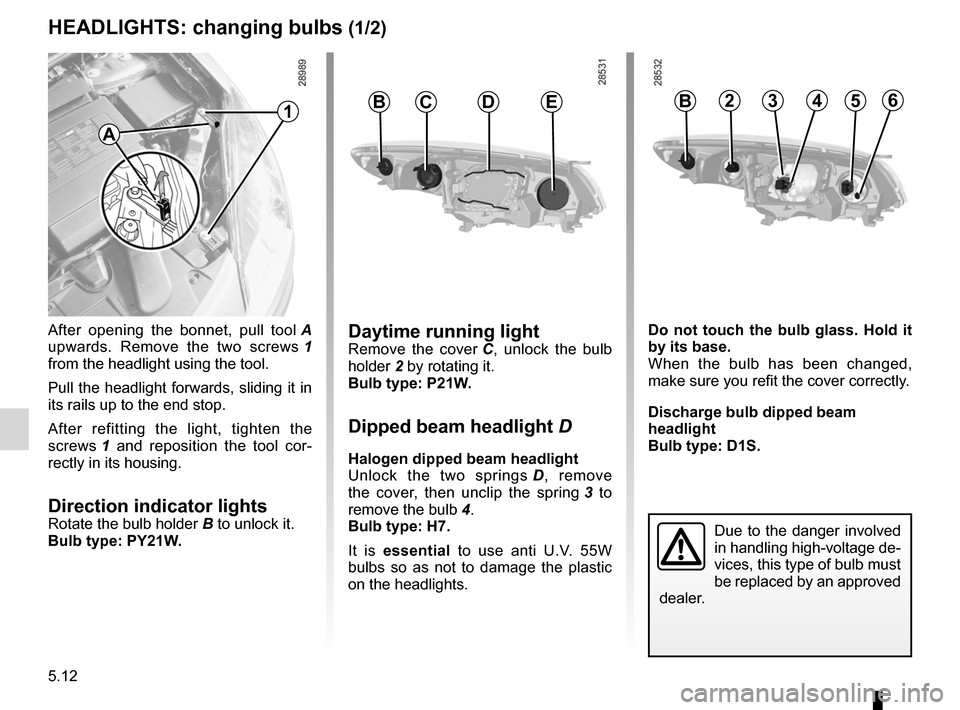
After opening the bonnet, pull tool A
upwards. Remove the two screws 1
from the headlight using the tool.
Pull the headlight forwards, sliding it in
its rails up to the end stop.
After refitting the light, tighten the
screws 1 and reposition the tool cor -
rectly in its housing.
Direction indicator lightsRotate the bulb holder B to unlock it.
Bulb type: Py21w .
Daytime running lightRemove the cover C , unlock the bulb
holder 2 by rotating it.
Bulb type: P21w .
Dipped beam headlight D
halogen dipped beam headlight
Unlock the two springs D , remove
the cover, then unclip the spring 3 to
remove the bulb 4.
Bulb type: h7.
It is essential to use anti U.V. 55W
bulbs so as not to damage the plastic
on the headlights.
1BcDe3245B6
Due to the danger involved
in handling high-voltage de-
vices, this type of bulb must
be replaced by an approved
dealer.
Do not touch the bulb glass. hold it
by its base.
When the bulb has been changed,
make sure you refit the cover correctly.
Discharge bulb dipped beam
headlight
Bulb type: D1s.
a
Page 197 of 239
batterytroubleshooting ............................... (up to the end of the DU)
5.25
ENG_UD9611_2
Batterie : dépannage (X95 - B95 - D95 - Renault)
ENG_NU_837-6_BDK95_Renault_5
Battery
Battery: troubleshooting (1/2)
to avoid all risk of sparks:
– Ensure that any electrical consumers
(courtesy lights, etc.) are switched
off before disconnecting or recon -
necting the battery.
– When charging, stop the charger
before connecting or disconnecting
the battery.
– Do not place metal objects on the
battery to avoid creating a short cir-
cuit between the terminals.
– Always wait at least one minute after
the engine has been switched off
before disconnecting a battery.
– Make sure that you reconnect the
battery terminals after refitting.
connecting a battery charger
the battery charger must be com -
patible with a battery with nominal
voltage of 12 volts.
Do not disconnect the battery when the
engine is running. Follow the instruc-
tions given by the manufacturer of
the battery charger you are using.
Special procedures may be
required to charge some
batteries. Contact your ap -
proved dealer.
Avoid all risk of sparks which may
cause an immediate explosion, and
charge the battery in a well-venti -
lated area. Risk of serious injury.
Handle the battery with care
as it contains sulphuric acid,
which must not come into
contact with eyes or skin. If
it does, wash the affected area with
plenty of cold water. If necessary,
consult a doctor.
Ensure that naked flames, red hot
objects and sparks do not come into
contact with the battery as there is a
risk of explosion.
The engine may be hot when car -
rying out operations in close prox -
imity. In addition, the engine cooling
fan can come on at any moment.
Risk of injury.
Page 203 of 239

towingbreakdown ...................................... (up to the end of the DU)
towing hitch ........................................... (up to the end of the DU)
5.31
ENG_UD14787_2
Remorquage : dépannage (X95 - B95 - D95 - Renault)
ENG_NU_837-6_BDK95_Renault_5
Towing
tOwIng : breakdown (1/2)
Before towing, unlock the steering
column: with the clutch depressed,
engage first gear (lever in position n
or r for vehicles with automatic trans -
missions), insert the RENAULT card in
the card reader then press the engine
start button for two seconds.
Reposition the lever to neutral (posi -
tion N for vehicles fitted with an auto -
matic gearbox)
The steering column unlocks, the ve -
hicle’s accessory functions are pow -
ered, and you can use the vehicle lights
(brake lights, hazard warning lights,
etc.). At night, the vehicle must be lit.
Once you have finished towing, press
the engine start button twice (risk of
running down the battery). The speed specified by current legis
-
lation for towing must always be ob -
served. If your vehicle is the towing
vehicle, do not exceed the maximum
towing weight for your vehicle (refer to
the information on “Weights” in Section
6).
t owing a vehicle with an
automatic gearbox
With the engine switched off, the trans-
mission is no longer lubricated. It is
preferable to tow this type of vehicle on
a trailer or tow it with the front wheels
off the ground.
u nder exceptional circumstances,
you may tow the vehicle with all four
wheels on the ground, only going for -
ward, with the gear lever in the n posi-
tion, and for a distance not exceeding
50 miles (80 km).
If the lever is stuck in P,
even though you are de -
pressing the brake pedal,
the lever can be released
manually. To do this, insert a rigid
rod in the hole 2, press the rod and
unlocking button 1 located on the
lever simultaneously.
1
2
D o n o t r e m o v e t h e
RENAULT card from the
reader when the vehicle is
being towed.
Page 233 of 239

7.1
FRA_UD19033_8
Index (X95 - B95 - D95 - Renault)
ENG_NU_837-6_BDK95_Renault_7
AlphAbeticAl index (1/5)
A
ABS .............................................................. 1.51, 2.19 → 2.22
accessories........................................................................\
5.29
accessories socket ............................................................ 3.21
additional methods of restraint .....................1.25 → 1.28, 1.31
side protection ............................................................. 1.30
to the front seat belts ....................................... 1.25 → 1.28
to the rear seat belts ........................................ 1.25 → 1.29
adjusting your driving position ....................... 1.15 – 1.16, 1.22
advice on antipollution ........................................... 2.12 → 2.14
air bag ........................................................... 1.25 → 1.31, 1.51
activating the front passenger air bags ........................ 1.45
deactivating the front passenger air bags .................... 1.43
air conditioning ........................................................ 3.4 → 3.11
air vents ...................................................................... 3.2 – 3.3
anti-corrosion check .............................................. 6.17 → 6.22
anti-corrosion protection ......................................... 4.12 – 4.13
anti-lock braking system: ABS ...............................2.19 → 2.22
antipollution advice .......................................................................... 2.12
armrest: front .............................................................................. 3.18
ashtray ........................................................................\
....... 3.21
ASR (traction control) ............................................ 2.19 → 2.22
audible and visual signals .................................................. 1.70
automatic gearbox (use) ........................................ 2.33 → 2.35
automatic gearbox selector lever ...........................2.33 → 2.35
b
battery ....................................................................... 1.52, 4.11
troubleshooting ................................................. 5.25 – 5.26
bonnet ........................................................................\
.......... 4.2
brake fluid ........................................................................\
.... 4.8
bulbs changing .......................................................... 5.12 → 5.20c
catalytic converter
....................................................... 2.6 – 2.7
central door locking ........................................ 1.8, 1.12 → 1.14
changing a bulb ..................................................... 5.12 → 5.20
changing a wheel ........................................................ 5.7 – 5.8
changing gear ................................................. 2.8, 2.33 → 2.35
child restraint/seat ............................. 1.32 – 1.33, 1.35 → 1.45
child safety .........1.2, 1.6, 1.11, 1.32 – 1.33, 1.35 → 1.45, 3.12
child seats .......................................... 1.32 – 1.33, 1.35 → 1.42
children ...................................... 1.10 – 1.11, 1.32 – 1.33, 1.33
children (safety) .......................................... 1.2, 1.6, 1.11, 3.12
cigar lighter ........................................................................\
3.21
clock ........................................................................\
.......... 1.68
closing the doors ................................................... 1.10 → 1.13
control instruments ................................................ 1.50 → 1.65
controls .................................................................. 1.46 → 1.49
coolant ........................................................................\
1.54, 4.7
courtesy light ...................................... 3.15 – 3.16, 5.21 – 5.22
courtesy mirrors ................................................................. 3.16
cruise control ................................................ 1.51, 2.23 → 2.29
cruise control-speed limiter.................................... 2.23 → 2.29
customised vehicle settings ............................................... 1.66
customising the vehicle settings ........................................ 1.66
d
dashboard .............................................................. 1.46 → 1.49
daytime running lights ........................................................ 1.71
deadlocking the doors ......................................................... 1.8
dimensions ................................................................ 6.5 → 6.7
dipstick........................................................................\
......... 4.4
display ................................................................... 1.50 → 1.55
doors .............................................................. 1.10 – 1.11, 1.14
doors/tailgate .......................................... 1.8, 1.10 – 1.11, 1.14
driver’s position ..................................................... 1.46 → 1.53
driving ................................ 2.2 – 2.4, 2.6 → 2.14, 2.16 → 2.35
Page 236 of 239

7.4
FRA_UD19033_8
Index (X95 - B95 - D95 - Renault)
ENG_NU_837-6_BDK95_Renault_7
Jaune NoirNoir texte
AlphAbeticAl index (4/5)
p
paintwork
maintenance ..................................................... 4.12 – 4.13
parking distance control ......................................... 2.30 → 2.32
power-assisted steering ..................................................... 1.67
pretensioners ..................................................................... 1.25
puncture .............................................................. 5.2, 5.6 → 5.8
R
radio........................................................................\
........... 3.36
fitting a radio ................................................................ 5.28
rear bench seat ...................................................... 3.22 → 3.24
rear parcel shelf ..................................................... 3.26 → 3.28
rear screen de-icing/demisting ..................................... 3.5, 3.9
rear seats functions .......................................................... 3.22 → 3.24
rear view mirrors ................................................................ 1.69
RENAULT ANTI-INTRUDER DEVICE (RAID) ...................1.14
RENAULT card battery .......................................................................... 5.27
use ....................................................................... 1.2 → 1.9
RENAULT card battery ...................................................... 5.27
replacement parts .............................................................. 6.10
reverse gear selecting .................................................... 2.8, 2.33 → 2.35
reversing sensor .................................................... 2.30 → 2.32
roof bars ........................................................................\
.... 3.35
roof rack roof bars ....................................................................... 3.35
running in ........................................................................\
..... 2.2
S
screen wash/wipe .............................................................. 1.77
seat belt pretensioners .......................................... 1.25 → 1.28
front seat belt ...................................................1.25 → 1.28
seat belts .................................. 1.22 → 1.28, 1.30 – 1.31, 1.52 see-me-home lighting
............................................... 1.72, 1.74
service sheets ........................................................ 6.11 → 6.16
side indicator lights changing bulbs ............................................................. 5.20
side protection devices ...................................................... 1.30
signals and lights ................................................... 1.71 → 1.74
speakers location ........................................................................ 5.28
special features of diesel versions .......................................2.7
special features of petrol vehicles ....................................... 2.6
speed limiter ................................................. 1.51, 2.23 → 2.25
starting the engine ...................................................... 2.3 – 2.4
steering wheel adjustment ................................................................... 1.67
stopping the engine ............................................................. 2.5
storage compartment ............................................. 3.17 → 3.20
storage compartments ..................... 3.17 → 3.20, 3.29 → 3.31
storing the driver’s seat position ........................................1.20
sun visor ........................................................................\
.... 3.16
sunroof ................................................................... 3.12 → 3.14
switching on the vehicle ignition .......................................... 2.4
t
tailgate ........................... 3.25 – 3.26, 3.29 → 3.31, 3.33 – 3.34
tanks and reservoirs brake fluid ...................................................................... 4.8
coolant ........................................................................... 4.7
tanks and reservoirs: windscreen washer ........................................................ 4.9
technical specifications ............................ 6.3 → 6.7, 6.9 – 6.10
telephone ........................................................................\
... 3.36
temperature regulation ............................................ 3.6 → 3.10
tool kit ........................................................................\
.......... 5.6
towing breakdown ........................................................ 5.31 – 5.32
towing equipment ......................................................... 3.32