2012 RENAULT LAGUNA COUPE ignition
[x] Cancel search: ignitionPage 129 of 221

electric windows ................................... (up to the end of the DU)
child safety ............................................................. (current page)
children (safety) .................................... (up to the end of the DU)
3.11
ENG_UD22219_4
Lève-vitres électriques (X91 - D91 - Renault)
ENG_NU_939-3_D91_Renault_3
Electric windows
ElEcTRIc WINDoWS (1/2)
With the ignition on, press the switch
for the window concerned to lower it to
the desired height.
Lift the switch to raise the window to the
desired height.
From the driver’s seat
Operate the switches as follows:
1 for the driver’s side;
2 for the passenger side.
From the front passenger seat
Press switch 3.
1
23
one-touch windows
The one-touch mode works in addition
to the operation of the electric windows
described previously.
– Fully press down (beyond the
notch) on the relevant switch: the
window will open completely.
– Fully lift (beyond the notch) the
relevant switch up: the window will
close completely.
Pressing the switch again while the
window is moving will stop its move -
ment.
Note: If the window detects resistance
when closing (e.g.: fingers, branch of
a tree, etc.) it stops and then lowers
again by a few centimetres.
These systems operate up to approxi -
mately 5 minutes after the engine is
switched off or until a door is opened.
If any part of the body be -
comes trapped, reverse the
direction of the window im -
mediately by pressing the
relevant switch.
Driver’s responsibility
Never leave your vehicle
with the RENAULT card
inside and never leave a
child (or a pet) unsupervised, even
for a short while.
They may pose a risk to themselves
or to others by starting the engine,
activating equipment such as the
electric windows or by locking the
doors.
Risk of serious injury.
Page 137 of 221
ashtray .................................................. (up to the end of the DU)
cigar lighter ........................................... (up to the end of the DU)
accessories socket ............................... (up to the end of the DU)
3.19
ENG_UD19989_3
Cendriers-Allume cigares (X91 - D91 - Renault)
ENG_NU_939-3_D91_Renault_3
Accessories socket
Ashtray/cigar lighter
AShTRA y/cIgAR lIghTER/AccESSoRIES SockET
1
2
Accessories sockets
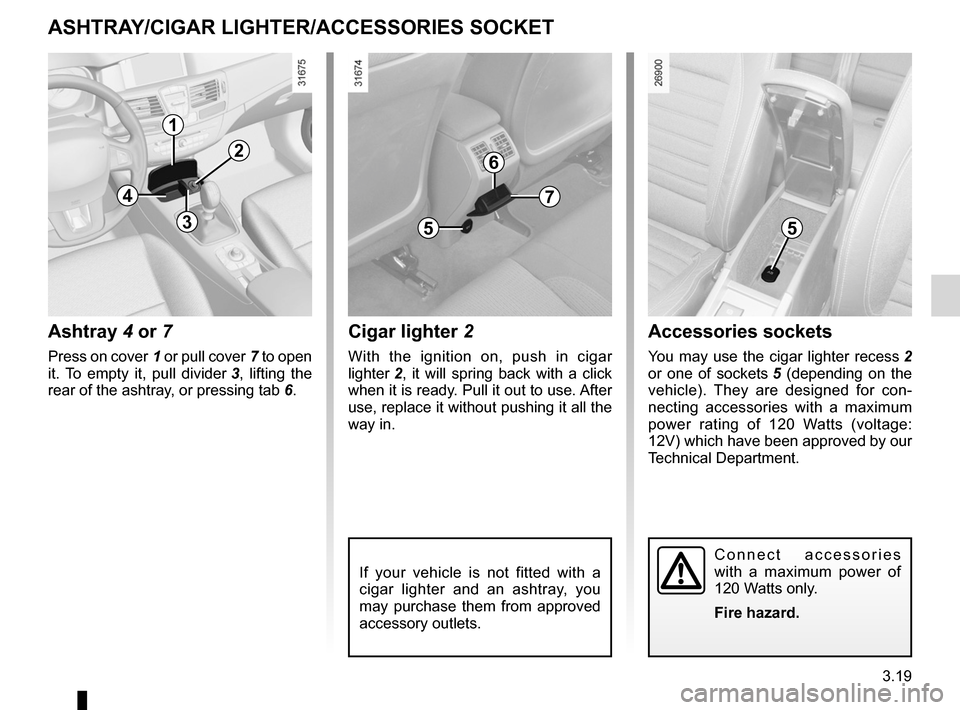
You may use the cigar lighter recess 2
or one of sockets 5 (depending on the
vehicle). They are designed for con -
necting accessories with a maximum
power rating of 120 Watts (voltage:
12V) which have been approved by our
Technical Department.
4
55
If your vehicle is not fitted with a
cigar lighter and an ashtray, you
may purchase them from approved
accessory outlets.
3
7
6
C o n n e c t a c c e s s o r i e s
with a maximum power of
120 Watts only.
Fire hazard.
cigar lighter 2
With the ignition on, push in cigar
lighter 2, it will spring back with a click
when it is ready. Pull it out to use. After
use, replace it without pushing it all the
way in.
Ashtray 4 or 7
Press on cover 1 or pull cover 7 to open
it. To empty it, pull divider 3 , lifting the
rear of the ashtray, or pressing tab 6.
Page 184 of 221

5.22
ENG_UD29103_2
Batterie : dépannage (X91 - D91 - Renault)
ENG_NU_939-3_D91_Renault_5
Battery in the engine compartment
Connect the positive cable A to the
support 1 on the (+) terminal, then to
the (+) terminal 2 of the battery sup -
plying the current.
Connect the negative cable B to the (–)
terminal 3 of the battery supplying the
current and then to the (–) terminal 4 of
the discharged battery.
BA tter Y: breakdown recovery (2/2)
Battery in the luggage compartment
(V6 engines)
Use the terminals in the engine com -
partment.
Turn screw 6 one quarter of a turn to
the right, then pull cover 7 upwards to
access the 8 (+) terminal. Connect the
positive cable A to the support 8 on
the (+) terminal, then to the (+) termi-
nal 3 of the battery supplying the cur -
rent.
Connect the negative cable B to the (–)
terminal 4 of the battery supplying the
current and then to the (–) terminal 5.
Starting the vehicle using the
battery from another vehicle
(continued)
Ensure that there is no risk of contact
between the two vehicles (risk of short
circuiting when the positive terminals
are connected) and that the discharged
battery is properly connected. Switch
off your vehicle ignition.
Start the engine of the vehicle supply -
ing the current and run it at an interme-
diate engine speed.
8
5
6
7
Start the engine, and as soon as it starts running, disconnect cables A and B in
reverse order (4 - 3 - 2 - 1 or 5 - 3 - 2 - 8).
Check that there is no con-
tact between leads A and B
and that the positive lead A
is not touching any metal
parts on the vehicle supplying the
current.
Risk of injury or damage to the ve-
hicle.
Leads A and B must only be con-
nected to the terminals indicated.
1
A
B
1
4
23
Page 187 of 221
wiper blades ......................................... (up to the end of the DU)
wipers blades ............................................. (up to the end of the DU)
5.25
ENG_UD4848_1
Balais d’essuie-vitres (X91 - D91 - Renault)
ENG_NU_939-3_D91_Renault_5
Wipers (replacing blades)
WInDScreen WIPer BLADeS
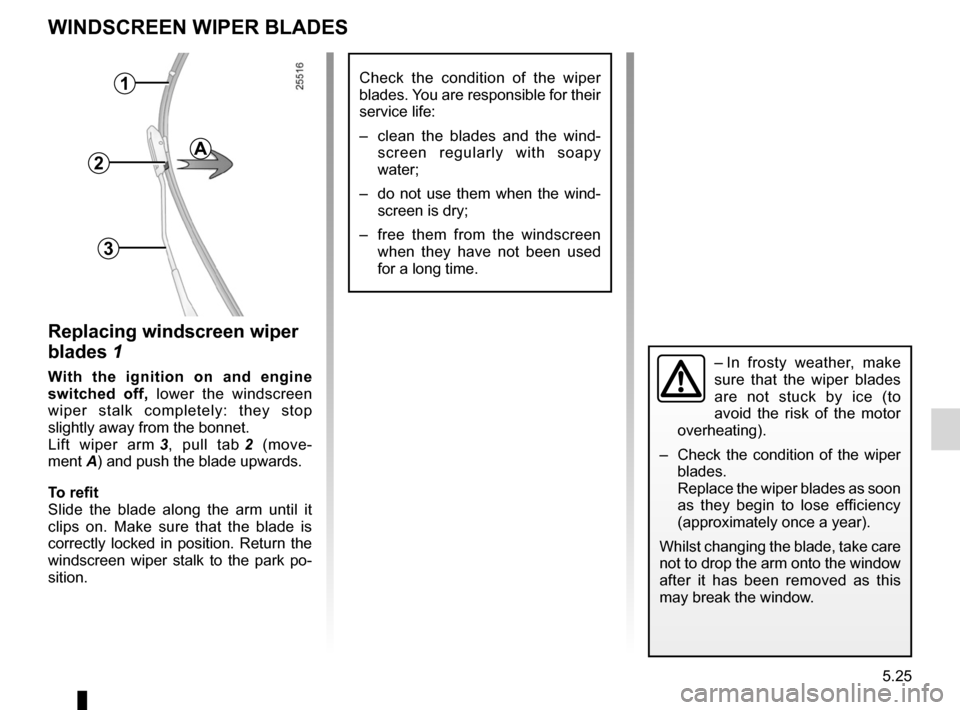
replacing windscreen wiper
blades 1
With the ignition on and engine
switched off, lower the windscreen
wiper stalk completely: they stop
slightly away from the bonnet.
Lift wiper arm 3 , pull tab 2 (move -
ment A) and push the blade upwards.
t o refit
Slide the blade along the arm until it
clips on. Make sure that the blade is
correctly locked in position. Return the
windscreen wiper stalk to the park po-
sition.– In frosty weather, make
sure that the wiper blades
are not stuck by ice (to
avoid the risk of the motor
overheating).
– Check the condition of the wiper
blades.
Replace the wiper blades as soon
as they begin to lose efficiency
(approximately once a year).
Whilst changing the blade, take care
not to drop the arm onto the window
after it has been removed as this
may break the window.
1
2
3
Check the condition of the wiper
blades. You are responsible for their
service life:
– clean the blades and the wind -
screen regularly with soapy
water;
– do not use them when the wind -
screen is dry;
– free them from the windscreen
when they have not been used
for a long time.
A
Page 192 of 221

ENG_NU_939-3_D91_Renault_5
Jaune NoirNoir texte
OPerA tInG FAuL tS (3/5)
On")
5.30
ENG_UD28899_2
Anomalies de fonctionnement (X91 - B91 - K91 - D91 - X95 - B95 - D95 - \
K95 - J95 - R95 - X98 - Renault)
ENG_NU_939-3_D91_Renault_5
Jaune NoirNoir texte
OPerA tInG FAuL tS (3/5)
On the road POSSIBLe cAuSeSWHAt tO DO
Vibrations. Tyres not inflated to correct pres-
sures, incorrectly balanced or dam -
aged. Check the tyre pressures: if this is not the
problem, have them checked by an ap
-
proved Dealer.
White smoke from the exhaust. This is not necessarily a fault. Smoke
may be caused by regeneration of the
particle filter.Please refer to the information on “Special
features of diesel versions” in Section 2.
Smoke under the bonnet. Short-circuit or cooling system leak.Stop, switch off the ignition, stand away
from the vehicle and contact an approved
dealer.
The oil pressure warning light comes
on: while cornering or braking The level is too low. Top up the engine oil (refer to the informa-
tion on “Engine oil level – Topping up/refill-
ing” in Section 4).
is slow to go out or remains lit
under acceleration Loss of oil pressure.
Stop the vehicle and contact an approved
Dealer.
Page 218 of 221

7.4
FRA_UD29933_4
Index (X91 - D91 - Renault)
ENG_NU_939-3_D91_Renault_7
Jaune NoirNoir texte
AlphAbeticAl index (4/5)
rear seats
functions ...................................................................... 3.21
rear view mirrors ..................................................... 1.63 – 1.64
RENAULT ANTI-INTRUDER DEVICE (RAID) ...................1.14
RENAULT card battery .......................................................................... 5.23
use ....................................................................... 1.2 → 1.9
RENAULT card battery ...................................................... 5.23
replacement parts ................................................................ 6.8
reverse gear selecting .................................................. 2.11, 2.37 → 2.39
reversing sensor .................................................... 2.34 → 2.36
roof bars ................................................................. 3.23 – 3.24
running in ............................................................................. 2.2
S
seat belt pretensioners .......................................... 1.23 → 1.26
seat belts ............................................. 1.20 → 1.26, 1.28, 1.48
see-me-home lighting ........................................................ 1.67
service sheets .......................................................... 6.9 → 6.14
side protection devices ...................................................... 1.28
signals and lights ................................................... 1.66 → 1.68
special features of diesel versions .....................................2.10
special features of petrol vehicles ....................................... 2.9
speed limiter ................................................. 1.48, 2.27 → 2.29
starting the engine ..................................................... 2.3 → 2.8
steering wheel adjustment ................................................................... 1.41
Stop & Start ............................................................... 2.6 → 2.8
Stop & Start function .................................................. 2.6 → 2.8
stopping the engine ................................................... 2.3 → 2.5
storage compartment ............................................. 3.15 → 3.18
storage compartments .................................. 3.15 → 3.18, 3.22
switching on the vehicle ignition .......................................... 2.4t
tailgate
............................................................................... 3.22
tanks and reservoirs brake fluid ...................................................................... 4.9
coolant ........................................................................... 4.8
tanks and reservoirs: windscreen washer ...................................................... 4.10
technical specifications .............................................. 6.2 → 6.8
telephone ........................................................................... 3.25
temperature regulation .............................................. 3.6 → 3.9
tool kit .................................................................................. 5.8
towing breakdown ........................................................ 5.26 – 5.27
towing equipment .............................................. 3.23 – 3.24
towing a caravan ............................................. 3.23 – 3.24, 6.7
towing equipment fitting ................................................................. 3.23 – 3.24
towing hitch ...................................................... 5.8, 5.26 – 5.27
towing rings ................................................... 1.31, 3.23 – 3.24
towing weights ..................................................................... 6.7
traction control: ASR .............................................. 2.22 → 2.26
traction control system: ASR .................................2.22 → 2.26
transporting children .......................... 1.30 – 1.31, 1.33 → 1.37
transporting objects in the luggage compartment ............................. 3.23 – 3.24
trip computer and warning system ...1.46 → 1.49, 1.51 → 1.60
tyre inflation kit ........................................................... 5.3 → 5.7
tyre pressure ........................................ 2.19 → 2.21, 4.11, 5.12
tyre pressure monitor ............................................. 2.19 → 2.21
tyre pressures .................................................................... 4.11
tyres ........................................ 2.19 → 2.21, 4.11, 5.11 → 5.13
U
unlocking the doors ................................................ 1.12 – 1.13