2012 RENAULT KOLEOS warning
[x] Cancel search: warningPage 87 of 233
gear lever.............................................. (up to the end of the DU)
changing gear ....................................... (up to the end of the DU)
reverse gear selecting .......................................... (up to the end of the DU)
driving ................................................... (up to the end of the DU)
handbrake ............................................. (up to the end of the DU)
2.9
ENG_UD23642_4
Levier de vitesses/Frein à main (X45 - H45 - Renault)
ENG_NU_977-2_H45_Ph2_Renault_2
Gear lever
Handbrake
GEAR LEvER/HANDBRAKE
1
3
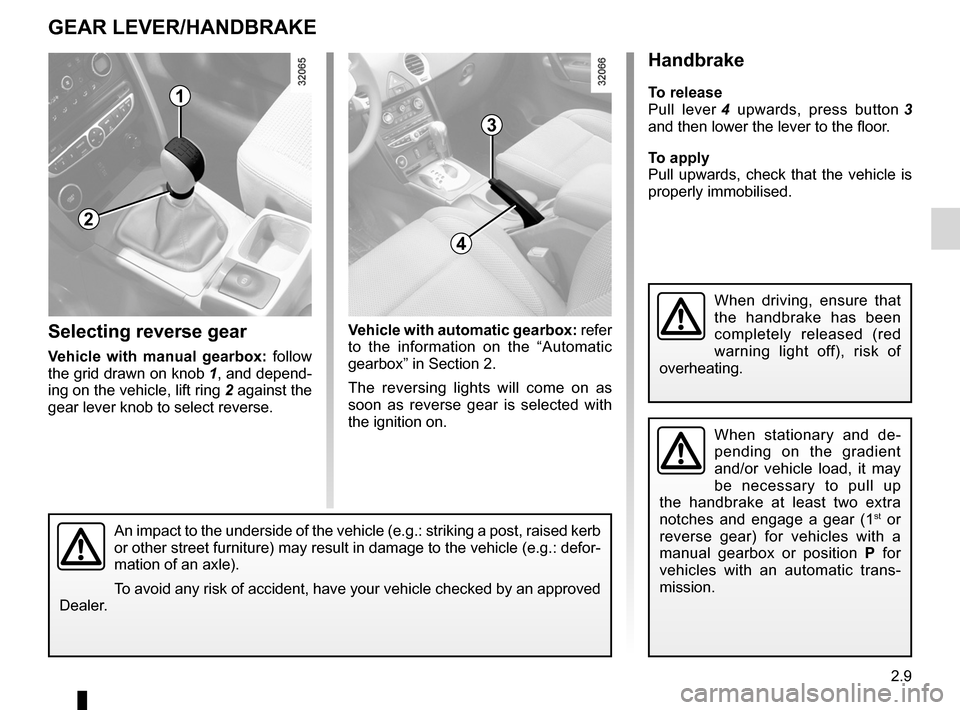
Selecting reverse gear
v ehicle with manual gearbox: follow
the grid drawn on knob 1, and depend -
ing on the vehicle, lift ring 2 against the
gear lever knob to select reverse.
Handbrake
To release
Pull lever 4 upwards, press button 3
and then lower the lever to the floor.
To apply
Pull upwards, check that the vehicle is
properly immobilised.
When stationary and de -
pending on the gradient
and/or vehicle load, it may
be necessary to pull up
the handbrake at least two extra
notches and engage a gear (1
st or
reverse gear) for vehicles with a
manual gearbox or position P for
vehicles with an automatic trans -
mission.
4
2
When driving, ensure that
the handbrake has been
completely released (red
warning light off), risk of
overheating.
v ehicle with automatic gearbox: refer
to the information on the “Automatic
gearbox” in Section 2.
The reversing lights will come on as
soon as reverse gear is selected with
the ignition on.
An impact to the underside of the vehicle (e.g.: striking a post, raised kerb
or other street furniture) may result in damage to the vehicle (e.g.: defor-
mation of an axle).
To avoid any risk of accident, have your vehicle checked by an approved
Dealer.
Page 89 of 233

JauneNoirNoir texte
2.11
ENG_UD27280_8
Frein de parking assist (X45 - H45 - Renault)
ENG_NU_977-2_H45_Ph2_Renault_2
ELECTRONIC PARKING BRAKE (2/4)
Special cases
When the vehicle is on an incline or
when towing a trailer, pull handle 2 for
approximately 3 seconds to fully apply
the parking brake.
Note: if the vehicle is not immobilised
despite fully applying the parking brake,
due to the steepness of the incline, the
message “Stop vehicle ” is displayed on
the instrument panel. The vehicle must
be parked elsewhere. Parking without applying the
parking brake
(if there is a risk of ice etc.):
–
Stop the engine by pressing the
engine on/off button 1;
– engage a gear (on vehicles with
manual gearboxes) or shift the gear
lever into position P (on vehicles with
automatic transmissions);
– simultaneously depress the brake
pedal and press switch 2 until indica-
tor light 3 goes out.
When the driver ’s door is opened, a
warning message will be displayed and
a beep sounds for around 5 seconds to
indicate that the parking brake has not
been applied.
Note: it is still possible to release the
parking brake as long as no door is
opened or closed and the vehicle is not
locked.
1
2
3
Brief stopTo manually activate the electronic
parking brake, (when stopping at a red
light, or stopping when the engine is
running, etc.): pull and release switch 2.
The brake is released as soon as the
vehicle is started up again.
Page 93 of 233

JauneNoirNoir texte
2.15
ENG_UD27288_2
Conseils : antipollution, conomies de carburant, conduite (X45 - H45 - Renault)
ENG_NU_977-2_H45_Ph2_Renault_2
ADvICE: antipollution, fuel economy and driving (2/3)
– Sporty driving uses a lot of fuel: drive
with a light right foot.
– Brake as little as possible. If you an-
ticipate an obstacle or bend in ad -
vance, you may then simply release
the accelerator pedal.
– Do not try to maintain the same
speed up a hill, accelerate no more
than you would on the level. Keep
your foot in the same position on the
accelerator pedal.
– Double declutching and accelerating
before switching off are unnecessary
in modern vehicles.
– Bad weather, flooded roads:
Do not drive through floods
if the water is above the
lower edge of the wheel
rims.Driving– Drive carefully for the first few miles
until the engine reaches its normal
operating temperature, rather than
let it warm up while the vehicle is sta-
tionary.
– Speed is expensive.
– Do not overrev the engine in the in-
termediate gears.
Always use the highest gear possi -
ble without labouring the engine.
On versions with an automatic gear-
box, it is preferable to keep the gear
lever in position D.
– Avoid sudden acceleration.
Exhaust gas monitoring
system
The exhaust gas monitoring system will
detect any operating faults in the vehi-
cle’s antipollution system.
If this system malfunctions, toxic sub -
stances may be released into the at -
mosphere or damage may occur.
ÄThis warning light on the in -
strument panel will indicate if
there are any faults in the system:
This lights up when the ignition is
switched on and goes out when the
engine is started.
– If it lights up continuously, consult an
approved Dealer as soon as possi -
ble;
– if it flashes, reduce the engine speed
until the light stops flashing. Contact
your approved dealer as soon as
possible.
Obstructions to the driver
On the driver ’s side, only
use mats suitable for the
vehicle, attached with the
pre-fitted components, and check
the fitting regularly. Do not lay one
mat on top of another.
There is a risk of wedging the
pedals
Page 96 of 233

tyres ...................................................... (up to the end of the DU)
tyre pressure monitor ............................(up to the end of the DU)
tyre pressure ......................................... (up to the end of the DU)
driving ................................................... (up to the end of the DU)
2.18
ENG_UD27289_6
Syst me de surveillance de pression des pneumatiques (X45 - H45 - Renault)
ENG_NU_977-2_H45_Ph2_Renault_2
Jaune NoirNoir texte
Tyre pressure monitor
TYRE PRESSURE MONITOR (1/3)
This system monitors the tyre pressure.
The pressures must be adjusted
when the tyres are cold.
If the tyre pressures cannot be checked
when the tyres are cold, assume an in-
crease of 0.2 to 0.3 bar (or 3 PSI).
Never deflate a hot tyre.
Operating principle
Each wheel (except for the emergency
spare wheel) has a sensor in the infla-
tion valve which periodically measures
the tyre pressure.
The system informs the driver via the
trip computer and warning system 1
that the tyres are sufficiently inflated
and warns if they are underinflated or
leaking.
1
This function is an addi -
tional driving aid.
However, the function does
not take the place of the
driver. It cannot, therefore, under
any circumstances replace the vig -
ilance or the responsibility of the
driver.
Check the tyre pressures, including
the emergency spare wheel, once a
month.
The operation of the tyre pressure
monitor may be affected by using
devices near the vehicle which op -
erate on the same frequency.
In this case, the system indicates a
drop in tyre pressure under normal
conditions.
The operation of the tyre pressure
monitor may be affected if snow
chains are fitted to the tyres or if the
tyres are stuck in snow.
Changing a wheel
Depending on use, the
system may take several
minutes for the new wheel
positions and pressures to be rec -
ognised; check the tyre pressures
after all operations.
Page 97 of 233

JauneNoirNoir texte
2.19
ENG_UD27289_6
Syst me de surveillance de pression des pneumatiques (X45 - H45 - Renault)
ENG_NU_977-2_H45_Ph2_Renault_2
TYRE PRESSURE MONITOR (2/3)
Changing a wheel
The tyre pressure monitor takes ap -
proximately 8 minutes to identify the
tyres which have been replaced. The
system will not operate during this time.
Fitting tyres(replacing tyres or fitting winter
tyres)
Since replacing tyres requires special
precautions, we advise you to contact
your approved dealer.
While the tyre pressure
monitor is identifying the
tyres which have been re -
placed, the information sent
by the system may be inaccurate
and this could have serious conse-
quences.
Emergency spare wheel
The emergency spare wheel has no
sensor, and cannot be recognised by
the system.
When it is fitted in the place of another
wheel, the system then detects an op-
erating fault.
Replacing wheels/tyres
This system requires specific equip -
ment (wheels, hubcaps, etc.).
Contact an approved dealer to fit new
tyres and to find out about available ac-
cessories compatible with the system
and available from your approved
dealer: the use of any other accessory
could affect the correct operation of the
system or damage a sensor.
Display
If warning lights 1 and 2 light up on the
instrument panel, this indicates there
is a fault relating to the tyre pressure
(flat tyre, puncture, system malfunction,
etc.).
An explanation of the indicator lights,
signals and messages is given on the
following page.
1
2
Page 100 of 233

2.22
ENG_UD27290_7
Transmission int grale : 4 roues motrices : 4WD (X45 - H45 - Renault)
ENG_NU_977-2_H45_Ph2_Renault_2
Jaune NoirNoir texte
ALL-wHEEL DRIvE SYSTEM: 4 wheel drive (4wD) (2/3)
Special note on all-wheel
drive system
– The vehicle may make more
noise when the “AUTO” or “4WD
Lock” modes are activated. This
is normal;
– if the system detects a difference
in the size of the front and rear
wheels (as is the case, for exam-
ple, when the wrong size tyres
are fitted, or if the tyres are un -
der-inflated or significantly worn
on one axle etc.) the message
“4WD not available ” is displayed
on the instrument panel and the
indicator light
‘ flashes.
Select “2WD” mode and drive at
a moderate speed;
– always use four tyres with the
same level of wear;
– as soon as the vehicle speed ex-
ceeds 24 mph (40 km/h) in “4WD
Lock” mode, the system automat-
ically switches back to “AUTO”
mode. The indicator light goes
out;
– when the front and rear wheels
are turning at different speeds
(for example, when driving on
uneven road surfaces, sand or
mud, or when being towed, tyres
with different levels of wear), the
oil temperature may rise, given
the mechanical stresses. In this
case, the system automatically
switches back to “2WD” mode to
prevent overheating. The mes-
sage “ 4w D not available ” is
displayed on the instrument
panel and the
‘ or ’
indicator light comes on. Park
the vehicle in a safe place and
wait until the message “4WD not
available ” disappears.
If the warning appears again,
contact an approved Dealer.
Operating faults
When the system detects an operating
fault the message “ Check 4WD” and
warning light
© appear on the in-
strument panel.
Contact your approved Dealer as soon
as possible.
Page 102 of 233

ESP: Electronic Stability Program ........ (up to the end of the DU)
ABS ...................................................... (up to the end of the DU)
anti-lock braking system: ABS ..............(up to the end of the DU)
Electronic Stability Program: ESP ........ (up to the end of the DU)
driving ................................................... (up to the end of the DU)
2.24
ENG_UD27148_7
Dispositifs de correction et d’assistance la conduite (X45 - H45 - Renault)
ENG_NU_977-2_H45_Ph2_Renault_2
Jaune NoirNoir texte
Driver correction devices
DRIvER CORRECTION DEvICES (1/5)
Depending on the vehicle, this is com-
posed of:
– the anti-lock braking system ABS;
– the electronic stability control
ESC with traction control ASR;
– the emergency brake assist;
– the hill descent control;
– the hill start assistance. Operating faults:
–
If the message “ Check ABS” is dis-
played and the
x and ©
warning lights on the instrument
panel come on when driving, brak-
ing safety is still guaranteed, but
without ABS;
– if the message “Brake system fault”
is displayed and the
x, D
and
® warning lights on the in-
strument panel come on when driv -
ing, there is a fault in the braking
system.
Consult an approved Dealer.
These functions are an ad-
ditional aid in the event of
critical driving conditions,
enabling the vehicle behav -
iour to be adapted to suit the driving
conditions.
However, the functions do not take
the place of the driver. They do
not increase the vehicle’s limits
and should not encourage you
to drive more quickly. Therefore,
they can under no circumstances
replace the vigilance or responsibil -
ity of the driver when manoeuvring
the vehicle (the driver must always
be ready for sudden incidents which
may occur when driving).
ABS (anti-lock braking
system)
Under heavy braking, the ABS prevents
the wheels from locking, allowing the
stopping distance to be managed and
keeping control of the vehicle.
Under these circumstances, the vehi -
cle can be steered to avoid an obstacle
whilst braking. In addition, this system
can increase stopping distances, par -
ticularly on roads with low surface grip
(wet ground etc.).
You will feel a pulsation through the
brake pedal each time the system is
activated. The ABS does not in any way
improve the vehicle's physical perform-
ance relating to the road surface and
roadholding. It is still essential to follow
the rules of good driving practice (such
as driving at a safe distance from the
vehicle in front etc.).
In an emergency, apply firm and
continuous pressure to the brake
pedal. There is no need to pump
it repeatedly. The ABS will modu -
late the force applied in the braking
system.
Yo u r b r a k i n g s y s t e m s
are partially operational.
However, it is dangerous
to brake suddenly and
it is essential to stop immediately,
as soon as traffic conditions allow.
Contact an approved dealer.
Page 103 of 233

JauneNoirNoir texte
2.25
ENG_UD27148_7
Dispositifs de correction et d’assistance la conduite (X45 - H45 - Renault)
ENG_NU_977-2_H45_Ph2_Renault_2
DRIvER CORRECTION DEvICES (2/5)
Electronic stability control
ESC with understeer control
and traction control ASR
Electronic stability control ESC
This system helps you to keep control
of the vehicle in critical driving condi -
tions (avoiding an obstacle, loss of grip
on a bend, etc.).
Operating principle
A sensor in the steering wheel detects
the direction selected by the driver.
Other sensors throughout the vehicle
measure the actual direction.
The system compares the direction se-
lected by the driver and the actual di -
rection of the vehicle and corrects this
as necessary by applying the brakes
selectively and/or acting on the engine
power. Traction control
ASR
This system helps to limit wheelspin of
the drive wheels and to control the ve-
hicle when pulling away accelerating or
decelerating.
Operating principle
Using the wheel sensors, the system
measures and compares the speed of
the drive wheels at all times and slows
down their over-rotation. If a wheel is
starting to slip, the system brakes au -
tomatically until the drive supplied be -
comes compatible with the level of grip
under the wheel again.
The system also adjusts the engine
speed to the grip available under the
wheels, independently of the pressure
exerted on the accelerator pedal.
lit indicates that the ESC system
(with the ASR) is active. Operating faults
When the system detects an operat
-
ing fault the message “Check ESC” and
warning light
© and appear
on the instrument panel. In this case,
the ESC and ASR are deactivated.
Consult an approved dealer.