2012 RENAULT KOLEOS belt
[x] Cancel search: beltPage 49 of 233

JauneNoirNoir texte
1.43
ENG_UD27145_6
Poste de conduite direction droite (X45 - H45 - Renault)
ENG_NU_977-2_H45_Ph2_Renault_1
dRIvINg pOsITION: RIghT -hANd dRIvE (2/2)
The fittings described below dEpENd ON ThE vEhIcLE EQUIpMENT ANd cOUNTRY.
11 Instrument panel.
12 Location of driver’s air bag and horn.
13 Stalk for:
– Windscreen and rear screen wash/
wiper;
– Trip computer and warning system
information readout control;
14 Vents.
15 Switches:
– Headlight adjustment control knob;
– Instrument panel and dashboard
brightness control knob;
– Parking distance control deactivation
switch;
– Electronic stability control deactiva -
tion switch.
16 Bonnet release.
17 Tailgate release. 18
Cruise control/speed limiter con -
trols.
19 Passenger seat belt indicator light.
20 Heating and ventilation controls.
21 Ignition switch.
22 Card reader.
23 Switch for:
– Hill Descent Control (HDC);
– Cruise control and speed limiter.
24 Navigation system.
25 Manual or electronic parking brake.
26 Gear lever.
27 Cigar lighter.
28 Audio equipment.
29 Glovebox.
1
Vents
2 Location for passenger air bag.
3 Front passenger airbag deactivation
warning light.
4 Central door locking switch.
5 Hazard warning lights switch.
6 Seat belt unfastened and passenger
air bag deactivated warning lights.
7 Display (depending on the vehicle)
of time, temperature, radio informa -
tion, navigation system information,
etc.
8 Windscreen demister outlet.
9 Centre air vents.
10 Stalk for:
– Direction indicator lights;
– Exterior lights;
– Front fog lights;
– Rear fog light.
Page 53 of 233

JauneNoirNoir texte
1.47
ENG_UD23307_5
Témoins lumineux (X45 - H45 - Renault)
ENG_NU_977-2_H45_Ph2_Renault_1
W ARNINg LIghTs (4/4)
™front seat belt reminder
warning light
This comes on when the engine is
started then, if the driver’s or front pas-
senger’s seat belt (if this seat is occu-
pied) is not fastened and the vehicle
has reached approximately 12 mph
(20 km/ h), it flashes and a bleep sounds
for around 120 seconds.
Note: an object placed on the passen-
ger seat base may activate the warning
light in some cases.
\bdriver correction devices in-
dicator light
Refer to information on “Driver correc -
tion devices” in Section 2.
xAnti-lock braking warning
light
This comes on when the ignition is
switched on and goes out after a few
seconds. If it does not go out after the
ignition is switched on, or lights up
when driving, there is a fault with the
ABS. The braking system then oper -
ates as it would on a vehicle without
the ABS system: Contact an authorised
dealer as soon as possible.
}h andbrake “on” or elec -
tronic parking brake warn -
ing light
Refer to the information on the
“Handbrake” or “Electronic parking
brake” in Section 2.
uside light tell-tale light
áh eadlight main beam tell -
tale light
kd ipped beam headlight tell -
tale light
gfront fog light tell-tale light
fRear fog light tell-tale light
˜Right-hand direction indica -
tor tell-tale light
–Left-hand direction indicator
tell-tale light
The presence and operation of the warning lights dEpENd ON ThE EQUIpMENT ANd cOUNTRY.
Page 144 of 233
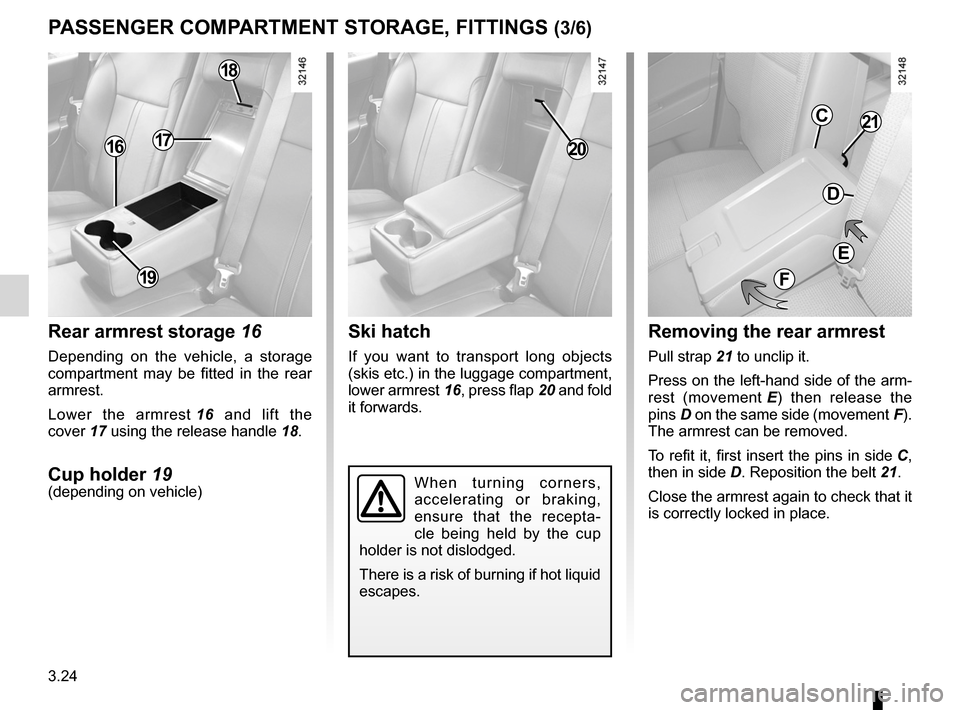
armrest:rear .................................................................. (current page)
3.24
ENG_UD23672_6
Rangements, aménagements habitacle (X45 - H45 - Renault)
ENG_NU_977-2_H45_Ph2_Renault_3
Jaune NoirNoir texte
PASSENgER coMPARTMENT ST oRAgE, FITTINgS (3/6)
Rear armrest storage 16
Depending on the vehicle, a storage
compartment may be fitted in the rear
armrest.
Lower the armrest 16 and lift the
cover 17 using the release handle 18.
cup holder 19(depending on vehicle)
Ski hatch
If you want to transport long objects
(skis etc.) in the luggage compartment,
lower armrest 16, press flap 20 and fold
it forwards.
Removing the rear armrest
Pull strap 21 to unclip it.
Press on the left-hand side of the arm-
rest (movement E ) then release the
pins D on the same side (movement F).
The armrest can be removed.
To refit it, first insert the pins in side C,
then in side D. Reposition the belt 21.
Close the armrest again to check that it
is correctly locked in place.
19
1617
18
20
21
W h e n t u r n i n g c o r n e r s ,
accelerating or braking,
ensure that the recepta -
cle being held by the cup
holder is not dislodged.
There is a risk of burning if hot liquid
escapes.
F
E
c
D
Page 150 of 233

rear seatsfunctions ......................................... (up to the end of the DU)
rear bench seat ..................................... (up to the end of the DU)
3.30
ENG_UD8576_2
Banquette arri re (X45 - H45 - Renault)
ENG_NU_977-2_H45_Ph2_Renault_3
Jaune NoirNoir texte
Rear bench seat functions
REAR BENch SEAT FuNcTIoNS (1/2)
When adjusting the seat, always ensure that the seat belt can return to
its original position.
When refitting the seatback, make sure it is correctly locked in place.
2
3
4
5
1
To fold down the rear seats
from inside the passenger
compartment
– lower the headrest;
– move the front seat as far forward as
necessary;
– feed the seat belt into the clip 5;
– pull lever 3: the seat base is raised;
– pull handle 4 and fold down the seat-
back.
Check that no-one, includ -
ing animals, is in the vicin -
ity of the rear bench seat
before pulling handle 1.
Risk of injury.
To fold down the rear
seats from the luggage
compartment
(depending on vehicle)
– lower the headrests;
– move the front seat as far forward as
necessary;
– feed the seat belt into the clip 5;
– use the controls 1.
To return the seat to its
original position
– lift the seatback and return it to its
original position;
– fold down the seat base 2;
– ensure that the seat is correctly
locked in position.
When the seat belt is not being used,
attach it to hook 5.
Page 151 of 233

JauneNoirNoir texte
3.31
ENG_UD8576_2
Banquette arri re (X45 - H45 - Renault)
ENG_NU_977-2_H45_Ph2_Renault_3
REAR BENch SEAT FuNcTIoNS (2/2)
To adjust the seatback on the
rear seat
(depending on vehicle)
There are 5 position settings for the
rear seatback inclination. Tilt it while
raising the lever 6.
6
When adjusting the seat,
always ensure that the seat
belt can return to its original
position.
When moving the rear bench seat,
make sure the bench seat anchor -
age points are clean (they should be
free from grit, cloths etc.).
When refitting the seatback, make
sure it is correctly locked in place.
If seat covers are fitted, make sure
these do not prevent the seatback
latch from locking in.
Make sure that the seat belts are
positioned correctly.
Reposition the headrests.
Page 155 of 233

transporting objectsin the luggage compartment ........... (up to the end of the DU)
towing rings .......................................... (up to the end of the DU)
towing towing equipment ............................ (up to the end of the DU)
towing equipment fitting ............................................... (up to the end of the DU)
towing a caravan .................................. (up to the end of the DU)
tailgate .................................................. (up to the end of the DU)
3.35
ENG_UD23502_5
Transport d’objets dans le coffre, remorquage (attelage) (X45 - H45 - Renault)
ENG_NU_977-2_H45_Ph2_Renault_3
32323
Transporting objects in the boot/towing
TRANSPoRTINg oBjEcTS IN ThE luggAgE coMPARTMENT/TowINg (towing equipment)
B
c
Always place the objects to be trans -
ported so that their largest side rests
against the back of the rear bench
seat, for normal loads (example A ), or
against the back of the front seats when
the rear bench seatbacks are folded
down (example B).
A
Always position the heavi -
est items directly on the
floor. Use the lashing points
on the floor of the luggage
compartment, if these are fitted to
the vehicle. The luggage should be
loaded in such a way that no items
will be thrown forward and strike the
occupants if the driver has to brake
suddenly. Fasten the rear seat belts,
even if the seats are not occupied.
C: 1138 mm
Permissible nose weight, maximum
permissible towing weight, braked
and unbraked: refer to the information
on “Weights” in Section 6.
32322
Page 156 of 233

towing rings .......................................... (up to the end of the DU)
luggage retaining net ............................ (up to the end of the DU)
transporting objects luggage net ..................................... (up to the end of the DU)
3.36
ENG_UD20993_3
Points d’arrimage / Filet de retenue de bagages (X45 - H45 - Renault)
ENG_NU_977-2_H45_Ph2_Renault_3
Anchorage points/luggage net
ANchoRAgE PoINTS/luggAgE NET
Anchorage points 1
It is prohibited to attach a
luggage net to one of the
hooks 3 if this is already
being used to hold a child
seat in place (refer to information on
“Child safety” in section 1).
Risk of injury in the event of an
impact.
luggage net
The luggage net can be attached using
anchorage points 1, 2 and 3.
2
Always position the heavi -
est items directly on the
floor. If the vehicle is
equipped with anchorage
points 1 on the luggage compart -
ment floor, use them. The luggage
should be loaded in such a way that
no items will be thrown forward and
strike the occupants if the driver has
to brake suddenly. Fasten the rear
seat belts, even if the seats are not
occupied.
3
1
1
The luggage net must not
be used to restrain or hold
objects.
Risk of injury.
Page 172 of 233

maintenance:interior trim ...................................... (up to the end of the DU)
interior trim maintenance ................................... (up to the end of the DU)
cleaning: inside the vehicle ............................ (up to the end of the DU)
4.14
ENG_UD22866_8
Entretien des garnitures intérieures (X35 - X45 - X65 - J77 - X81 - J81 - X85 - X91 - B91 - K91 - D91 - X83 - X61 - X77 ph2 - X95 - B95 - D95 - E95 - K95 - J95 - R95 -
ENG_NU_977-2_H45_Ph2_Renault_4
Jaune NoirNoir texte
Interior trim maintenance
Glass instrument panel(e.g. instrument panel, clock, exterior
temperature display, radio display, etc.)
Use a soft cloth (or cotton wool).
If this does not clean it properly, use a
soft cloth (or cotton wool) slightly mois-
tened with soapy water and then wipe
clean with a soft damp cloth or cotton
wool.
Finally, carefully dry off with a soft dry
cloth.
Cleaning products containing alco -
hol must not be used under any cir-
cumstances.
Seat belts
These must be kept clean.
Use products selected by our Technical
Department (Approved outlets) or
warm, soapy water and a sponge and
wipe with a dry cloth.
Detergents or dyes must not be used
under any circumstances.
InteRIOR tRIM MAIntenAnCe (1/2)
textiles (seats, door trim, etc)
Vacuum-clean the textiles regularly.
Liquid stain
Use soapy water.
Dab lightly (never rub) with a soft cloth,
rinse and remove the excess.
Solid or pasty stain
Carefully remove the excess solid or
pasty material immediately with a
spatula (working from the edges to the
centre to avoid spreading the stain).
Clean as for a liquid stain.
Special instructions for sweets or
chewing gum
Put an ice cube on the stain to solidify
it, then proceed as for a solid stain.
A well-maintained vehicle will last
longer. It is therefore recommended to
maintain the interior of the vehicle regu-
larly.
A stain should always be dealt with
swiftly.
Whatever type of stain is on the trim,
use
cold (or warm) soapy water with
natural soap.
Detergents (washing-up liquid, pow -
dered products, alcohol-based prod-
ucts) should not be used.
Use a soft cloth.
Rinse and soak up the excess.
For further recommendations for
maintaining the interior, and/or for
any unsatisfactory results, please
see an authorised dealer.