2012 RENAULT KANGOO ZERO EMISSION child lock
[x] Cancel search: child lockPage 47 of 213
child safety............................................ (up to the end of the DU)
child restraint/seat ................................ (up to the end of the DU)
child restraint/seat ................................ (up to the end of the DU)
child restraint/seat ................................ (up to the end of the DU)
child seats ............................................. (up to the end of the DU)
transporting children ............................. (up to the end of the DU)
children ................................................. (up to the end of the DU)
1.42
ENG_UD20087_1
Sécurité enfants: généralités (X91 - B91 - K91 - Renault\
)
ENG_NU_911-4_F61e_Renault_1
Jaune NoirNoir texte
Child safety: General information
chilD SAFetY : general information (1/2)
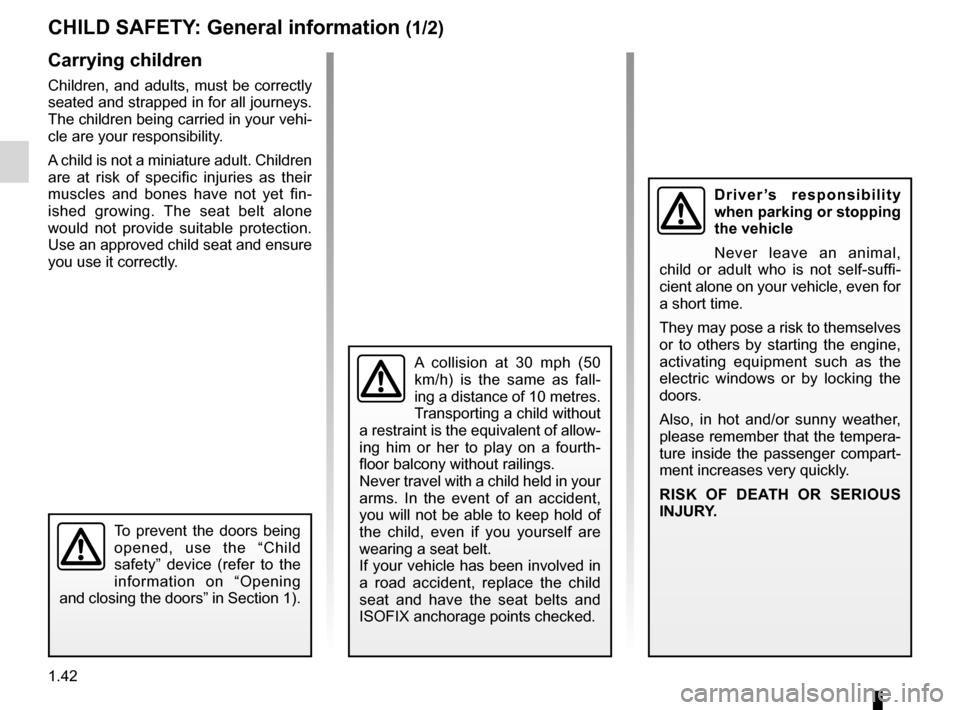
carrying children
Children, and adults, must be correctly
seated and strapped in for all journeys.
The children being carried in your vehi-
cle are your responsibility.
A child is not a miniature adult. Children
are at risk of specific injuries as their
muscles and bones have not yet fin -
ished growing. The seat belt alone
would not provide suitable protection.
Use an approved child seat and ensure
you use it correctly.
A collision at 30 mph (50
km/h) is the same as fall -
ing a distance of 10 metres.
Transporting a child without
a restraint is the equivalent of allow-
ing him or her to play on a fourth -
floor balcony without railings.
Never travel with a child held in your
arms. In the event of an accident,
you will not be able to keep hold of
the child, even if you yourself are
wearing a seat belt.
If your vehicle has been involved in
a road accident, replace the child
seat and have the seat belts and
ISOFIX anchorage points checked.
To prevent the doors being
opened, use the “Child
safety” device (refer to the
information on “Opening
and closing the doors” in Section 1).
D r i v e r ’s r e s p o n s i b i l i t y
when parking or stopping
the vehicle
Never leave an animal,
child or adult who is not self-suffi -
cient alone on your vehicle, even for
a short time.
They may pose a risk to themselves
or to others by starting the engine,
activating equipment such as the
electric windows or by locking the
doors.
Also, in hot and/or sunny weather,
please remember that the tempera-
ture inside the passenger compart-
ment increases very quickly.
ri SK OF D eAth Or S eri OUS
iNJUr Y.
Page 50 of 213

child safety............................................ (up to the end of the DU)
child restraint/seat ................................ (up to the end of the DU)
child seats ............................................. (up to the end of the DU)
towing rings .......................................... (up to the end of the DU)
Isofix ..................................................... (up to the end of the DU)
transporting children ............................. (up to the end of the DU)
child restraint/seat ................................ (up to the end of the DU)
1.45
ENG_UD26785_4
Sécurité enfants : choix de la fixation siège enfant (X61 - F6\
1 - K61 - Renault)
ENG_NU_911-4_F61e_Renault_1
Choosing a child seat mounting
chilD SAFetY : choosing a child/baby seat mounting (1/2)
The are two ways of attaching child
seats: via the seat belt or using the
ISOFIX system.
Attachment via the seat belt
The seat belt must be adjusted to
ensure that it is effective in the event of
harsh braking or an impact.
Ensure that the strap paths indicated
by the child seat manufacturer are re-
spected.
Always check that the seat belt is cor-
rectly fastened by pulling it up, then
pulling it out fully whilst pressing on the
child seat.
Check that the seat is correctly held by
moving it from side to side and back
to front: the seat should remain firmly
fixed.
Check that the child seat has not been
installed at an angle and that it is not
resting against a window. Attachment with the iSOFiX system
Authorised ISOFIX child seats are ap
-
proved in accordance with regulation
ECE-R44 in one of the three following
scenarios:
– ISOFIX universal 3 point forward -
facing seat;
– ISOFIX semi-universal 2 point seat;
– specific.
For the latter two, check that your child
seat can be installed by consulting the
list of compatible vehicles.
Attach the child seat with the ISOFIX
locks, if these are provided. The ISOFIX
system allows quick, easy, safe fitting.
The ISOFIX system consists of 2 rings
and, in some cases, a third ring.
Before using an ISOFIX
child seat that you pur -
chased for another vehicle,
check that its installation is
authorised. Consult the list of ve -
hicles which can be fitted with the
seat with the equipment manufac -
turer.
No modifications may be
made to the component
parts of the restraint system
(belts, ISOFIX and seats
and their mountings) originally fitted.
The seat belt must never
be twisted or the tension
relieved. Never pass the
shoulder strap under the
arm or behind the back.
Check that the seat belt has not
been damaged by sharp edges.
If the seat belt does not operate nor-
mally, it will not protect the child.
Consult an approved Dealer. Do not
use this seat until the seat belt has
been repaired.
Do not use the child seat
if it may unfasten the seat
belt restraining it: the base
of the seat must not rest on
the buckle and/or catch of the seat
belt.
Page 51 of 213

ENG_NU_911-4_F61e_Renault_1
The two rings 1 are located between
the seatback and the se")
1.46
ENG_UD26785_4
Sécurité enfants : choix de la fixation siège enfant (X61 - F6\
1 - K61 - Renault)
ENG_NU_911-4_F61e_Renault_1
The two rings 1 are located between
the seatback and the seat base, behind
the zip fasteners, and are identified by
a marking.
To ensure your child seat can be easily
fitted and locked on rings 1, use access
guides 2 on the child seat.
The third ring is used to attach the
upper strap on some child seats.
3
chilD SAFetY : choosing a child/baby seat mounting (2/2)
Depending on the vehicle, pass the
strap between wheel arch liner 4 and
the underside of upper partition 5.
From the luggage compartment, attach
the strap hook to ring 3 on the corre -
sponding side. Check that the bench
seatback is correctly locked.
Pull the belt so that the back of the child
seat comes into contact with the back
of the vehicle seat.
The ISOFIX anchorage
points have been exclu -
sively designed for child
seats with the ISOFIX
system. Never fit a different type of
child seat, seat belt or other objects
to these anchorage points.
Check that nothing is obstructing
the anchorage points.
If your vehicle has been involved in
a road accident, have the ISOFIX
anchorage points checked and re -
place your child seat.
The anchoring points (rings) in luggage compartment 3 cannot be used if
they are already being used to mount two of the following three compo-
nents: luggage net, load in the luggage compartment or child seat.
4
5
3
1
2
Page 57 of 213

air bagdeactivating the front passenger air bags
(up to the end of the DU)
air bag activating the front passenger air bags
(up to the end of the DU)
child safety ............................................ (up to the end of the DU)
child restraint/seat ................................ (up to the end of the DU)
transporting children ............................. (up to the end of the DU)
front passenger air bag deactivation .... (up to the end of the DU)
child restraint/seat ................................ (up to the end of the DU)
1.52
ENG_UD28660_3
Sécurité enfants : désactivation/activation airbag passager ava\
nt (X61 - F61 - Renault)
ENG_NU_911-4_F61e_Renault_1
Jaune NoirNoir texte
Deactivating/activating the front passenger airbag
Deactivating the front
passenger air bags
(on equipped vehicles)
You must deactivate the devices in ad-
dition to the front passenger seat belt
before fitting a child seat in the front
passenger seat. t
o deactivate the airbags: with the
vehicle stopped and the ignition off,
press and turn lock 1 to the OFF posi-
tion.
With the ignition on, you must check
that warning light 2 is lit on the central
display and, depending on the vehicle,
that the message “passenger airbag
off” is displayed.
NB: on equipped vehicles, the side
airbag is also deactivated.
this light remains permanently lit to
let you know that you can fit a child
seat.
chilD SAFetY : deactivating/activating the front passenger airbag (1/3)
The passenger air bag must
only be deactivated or acti-
vated with the ignition off.
If it is interfered with when
the vehicle is being driven, indicator
lights
å and © will come
on.
Switch the ignition off then on again
to reset the air bag in accordance
with the lock.
2
1
DANger
S i n c e f r o n t p a s s e n g e r
airbag triggering and the
position of a rear-facing
child seat are incompatible, Never
use a restraining device for rear -
facing children on a seat with an
A ctiv Ate D A irBA g in front of it.
This provides a risk of DeAth or
SeriOUS iNJUr Y to the chilD.
Page 59 of 213

ENG_NU_911-4_F61e_Renault_1
The passenger air bag must
only be deactivated or acti-")
1.54
ENG_UD28660_3
Sécurité enfants : désactivation/activation airbag passager ava\
nt (X61 - F61 - Renault)
ENG_NU_911-4_F61e_Renault_1
The passenger air bag must
only be deactivated or acti-
vated with the ignition off.
If it is interfered with when
the vehicle is being driven, indicator
lights
å and © will come
on.
Switch the ignition off then on again
to reset the air bag in accordance
with the lock.
Operating faults
In the event that the front passenger air
bag activation/deactivation system is
faulty, child seats must not be fitted to
the front seat.
Allowing any other passenger to sit in
that seat is not recommended.
Contact your approved Dealer as soon
as possible.
Activation of the front
passenger air bag
You should reactivate the air bag as
soon as you remove the child seat from
the front passenger seat to ensure the
protection of the front passenger in the
event of an impact.
r eactivating the airbags: with the
vehicle stopped and the ignition off,
press and turn lock 1 to the ON posi -
tion.
With the ignition on, you must check
that the warning light 2 is off.
The front passenger seat belt additional
restraint systems are activated.
2
chilD SAFetY : deactivating/activating the front passenger airbag (3/3)
1
Page 93 of 213

2.2
ENG_UD25284_3
Démarrage (X61 électrique - Renault)
ENG_NU_911-4_F61e_Renault_2
Starting, stopping the engine
“On” position MThe ignition is switched on:
Start position D
Starting the engine
– Move lever 1 to position P only ;
– turn the key to position D and then
release it.
Warning light
Ṑ may flash on the in -
strument panel, along with a beep. As
soon as light
Ṑ stops flashing and
the beep stops, the vehicle is ready to
drive.
Stopping the engine
With the engine running, turn the key
back to the “Stop” position St. Warning
light
Ṑ goes out.
Starting/St OPPing tHE EnginE
Driver’s responsibility
Never leave your vehi -
cle with the key inside and
never leave a child (or a
pet) unsupervised, even for a short
while.
There is a risk that they could start
the engine or operate electrical
equipment (electric windows etc.)
and trap part of their body (neck,
arms, hands, etc.).
Risk of serious injury.
Never switch off the ignition before
the vehicle has come to a complete
stop. Switching off the engine dis -
ables the assistance equipment:
brakes, power-assisted steering,
etc., and the passive safety devices
such as airbagsand pretensioners.
“Stop and steering lock”
position St
To unlock: turn the key and the steering
wheel slightly.
To lock: remove the key and turn the
steering wheel until the steering column
locks.
“accessories” position a
When the ignition is switched off, any
accessories (radio, etc.) will continue to
function.The vehicle can only be started if
the charging cord is unplugged from
the vehicle.
The vehicle can only be started if
the selector lever is at P. Please see
the information on “Gear control” in
Section 2.
1
Page 126 of 213

electric windows ................................... (up to the end of the DU)
child safety ............................................................. (current page)
3.15
ENG_UD20962_2
Vitres (X61 - F61 - Renault)ENG_NU_911-4_F61e_Renault_3
Electric windows
electric windows
With the ignition on:
– press the switch for the window
concerned to lower it to the desired
height;
– lift the switch for the window con -
cerned to raise it to the desired
height.
From the driver’s seat
Operate the switches as follows:
– 1 for the driver’s side;
– 2 for the front passenger side.
eleCtriC WindoWs (1/2)
From the front passenger seat
Operate switch 3.
1
23
driver’s responsibility
Never leave your vehicle
with the remote control unit
inside and never leave a
child (or a pet) unsupervised, even
for a short while.
The reason for this is that the child
may endanger himself or others
by starting the vehicle, activating
equipment such as the electric win-
dows, or locking the doors. If any
part of the body becomes trapped,
reverse the direction of the window
immediately by pressing the rele -
vant switch. Risk of serious injury.
Page 208 of 213

7.1
FRA_UD29098_4
Index (X61 - F61 - Renault)
ENG_NU_911-4_F61e_Renault_7
AlphAbeticAl index (1/5)
A
ABS ........................................................................ 2.10 – 2.11
accessories........................................................................ 5.35
accessories socket ............................................................ 3.17
additional heating fuel ........................................................ 1.86
additional heating tank ....................................................... 1.86
additional methods of restraint .......................................... 1.41
additional heating ..................................................... 3.9 – 3.10
additional heating fuel tank .......................................... 1.86
additional tank capacity ..................................................... 1.86
additional tank filling .......................................................... 1.86
air bag .................................................................... 1.37 → 1.41
activating the front passenger air bags ............ 1.52 → 1.54
deactivating the front passenger air bags ........ 1.52 → 1.54
air conditioning ................................................. 3.4 → 3.6, 3.11
air vents ...................................................................... 3.2 – 3.3
anti-corrosion check .............................................. 6.14 → 6.18
anti-corrosion protection ...................................................... 4.9
anti-lock braking system: ABS ................................2.10 – 2.11
ashtrays ............................................................................. 3.17
audible and visual signals .................................................. 1.77
b
12 volt battery breakdown recovery ......................................... 5.24 – 5.25
maintenance ......................................................... 4.6 – 4.7
12 volt battery ........................ 1.2 → 1.6, 4.6 – 4.7, 5.24 – 5.25
battery troubleshooting ................................................. 5.24 – 5.25
battery (remote control) ..................................................... 5.36
bonnet ......................................................................... 4.2 – 4.3
brake fluid ............................................................................ 4.5
brake lights changing bulbs .................................................. 5.18 – 5.19
bulbs changing .......................................................... 5.15 → 5.23c
changing a bulb
............................... 5.15 → 5.17, 5.21 → 5.23
changing a wheel ............................................................... 5.10
changing gear ............................................................. 2.3 – 2.4
charge meter ....................................................... 1.64, 2.5, 2.8
charging cord .................................................. 1.8 → 1.13, 1.16
charging flap ............................................................ 1.7 → 1.13
charging socket ..................................... 1.2 → 1.6, 1.8 → 1.13
child minder mirror ............................................................. 3.14
child restraint/seat ............................. 1.42 – 1.43, 1.45 → 1.54
child safety .....1.14, 1.16, 1.18, 1.42 – 1.43, 1.45 → 1.54, 3.15
child seats .......................................... 1.42 – 1.43, 1.45 → 1.51
children ................................................................... 1.42 – 1.43
cigar lighter ........................................................................ 3.17
cleaning: inside the vehicle .............................................. 4.11 – 4.12
clock .................................................................................. 1.75
closing the doors ................................................... 1.17 → 1.21
connected services .............................................................. 1.3
control instruments ................................................ 1.63 → 1.71
controls .................................................................. 1.56 → 1.59
coolant ................................................................................. 4.4
courtesy light .......................................................... 3.12 – 3.13
courtesy mirrors ................................................................. 3.14
cruise control ......................................................... 2.15 → 2.18
d
dashboard .............................................................. 1.56 → 1.59
deadlocking the doors ....................................................... 1.16
de-icing ................................................................................ 3.5
dimensions ................................................................. 6.5 – 6.6
display ................................................................... 1.60 → 1.65
doors ...................................................................... 1.17 → 1.24
driver’s position ..................................................... 1.56 → 1.62
driving .................................................. 2.3 → 2.6, 2.10 → 2.20