Page 257 of 502

CD/DVD DISC MAINTENANCE
To keep a CD/DVD in good condition, take the following
precautions:
1. Handle the disc by its edge; avoid touching the
surface.
2. If the disc is stained, clean the surface with a soft cloth,
wiping from center to edge.
3. Do not apply paper or tape to the disc; avoid scratch-
ing the disc.
4. Do not use solvents such as benzene, thinner, cleaners,
or anti-static sprays.
5. Store the disc in its case after playing.
6. Do not expose the disc to direct sunlight.
7. Do not store the disc where temperatures may become
too high. NOTE: If you experience difficulty in playing a particu-
lar disc, it may be damaged (i.e., scratched, reflective
coating removed, a hair, moisture or dew on the disc)
oversized, or have protection encoding. Try a known
good disc before considering disc player service.
RADIO OPERATION AND MOBILE PHONES
Under certain conditions, the mobile phone being on in
your vehicle can cause erratic or noisy performance from
your radio. This condition may be lessened or eliminated
by relocating the mobile phone antenna. This condition is
not harmful to the radio. If your radio performance does
not satisfactorily “clear” by the repositioning of the
antenna, it is recommended that the radio volume be
turned down or off during mobile phone operation when
not using Uconnect™ (if equipped).
4 UNDERSTANDING YOUR INSTRUMENT PANEL 255
Page 258 of 502

CLIMATE CONTROLS
The Climate Control System allows you to regulate the
temperature, amount, and direction of air circulating
throughout the vehicle. The controls are located on the
instrument panel below the radio.
NOTE: During snowplow usage on vehicles equipped
with outside temperature display, the display may show
higher temperatures than the outside ambient tempera-
ture. The higher displayed temperature is due to blocked
or reduced airflow to the underhood ambient tempera-
ture sensor caused by the snowplow. In addition, on
vehicles equipped with Automatic Temperature Control
(ATC), it is suggested that the interior cabin temperature
be manually controlled should the system not perform as
desired while in automatic mode. Both the outside tem-
perature display and ATC operation will return to nor-
mal when the snowplow is removed. Manual Heating And Air Conditioning System
The controls for the manual heating and air conditioning
system in this vehicle consist of a series of outer rotary
dials and inner push knobs. These comfort controls can
be set to obtain desired interior conditions.
1 – Front Blower 4 – DEFROST Mode
2 – Temperature Control 5 – Air Conditioning (A/C)
3 – MODE Control 6 – RECIRCULATION Control256 UNDERSTANDING YOUR INSTRUMENT PANEL
Page 309 of 502

Four-Wheel Anti-Lock Brake System
WARNING!The Four-Wheel Anti-Lock Brake System contains
sophisticated electronic equipment. It may be sus-
ceptible to interference caused by improperly in-
stalled or high output radio transmitting equipment.
This interference can cause possible loss of anti-lock
braking capability. Installation of such equipment
should be performed by qualified professionals.
The Four-Wheel Anti-Lock Brake System (ABS) is de-
signed to aid the driver in maintaining vehicle control
under adverse braking conditions. The system operates
with a separate computer to modulate hydraulic pressure
to prevent wheel lockup and help avoid skidding on
slippery surfaces. The system’s pump motor runs during an ABS stop to
provide regulated hydraulic pressure. The pump motor
makes a low humming noise during operation. This is
normal.
The ABS conducts a low-speed selftest at about 10 mph
(16 km/h). If you have your foot lightly on the brake
while this test is occurring, you may feel slight pedal
movement. The movement can be more apparent on ice
and snow. This is normal.
When you are in a severe braking condition involving
use of the ABS, you will experience some pedal drop as
the vehicle comes to a complete stop. This is the result of
the system reverting to the base brake system and is
normal.
Engagement of the ABS may be accompanied by a
pulsing sensation. You may also hear a clicking noise.
These occurrences are normal, and indicate that the
system is functioning. 5 STARTING AND OPERATING 307
Page 378 of 502

HAZARD WARNING FLASHERS
The Hazard Warning flasher switch is located on the
upper switch bank just below the radio.
Press the switch to turn on the Hazard Warning
flasher. When the switch is activated, all directional
turn signals will flash on and off to warn oncoming
traffic of an emergency. Press the switch a second time to
turn off the Hazard Warning flashers.
This is an emergency warning system and it should not
be used when the vehicle is in motion. Use it when your
vehicle is disabled and it is creating a safety hazard for
other motorists.
When you must leave the vehicle to seek assistance, the
Hazard Warning flashers will continue to operate even
though the ignition is placed in the OFF position.
NOTE: With extended use the Hazard Warning flashers
may wear down your battery. JACKING AND TIRE CHANGING
WARNING!• Do not attempt to change a tire on the side of the
vehicle close to moving traffic, pull far enough off
the road to avoid the danger of being hit when
operating the jack or changing the wheel.
• Being under a jacked-up vehicle is dangerous. The
vehicle could slip off the jack and fall on you. You
could be crushed. Never put any part of your body
under a vehicle that is on a jack.
• Never start or run the engine while the vehicle is
on a jack. If you need to get under a raised vehicle,
take it to a service center where it can be raised on
a lift.
(Continued)376 WHAT TO DO IN EMERGENCIES
Page 391 of 502

Preparations For Jump-Start
The battery in your vehicle is located in the front of the
engine compartment, behind the left headlight assembly.
NOTE: The positive battery post is covered with a
protective cap. Lift up on the cap to gain access to the
positive battery post. WARNING!• Take care to avoid the radiator cooling fan when-
ever the hood is raised. It can start anytime the
ignition switch is on. You can be injured by
moving fan blades.
• Remove any metal jewelry such as watch bands or
bracelets that might make an inadvertent electrical
contact. You could be seriously injured.
• Batteries contain sulfuric acid that can burn your
skin or eyes and generate hydrogen gas which is
flammable and explosive. Keep open flames or
sparks away from the battery.
1. Set the parking brake, shift the automatic transmission
into PARK and turn the ignition to LOCK.
2. Turn off the heater, radio, and all unnecessary electri-
cal accessories.Positive Battery Post
6 WHAT TO DO IN EMERGENCIES 389
Page 437 of 502

Glass Surfaces
All glass surfaces should be cleaned on a regular basis
with MOPAR � Glass Cleaner or any commercial
household-type glass cleaner. Never use an abrasive type
cleaner. Use caution when cleaning the inside rear win-
dow equipped with electric defrosters or the right rear
quarter window equipped with the radio antenna. Do
not use scrapers or other sharp instruments which may
scratch the elements. When cleaning the rearview mirror,
spray cleaner on the towel or rag that you are using. Do
not spray cleaner directly on the mirror.
Cleaning Plastic Instrument Cluster Lenses
The lenses in front of the instruments in this vehicle are
molded in clear plastic. When cleaning the lenses, care
must be taken to avoid scratching the plastic.
1. Clean with a wet soft rag. A mild soap solution may be
used, but do not use high alcohol content or abrasive
cleaners. If soap is used, wipe clean with a clean damp rag. 2. Dry with a soft cloth.
Seat Belt Maintenance
Do not bleach, dye or clean the belts with chemical
solvents or abrasive cleaners. This will weaken the fabric.
Sun damage can also weaken the fabric.
If the belts need cleaning, use a mild soap solution or
lukewarm water. Do not remove the belts from the car to
wash them. Dry with a soft cloth.
Replace the belts if they appear frayed or worn or if the
buckles do not work properly.
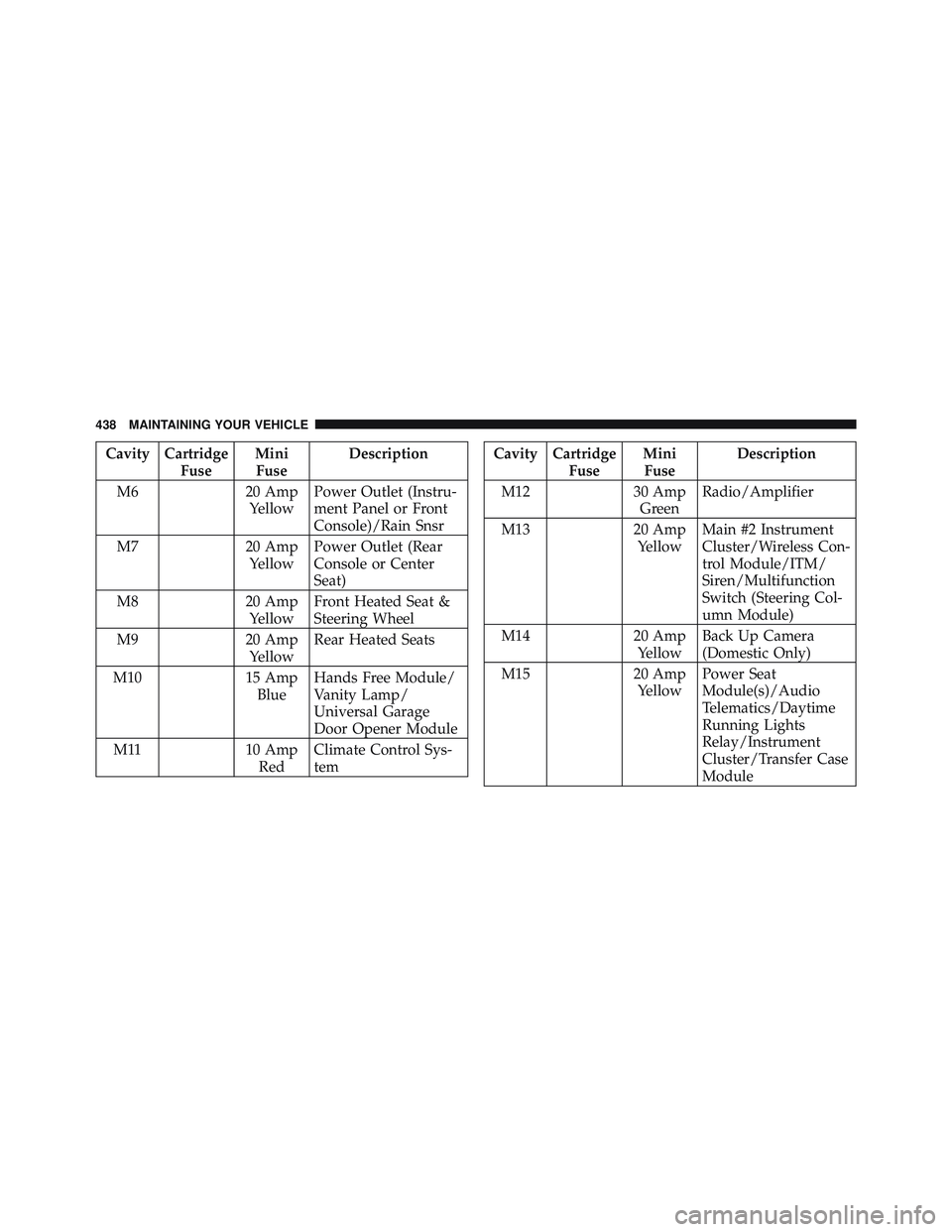
FUSES
Totally Integrated Power Module
The Totally Integrated Power Module is located in the
engine compartment near the battery. This center con-
tains cartridge fuses and mini fuses. A description of each
fuse and component may be stamped on the inside cover,
7 MAINTAINING YOUR VEHICLE 435
Page 440 of 502
Cavity Cartridge
Fuse Mini
Fuse Description
M6 20 Amp
Yellow Power Outlet (Instru-
ment Panel or Front
Console)/Rain Snsr
M7 20 Amp
Yellow Power Outlet (Rear
Console or Center
Seat)
M8 20 Amp
Yellow Front Heated Seat &
Steering Wheel
M9 20 Amp
Yellow Rear Heated Seats
M10 15 Amp
Blue Hands Free Module/
Vanity Lamp/
Universal Garage
Door Opener Module
M11 10 Amp
Red Climate Control Sys-
tem Cavity Cartridge
Fuse Mini
Fuse Description
M12 30 Amp
Green Radio/Amplifier
M13 20 Amp
Yellow Main #2 Instrument
Cluster/Wireless Con-
trol Module/ITM/
Siren/Multifunction
Switch (Steering Col-
umn Module)
M14 20 Amp
Yellow Back Up Camera
(Domestic Only)
M15 20 Amp
Yellow Power Seat
Module(s)/Audio
Telematics/Daytime
Running Lights
Relay/Instrument
Cluster/Transfer Case
Module438 MAINTAINING YOUR VEHICLE
Page 443 of 502

CAUTION! (Continued)• When replacing a blown fuse, it is important to
use only a fuse having the correct amperage rating.
The use of a fuse with a rating other than indicated
may result in a dangerous electrical system over-
load. If a properly rated fuse continues to blow, it
indicates a problem in the circuit that must be
corrected.
VEHICLE STORAGE
If you are storing your vehicle for more than 21 days, we
recommend that you take the following steps to mini-
mize the drain on your vehicle’s battery:
• Disconnect the Ignition-Off Draw (IOD) fuse located in
the Integrated Power Module, located in the engine
compartment. The IOD cavity includes a snap-in re-
tainer that allows the fuse to be disconnected without
removing it from the fuse block. • As an alternative to the above steps you may discon-
nect the negative cables from both batteries.
• Any time you store your vehicle or keep it out of
service (i.e., vacation) for two weeks or more, run the
air conditioning system at idle for about five minutes
in the fresh air and high blower setting. This will
ensure adequate system lubrication to minimize the
possibility of compressor damage when the system is
started again.
NOTE:
• When reinstalling the IOD fuse push firmly until fully
seated; the gauges in the instrument cluster will do a
full sweep when the ignition switch is turned to the
RUN position. This is a normal condition.
• When the vehicle is shipped from the factory, the IOD
fuse is in the up or extracted position. If the radio,
interior lamps, keyless entry or other features do not
work with the key OFF, check the position of the fuse
7 MAINTAINING YOUR VEHICLE 441