Page 332 of 502

WARNING! (Continued)• Never use a tire with a smaller load index or
capacity, other than what was originally equipped
on your vehicle. Using a tire with a smaller load
index could result in tire overloading and failure.
You could lose control and have a collision result-
ing in serious injury or death.
• Failure to equip your vehicle with tires having
adequate speed capability can result in sudden tire
failure and loss of vehicle control resulting in
serious injury or death.
CAUTION!Replacing original tires with tires of a different size
may result in false speedometer and odometer read-
ings. SUPPLEMENTAL TIRE PRESSURE INFORMATION
— IF EQUIPPED
A light load vehicle condition is defined as two passen-
gers [150 lbs (68 kg) each] plus 200 lbs (91 kg) of cargo.
Cold tire inflation pressures for a lightly loaded vehicle
will be found on the face of the driver’s door.
TIRE CHAINS
Use “Class U” chains or other traction aids that meet SAE
Type “U” specifications.
NOTE: Chains must be the proper size for the vehicle,
as recommended by the chain manufacturer.
CAUTION!To avoid damage to your vehicle, tires or chains,
observe the following precautions:
(Continued)330 STARTING AND OPERATING
Page 334 of 502

• On 4X2 vehicles, class “U” snow chains are permitted
on the rear wheels only of vehicles equipped with
LT245/70R17, LT265/70R17, and LT235/80R17 size
tires.
• On 4X4 Single Rear Wheel (SRW) vehicles, class “U”
snow chains are permitted on the rear wheels only on
vehicles equipped with LT265/70R17.
CAUTION!Do not use tire chains on the 4X2 front wheels of
SRW (Single Rear Wheels) equipped with LT245/
70R17, LT265/70R17 tires or 4X4 front tires of vehicles
equipped with LT265/70R17 tires. There may not be
adequate clearance for the chains and you are risking
structural or body damage to your vehicle. SNOW TIRES
Some areas of the country require the use of snow tires
during the winter. All season tires can be identified by the
M+S designation on the tire sidewall.
If you need snow tires, select tires equivalent in size and
type to the original equipment tires. Use snow tires only
in sets of four; failure to do so may adversely affect the
safety and handling of your vehicle.
Snow tires generally have lower speed ratings than what
was originally equipped with your vehicle and should
not be operated at sustained speeds over 75 mph
(120 km/h). For speeds above 75 mph (120 km/h) refer to
original equipment or an authorized tire dealer for
recommended safe operating speeds, loading and cold
tire inflation pressures.332 STARTING AND OPERATING
Page 337 of 502
CAUTION! (Continued)• When replacing a flat, the spare tire may have to
be remounted on the rim or installed at a different
location to maintain the correct placement of the
tire on the wheel relative to the tire/wheel position
on the vehicle. For example, if the spare is used to
replace an outer rear tire it will have to be re-
mounted on the rim so that the wheel is dished
inward. That way the tread design of asymmetrical
tires will maintain proper position.
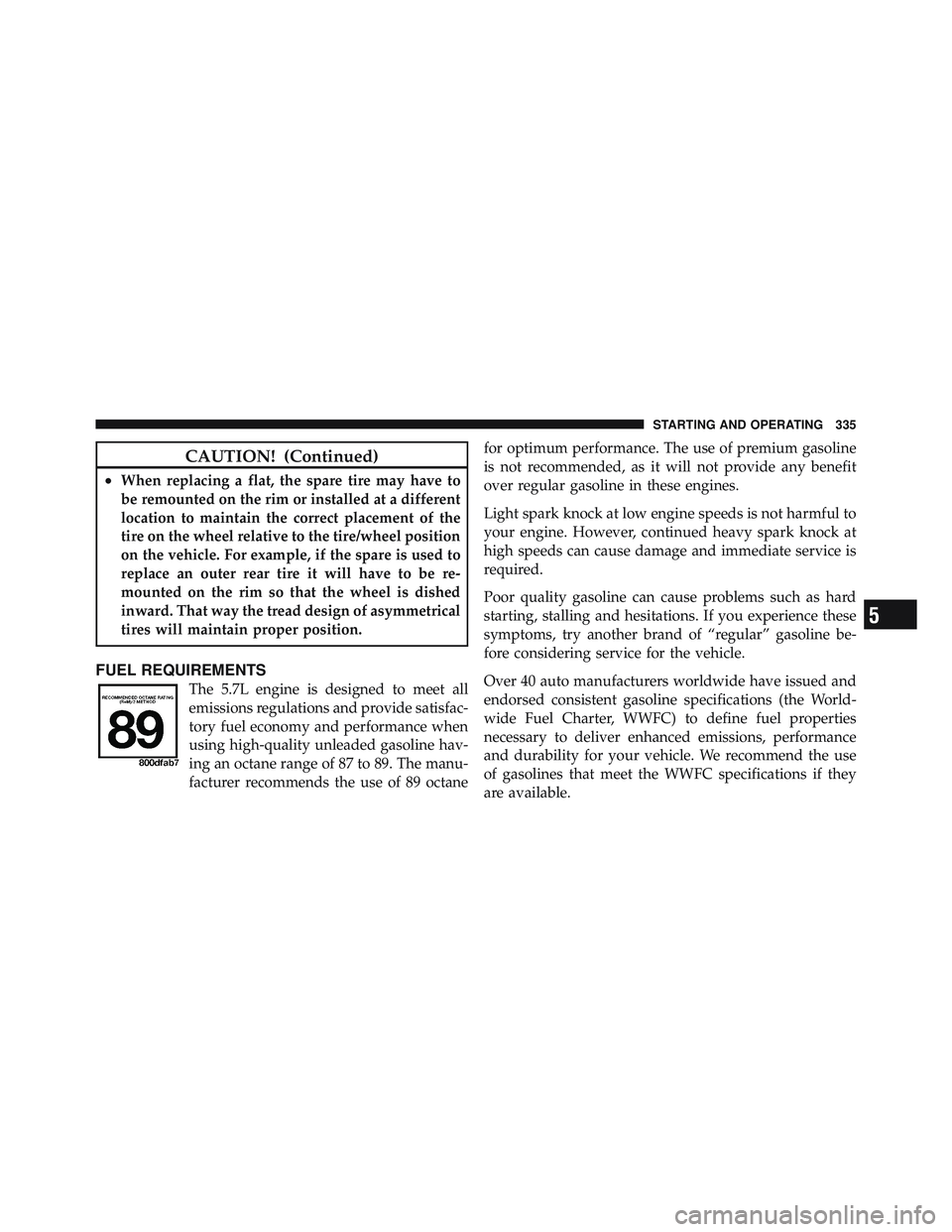
FUEL REQUIREMENTS
The 5.7L engine is designed to meet all
emissions regulations and provide satisfac-
tory fuel economy and performance when
using high-quality unleaded gasoline hav-
ing an octane range of 87 to 89. The manu-
facturer recommends the use of 89 octane for optimum performance. The use of premium gasoline
is not recommended, as it will not provide any benefit
over regular gasoline in these engines.
Light spark knock at low engine speeds is not harmful to
your engine. However, continued heavy spark knock at
high speeds can cause damage and immediate service is
required.
Poor quality gasoline can cause problems such as hard
starting, stalling and hesitations. If you experience these
symptoms, try another brand of “regular” gasoline be-
fore considering service for the vehicle.
Over 40 auto manufacturers worldwide have issued and
endorsed consistent gasoline specifications (the World-
wide Fuel Charter, WWFC) to define fuel properties
necessary to deliver enhanced emissions, performance
and durability for your vehicle. We recommend the use
of gasolines that meet the WWFC specifications if they
are available. 5 STARTING AND OPERATING 335
Page 345 of 502

Tire Size
The tire size on the Label represents the actual tire size on
your vehicle. Replacement tires must be equal to the load
capacity of this tire size.
Rim Size
This is the rim size that is appropriate for the tire size
listed.
Inflation Pressure
This is the cold tire inflation pressure for your vehicle for
all loading conditions up to full GAWR.
Curb Weight
The curb weight of a vehicle is defined as the total weight
of the vehicle with all fluids, including vehicle fuel, at full
capacity conditions, and with no occupants or cargo
loaded into the vehicle. The front and rear curb weight
values are determined by weighing your vehicle on a
commercial scale before any occupants or cargo are
added. Loading
The actual total weight and the weight of the front and
rear of your vehicle at the ground can best be determined
by weighing it when it is loaded and ready for operation.
The entire vehicle should first be weighed on a commer-
cial scale to insure that the GVWR has not been exceeded.
The weight on the front and rear of the vehicle should
then be determined separately to be sure that the load is
properly distributed over front and rear axle. Weighing
the vehicle may show that the GAWR of either the front
or rear axles has been exceeded but the total load is
within the specified GVWR. If so, weight must be shifted
from front to rear or rear to front as appropriate until the
specified weight limitations are met. Store the heavier
items down low and be sure that the weight is distributed
equally. Stow all loose items securely before driving.
5 STARTING AND OPERATING 343
Page 354 of 502

WARNING! (Continued)• Safety chains must always be used between your
vehicle and trailer. Always connect the chains to
the hook retainers of the vehicle hitch. Cross the
chains under the trailer tongue and allow enough
slack for turning corners.
• Vehicles with trailers should not be parked on a
grade. When parking, apply the parking brake on
the tow vehicle. Put the tow vehicle transmission
in PARK. For four-wheel drive vehicles, make sure
the transfer case is not in NEUTRAL. Always,
block or � chock � the trailer wheels.
• GCWR must not be exceeded.
• Total weight must be distributed between the tow
vehicle and the trailer such that the following four
ratings are not exceeded:
1. GVWR
(Continued) WARNING! (Continued)2. GTW
3. GAWR
4. Trailer tongue weight rating for the trailer hitch
utilized (This requirement may limit the ability to
always achieve the 10% to 15% range of tongue
weight as a percentage of total trailer weight).
Towing Requirements – Tires
• Do not attempt to tow a trailer with less than the full
size spare tire.
• Proper tire inflation pressures are essential to the safe
and satisfactory operation of your vehicle. Refer to
“Tires – General Information” in “Starting and Oper-
ating” for proper tire inflation procedures.
• Check the trailer tires for proper tire inflation pres-
sures before trailer usage.352 STARTING AND OPERATING
Page 382 of 502
WARNING! (Continued)• If working on or near a roadway, be extremely
careful of motor traffic.
• To assure that spare tires, flat or inflated, are
securely stowed, spares must be stowed with the
valve stem facing the ground. CAUTION!Do not attempt to raise the vehicle by jacking on
locations other than those indicated in the Jacking
Instructions for this vehicle.
1. If equipped, remove the spare wheel, jack, and tools
from storage.
2. Using the wheel wrench, loosen, but do not remove,
the wheel nuts by turning them counterclockwise one
turn while the wheel is still on the ground.
3. When changing the front wheel, assemble the jack
drive tube to the jack and connect the drive tube to the
extension tube. Place the jack under the axle as close to
the tire as possible with the drive tubes extending to the
front. Connect the jack tube extension and wheel wrench.Jack Warning Label380 WHAT TO DO IN EMERGENCIES
Page 383 of 502
When changing a rear wheel, assemble the jack drive
tube to the jack and connect the drive tube to the
extension tube. Securely place the jack under the sway
bar bracket (unless both tires are flat on one side, then
place jack under shock bracket) facing forward in vehicle.
Connect the jack tube extension and lug wrench. Before raising the wheel off the ground, make sure that
the jack will not damage surrounding truck parts and
adjust the jack position as required.
NOTE: If the jack will not lower by turning the dial
(thumbwheel) by hand, it may be necessary to use the
jack drive tube in order to lower the jack.Front Jacking Locations Rear Jacking Location
6 WHAT TO DO IN EMERGENCIES 381
Page 384 of 502

4. By rotating the wheel wrench clockwise, raise the
vehicle until the wheel just clears the surface.
WARNING!Raising the vehicle higher than necessary can make
the vehicle unstable and cause a collision. It could
slip off the jack and hurt someone near it. Raise the
vehicle only enough to remove the tire.
5. Remove the wheel nuts and pull the wheel off. Install
the spare wheel and wheel nuts with the cone shaped end
of the nuts toward the wheel on single rear wheel (SRW)
models. On dual rear wheel models (DRW) the lug nuts
are a two-piece assembly with a flat face. Lightly tighten
the nuts. To avoid risk of forcing the vehicle off the jack,
do not fully tighten the nuts until the vehicle has been
lowered. 6. Using the wheel wrench, finish tightening the nuts
using a crisscross pattern. The correct nut tightness is
135 ft lbs (183 N·m) torque for single rear wheel (SRW)
models and 145 ft lbs (197 N·m) for dual rear wheel
models. If in doubt about the correct tightness, have them
checked with a torque wrench by your authorized dealer
or at a service station.
WARNING!A loose tire or jack thrown forward in a collision or
hard stop could injure someone in the vehicle. Al-
ways stow the jack parts and the extra tire and wheel
in the places provided.
7. Install wheel center cap (if equipped) and remove
wheel blocks. Do not install chrome or aluminum wheel
center caps on the spare wheel. This may result in cap
damage.382 WHAT TO DO IN EMERGENCIES

