Page 167 of 508
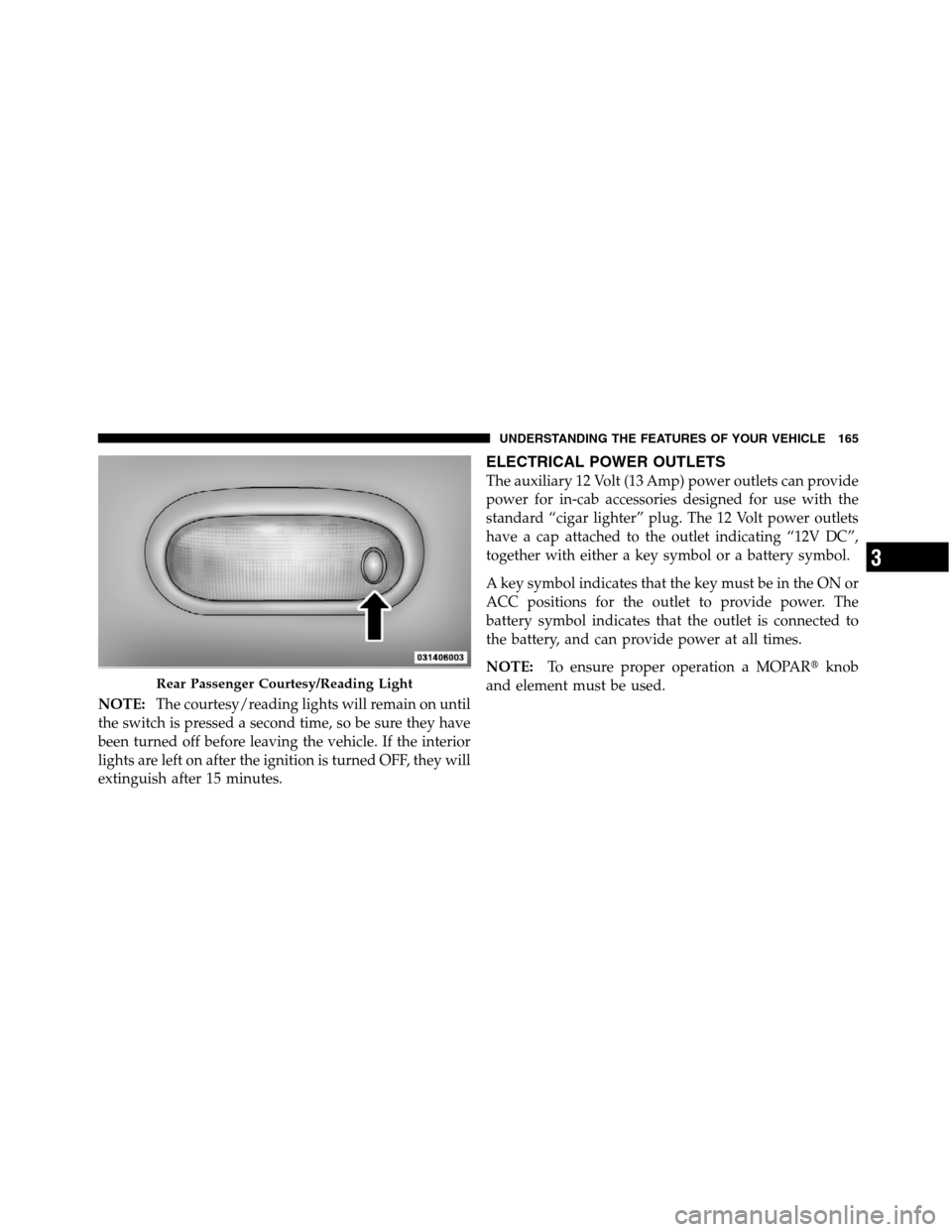
NOTE:The courtesy/reading lights will remain on until
the switch is pressed a second time, so be sure they have
been turned off before leaving the vehicle. If the interior
lights are left on after the ignition is turned OFF, they will
extinguish after 15 minutes.
ELECTRICAL POWER OUTLETS
The auxiliary 12 Volt (13 Amp) power outlets can provide
power for in-cab accessories designed for use with the
standard “cigar lighter” plug. The 12 Volt power outlets
have a cap attached to the outlet indicating “12V DC”,
together with either a key symbol or a battery symbol.
A key symbol indicates that the key must be in the ON or
ACC positions for the outlet to provide power. The
battery symbol indicates that the outlet is connected to
the battery, and can provide power at all times.
NOTE:To ensure proper operation a MOPAR�knob
and element must be used.
Rear Passenger Courtesy/Reading Light
3
UNDERSTANDING THE FEATURES OF YOUR VEHICLE 165
Page 170 of 508
The key symbol indicates that this outlet can supply
power when the key is in the ON or ACC positions.
All accessories connected to the outlet(s) should be
removed or turned off when the vehicle is not in use to
protect the battery against discharge.
WARNING!
To avoid serious injury or death:
•Only devices designed for use in this type of
outlet should be inserted into any 12 Volt outlet.
•Do not touch with wet hands.
•Close the lid when not in use and while driving
the vehicle.
•If this outlet is mishandled, it may cause an
electric shock and failure.
Power Outlet Fuse Locations
1 — M7 Fuse 20 A Yellow Power Outlet Center Seat (Opt) or
with Console Rear
2 — M6 Fuse 20 A Yellow Cigar Lighter Instrument Panel or
with Console Front
3 — M36 Fuse 20 A Yellow Power Outlet Instrument Panel or
with Console Center 168 UNDERSTANDING THE FEATURES OF YOUR VEHICLE
Page 209 of 508
•Trailer Brake Connected
•Trailer Brake Disconnected
•Lights On
•Keyfob Battery Low
•ECO (Fuel Saver Indicator) — If Equipped
•Wrong Key
•Damaged Key
•Key not programmed
•Key In Ignition
•Turn Signal On
•Oil Change Due > Dealer Info
•System Setup Unavailable
•Warning Object Detected
•System Setup Unavailable - Vehicle in Motion
•Service Four Wheel Drive System
•Adjustable pedals unavail.
•Cruise engaged
•Adjustable pedals unavail. Veh. in reverse
•Clean Park Assist sensors
•Front Park Assist Not available - Blinded
•Rear Park Assist Not available - Blinded
•Low Fuel
•Personal Settings Not Available — Vehicle Not in Park
•Service blind spot system
4
UNDERSTANDING YOUR INSTRUMENT PANEL 207
Page 283 of 508

WARNING! (Continued)
•If the vehicle has a discharged battery, booster
cables may be used to obtain a start from a booster
battery or the battery in another vehicle. This type
of start can be dangerous if done improperly. Refer
to “Jump Starting” in “What To Do In Emergen-
cies” for further information.
If the engine has been flooded, it may start to run, but not
have enough power to continue running when the key
fob is released. If this occurs, continue cranking with the
accelerator pedal pushed all the way to the floor. Release
the accelerator pedal and the key fob once the engine is
running smoothly.
If the engine shows no sign of starting after two 15-
second periods of cranking with the accelerator pedal
held to the floor, the “Normal Starting” procedure should
be repeated.
After Starting
The idle speed is automatically controlled and will de-
crease as the engine warms up.
ENGINE BLOCK HEATER — IF EQUIPPED
The engine block heater warms the engine, and permits
quicker starts in cold weather. Connect the cord to a
standard 110-115 Volt AC electrical outlet with a
grounded, three-wire extension cord.
3500 Models — 5.7L Engine Only
The engine block heater cord is routed through the grille
by the right front tow hook.
It includes a removable cap that is secured by a tethered
strap. It also has a c-clip that is used for storage when not
in use for the winter months. During winter months,
remove the heater cord wiring assembly from itself on
the c-clip.
5
STARTING AND OPERATING 281
Page 402 of 508

Proper towing or lifting equipment is required to prevent
damage to your vehicle. Use only tow bars and other
equipment designed for the purpose, following equip-
ment manufacturer ’s instructions. Use of safety chains is
mandatory. Attach a tow bar or other towing device to
main structural members of the vehicle, not to bumpers
or associated brackets. State and local laws applying to
vehicles under tow must be observed.
If you must use the accessories (wipers, defrosters, etc.)
while being towed, the ignition must be in the ON/RUN
position, not the ACC position.
If the vehicle’s battery is discharged, see “Shift Lever
Override” in “What To Do In Emergencies” for instruc-
tions on shifting the automatic transmission out of the
PARK position for towing.CAUTION!
Do not attempt to use sling type equipment when
towing. When securing the vehicle to a flat bed truck,
do not attach to front or rear suspension components.
Damage to your vehicle may result from improper
towing.
Towing Without The Ignition Key Fob
Special care must be taken when the vehicle is towed
with the ignition in the LOCK/OFF position. The only
approved method of towing without the ignition key is
with a flatbed truck. Proper towing equipment is neces-
sary to prevent damage to the vehicle.
400 WHAT TO DO IN EMERGENCIES
Page 409 of 508

the SELECT button to turn off the message. If the
problem continues, the message will appear the next time
the vehicle is started.
A loose, improperly installed, or damaged fuel filler cap
may also turn on the Malfunction Indicator Light (MIL).
EMISSIONS INSPECTION AND MAINTENANCE
PROGRAMS
In some localities, it may be a legal requirement to pass
an inspection of your vehicle’s emissions control system.
Failure to pass could prevent vehicle registration.
For states that require an Inspection and Mainte-
nance (I/M), this check verifies the “Malfunction
Indicator Light (MIL)” is functioning and is not
on when the engine is running, and that the OBD II
system is ready for testing.Normally, the OBD II system will be ready. The OBD II
system maynotbe ready if your vehicle was recently
serviced, recently had a dead battery or a battery replace-
ment. If the OBD II system should be determined not
ready for the I/M test, your vehicle may fail the test.
Your vehicle has a simple ignition key-actuated test,
which you can use prior to going to the test station. To
check if your vehicle’s OBD II system is ready, you must
do the following:
1. Turn the ignition switch to the ON position, but do not
crank or start the engine.
2. If you crank or start the engine, you will have to start
this test over.
3. As soon as you turn the ignition switch to the ON
position, you will see the MIL symbol come on as part of
a normal bulb check.
7
MAINTAINING YOUR VEHICLE 407
Page 489 of 508

Automatic Transmission
Adding Fluid....................... 433
Fluid and Filter Changes............... 434
Fluid Level Check.................432,433
FluidType ......................432,455
Shifting ........................... 284
Special Additives..................... 432
AxleFluid .......................430,431,455
Axle Lubrication (Axle Fluid)............430,431
B-Pillar Location........................ 320
Battery............................... 414
Keyless Transmitter Replacement (RKE)..... 25
Saving Feature (Protection).............. 152
Belts, Seat............................ 40,80
Body Builders Guide....................... 6
Body Mechanism Lubrication............... 417
Brake Fluid.........................428,455Brake System........................312,427
Anti-Lock (ABS)..................... 313
Fluid Check........................ 428
Master Cylinder..................... 428
Parking........................... 310
Warning Light....................... 198
Brake/Transmission Interlock............... 284
Bulb Replacement....................... 447
Bulbs,Light .......................... 82,446
Cab Top Clearance Lights.................. 451
Calibration, Compass..................... 216
Capacities, Antifreeze (Engine Coolant)........ 453
Capacities, Fluid........................ 453
Caps, Filler
Oil (Engine)........................ 412
Power Steering...................... 309
Radiator (Coolant Pressure)............. 424
Car Washes............................ 435
10
INDEX 487
Page 503 of 508

Tow Hooks, Emergency................... 397
Towing ............................350,399
24-Hour Towing Assistance............. 108
Disabled Vehicle..................... 399
Guide ............................. 354
Recreational........................ 368
Weight ............................ 354
Towing Assistance....................... 108
Traction.............................. 305
TrailerTowing .......................... 350
Cooling System Tips.................. 364
Hitches............................ 353
Minimum Requirements................ 355
Mirrors ............................ 92
Trailer and Tongue Weight.............. 354
Wiring ............................ 362
TrailerTowingGuide ..................... 354
TrailerWeight .......................... 354Transfer Case........................... 431
ElectronicallyShifted .................. 298
Fluid ............................. 455
Transmission
Automatic.......................284,432
Fluid ............................. 455
Maintenance........................ 432
Shifting ........................... 282
Transmitter Battery Service
(Remote Keyless Entry).................... 25
Transmitter Programming
(Remote Keyless Entry).................... 20
Transmitter, Remote Keyless Entry (RKE)........ 20
Tread Wear Indicators.................... 333
Trip Odometer.......................193,194
Turn Signals......................153,190,447
10
INDEX 501