2012 PORSCHE CAYMAN S fuel
[x] Cancel search: fuelPage 19 of 69

12
36
Thermal management.
The intelligent thermal management
system in the Cayman models regulates
the temperature in the engine and gear -
box
to reduce friction losses that occur
during the warm-up phase.
Thanks to the purposeful control of heat
flow and on-demand, gradual activation
of the various cooling circuits, the engine
and gearbox warm up to normal operat -
ing temperature more rapidly. The result -
ing reduction in friction also reduces fuel
consumption and CO
2 emissions. During
sporty driving, thermal management also
acts to reduce temperatures so as to
maintain a high degree of performance. Our cross-flow cooling system, as used
in motorsport, supplies each engine cylin -
der uniformly with coolant, which protects
all valves against thermal overload and,
therefore, premature wear. This improves
combustion and keeps emissions, fuel con -
sumption and noise comparatively low.
exhaust system.
In the new Cayman models, each cylinder
bank has its own stainless-steel exhaust
tract. Downstream of their respective rear
silencer, the tracts converge into a con -
necting tube and a single (Cayman) or t win
(Cayman S) tailpipe. The stereo Lambda
control circuitr y
controls and monitors each cylinder bank
separately. For each
exhaust tract, four
corresponding oxygen sensors regulate
the composition of the exhaust gas and
monitor the performance of the catalytic
converters. The separate
tracts enable
the exhaust gas to flow more
f re e l y. T h e
resulting reduction in pressure loss has
a positive impact on power output, torque
and the unmistakable engine sound.
Available as an option for the new Cayman
models is the sports exhaust system*
including sports tailpipe. It produces an
even more resonant Porsche sound.
1 Standard tailpipe of the Cayman S
2 Standard tailpipe of the Cayman
* Available from 03/2013 at the earliest.
Drive |
Engine
Page 20 of 69

2
1
2
39
38
e ngine management.
The electronic engine management
system ensures optimum perfect engine
performance at all times. It regulates all
engine-related functions and assemblies.
The results are optimum power output
and torque with comparatively low fuel
consumption and emissions – whatever
the driving st yle.
One example is the cylinder-specific knock
control. Since engine cylinders never all
work under exactly the same conditions,
the knock control function monitors each one separately. The ignition point is shift
-
ed individually, as and when necessary,
so as to protect the cylinders and pistons
at high engine speeds and loads. For
compliance with EU standards, the on-
board diagnostics detect any faults and
defects that may occur in the exhaust
and fuel systems and then display them
on the on-board computer. This also
helps to avoid increased pollutant emis
-
sions and unnecessary fuel consumption.
a uto start/stop function.
The auto start/stop function, which is in -
tegrated as standard in the new Cayman
models, switches off the engine when
you stop, select neutral and release
the clutch pedal. In cars with Porsche
Doppelkupplung (PDK), it is simply a
case of applying and holding the brake.
All audio and communication systems
remain switched on. The engine will
restart as soon as you operate the clutch
or, in cars with PDK, release the brake.
This fuel-saving innovation is designed
primarily for use in urban traffic. The auto start /stop function can be deac
-
tivated and reactivated using a separate
but ton on the centre console. The func -
tion is deactivated automatically under
particular circumstances, e.g. in the
event of extreme outside temperatures,
activation of the SPORT but ton or low
bat tery charge.
Drive |
Engine
1 Auto start /stop but ton
2 SPORT but ton
Page 22 of 69

123
43
Six-speed manual gearbox.
The new Cayman models are equipped
as standard with the six-speed manual
gearbox. Gearshifts are smooth, precise
and optimally adapted to the respective
engine map. Shift throws are short and
the gear lever is easy to operate, provid -
ing a truly engaging driving experience.
The upshift indicator located in the central
circular instrument helps you to maximise
fuel efficiency.
The ascending centre console reinforces
the authentic sports car feel. It positions
the gear lever close to the steering wheel,
enabling you to change gear as fast and
as ergonomically as possible.
Porsche Doppelkupplung (PDK).
Of course, you could let us take care of
the gearshift strategy so that you can
devote all your at tention to your cornering
strategy.
Available as an option is the completely
retuned 7-speed Porsche Doppelkupplung
(PDK), featuring both manual and auto -
matic modes. The advantages are percep -
tible. Gear changes take place with no
interruption in the flow of power. Sharper
gearshift programs and significantly short -
er shift times produce faster acceleration
than with the manual gearbox. Fuel econ-
omy and comfort characteristics have also
been optimised. In response to a less
assertive driving st yle, shif t points are
recalculated to make use of the more
comfortable and more economical engine
speed ranges, and coasting mode is acti -
vated where possible (p. 44).
This is how PDK works: PDK is essentially
t wo gearboxes in one, thus requiring t wo
clutches. This double clutch arrangement
provides an alternating, non-positive con -
nection between the two half gearboxes
and the engine by means of t wo separate
input shafts. The flow of power from the
engine is transmit ted through one half
gearbox and one clutch at a time, while
the next gear is preselected in the second
half gearbox. During a gear change, there -
fore, one clutch simply opens and the
other closes at the same time, enabling
gear changes to take place within milli
-
seconds.
PDK has seven forward gears at its
disposal. Gears 1 to 6 have a sports
ratio and top speed is reached in sixth
gear. Seventh gear has a long ratio and
keeps
engine speed low to reduce fuel
con
sumption and improve comfort.
1 Gear lever for six-speed manual gearbox
2 Porsche Doppelkupplung (PDK) gear selector
3 Gearshif t switch on spor ts steering wheel
in conjunction with PDK
y ou’ve developed your own strategies for advancement.
So have we.
Transmission.
For fuel consumption, CO2 emissions and efficiency class, please refer to page 131.
Page 23 of 69

44
With the SPORT but ton selected, the full
advantages of the new version of PDK
are brought into play: a more immediate
response to throt tle inputs, relatively
short shift times and swift throt tle-blip
downshifts on overrun, such as during
braking into a corner, and always accom -
panied by an emotive engine sound.
With the optional Sport Chrono Package,
PDK is enhanced by ‘Launch Control’
and the ‘motorsport-derived gearshift
strategy’ for even faster and firmer gear
changes and best possible per formance,
thanks to a boost in torque during up -
shift phases. Overrun downshifts provide
extremely sport y braking and accelera -
tion for added excitement.
Coasting.
Efficiency is another area in which the
performance of the new Cayman models
has been further improved. The coasting
function available with Porsche Doppel-
kupplung (PDK) enables you to save even
more fuel where the situation allows.
The engine is decoupled from the trans -
mission to prevent deceleration caused
by engine braking. In this way, optimum
use is made of the vehicle’s momentum,
allowing it to coast for longer distances.
For example, you may want to slow down
from 100 to 80 km/ h (70 to 50 mph) in
anticipation
of the change of speed limit
ahead. As you ease off the accelerator
pedal, PDK deselects the current gear
automatically and you begin to coast in
neutral with minimal input required on
your part until
you have reached your desired speed.
As soon as you operate
the accelerator
or brake pedal, PDK
re-engages the appropriate gear within
fractions of a second. The process
is smooth and seamless, thanks to the
extremely fast
clutch.
Another way to reduce fuel consumption
is to utilise the coasting function on down -
hill gradients that are gentle enough for
you to maintain a constant speed. Efficient
on long journeys, such as on the motor -
way, PDK remains ready to respond as
swiftly and precisely as you would expect.
In short, driving in coasting mode makes
a real impact on fuel consumption without
the need to compromise on comfort or
sporty performance.
Drive |
Tra n s m i ssi o n
For fuel consumption, CO2 emissions and efficiency class, please refer to page 131.
Page 25 of 69

1212
49
Strong relationships need sincerity,
common goals and the abilit y to over-
come difficult situations in unison.
The chassis of the new Cayman models
develops a strong bond with the road. It
is specifically matched to the high power
output of the respective engine. A xle
components are made predominantly of
aluminium, which helps to keep the weight
of the vehicle and its unsprung masses
low. The results are impressive driving
dynamics with practically zero pitch and
roll, high levels of comfort and safet y and
lower fuel consumption. The track of the new Cayman models has
been widened and the wheelbase has
been extended by 60 mm compared with
that of the previous model. This improves
stabilit y. The new independent suspension
features light weight spring-strut axles
with longitudinal and transverse links. The
cross member at the front axle has been
refined for optimum stiffness and robust -
ness. How does this benefit you? Greater
directional stability, sharper steering preci -
sion and sportier handling.
Porsche active Suspension management
(PaSm ).
Optional PASM, the electronic damping
control system, actively and continuously
regulates the damping force for each
wheel according to the road conditions
and driving st yle. In addition, the suspen -
sion is 10 mm lower than that of the
st a n d a rd s e t u p .
The system is always active in the back-
ground, ready to assist you automatically
without you having to switch it on. Never -
theless, t wo modes are available at the
push of a but ton so that you can adapt
handling to suit your preferred driving
st yle: ‘Normal’ which is a blend of perfor-
mance and comfort, and ‘Sport ’ where
the setup is much firmer. Depending on
the mode selected, therefore, PASM can
be sportier and more comfortable than
the standard chassis. The PASM control
unit evaluates the driving conditions and modifies the damping force on each of
the wheels optimally in accordance with
the selected mode.
Sensors record all wheel and body move
-
ments. This enables intelligent adaptation
of damper stiffness for the selected
mode, optimising contact between each
individual t yre and the road for even less
roll and pitch.
h ow do we nurture our relationship with the driver?
By purposefully strengthening our bond with the road.
Chassis.
1 Front axle of the Cayman S
2 Rear axle of the Cayman S
Page 26 of 69
51
50
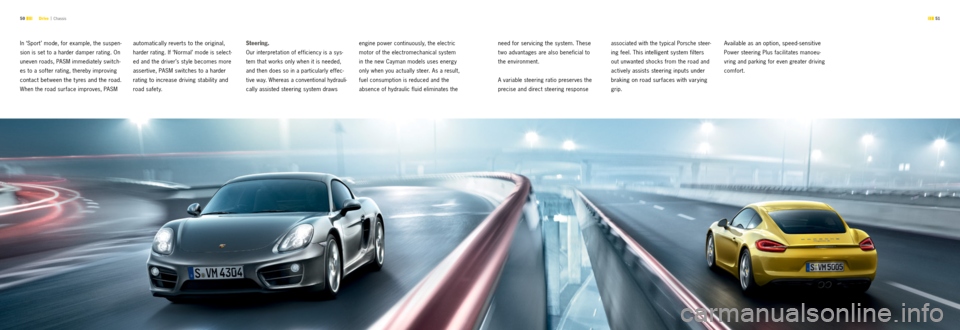
In ‘Sport ’ mode, for example, the suspen -
sion is set to a harder damper rating. On
uneven roads, PASM immediately switch -
es to a softer rating, thereby improving
contact bet ween the t yres and the road.
When the road surface improves, PASM
automatically reverts to the original,
harder rating. If ‘Normal’ mode is select -
ed and the driver’s st yle becomes more
assertive, PASM switches to a harder
rating to increase driving stabilit y and
road safety.
Steering.
Our interpretation of efficiency is a sys -
tem that works only when it is needed,
and then does so in a particularly effec -
tive way. Whereas a conventional hydrauli -
cally assisted steering system draws
engine power continuously, the electric
motor of the electromechanical system
in the new Cayman models uses energy
only when you actually steer. As a result,
fuel consumption is reduced and the
absence of hydraulic fluid eliminates the need for servicing the system. These
t wo advantages are also beneficial to
the environment.
A variable steering ratio preserves the
precise and direct steering response
associated with the t ypical Porsche steer-
ing feel. This intelligent system filters
out unwanted shocks from the road and
actively assists steering inputs under
braking on road surfaces with varying
grip.
Available as an option, speed-sensitive
Power steering Plus facilitates manoeu -
vring and parking for even greater driving
comfort.
Drive |
Chassis
Page 27 of 69

1
21
2
53
52
w heels.
Performance needs sustained stability.
Fit ted as standard on the new Cayman,
18-inch alloy wheels are responsible for
maintaining the strong connection be -
t ween the vehicle and the road. A mini -
malist dual -arm spoke design accentuates
their sport y character – and yours. Tyre
sizes are 235/45 ZR 18 at the front and
265/45 ZR 18 at the rear.
The Cayman S is equipped as standard
with 19-inch wheels with a classic five-
spoke design. The t yre size at the front is 235/40 ZR 19 and 265/40 ZR 19 at
the rear.
Wheels up to 20 inches are available
from our list of options. The large rolling circumference helps to
improve comfort. At the same time, the
rolling resistance of the new generation
of t yres has been reduced, which, in turn,
helps to reduce fuel consumption.
1 18-inch Cayman wheel
2 19 - inch Cayman S wheel
Drive |
Chassis
Tyre Pressure m onitoring (TPm).
Optional Tyre Pressure Monitoring (TPM)
sends warnings to the on-board comput -
er’s display screen in the event of low
t yre pressure. The TFT screen in the
instrument cluster enables the driver to
check the pressure in all four t yres. The system updates quickly and
accurately af ter an engine start, t yre
pressure correction or wheel change –
for increased comfort and your safet y.
Page 29 of 69

57
56
Another key advantage of PCCB is the
extremely low weight of the ceramic brake
discs, which are approximately 50 % light-
er than standard discs of a similar design
and size. As well as enhancing perfor -
mance and fuel economy, this represents a major reduction in unsprung and rotat
-
ing masses. The consequence of this is
bet ter road holding and increased com -
fort, particularly on uneven roads, as well
as greater agility and improved handling. Please note that circuit racing, track day
use and other forms of performance driv
-
ing can significantly reduce the service
life of even the most durable pads and
discs. As with conventional high-perfor -
mance braking systems, we recommend that all brake components be profession
-
ally inspected and replaced where neces -
sary after each track event.
e lectric parking brake.
The electric parking brake, which can be
activated and deactivated manually, is
released automatically as you pull away
with your seat belt fastened. A hill hold
function is integrated as standard for the
manual gearbox and for PDK. It assists
you in making a comfortable, smooth
and roll-free start on an incline. Whenever
you come to halt on an incline, this is
detected automatically and the braking
effect of the electric parking brake is
supplemented by application of the wheel
brakes. As long as a gear remains en -
gaged, the brake pressure is maintained
at all four wheels. To pull away, simply
apply throt tle. As soon as sufficient
starting torque is available, the brake
is
released and the vehicle moves off.
Drive |
Chassis