Page 131 of 336

6/
DRIVING
HILL START ASSIST
System which keeps your vehicle immobilised temporarily
(approximately 2 seconds) when starting on a gradient, the time it takes
to move your foot from the brake pedal to the accelerator pedal.
OPERATION
This function is only active when:
- the vehicle is completely stationary, with your foot on the brake
pedal,
- certain conditions of slope are met,
- with the driver’s door closed.
The hill start assist system cannot be deactivated.
Do not exit the vehicle while it is being held in the hill start assist
phase.
OPERATING FAULT
On an ascending slope, with the vehicle stationary, the vehicle is
held for a brief moment when you release the brake pedal:
- provided you are in fi rst gear or neutral on a manual gearbox,
- provided you are in position D
or M
on an automatic gearbox.
On a descending slope, with the vehicle stationary and reverse
gear engaged, the vehicle is held for a brief moment when you
release the brake pedal.
If you need to exit the vehicle with the engine running,
apply the parking brake and then check that the
corresponding warning lamp in the instrument panel is on.
If a malfunction of the system occurs, these warning lamps come on.
Have it checked by a PEUGEOT dealer or a qualifi ed workshop.
Page 133 of 336
6/
DRIVING
* According to engine.
GEAR SHIFT INDICATOR *
System which reduces fuel consumption by advising the driver to
change up on vehicles fi tted with a manual gearbox.
OPERATION
The system intervenes only when driving economically.
Depending on the driving situation and your vehicle's equipment, the
system may advise you to skip one or more gears. You can follow this
instruction without engaging the intermediate gears.
The gear engagement recommendations must not be considered
compulsory. In fact, the confi guration of the road, the amount of traffi c
and safety remain determining factors when choosing the best gear.
Therefore, the driver remains responsible for deciding whether or not to
follow the advice given by the system.
This function cannot be deactivated.
In the case of driving which makes particular demands on the
performance of the engine (fi rm pressure on the accelerator pedal,
for example, when overtaking...), the system will not recommend
a gear change.
The system never suggests:
- engaging fi rst gear,
- engaging reverse gear,
- engaging a lower gear.
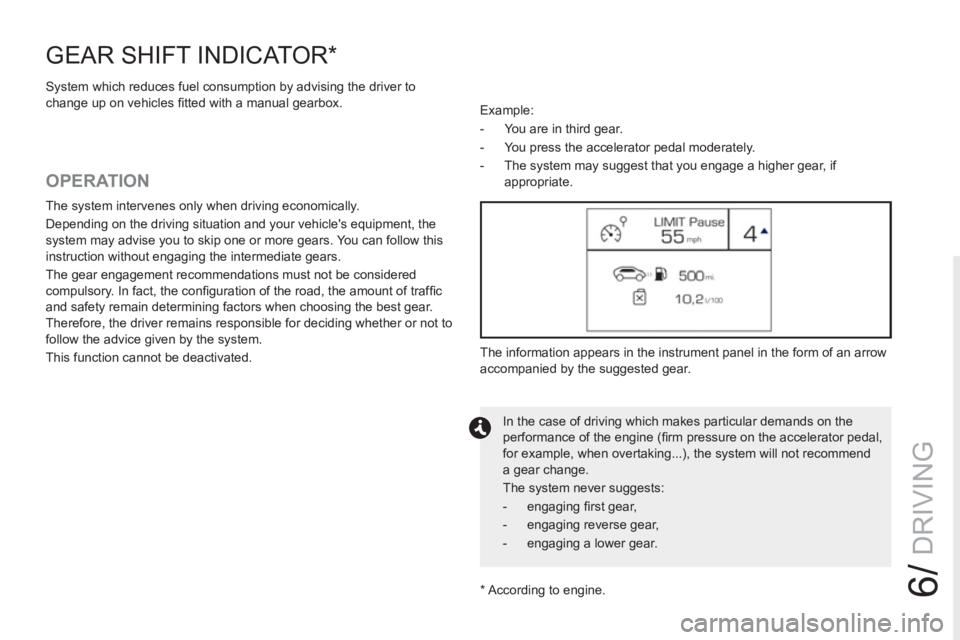
The information appears in the instrument panel in the form of an arrow
accompanied by the suggested gear.
Example:
- You are in third gear.
- You press the accelerator pedal moderately.
- The system may suggest that you engage a higher gear, if
appropriate.
Page 135 of 336
6/
33
33
DRIVING
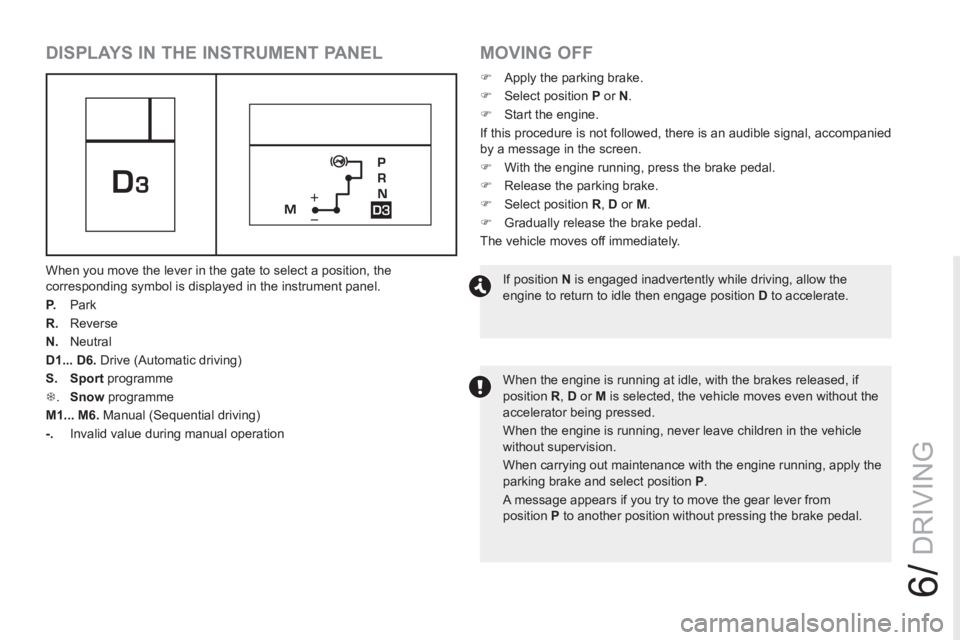
DISPLAYS IN THE INSTRUMENT PANEL
When you move the lever in the gate to select a position, the
corresponding symbol is displayed in the instrument panel.
P.
Park
R.
Reverse
N.
Neutral
D1... D6.
Drive (Automatic driving)
S.
Sport
programme
7
. Snow
programme
M1... M6.
Manual (Sequential driving)
-.
Invalid value during manual operation
MOVING OFF
)
Apply the parking brake.
)
Select position P
or N
.
)
Start the engine.
If this procedure is not followed, there is an audible signal, accompanied
by a message in the screen.
)
With the engine running, press the brake pedal.
)
Release the parking brake.
)
Select position R
, D
or M
.
)
Gradually release the brake pedal.
The vehicle moves off immediately.
If position N
is engaged inadvertently while driving, allow the
engine to return to idle then engage position D
to accelerate.
When the engine is running at idle, with the brakes released, if
position R
, D
or M
is selected, the vehicle moves even without the
accelerator being pressed.
When the engine is running, never leave children in the vehicle
without supervision.
When carrying out maintenance with the engine running, apply the
parking brake and select position P
.
A message appears if you try to move the gear lever from
position P
to another position without pressing the brake pedal.
Page 138 of 336
136
SPEED LIMITER
System which prevents the vehicle from exceeding the speed
programmed by the driver.
When the programmed speed limit is reached, pressing the accelerator
pedal no longer has any effect.
The speed limiter is switched on
manually: it requires a programmed
speed of at least 20 mph (30 km/h).
The speed limiter is switched off
by manual operation of the control.
The programmed speed can be exceeded temporarily by pressing the
accelerator fi rmly.
To return to the programmed speed, simply slow down to a speed below
the programmed speed.
The programmed speed remains in the memory when the ignition is
switched off.
The speed limiter cannot, in any circumstances, replace the need
to respect speed limits, nor can it replace the need for vigilance
and responsibility on the part of the driver.
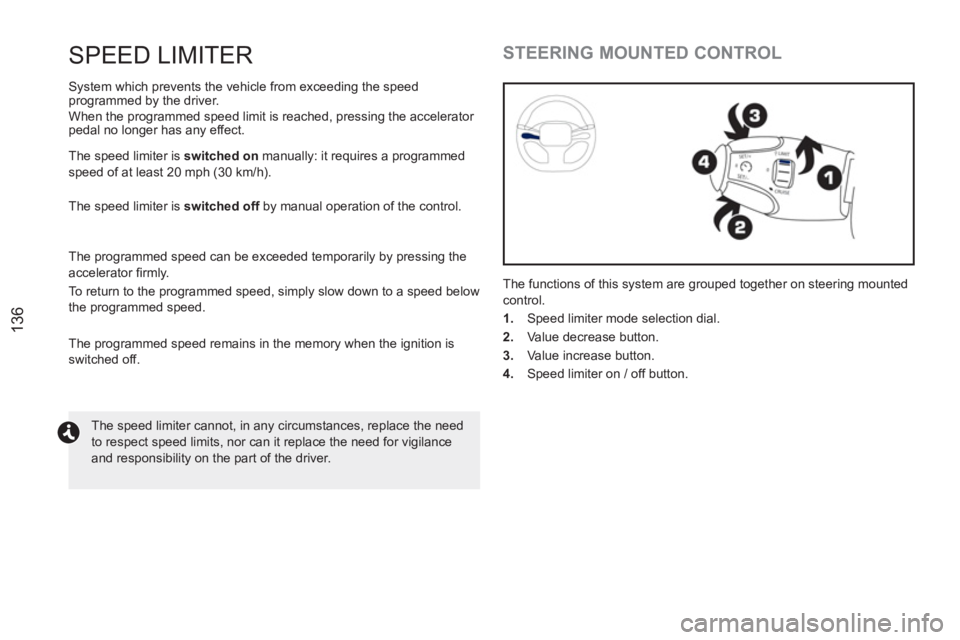
STEERING MOUNTED CONTROL
The functions of this system are grouped together on steering mounted
control.
1.
Speed limiter mode selection dial.
2.
Value decrease button.
3.
Value increase button.
4.
Speed limiter on / off button.
Page 141 of 336
6/
DRIVING
CRUISE CONTROL
System which automatically maintains the speed of the vehicle at the
value programmed by the driver, without any action on the accelerator
pedal.
The cruise control is switched off
manually or by pressing the brake or
clutch pedal or on triggering of the trajectory control system for safety
reasons.
Switching off the ignition cancels any programmed speed value.
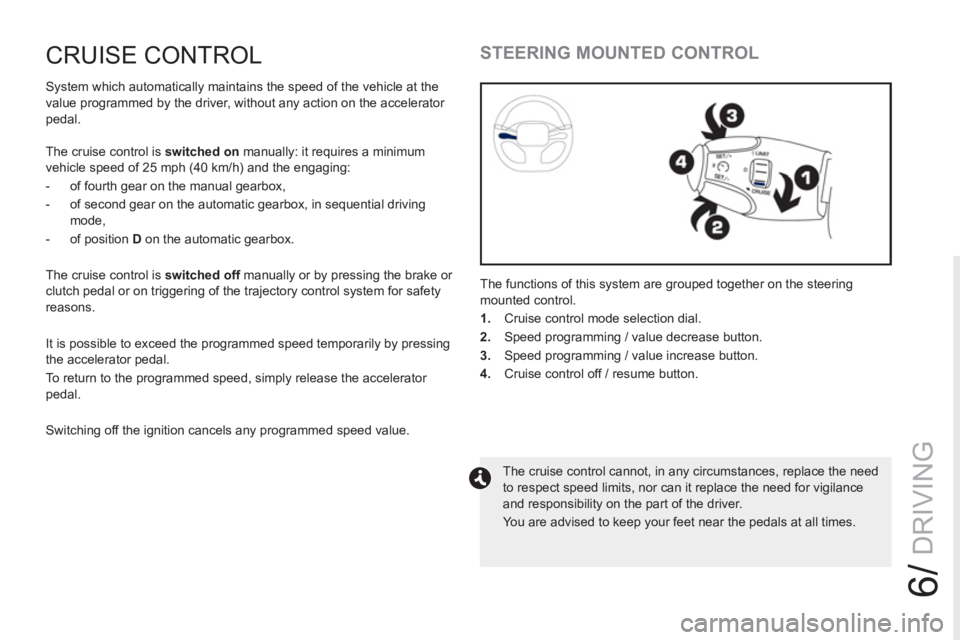
STEERING MOUNTED CONTROL
The functions of this system are grouped together on the steering
mounted control.
1.
Cruise control mode selection dial.
2.
Speed programming / value decrease button.
3.
Speed programming / value increase button.
4.
Cruise control off / resume button.
The cruise control cannot, in any circumstances, replace the need
to respect speed limits, nor can it replace the need for vigilance
and responsibility on the part of the driver.
You are advised to keep your feet near the pedals at all times. The cruise control is switched on
manually: it requires a minimum
vehicle speed of 25 mph (40 km/h) and the engaging:
- of fourth gear on the manual gearbox,
- of second gear on the automatic gearbox, in sequential driving
mode,
- of position D
on the automatic gearbox.
It is possible to exceed the programmed speed temporarily by pressing
the accelerator pedal.
To return to the programmed speed, simply release the accelerator
pedal.
Page 144 of 336

142
This function cannot, in any circumstances, take the place of the
vigilance and responsibility of the driver.
Certain types of obstacle (stake, roadworks cone, etc.) detected
initially will no longer be detected at the end of the manoeuvre due
to the presence of blind spots.
PARKING SENSORS
This system indicates the proximity of an obstacle (person, vehicle, tree,
gate, etc.) which comes within the fi eld of detection of sensors located
in the bumper.
REAR PARKING SENSORS
The system is switched on by engaging reverse gear. This is
accompanied by an audible signal.
The system is switched off when you exit reverse gear.
Audible assistance
The proximity information is given by an intermittent audible signal, the
frequency of which increases as the vehicle approaches the obstacle.
The sound emitted by the speaker (right or left) indicates the side on
which the obstacle is located.
When the distance between the vehicle and the obstacle becomes
less than approximately thirty centimetres, the audible signal becomes
continuous.
Page 154 of 336

152
CHECKING LEVELS
OIL LEVEL
The check is carried out either when the ignition is switched
on using the oil level indicator in the instrument panel, or using
the dipstick.
It will only be correct if the vehicle is on level ground and the engine
has been off for more than 30 minutes.
Take care when working under the bonnet, as certain areas of the engine may be extremely hot (risk of burns) and the cooling fan could start
at any time (even with the ignition off).
If a level drops signifi cantly, have the corresponding system checked by a PEUGEOT dealer or a qualifi ed workshop.
Check all of these levels regularly, in line with the servicing booklet and the requirements of the warranties. Top them up if necessary, unless otherwise indicated.
Engine oil change
Refer to the servicing and warranty booklet for details of the interval
for this operation.
In order to maintain the reliability of the engine and emission control
system, the use of additives in the engine oil is prohibited. It is normal to top up the oil level between two services (or oil
changes). PEUGEOT recommends that you check the level, and
top up if necessary, every 3 000 miles (5 000 kms).
After topping up the oil, the check when switching on the ignition with
the oil level indicator in the instrument panel is not valid during the
30 minutes after topping up.
Oil specification
The oil must be the correct grade for your engine and conform to the
manufacturer's recommendations.
BRAKE FLUID LEVEL
The brake fl uid level should be close to the "MAX" mark.
If it is not, check the brake pad wear.
Changing the fluid
Refer to the servicing and warranty booklet for details of the interval
for this operation.
Fluid specification
The brake fl uid must conform to the manufacturer's recommendations
and meet the DOT3 or DOT4 standard.
POWER STEERING FLUID LEVEL
The power steering fl uid level should be close to the "MAX"
mark. With the engine cold, unscrew the cap to check the level.
Page 171 of 336
8/
PRACTICAL INFORMATION
CHANGING A WIPER BLADE
BEFORE REMOVING A WIPER BLADE
)
Within one minute after switching off the ignition, operate the wiper
stalk to position the wiper blades in the centre of the windscreen.
REMOVING
)
Raise the corresponding wiper arm.
)
Unclip the wiper blade and remove it.
FITTING
)
Put the corresponding new wiper blade in place and clip it.
)
Fold down the wiper arm carefully.
AFTER FITTING A WIPER BLADE
)
Switch on the ignition.
)
Operate the wiper stalk again to park the wiper blades.